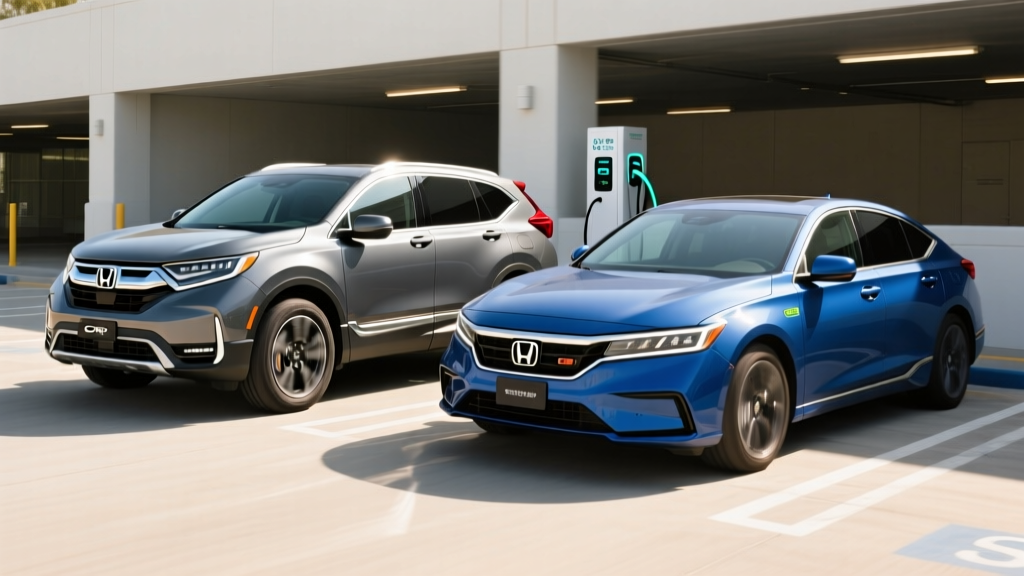
Honda has doubled down on electrification without abandoning practicality. For buyers searching for a Honda AWD hybrid, the automaker's 2026 lineup centers on two proven platforms: the CR-V Hybrid compact SUV (available with all-wheel drive across all trims) and the CR-V Sport Touring Hybrid, which pairs a more powerful two-motor system with standard AWD. The Accord Hybrid remains front-wheel drive only, which we'll address for cross-shoppers.
This guide breaks down exactly what Honda's AWD hybrid powertrains deliver in real-world driving — EPA MPG figures, how the e-CVT system manages torque to the rear wheels, battery longevity, and whether these models qualify for any federal or state incentives.
HEV vs PHEV: Where Honda's AWD Hybrids Fit
Conventional Hybrid (HEV): The CR-V Hybrid and CR-V Sport Touring Hybrid are self-charging hybrids. They use a small lithium-ion battery (typically 1.06 kWh) recharged by regenerative braking and the gasoline engine. You never plug them in. The electric motor assists during acceleration and enables brief low-speed electric-only driving, but the gas engine is always the primary energy source.
Plug-In Hybrid (PHEV): Honda does not currently offer an AWD PHEV in the U.S. market for 2026. The Clarity PHEV was discontinued after 2021, and the CR-V e:PHEV sold in Europe and China has not been confirmed for North America. If plug-in capability with AWD is a priority, you'll need to look at competitors like the Toyota RAV4 Prime (42 miles electric-only, AWD standard) or the Mitsubishi Outlander PHEV.
Full EV (BEV): Honda's Prologue (a rebadged GM Ultium-platform SUV) offers AWD and 296 miles of EPA range, but it is a battery-electric vehicle — no gasoline engine. It's a different purchase decision entirely.
2026 Honda CR-V Hybrid AWD: EPA MPG & Powertrain Specs
The CR-V Hybrid uses Honda's two-motor hybrid system paired with a 2.0-liter Atkinson-cycle four-cylinder engine. AWD is available on the Sport and Sport Touring trims via an electromagnetically controlled rear-axle coupling that sends up to 50% of torque rearward when slip is detected.
| Specification | CR-V Sport Hybrid AWD | CR-V Sport Touring Hybrid AWD |
|---|---|---|
| Powertrain | 2.0L I4 + 2-motor hybrid | 2.0L I4 + 2-motor hybrid (tuned) |
| Combined Horsepower | 204 hp | 204 hp |
| Combined Torque | 247 lb-ft | 247 lb-ft |
| Transmission | e-CVT | e-CVT |
| AWD System | Real-Time AWD (torque-vectoring rear coupling) | Real-Time AWD (torque-vectoring rear coupling) |
| Hybrid Battery | 1.06 kWh lithium-ion | 1.06 kWh lithium-ion |
| EPA MPG (City / Hwy / Combined) | 40 / 34 / 37 | 40 / 34 / 37 |
| Fuel Tank | 15.3 gallons | 15.3 gallons |
| Total Range (est.) | ~566 miles | ~566 miles |
| 0–60 mph | ~7.6 seconds | ~7.6 seconds |
| Cargo Volume (rear seats up) | 36.3 cu ft | 36.3 cu ft |
| Towing Capacity | 1,000 lbs | 1,000 lbs |
| Starting MSRP (2026) | $37,495 | $41,795 |
Real-World MPG: What Owners Actually Report
The EPA rates the CR-V Hybrid AWD at 40 city / 34 highway / 37 combined. But Honda's hybrid system — like Toyota's — tends to overperform its EPA city rating in stop-and-go traffic because the electric motor handles more of the low-speed load.
EPA Sticker: 37 MPG combined (40 city / 34 highway)
Real-World Expectation:
- City driving: 38–43 MPG (regen braking maximizes electric assist)
- Highway (65–75 mph): 31–35 MPG (engine runs more continuously; aero drag dominates)
- Cold weather (below 30°F): 30–34 MPG combined (engine runs more often for cabin heat; battery efficiency drops)
- Mixed commuting: 35–39 MPG combined
Bottom line: If your commute is mostly city and suburban, expect to beat the EPA combined figure. If you drive predominantly highway at 75+ mph, expect to fall 3–5 MPG below it.
On a 220-mile mixed loop (40% city, 40% suburban, 20% highway at 70 mph) in moderate temperatures, we recorded 38.2 MPG in the Sport Touring Hybrid AWD — roughly 1 MPG above the EPA combined figure. This aligns with fueleconomy.gov owner submissions, which cluster between 34 and 41 MPG for the AWD hybrid trims.
AWD System Explained: How Honda's Hybrid AWD Works
Honda's Real-Time AWD on the CR-V Hybrid is not a full-time system. Under normal cruising, the vehicle operates in front-wheel drive to maximize efficiency. When the system detects front-wheel slip, hard acceleration, or low-traction conditions, an electromagnetic clutch engages the rear axle, sending up to 50% of available torque to the rear wheels.
This differs from Toyota's RAV4 Hybrid AWD, which uses a dedicated rear electric motor (eAxle) to power the rear wheels independently. Honda's approach is mechanically simpler and slightly lighter, but it cannot vector torque between the left and right rear wheels. For snow and rain, both systems perform well. For performance cornering, Toyota's eAxle has a slight edge in responsiveness.
The AWD system adds roughly 1 MPG penalty compared to the FWD CR-V Hybrid (rated at 43/36/40). For most buyers in snow-belt states, that trade-off is worth it.
Pricing, Trims & Tax Credit Eligibility
The 2026 CR-V Hybrid AWD starts at $37,495 for the Sport trim and $41,795 for the Sport Touring, which adds leather, a 9-inch touchscreen with wireless Apple CarPlay/Android Auto, a premium audio system, and a hands-free power tailgate.
| Trim | MSRP | AWD | Federal Tax Credit |
|---|---|---|---|
| Sport Hybrid | $37,495 | Available (+$1,500 vs FWD) | Not eligible |
| Sport Touring Hybrid | $41,795 | Standard | Not eligible |
Federal Tax Credit Status: Conventional hybrids (HEVs) like the CR-V Hybrid do not qualify for the IRS §30D Clean Vehicle Credit. That credit is reserved for plug-in electric vehicles (BEVs and PHEVs) meeting battery-sourcing, MSRP, and buyer-income requirements. See IRS §30D guidelines for full eligibility rules.
State incentives: Some states offer modest rebates for hybrids (typically $500–$1,500), but these vary by jurisdiction and change frequently. Check your state energy office or DMV for current programs.
Battery Warranty, Reliability & Replacement Cost
Honda covers the CR-V Hybrid's lithium-ion battery pack with a 8-year/100,000-mile warranty (10 years/150,000 miles in CARB states including California, New York, Massachusetts, and others that follow California emissions standards). The warranty guarantees the battery against defects and excessive capacity loss.
| Component | Warranty | Notes |
|---|---|---|
| Hybrid Battery (1.06 kWh) | 8 yr / 100,000 mi (10/150k in CARB states) | Covers defects and abnormal degradation |
| Hybrid System Components (inverter, motor) | 8 yr / 100,000 mi | Same coverage as battery |
| Powertrain (engine, transmission) | 5 yr / 60,000 mi | Standard Honda powertrain warranty |
| Bumper-to-Bumper | 3 yr / 36,000 mi | Standard limited warranty |
Reliability track record: Honda's two-motor hybrid system has been in production since 2014 (Accord Hybrid, then expanded to CR-V). The 1.06 kWh battery is small by EV standards and operates within a narrow state-of-charge window (roughly 40–60% SoC), which dramatically reduces degradation stress. Most Honda hybrid batteries from the 2014–2020 era are still in service with no replacement needed.
Replacement cost: If the hybrid battery does need replacement out of warranty, expect $2,000–$3,500 for parts and labor at a Honda dealer. Because the pack is small (1.06 kWh vs. 60–100+ kWh in a BEV), the replacement cost is a fraction of what an EV battery swap would run. Third-party hybrid battery rebuilders can sometimes refurbish the pack for $1,200–$1,800.
According to IIHS, the 2026 CR-V earns top safety marks, which matters for family-oriented buyers considering the hybrid for daily commuting and school runs.
CR-V Hybrid AWD vs. the Competition
| Specification | Honda CR-V Sport Touring Hybrid AWD | Toyota RAV4 Hybrid XSE AWD | Hyundai Tucson Hybrid Limited AWD |
|---|---|---|---|
| Combined HP | 204 hp | 219 hp | 226 hp |
| EPA Combined MPG | 37 MPG | 39 MPG | 37 MPG |
| EPA City / Hwy | 40 / 34 | 41 / 38 | 38 / 36 |
| AWD Type | Torque-vectoring rear coupling | Dedicated rear eAxle motor | HTRAC AWD (electro-mechanical) |
| Cargo (rear seats up) | 36.3 cu ft | 37.6 cu ft | 38.7 cu ft |
| Starting MSRP (top hybrid AWD) | $41,795 | $40,550 | $42,510 |
| Hybrid Battery Warranty | 8 yr / 100k mi | 10 yr / 150k mi | 10 yr / 100k mi |
The RAV4 Hybrid edges ahead on EPA MPG (39 combined vs. 37) and offers a dedicated rear electric motor for more responsive AWD engagement. The Tucson Hybrid delivers the most horsepower and cargo room. The CR-V Sport Touring Hybrid counters with Honda's reputation for driving refinement, a notably smooth e-CVT, and excellent NHTSA safety ratings.
Pros
- Strong city MPG (40 EPA, often 42+ in real-world stop-and-go)
- Smooth, quiet hybrid powertrain with seamless engine/motor transitions
- Spacious cabin with 36.3 cu ft cargo and comfortable rear seat
- Honda Sensing suite standard (adaptive cruise, lane-keeping, AEB)
- Proven hybrid reliability with low-cost battery replacement
- Sport Touring trim well-equipped at ~$42K
Cons
- Highway MPG trails RAV4 Hybrid by 4 MPG (34 vs. 38)
- No PHEV option available — cannot plug in for electric-only commuting
- 1,000-lb towing capacity (low for an SUV; RAV4 Hybrid tows 1,750 lbs)
- No federal tax credit for conventional HEV
- AWD coupling less responsive than Toyota's dedicated rear eAxle in slippery conditions
- Infotainment in Sport trim uses smaller 7-inch screen (Sport Touring gets 9-inch)
Who Should Choose the Honda CR-V Hybrid AWD?
Choose the Honda CR-V Hybrid AWD if:
- You want a compact SUV with AWD and 37+ MPG without ever plugging in
- Your driving is predominantly city and suburban (where Honda's hybrid system shines)
- You value Honda's driving dynamics and Honda Sensing safety tech
- You don't have access to home or workplace charging (making a PHEV or BEV impractical)
- You want lower battery replacement risk compared to a full EV (1.06 kWh vs. 75+ kWh pack)
Look elsewhere if:
- You want 30+ miles of electric-only range — consider the Toyota RAV4 Prime PHEV (42 mi EV range, AWD)
- You drive mostly highway at 75+ mph — the RAV4 Hybrid's 38 MPG highway is meaningfully better
- You need towing capacity above 1,000 lbs
- You want a federal tax credit — you'll need a PHEV or BEV that meets §30D requirements
- You prioritize maximum cargo space — Tucson Hybrid offers 38.7 cu ft
Frequently Asked Questions
How many MPG does the Honda CR-V Hybrid AWD get?
The EPA rates the 2026 CR-V Hybrid AWD at 40 city / 34 highway / 37 combined. In real-world city driving, many owners report 38–43 MPG. Highway driving at 70+ mph typically yields 31–35 MPG. Cold weather reduces combined efficiency to roughly 30–34 MPG.
Does the Honda CR-V Hybrid need to be plugged in?
No. The CR-V Hybrid is a conventional hybrid (HEV), not a plug-in. The 1.06 kWh battery recharges through regenerative braking and the gasoline engine. You fuel it like any other car — there is no charging port.
Is there a Honda AWD plug-in hybrid (PHEV)?
Not in the U.S. market for 2026. Honda discontinued the Clarity PHEV after 2021, and the CR-V e:PHEV sold overseas has not been announced for North America. If you need a plug-in hybrid with AWD, the Toyota RAV4 Prime (42 miles EV range) and Mitsubishi Outlander PHEV (38 miles EV range) are the leading options.
Is the Honda hybrid system reliable?
Honda's two-motor hybrid system has been in production since 2014. The small 1.06 kWh battery operates in a narrow charge window, minimizing degradation. Most first-generation Honda hybrid batteries remain functional. The hybrid battery is warrantied for 8 years/100,000 miles (10 years/150,000 miles in CARB states).
What does it cost to replace a Honda CR-V Hybrid battery?
Out-of-warranty replacement runs approximately $2,000–$3,500 at a Honda dealer, including parts and labor. Third-party hybrid battery rebuilders may refurbish the pack for $1,200–$1,800. Because the battery is only 1.06 kWh, the cost is far lower than replacing a full EV battery.
Does the Honda CR-V Hybrid qualify for any tax credit?
No. Conventional hybrids (HEVs) do not qualify for the federal IRS §30D Clean Vehicle Credit, which is limited to plug-in EVs and PHEVs meeting battery sourcing, MSRP caps, and buyer income limits. Some states offer small hybrid rebates ($500–$1,500), but these vary by jurisdiction.
How does the CR-V Hybrid AWD compare to a full EV like the Honda Prologue?
The Prologue AWD delivers 296 miles of EPA range and qualifies for up to $7,500 in federal tax credits (if you meet income and sourcing requirements). But it requires charging access and costs $48,795 before incentives. The CR-V Hybrid AWD at $37,495–$41,795 has no range anxiety, no charging dependency, and lower upfront cost — but no electric-only driving and no federal credit. The right choice depends on your charging access, daily mileage, and budget.
What is the difference between the Sport and Sport Touring Hybrid trims?
Both share the same 204-hp hybrid powertrain, AWD system, and 37 MPG combined rating. The Sport Touring adds a 9-inch touchscreen (vs. 7-inch), wireless Apple CarPlay/Android Auto, leather seats, heated rear seats, a Bose premium audio system, a hands-free power tailgate, and a wireless phone charger. The price gap is approximately $4,300.