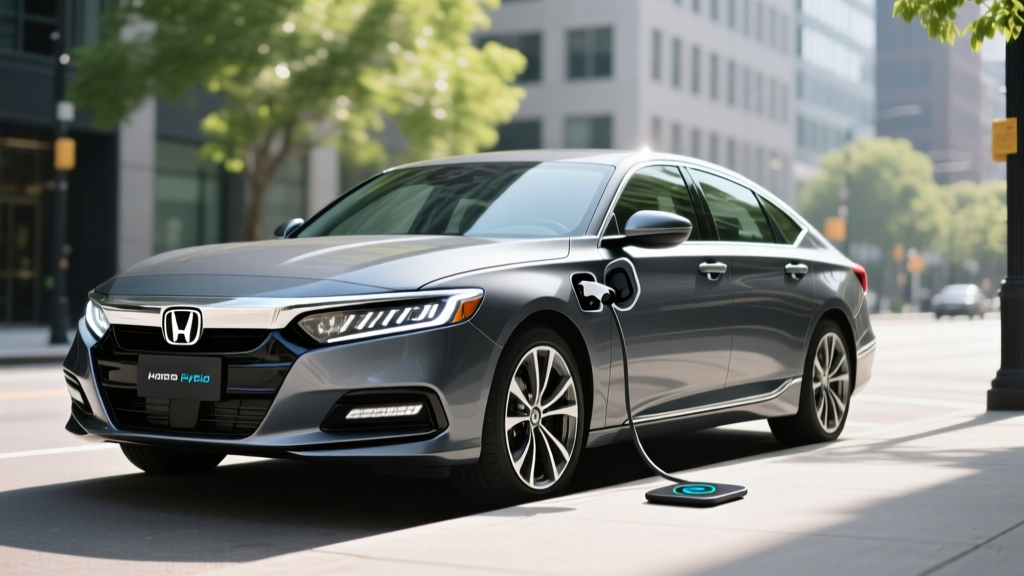
The Honda Accord Touring Hybrid occupies a specific niche in 2026: it's the top-trim, fully loaded version of America's best-selling hybrid sedan, and it doesn't require you to plug it in. As a conventional hybrid electric vehicle (HEV), the Accord Touring generates its own electricity through regenerative braking and its gasoline engine — no charging cable, no range anxiety, no dependence on public charging infrastructure. For buyers who want electrified efficiency without changing their fueling habits, this is the pitch.
But the Touring trim also pushes the Accord into luxury-adjacent pricing territory, which raises a legitimate question: does the premium equipment justify the cost, or are you better served by a lower trim, a plug-in hybrid, or a full battery-electric vehicle? This review breaks down every number that matters.
HEV vs PHEV vs EV: Where the Accord Touring Hybrid Fits
Before examining specs, it's essential to understand what the Accord Touring Hybrid is not. It is not a plug-in hybrid (PHEV). It has no electric-only driving range, no charge port, and no eligibility for the federal §30D new clean vehicle tax credit. Honda discontinued the Accord Plug-In Hybrid after the 2015 model year and has not reintroduced a PHEV variant for the US market as of 2026.
Quick Reference: HEV vs PHEV vs BEV
| Feature | HEV (Accord Hybrid) | PHEV (e.g., Toyota Prius Prime) | BEV (e.g., Tesla Model 3) |
|---|---|---|---|
| Plug-in required? | No | Yes | Yes |
| Electric-only range | ~1 mi (low-speed assist) | 25–44 mi typical | 250–360 mi typical |
| Battery size | ~1.3 kWh | 13–18 kWh | 50–100 kWh |
| Federal tax credit | Not eligible | Up to $7,500 (if eligible) | Up to $7,500 (if eligible) |
| Gas engine? | Yes | Yes | No |
The Accord Touring Hybrid competes directly with the Toyota Camry XSE Hybrid, Hyundai Sonata Limited Hybrid, and Kia K5 GT-Line Hybrid. It does not compete with PHEVs like the Toyota Prius Prime or BEVs like the Tesla Model 3 on a cost-per-mile basis — those vehicles can be dramatically cheaper to fuel if you have home charging access.
Fuel Economy: EPA Ratings and Real-World MPG
The 2026 Honda Accord Hybrid carries EPA fuel economy ratings that remain among the best in the midsize sedan segment. Here's the official breakdown:
| Metric | EPA Rating |
|---|---|
| City | 51 MPG |
| Highway | 44 MPG |
| Combined | 48 MPG |
| Fuel tank capacity | 12.8 gallons |
| Total range (est.) | ~614 miles |
Source: fueleconomy.gov
Real-World MPG vs EPA Sticker
Honda's two-motor hybrid system excels in city and suburban driving, where the electric motor handles most low-speed propulsion and the 2.0L Atkinson-cycle engine acts primarily as a generator. In real-world driving, Accord Hybrid owners frequently report exceeding the EPA city rating — 52–55 MPG is common in stop-and-go traffic below 45 mph.
Highway efficiency is the flip side. At sustained 70–80 mph speeds, the Accord Hybrid's aerodynamic drag and the engine's direct-drive mode reduce efficiency to approximately 40–43 MPG. Cold weather (below 35°F) further reduces economy by 5–8 MPG due to increased engine idling for cabin heat and reduced battery efficiency. If your commute is predominantly highway miles, expect a combined real-world figure closer to 42–45 MPG. For mixed suburban driving, 48–50 MPG is readily achievable.
Powertrain and Performance Specs
| Specification | 2026 Accord Touring Hybrid |
|---|---|
| Powertrain | 2-motor hybrid (2.0L DOHC Atkinson-cycle 4-cyl + 2 electric motors) |
| Combined system horsepower | 204 hp |
| Combined system torque | 247 lb-ft |
| Electric motor output (drive) | 181 hp / 247 lb-ft |
| Gas engine output | 146 hp / 134 lb-ft |
| Hybrid battery | ~1.3 kWh lithium-ion |
| Transmission | e-CVT (single-speed direct-drive, no traditional CVT belt) |
| Drivetrain | Front-wheel drive |
| 0–60 mph (est.) | ~7.0 seconds |
| Drive modes | Normal, ECON, Sport, Individual |
Honda's hybrid system operates in three modes seamlessly: EV Drive (battery-only, short distances at low speed), Hybrid Drive (engine generates electricity for the drive motor), and Engine Drive (engine connects directly to wheels at highway cruising speeds). The transition between modes is nearly imperceptible — one of the system's strongest attributes compared to competitors that produce noticeable drivetrain drone under acceleration.
The 247 lb-ft of torque from the electric drive motor delivers responsive off-the-line acceleration that feels quicker than the 7-second 0–60 time suggests. Sport mode sharpens throttle response and increases regenerative braking aggressiveness, though the Accord Hybrid is tuned for efficiency, not performance.
Pricing: 2026 Accord Touring Hybrid MSRP
The Touring is the most expensive trim in the Accord Hybrid lineup. Here's the pricing structure for the 2026 model year:
| Trim | MSRP (incl. destination) |
|---|---|
| Sport Hybrid | $34,590 |
| Sport-L Hybrid | $36,385 |
| EX-L Hybrid | $38,085 |
| Touring Hybrid | $40,390 |
Source: Honda Automobiles
Tax Credit Eligibility
The Honda Accord Touring Hybrid does not qualify for the federal §30D new clean vehicle tax credit. The IRS restricts this credit (up to $7,500) to plug-in electric vehicles — battery-electric vehicles (BEVs) and plug-in hybrids (PHEVs) that meet battery capacity, critical mineral sourcing, and buyer income requirements. Conventional hybrids like the Accord are excluded by statute.
Some states offer modest rebates or HOV lane access for hybrid vehicles, but these vary by jurisdiction and change frequently. Check your state's energy office or department of environmental quality for current programs. The Accord Hybrid does not currently qualify for HOV stickers in California, for example — that privilege is now limited to zero-emission and plug-in hybrid vehicles.
Touring Trim: What You Get for the Premium
The Touring trim justifies its ~$5,800 premium over the Sport Hybrid with equipment that pushes into near-luxury territory:
- Google built-in — native Google Maps, Google Assistant, and Google Play Store integrated into the 12.3-inch infotainment display
- 12-speaker Bose premium audio system with Centerpoint surround
- Heated and ventilated front seats with leather-trimmed upholstery
- Heated rear outboard seats — uncommon in this segment
- Wireless phone charger (15W Qi)
- Head-up display with speed and navigation projection
- Low-speed braking control and front/rear parking sensors
- Honda Sensing suite — adaptive cruise control, lane keeping, collision mitigation, traffic sign recognition, traffic jam assist
- 19-inch alloy wheels (exclusive to Touring)
- Wireless Apple CarPlay and Android Auto
For buyers who don't need ventilated seats, rear heat, or Bose audio, the EX-L Hybrid at $38,085 delivers identical powertrain efficiency and most driver-assistance features at a lower cost. The Touring is the right choice if you plan to keep the car 8+ years and want maximum comfort and technology.
Battery Warranty, Reliability, and Replacement Cost
Honda Hybrid Battery Warranty
Duration: 8 years / 100,000 miles (whichever comes first) in most states
Extended in CARB states: 10 years / 150,000 miles in California and states that follow CARB emissions standards (CT, ME, MD, MA, NJ, NY, OR, RI, VT, WA, CO, and others adopting CARB)
Coverage: Defects and capacity loss below a defined threshold (typically ~70% of original capacity)
Source: Honda Warranty Information
Long-Term Reliability
Honda's two-motor hybrid system has been in production since 2014 (Accord Hybrid) and has proven highly durable. The system eliminates the traditional transmission entirely — there is no CVT belt, no planetary gearset, and no torque converter to fail. The e-CVT is fundamentally a power-split device connecting two motor-generators, with fewer wear components than a conventional automatic.
The 1.3 kWh hybrid battery is small and operates within a narrow state-of-charge window (roughly 40–60%), which significantly reduces degradation compared to larger PHEV or BEV batteries. Real-world data from earlier-generation Accord Hybrids shows minimal capacity loss at 150,000+ miles.
Battery Replacement Cost
If the hybrid battery does require replacement outside warranty, expect costs in the range of $2,000–$4,000 for the battery pack itself, plus $500–$1,000 in labor. This is substantially less than BEV battery replacements ($8,000–$20,000) because the pack is small. Third-party refurbishers offer reconditioned packs for $1,200–$2,000, though this is rarely needed given Honda's warranty coverage and the battery's demonstrated longevity.
Pros
- 48 MPG combined — among the best midsize sedans
- No plug-in required; no behavior change
- Smooth, quiet hybrid powertrain transitions
- Excellent city/traffic efficiency (50+ MPG achievable)
- Strong Honda Sensing ADAS suite standard
- Spacious rear seat and 16.7 cu-ft trunk (no battery intrusion)
- 8-year/100k-mile hybrid battery warranty
Cons
- No federal tax credit eligibility
- Highway MPG drops to ~40–43 at 75+ mph
- Touring trim pushes $40k+ without luxury badge
- No AWD option (competitors offer it)
- No plug-in hybrid variant available
- Cold-weather cabin heating reduces efficiency
- Infotainment can lag vs. native Google in some conditions
Who Should Choose the Accord Touring Hybrid vs a PHEV or EV?
Decision Framework
Choose the Accord Touring Hybrid if:
- You cannot charge at home (apartment, street parking, no garage outlet)
- You take frequent road trips exceeding 300 miles and don't want to plan charging stops
- You want a simple ownership experience with zero charging infrastructure dependency
- Your annual mileage is moderate (10,000–15,000 mi/yr) — fuel savings vs. gas are meaningful but not transformative
- You value Honda's reliability track record and resale value
Consider a PHEV (e.g., Toyota Prius Prime) if:
- You can install a Level 2 charger at home and your daily commute is under 40 miles
- You want to qualify for the federal §30D tax credit (up to $7,500)
- You want near-EV daily driving with a gas backup for long trips
Consider a full EV (e.g., Tesla Model 3, Hyundai Ioniq 6) if:
- You have reliable home Level 2 charging
- You want the lowest possible fuel and maintenance costs
- You're eligible for the full $7,500 federal credit and your state offers additional incentives
- Your typical trips fall within 200–250 miles or you're comfortable with DC fast charging on road trips
Frequently Asked Questions
How many MPG does the Honda Accord Touring Hybrid get?
The EPA rates the 2026 Accord Hybrid (all trims, including Touring) at 51 city / 44 highway / 48 combined MPG. Real-world results vary: expect 50–55 MPG in city driving and 40–43 MPG at sustained highway speeds above 70 mph. Cold weather reduces these figures by approximately 5–8 MPG.
How far can the Accord Hybrid go on electric only?
Essentially zero miles in practical terms. The Accord Hybrid can creep at very low speeds (under 25 mph) for roughly one mile on battery power alone, but it is not designed for electric-only commuting. The battery is ~1.3 kWh — it exists to smooth power delivery and capture regenerative energy, not to provide meaningful all-electric range. If you need electric-only driving, look at a PHEV like the Toyota Prius Prime (up to 44 miles electric) or a full EV.
Does the Honda Accord Hybrid qualify for any tax credit?
No. The federal §30D new clean vehicle tax credit applies only to plug-in electric vehicles (BEVs and qualifying PHEVs). The Accord Hybrid is a conventional HEV and is not eligible. Some states may offer minor incentives for hybrid purchases, but these are not common and vary by jurisdiction. Consult a tax professional for your specific situation.
Is the Accord Hybrid reliable, and what does a battery replacement cost?
Honda's two-motor hybrid system has demonstrated strong long-term reliability since its 2014 introduction. The hybrid battery is covered by an 8-year/100,000-mile warranty (10 years/150,000 miles in CARB states). Out-of-warranty battery replacement typically costs $2,000–$4,000 for parts and labor — far less than a BEV battery. The system has no traditional transmission to fail, reducing major repair risk.
Does the Accord Hybrid need to be plugged in?
No. The Accord Hybrid is a self-charging conventional hybrid. It generates electricity through regenerative braking and the gasoline engine. There is no charge port. You fuel it exclusively with gasoline, exactly like a conventional car.
How does the Accord Hybrid compare to the Toyota Camry Hybrid?
The 2026 Toyota Camry Hybrid (XSE trim) offers comparable efficiency at 44–47 MPG combined, with an available AWD option that the Accord lacks. The Camry Hybrid is slightly less powerful (estimated 225 hp combined with AWD) but offers a lower entry price. The Accord Hybrid edges ahead on interior space (16.7 cu-ft trunk vs. Camry's ~15 cu-ft) and city MPG. Both carry strong reliability reputations and similar hybrid battery warranties.
What is the total cost of ownership vs. a gas-only Accord?
At 48 MPG combined and $3.50/gallon gas, the Accord Hybrid costs approximately $1,094/year in fuel for 15,000 miles. A comparable gas-only midsize sedan at 28 MPG combined would cost approximately $1,875/year — a difference of ~$781/year in fuel savings. Over 8 years, that's roughly $6,250 in fuel savings, which largely offsets the hybrid powertrain premium. Maintenance costs are similar, though the hybrid's regenerative braking extends brake pad life significantly.