Quick Verdict: The Accord Hybrid Nails the Daily-Commute Formula
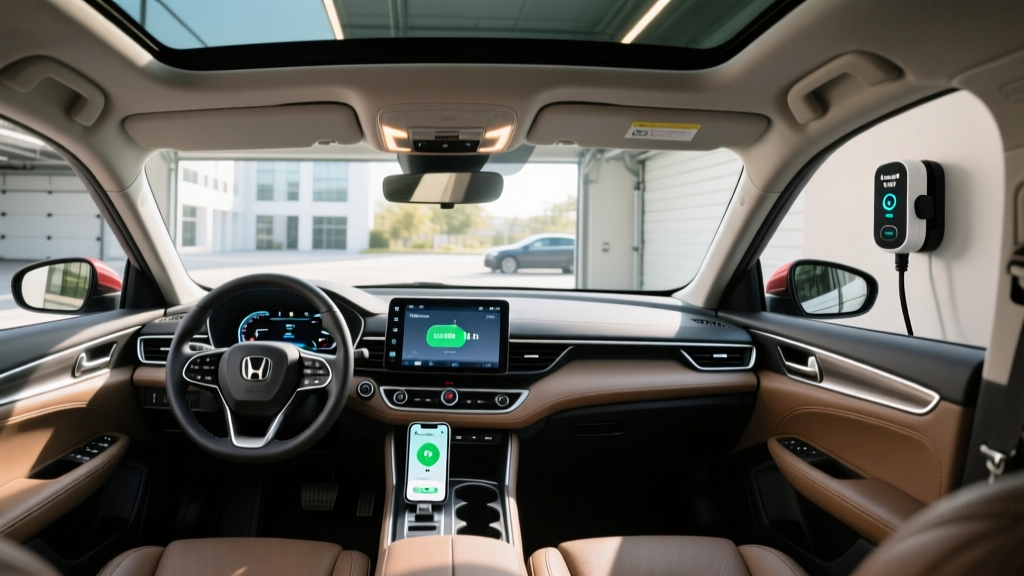
The 2026 Honda Accord Hybrid is not a plug-in, not an EV, and not trying to be either. It is a conventional hybrid electric vehicle (HEV) that pairs a 2.0-liter Atkinson-cycle four-cylinder with a two-motor system to deliver an EPA-estimated 48 MPG combined — without ever needing a charging cable. For buyers researching the Honda Accord Hybrid interior, the story is equally practical: a 12.3-inch infotainment touchscreen, wireless Apple CarPlay and Android Auto on upper trims, and a cabin that prioritizes material quality and ergonomics over flash.
This guide covers the Accord Hybrid's powertrain, real-world fuel economy, interior layout, battery longevity, pricing, and how it stacks up against plug-in hybrids and full EVs for different buyer profiles.
HEV vs. PHEV vs. EV: Where the Accord Hybrid Fits
Before diving into specs, it's essential to distinguish the three electrified powertrain types, because confusion here leads to mismatched expectations:
| Feature | HEV (Accord Hybrid) | PHEV (e.g., Toyota Prius Prime) | BEV (e.g., Tesla Model 3) |
|---|---|---|---|
| Plugs in? | No — self-charging via regen & engine | Yes — Level 1/2 AC charging | Yes — Level 1/2/DC fast charging |
| Electric-only range | ~1 mile at low speed | 25–45 miles typical | 250–360+ miles (EPA) |
| Gas engine | Yes, primary power + generator | Yes, extends range after battery depletes | None |
| Fueling/Charging | Gas station only | Gas station + home/outlet charging | Home Level 2 + public DC fast chargers |
| Federal tax credit (§30D) | Not eligible | Up to $7,500 if sourcing/income/MSRP rules met | Up to $7,500 if sourcing/income/MSRP rules met |
| Best for | No home charging access; want MPG without behavior change | Short commute + home charging; road-trip flexibility | Home charging available; want lowest running cost |
The Accord Hybrid is an HEV. Its small lithium-ion battery (roughly 1.1 kWh usable) recharges through regenerative braking and the gasoline engine. You never plug it in. If you need electric-only commuting range, you'll want a PHEV or BEV instead.
Powertrain Specs: Two-Motor System, 204 Combined Horsepower
Honda's fourth-generation two-motor hybrid system powers the 2026 Accord Hybrid across all trims (Sport, EX-L, Sport-L, Touring). Here's the hardware breakdown:
| Specification | 2026 Honda Accord Hybrid |
|---|---|
| Engine | 2.0L Atkinson-cycle DOHC 4-cylinder |
| Engine output | 146 hp @ 6,100 rpm / 134 lb-ft torque |
| Electric motors | Dual-motor hybrid system (propulsion + generator) |
| Combined system output | 204 hp / 247 lb-ft torque |
| Transmission | e-CVT (no traditional gears; motor-driven) |
| Drivetrain | Front-wheel drive |
| Hybrid battery | ~1.1 kWh lithium-ion (NMC chemistry) |
| 0–60 mph | ~7.2 seconds (est.) |
| EPA fuel economy | 51 city / 44 highway / 48 combined MPG |
The propulsion motor handles most acceleration duties, while the engine acts primarily as a generator at lower speeds — only engaging directly with the wheels via a lock-up clutch at highway cruising speeds where it's most efficient. This is why the Accord Hybrid achieves its best MPG in city driving, where the electric motor dominates and regenerative braking recaptures energy at every stop.
Fuel Economy: EPA Numbers vs. Real-World MPG
| Driving Scenario | EPA Estimate | Real-World Expectation |
|---|---|---|
| City | 51 MPG | 48–54 MPG (hybrids often beat EPA in stop-and-go) |
| Highway (70 mph) | 44 MPG | 40–44 MPG (less regen benefit; engine drives wheels directly) |
| Combined | 48 MPG | 45–50 MPG depending on driving mix |
| Cold weather (below 32°F) | — | 38–44 MPG (engine runs more for cabin heat and warm-up) |
According to fueleconomy.gov, the Accord Hybrid's combined 48 MPG places it among the most efficient midsize sedans available. Real-world owners frequently report exceeding the EPA city figure in warm-weather stop-and-go traffic, where regenerative braking is maximized and the engine rarely engages.
Highway efficiency drops noticeably — a characteristic of all series-parallel hybrids. At sustained 70–80 mph speeds, the engine must do more of the work directly, and aerodynamic drag reduces the advantage over the turbocharged gas-only Accord (which returns roughly 29 city / 37 highway / 32 combined MPG).
Battery Warranty & Replacement Cost
Honda covers the Accord Hybrid's lithium-ion battery pack for 8 years or 100,000 miles (10 years/150,000 miles in CARB states including California, New York, Massachusetts, and others). This warranty covers defects and capacity loss below a functional threshold.
Out-of-warranty replacement cost: approximately $2,500–$4,000 for the hybrid battery pack (parts + labor), based on current dealer pricing. However, hybrid battery failures before 150,000 miles are uncommon — Honda's hybrid system is among the most proven in the industry, with many Accord and Civic Hybrid units exceeding 200,000 miles on the original pack.
Inside the Cabin: Honda Accord Hybrid Interior Breakdown
The Accord Hybrid shares its interior with the gas-only Accord — meaning hybrid buyers get no compromises on cargo space, seating, or technology. Here's what defines the 2026 cabin:
Infotainment & Connectivity
- Base (Sport trim): 7.0-inch touchscreen, wired Apple CarPlay/Android Auto, 4-speaker audio
- EX-L and above: 12.3-inch touchscreen, wireless Apple CarPlay/Android Auto, 8-speaker audio
- Touring: 12.3-inch touchscreen with embedded Google built-in navigation, 12-speaker Bose premium audio, wireless phone charging
- All trims include a 10.2-inch digital driver display with hybrid-specific energy flow and battery state-of-charge readouts
Materials & Comfort
- Sport and Sport-L: cloth or leather-trimmed seats with contrast stitching
- EX-L: perforated leather-trimmed seats, heated front seats, heated steering wheel
- Touring: ventilated front seats, heated rear outboard seats, leather-wrapped steering wheel
- Soft-touch materials on the dashboard and door panels; honeycomb mesh accent trim across the dash
Cargo & Space
- Trunk volume: 16.7 cubic feet — identical to the gas Accord (the hybrid battery is packaged under the rear seats, not in the trunk)
- Rear legroom: 40.8 inches — class-leading for the midsize sedan segment
- 60/40 split-folding rear seatback on all trims
Driver-Assistance Technology (Honda Sensing Suite)
Every 2026 Accord Hybrid includes the Honda Sensing suite as standard equipment:
- Adaptive Cruise Control (ACC) with Low-Speed Follow
- Lane Keeping Assist System (LKAS)
- Road Departure Mitigation (RDM)
- Collision Mitigation Braking System (CMBS)
- Traffic Sign Recognition
- Blind Spot Information (BSI) with Cross Traffic Monitor (EX-L and above)
This is an SAE Level 2 driver-assistance system — it provides steering and speed support but requires the driver to remain fully engaged at all times. It is not autonomous or "self-driving."
Pricing, Trims, and Tax Credit Eligibility
| Trim | 2026 MSRP (est.) | Key Features |
|---|---|---|
| Sport Hybrid | ~$33,655 | 7" screen, 19" alloy wheels, cloth/leatherette seats |
| EX-L Hybrid | ~$36,325 | 12.3" screen, leather seats, moonroof, wireless CarPlay |
| Sport-L Hybrid | ~$37,055 | Sport styling + EX-L content, black accents |
| Touring Hybrid | ~$40,390 | Bose audio, ventilated seats, Google built-in, HUD |
Federal Tax Credit: Not Eligible
The Honda Accord Hybrid is a conventional HEV, not a plug-in vehicle. Under current IRS §30D rules, only plug-in electric vehicles (BEVs and PHEVs) with sufficient battery capacity qualify for the federal clean vehicle credit. The Accord Hybrid does not qualify for the $7,500 federal tax credit, nor does it qualify for the $4,000 used-EV credit.
Some states offer modest rebates for conventional hybrids (typically $500–$1,500), but these vary by jurisdiction and change frequently. Check your state's energy or environmental agency for current programs.
Accord Hybrid vs. Plug-In Hybrid vs. Full EV: Which Is Right for You?
Choose the Accord Hybrid (HEV) if:
- You lack access to home or workplace charging (apartment, street parking, no garage outlet)
- You want maximum MPG with zero behavior change — just fill up at any gas station
- Your commute is mixed city/highway and you average 12,000–15,000 miles/year
- You want a proven midsize sedan with strong resale value and low maintenance costs
Choose a PHEV (e.g., Toyota Prius Prime, Hyundai Tucson PHEV) if:
- You have home Level 1 or Level 2 charging and a commute under 35 miles each way
- You want electric-only daily driving but need gas-engine range for road trips
- You can meet IRS §30D requirements (income caps, MSRP limits, battery sourcing) to claim the $7,500 credit
Choose a full EV (e.g., Tesla Model 3, Hyundai Ioniq 6) if:
- You have reliable home Level 2 charging (240V, ~$500–$1,500 installation)
- You want the lowest per-mile energy cost (~$0.04–$0.06/mile on home electricity vs. ~$0.10–$0.13/mile on gas at 48 MPG)
- You drive primarily in urban/suburban areas and rarely exceed 250 miles between charging opportunities
- You want to qualify for the full federal tax credit and eliminate oil changes entirely
Reliability and Long-Term Ownership Costs
Honda's hybrid powertrain has a strong reliability record spanning two decades, from the original Insight to the current Accord and CR-V Hybrid lineups. The two-motor system eliminates the traditional transmission — there are no gears, torque converters, or belts to wear out. Maintenance is limited to:
- Oil changes every 7,500–10,000 miles (the engine runs intermittently, so oil degrades slower)
- Brake pads lasting 80,000–100,000+ miles (regenerative braking handles most deceleration)
- Cabin air filter, tire rotations, and coolant service on standard intervals
The hybrid battery is the primary long-term concern. Based on historical data from Honda's hybrid fleet, most packs retain sufficient capacity well beyond the 100,000-mile warranty threshold. Replacement at a dealer runs $2,500–$4,000; independent hybrid specialists can sometimes refurbish or replace individual cells for $1,000–$2,000.
Insurance costs for the Accord Hybrid are comparable to the gas-only Accord — typically $1,300–$1,800/year depending on driver profile and state. There is no significant EV insurance surcharge, as there can be with full battery-electric vehicles.
Pros
- 48 MPG combined EPA — real-world city driving often exceeds 50 MPG
- No plug-in charging required; zero behavior change from a gas car
- Class-leading rear legroom (40.8") and full 16.7 cu-ft trunk
- Honda Sensing suite standard on every trim
- Proven hybrid system with 8yr/100k-mile battery warranty
- Strong resale value; Accord historically retains ~55–60% at 5 years
Cons
- Not eligible for the $7,500 federal tax credit (HEV, not PHEV/BEV)
- Highway MPG drops to ~40–44 — less advantage over gas Accord on long trips
- Base Sport trim has a small 7" screen; 12.3" requires EX-L or above
- No all-wheel-drive option (FWD only)
- Engine drone under hard acceleration (e-CVT characteristic)
- ~$2,000–$3,000 price premium over equivalent gas-only Accord trims
Frequently Asked Questions
How many MPG does the Honda Accord Hybrid get?
The EPA rates the 2026 Accord Hybrid at 51 city / 44 highway / 48 combined MPG. In real-world city driving, many owners report 50–54 MPG thanks to regenerative braking. Highway-only trips at 75+ mph typically return 40–43 MPG.
Does the Honda Accord Hybrid need to be plugged in?
No. The Accord Hybrid is a conventional HEV. Its small lithium-ion battery charges through regenerative braking and the gasoline engine. You fuel it exclusively at gas stations — no plug, no home charger, no public charging required.
Is the Honda Accord Hybrid reliable?
Honda's hybrid system is one of the most proven in the industry. The two-motor design eliminates the conventional transmission, reducing mechanical wear points. The hybrid battery is warranted for 8 years/100,000 miles (10 years/150,000 miles in CARB states), and failures before 150,000 miles are rare based on fleet data.
What does a Honda Accord Hybrid battery replacement cost?
Out-of-warranty replacement typically costs $2,500–$4,000 at a Honda dealer, including parts and labor. Independent hybrid shops may offer refurbished packs for $1,000–$2,000. Most owners never need a replacement within typical ownership periods.
Does the Accord Hybrid qualify for any tax credit?
Not at the federal level. The IRS §30D clean vehicle credit applies only to plug-in vehicles (BEVs and PHEVs). The Accord Hybrid, as a conventional HEV, is ineligible. Some states offer small hybrid rebates — check your state's energy office for current programs.
How does the Accord Hybrid interior compare to the gas Accord?
Identically. The hybrid battery is mounted under the rear seats, so trunk space (16.7 cu ft), rear legroom (40.8"), and all interior features are the same between hybrid and gas trims at the same level. The only visual difference is the hybrid-specific energy flow display on the 10.2-inch digital instrument cluster.
Hybrid vs. PHEV vs. EV — which should I choose?
If you can't charge at home, the Accord Hybrid (HEV) is the right call — no infrastructure needed. If you have home charging and a short commute, a PHEV gives you 25–45 miles of electric-only driving plus gas-engine backup. If you have home charging and want the lowest operating cost, a full EV eliminates gas entirely. See our decision framework above for a detailed breakdown.