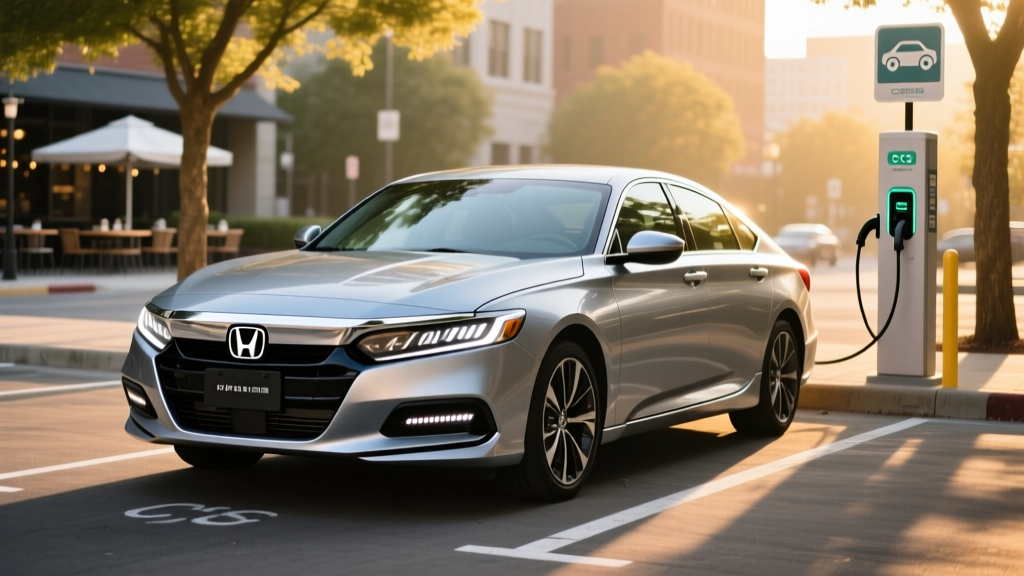
The midsize sedan segment has thinned out, but the 2023 Honda Accord Hybrid remains one of the most compelling choices for drivers who want EV-like efficiency without plugging in. Redesigned for the 2023 model year with a more refined two-motor hybrid system, the Accord Hybrid targets commuters and road-trippers alike with an EPA-estimated 48 MPG combined. But sticker numbers only tell half the story — real-world fuel economy, long-term battery reliability, and total ownership costs are what actually determine whether this hybrid earns a spot in your driveway.
In this guide, we dissect every spec that matters: exact MPG by trim, the eCVT powertrain architecture, Honda's hybrid battery warranty, and how the Accord Hybrid stacks up against plug-in hybrids and full EVs. If you're cross-shopping the Toyota Camry Hybrid, Hyundai Sonata Hybrid, or considering whether to leap to a BEV, this is the data-driven breakdown you need.
HEV vs PHEV: Where the Accord Hybrid Fits
Before diving into specs, it's critical to understand what the 2023 Accord Hybrid is — and what it isn't. Honda offers the Accord exclusively as a conventional hybrid (HEV). There is no plug-in hybrid (PHEV) variant of the current-generation Accord.
| Feature | Conventional Hybrid (HEV) | Plug-In Hybrid (PHEV) | Battery Electric (BEV) |
|---|---|---|---|
| Plug in to charge? | No — self-charging via regen & engine | Yes — Level 1 or Level 2 | Yes — Level 1, 2, or DC fast |
| Electric-only driving | Limited (low-speed, short distance) | 20–45 miles typical | 200–400+ miles |
| Battery size | ~1.0–1.5 kWh | ~10–20 kWh | ~50–100+ kWh |
| Federal tax credit (§30D) | No | Up to $7,500 (if eligible) | Up to $7,500 (if eligible) |
| Gasoline required? | Yes | Yes (after EV range depletes) | No |
| Example | Honda Accord Hybrid | Toyota RAV4 Prime | Honda Prologue |
The Accord Hybrid's battery is small — roughly 1.06 kWh — and charges entirely through regenerative braking and the gasoline engine. You never plug it in. This makes it ideal for drivers who lack home charging access or who want zero behavioral change from their gas-car routine while still cutting fuel consumption by 30–40% compared to a non-hybrid midsize sedan.
Fuel Economy: EPA Ratings vs Real-World MPG
The 2023 Accord Hybrid is rated by the EPA at 48 MPG combined, but that figure varies by trim due to wheel size and weight differences. Here's the full breakdown from fueleconomy.gov:
| Trim | City MPG | Highway MPG | Combined MPG | Est. Annual Fuel Cost |
|---|---|---|---|---|
| Sport / Sport-L | 46 | 41 | 44 | $1,350 |
| EX-L | 51 | 44 | 48 | $1,250 |
| Sport Touring | 46 | 41 | 44 | $1,350 |
The EX-L trim achieves the highest rating thanks to its lighter curb weight and 17-inch wheels, while the Sport and Sport Touring trims ride on 19-inch alloys that add rolling resistance and mass.
Real-World MPG: What Owners Actually See
Honda's two-motor hybrid system excels in stop-and-go city driving, where the electric motor handles most low-speed propulsion and the engine acts primarily as a generator. Many owners report exceeding the EPA city estimate — 50–54 MPG is common in warm-weather urban commutes under 45 mph.
Highway driving tells a different story. At sustained speeds above 70 mph, the engine engages directly via a lock-up clutch, and aerodynamic drag dominates. Expect 38–42 MPG on the highway in real-world conditions. Cold weather (below 35°F) further reduces efficiency by roughly 5–8 MPG as the engine runs more frequently for cabin heat and battery conditioning.
Real-World Range Estimate: With a 12.8-gallon fuel tank, the EX-L trim delivers approximately 550–600 miles of real-world combined range before refueling — and over 620 miles is achievable with a light foot in warm conditions.
Powertrain and Performance Specs
The 2023 Accord Hybrid uses Honda's fourth-generation two-motor hybrid system, which pairs a 2.0-liter Atkinson-cycle inline-four with two electric motors. Here's the complete powertrain breakdown:
| Specification | Detail |
|---|---|
| Engine | 2.0L DOHC Atkinson-cycle I-4 |
| Engine horsepower | 146 hp @ 6,100 rpm |
| Engine torque | 134 lb-ft @ 4,500 rpm |
| Drive motor output | 181 hp / 247 lb-ft |
| Combined system horsepower | 204 hp |
| Combined system torque | 247 lb-ft |
| Transmission | eCVT (no traditional gears) |
| Drivetrain | Front-wheel drive |
| 0–60 mph | ~6.5 seconds (est.) |
| Battery capacity | ~1.06 kWh (lithium-ion) |
| Curb weight | 3,477–3,527 lbs (trim-dependent) |
The eCVT isn't a belt-driven CVT like some competitors use. Honda's system uses a direct-drive clutch for highway cruising and electric-motor drive for most other conditions, which eliminates the "rubber-band" effect common to traditional CVTs. The result is linear, predictable acceleration that feels more like a single-speed EV than a conventional automatic.
With 247 lb-ft of torque available from the drive motor near zero RPM, the Accord Hybrid pulls away from stoplights with authority. The 204 combined horsepower is adequate for merging and passing, though it won't feel sporty against turbocharged rivals.
Pricing, Trims, and Tax Credit Eligibility
For the 2023 model year, Honda offered the Accord Hybrid in three trims. Here's the original MSRP (prices reflect 2023 launch pricing):
| Trim | 2023 MSRP | Key Features |
|---|---|---|
| Sport | $32,990 | 19" wheels, heated front seats, wireless CarPlay/Android Auto, Honda Sensing suite |
| EX-L | $34,635 | 17" wheels (best MPG), leather seats, power moonroof, wireless charging |
| Sport Touring | $38,990 | 19" wheels, Bose 12-speaker audio, navigation, heated rear seats, front ventilation |
Does the Accord Hybrid Qualify for a Federal Tax Credit?
No. The 2023 Honda Accord Hybrid is a conventional HEV and does not qualify for the federal §30D Clean Vehicle Credit. That credit — up to $7,500 for new vehicles or up to $4,000 for used — applies only to plug-in vehicles (PHEVs and BEVs) that meet battery sourcing, MSRP caps, and buyer income requirements per IRS guidelines.
Some states offer their own incentives for hybrids, though these are increasingly rare. Check your state's energy office or department of environmental quality for current programs. A few states have offered rebates as modest as $500–$1,000 for HEVs in the past, but most incentive dollars now flow to plug-in vehicles.
Battery Warranty, Lifespan, and Replacement Cost
Hybrid battery longevity is the single most common concern among first-time hybrid buyers. Here's what Honda covers:
Honda Hybrid Battery Warranty: 8 years / 100,000 miles (10 years / 150,000 miles in CARB states including CA, CT, MA, ME, NJ, NY, OR, RI, VT, WA). The warranty covers capacity loss below a defined threshold and manufacturing defects.
How Long Does the Battery Actually Last?
Honda's lithium-ion hybrid battery is small (~1.06 kWh) and operates within a conservative state-of-charge window — typically between 20% and 80%. This shallow cycling dramatically reduces degradation compared to a full EV battery that regularly charges to 100%. Based on long-term data from Honda and Toyota hybrid fleets, hybrid batteries routinely last 150,000–200,000+ miles before needing replacement, and many outlast the vehicle itself.
Replacement Cost if Needed
If the hybrid battery does fail outside warranty, replacement costs for the Accord Hybrid typically range from $2,000 to $4,000 for a new OEM unit installed at a dealership. Aftermarket and refurbished options can reduce this to $1,000–$2,500. This is significantly cheaper than EV battery replacement ($8,000–$20,000+) because the hybrid battery is much smaller.
The rest of the hybrid system — the power control unit, drive motor, and generator — is also covered under the 8-year/100,000-mile hybrid component warranty and is generally very reliable.
Reliability and Safety Ratings
Honda's hybrid powertrain has an excellent reliability track record. The two-motor system has fewer wear components than a traditional automatic transmission (no torque converter, no multi-gear shifting mechanisms), and regenerative braking reduces wear on the friction brake pads — many hybrid owners report 80,000+ miles on original brake pads.
For the 2023 Accord, the IIHS awarded the vehicle a TOP SAFETY PICK+ rating, the institute's highest honor. The standard Honda Sensing suite includes:
- Collision Mitigation Braking System (CMBS)
- Road Departure Mitigation (RDM)
- Adaptive Cruise Control (ACC) with Low-Speed Follow
- Lane Keeping Assist System (LKAS)
- Traffic Sign Recognition
Note: Honda Sensing is a SAE Level 1–2 driver-assistance system. It provides steering and braking support but requires the driver to remain fully engaged at all times. It is not a self-driving system.
Accord Hybrid vs PHEV vs EV: Which Should You Choose?
The right electrified vehicle depends on your charging access, daily mileage, and budget. Here's a decision framework:
Choose the Accord Hybrid (HEV) if:
- You don't have access to home or workplace charging
- You want maximum simplicity — no plug, no range planning, no charging apps
- Your budget is under $40,000 and you want proven reliability
- You drive a mix of city and highway miles and want strong MPG in both
- You take frequent long road trips and don't want to plan around charging stops
Choose a PHEV (like the Toyota RAV4 Prime or Hyundai Tucson PHEV) if:
- You can install a Level 2 charger at home
- Your daily commute is under 35 miles round-trip (you could drive mostly on electricity)
- You want to reduce gas consumption by 60–80% without range anxiety on long trips
- You may qualify for the $7,500 federal tax credit (subject to income, MSRP, and sourcing rules)
Choose a full EV (like the Tesla Model 3 or Hyundai Ioniq 6) if:
- You have reliable home Level 2 charging
- You want zero tailpipe emissions and the lowest per-mile energy cost
- You want minimal maintenance (no oil changes, no spark plugs, reduced brake wear)
- Your typical trips fall within 250–300 miles or you're comfortable with DC fast-charging on road trips
Pros and Cons at a Glance
Pros
- Excellent real-world city MPG (often exceeds EPA estimate)
- Smooth, linear power delivery from the two-motor system
- Spacious cabin with 16.7 cu-ft trunk — no battery intrusion
- Top Safety Pick+ from IIHS
- Conservative battery cycling means exceptional long-term battery life
- No charging infrastructure needed — works like a gas car
- Strong resale value in the midsize sedan segment
Cons
- No PHEV or EV variant available — hybrid only
- Highway MPG drops noticeably at 75+ mph
- No federal tax credit eligibility
- FWD only — no AWD option unlike Camry Hybrid
- Engine drone under hard acceleration (eCVT characteristic)
- Sport and Sport Touring trims lose 4 MPG vs EX-L due to 19" wheels
Frequently Asked Questions
How many MPG does the 2023 Honda Accord Hybrid get?
The EPA rates the Accord Hybrid EX-L at 51 city / 44 highway / 48 combined MPG. Sport and Sport Touring trims are rated at 46 city / 41 highway / 44 combined. Real-world city driving often yields 50–54 MPG in warm weather, while highway cruising above 70 mph typically returns 38–42 MPG.
Does the Honda Accord Hybrid need to be plugged in?
No. The Accord Hybrid is a conventional HEV, not a plug-in hybrid. Its 1.06 kWh battery charges through regenerative braking and the gasoline engine. You fuel it exactly like a standard gas car — just with significantly better mileage.
How far can the Accord Hybrid go on electric power alone?
The Accord Hybrid can operate in EV mode for very short distances (roughly 1–2 miles) at low speeds (under 30 mph) on flat terrain. This is useful for creeping through neighborhoods or parking lots, but it is not designed for meaningful electric-only commuting. If you want 25–40 miles of electric range, you need a PHEV.
Is the Honda Accord Hybrid reliable?
Yes. Honda's two-motor hybrid system has demonstrated excellent long-term reliability. The eCVT has fewer moving parts than a traditional automatic, regenerative braking extends brake pad life, and the hybrid battery operates within a conservative charge window. The battery is warranted for 8 years/100,000 miles (10 years/150,000 miles in CARB states), and real-world data suggests most hybrid batteries last 150,000–200,000+ miles.
What does a Honda Accord Hybrid battery replacement cost?
Out-of-warranty replacement of the hybrid battery typically costs $2,000–$4,000 at a dealership for a new OEM unit. Refurbished or aftermarket batteries can reduce this to $1,000–$2,500. Given the battery's small size and conservative cycling, most owners will never need a replacement during typical ownership.
Does the 2023 Accord Hybrid qualify for any tax credit?
The Accord Hybrid does not qualify for the federal §30D Clean Vehicle Credit, which is limited to plug-in hybrids and battery-electric vehicles. Some states may offer modest hybrid incentives, but these vary by jurisdiction and change frequently. Consult your state's energy office or a tax professional for current eligibility.
Accord Hybrid vs Toyota Camry Hybrid: which is better?
Both are excellent, but they serve slightly different priorities. The Camry Hybrid offers an AWD option and a slightly lower starting price, with an EPA rating of up to 52 combined MPG (LE trim). The Accord Hybrid provides a larger rear seat, more trunk space (16.7 vs 15.1 cu-ft), and a more refined driving experience. If AWD is essential for your climate, the Camry wins. If interior space and ride quality matter more, the Accord is the stronger pick.
Should I buy the Accord Hybrid or a full EV?
If you have home Level 2 charging and your daily driving is under 250 miles, a full EV like the Tesla Model 3 or Hyundai Ioniq 6 will deliver lower per-mile energy costs and near-zero maintenance. But if you lack charging access, regularly drive 400+ miles in a day, or want to avoid the higher upfront cost of an EV, the Accord Hybrid provides outstanding efficiency with zero lifestyle change.
The Bottom Line
The 2023 Honda Accord Hybrid remains one of the most rational choices in the midsize sedan segment. With 44–48 MPG combined depending on trim, a spacious and well-equipped interior, top safety ratings, and a hybrid powertrain built to outlast 200,000 miles, it delivers exactly what hybrid buyers want: dramatic fuel savings without compromise. The lack of a PHEV variant and no federal tax credit are genuine limitations, but for drivers who simply want to fill up less often without changing how they drive, the Accord Hybrid is hard to beat.