Quick Verdict: The Accord Hybrid Is the Midsize Sedan Efficiency King
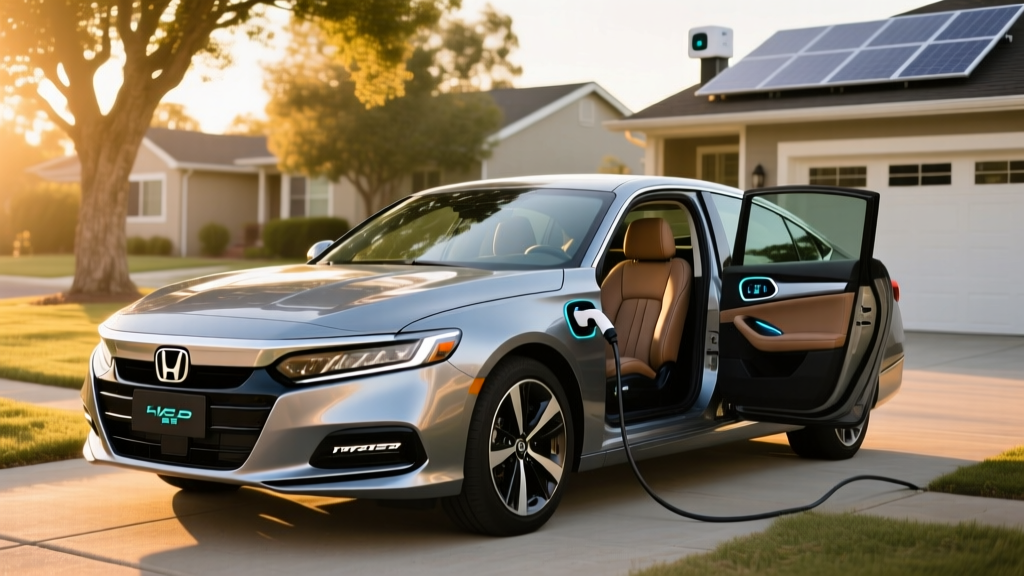
The 2024 Honda Accord Hybrid isn't trying to be a plug-in or a battery-electric vehicle — and that's exactly the point. Honda's two-motor hybrid system pairs a 2.0-liter Atkinson-cycle four-cylinder with twin electric motors to deliver 204 combined horsepower and an EPA-rated 48 MPG combined. For buyers who want genuine fuel savings without plugging in, changing habits, or paying an EV premium, the Accord Hybrid remains one of the most rational midsize sedans on the market.
This review covers every number that matters: real-world MPG versus the EPA sticker, powertrain architecture, battery longevity, warranty coverage, pricing by trim, and how the Accord Hybrid stacks up against plug-in hybrids and full EVs in 2026's evolving landscape.
| Spec | Value |
|---|---|
| Powertrain | 2.0L Atkinson I-4 + two-motor hybrid system |
| Combined Horsepower | 204 hp |
| Combined Torque | 247 lb-ft (motor) |
| Transmission | eCVT (no traditional gears) |
| EPA MPG (Sport/L) | 51 city / 44 highway / 48 combined |
| EPA MPG (EX-L/Sport-L/Touring) | 51 city / 44 highway / 48 combined |
| Fuel Tank | 12.8 gallons |
| Total Range | ~614 miles (EPA est.) |
| 0–60 mph | ~6.5 seconds (est.) |
| Battery Type | Lithium-ion (approx. 1.06 kWh usable) |
| Drivetrain | Front-wheel drive |
| Cargo Volume | 16.7 cu ft |
| Base MSRP (Sport) | $33,990 |
How Many MPG Does the 2024 Honda Accord Hybrid Actually Get?
| Trim | City | Highway | Combined |
|---|---|---|---|
| Sport | 51 MPG | 44 MPG | 48 MPG |
| EX-L | 51 MPG | 44 MPG | 48 MPG |
| Sport-L | 51 MPG | 44 MPG | 48 MPG |
| Touring | 51 MPG | 44 MPG | 48 MPG |
Source: EPA Fuel Economy — 2024 Honda Accord Hybrid
Real-World MPG vs. EPA Sticker
The Accord Hybrid's two-motor system is optimized for city and suburban driving, where regenerative braking and low-speed electric propulsion dominate. In real-world mixed driving, owners consistently report 46–52 MPG combined, with city-heavy commutes often exceeding the 51 MPG EPA city figure. Highway-only driving at 75+ mph tends to drop efficiency to 40–43 MPG, as the gasoline engine shoulders more of the load without regen assistance.
Cold weather (below 30°F) reduces efficiency by roughly 5–10%, primarily because the engine runs more often to provide cabin heat. This is a known hybrid characteristic — not a defect — and still outperforms the gasoline Accord by a wide margin in winter conditions.
Powertrain Deep Dive: How Honda's Two-Motor Hybrid Works
The Accord Hybrid uses Honda's fourth-generation two-motor hybrid system, which operates differently from a traditional parallel hybrid like Toyota's planetary-gear setup:
- Propulsion Motor: 181 hp / 247 lb-ft — drives the front wheels directly in most conditions
- Generator Motor: Acts as a starter, generator, and regenerative-braking unit
- 2.0L Atkinson-Cycle I-4: 146 hp / 134 lb-ft — primarily generates electricity, occasionally drives wheels at highway cruise via a lockup clutch
At low speeds and in stop-and-go traffic, the Accord Hybrid runs almost entirely on its electric propulsion motor, with the gas engine spinning the generator to keep the small lithium-ion battery charged. At highway speeds (roughly 55+ mph), a lockup clutch mechanically connects the engine to the wheels for maximum efficiency. This is why the Accord Hybrid excels in city driving (51 MPG city) but sees a slight highway drop compared to some competitors.
Combined system output is 204 horsepower, delivered through an eCVT that isn't a traditional belt-and-pulley CVT — it's a direct-drive system with a single fixed gear ratio plus the engine lockup clutch. The result is smooth, linear acceleration with none of the "rubber-band" drone associated with older CVTs.
HEV vs. PHEV vs. EV: Which Powertrain Fits You?
A common question from midsize sedan shoppers: should you buy the Accord Hybrid (HEV), a plug-in hybrid like the Toyota Prius Prime, or a full EV like the Hyundai Ioniq 6? Here's the framework:
| Factor | HEV (Accord Hybrid) | PHEV (e.g., Prius Prime) | BEV (e.g., Ioniq 6) |
|---|---|---|---|
| Plug-in Required? | No | Yes (for EV mode benefit) | Yes |
| Electric-Only Range | ~1 mile at low speed | 35–44 miles | 300–361 miles |
| Total Range | ~614 miles | ~440+ miles | 300–361 miles |
| Home Charging Needed? | No | Recommended (120V or 240V) | Required |
| Federal Tax Credit (§30D) | Not eligible | Up to $7,500 (if eligible) | Up to $7,500 (if eligible) |
| Upfront Cost Premium | ~$1,200 over gas model | ~$4,000–$7,000 over HEV | ~$8,000–$15,000 over HEV |
| Maintenance Complexity | Low (gas engine + simple hybrid) | Medium (gas engine + larger battery) | Lowest (no gas engine) |
| Best For | No home charging access; road-trip heavy | Short commute + home charging | Home charging + daily driving under 300 mi |
Choose the Accord Hybrid if: You don't have reliable home charging access, you take frequent road trips beyond 300 miles, or you want maximum simplicity with no plug-in behavior to manage.
Choose a PHEV if: You have home charging, your daily commute is under 40 miles round-trip, and you want some electric-only driving without range anxiety on longer trips.
Choose a full EV if: You have Level 2 home charging, your daily driving is well under 250 miles, you want the lowest per-mile fuel cost, and you're ready to plan road-trip charging stops.
Does the 2024 Accord Hybrid Qualify for a Tax Credit?
No. The 2024 Honda Accord Hybrid is a conventional hybrid (HEV), not a plug-in hybrid or battery-electric vehicle. Under current IRS §30D Clean Vehicle Credit rules, only plug-in vehicles with a battery capacity of at least 7 kWh and the ability to charge from an external power source qualify. The Accord Hybrid's ~1 kWh battery charges exclusively through regenerative braking and the onboard engine — it cannot be plugged in.
This means the Accord Hybrid's price is the price you pay. There are no federal purchase incentives, though some states or local utilities may offer minor rebates for any high-efficiency vehicle. Always check your state incentive database for current local offers.
Pricing by Trim: What You'll Actually Pay
| Trim | MSRP | Key Features |
|---|---|---|
| Sport | $33,990 | 19" wheels, wireless CarPlay/Android Auto, Honda Sensing suite |
| EX-L | $35,690 | Leather seats, 10-speaker audio, wireless phone charger, heated rear seats |
| Sport-L | $36,330 | Sport styling + leather interior, 19" wheels |
| Touring | $39,330 | Adaptive dampers, Bose 12-speaker audio, heated/cooled front seats, low-speed braking control |
For context, the gasoline-only Accord LX starts at $28,990, making the hybrid system a roughly $5,000 step-up to the Sport Hybrid trim. At 48 MPG versus the gas model's 32 MPG combined, the fuel payback period depends on your annual mileage and local gas prices — typically 3–5 years at 15,000 miles/year and $3.50/gallon.
Battery Warranty, Reliability, and Replacement Cost
2024 Accord Hybrid — Battery & Powertrain Coverage
- Hybrid Battery Warranty: 8 years / 100,000 miles (10 years / 150,000 miles in CARB states including CA, NY, MA, CT, ME, MD, NJ, OR, RI, VT, WA, CO, and others adopting California emissions standards)
- Hybrid System Warranty: 8 years / 100,000 miles (covers inverter, motor, control unit)
- Powertrain Warranty: 5 years / 60,000 miles (engine, transmission)
- Limited Vehicle Warranty: 3 years / 36,000 miles
How Long Will the Accord Hybrid Battery Last?
Honda's lithium-ion hybrid battery pack is approximately 1.06 kWh — far smaller than an EV battery. Because it's never deeply cycled (the system keeps it between roughly 20–80% state of charge), degradation is minimal. Real-world data from previous-generation Accord and Civic Hybrids shows battery packs routinely lasting 150,000–200,000+ miles before significant capacity loss.
If replacement is ever needed out of warranty, expect $2,000–$4,000 for a new OEM hybrid battery pack at a Honda dealer, with refurbished options available for $1,000–$2,000. This is dramatically less than an EV traction battery replacement ($5,000–$20,000+), and the smaller battery means lower long-term ownership risk.
Overall Reliability
Honda's hybrid system is among the most proven in the industry, with over two decades of real-world deployment. The 11th-generation Accord (2023+) is too new for long-term reliability data from IIHS and J.D. Power, but the underlying two-motor architecture carries over from highly rated predecessors. The Accord earned IIHS Top Safety Pick+ status for 2024.
Driving Impressions: Performance and Refinement
The Accord Hybrid's 204 hp and 247 lb-ft of electric torque deliver confident acceleration — the 0–60 mph time of approximately 6.5 seconds puts it in the same territory as many turbocharged midsize sedans. The electric motor's instant torque makes it feel quicker than the numbers suggest in city driving, and the lockup-clutch highway mode eliminates the droning associated with older hybrid systems.
Ride quality varies by trim: the Touring's adaptive dampers provide noticeably better isolation over rough pavement, while the Sport's 19-inch wheels trade some comfort for sharper handling. Road noise is well-controlled across all trims, and the regenerative braking system offers four levels of deceleration (selectable via paddle shifters), enabling moderate one-pedal-style driving without full stop capability.
Who Should Buy the 2024 Accord Hybrid — and Who Shouldn't
Pros
- 48 MPG combined — among the best in the midsize segment
- No plug-in required — zero behavior change from a gas car
- Spacious interior (16.7 cu ft trunk, generous rear legroom)
- Strong reliability history and generous CARB-state battery warranty
- Smooth, refined powertrain with adequate passing power
- Honda Sensing ADAS suite standard on all trims
Cons
- No federal tax credit eligibility (HEV, not PHEV/EV)
- Highway MPG drops to ~40–43 in real-world 75+ mph driving
- No AWD option (unlike the Toyota Camry Hybrid)
- Base Sport trim price ($33,990) is steep for a midsize sedan
- Cannot drive on electric-only for meaningful distances
Frequently Asked Questions
How many MPG does the 2024 Honda Accord Hybrid get?
The EPA rates all 2024 Accord Hybrid trims at 51 city / 44 highway / 48 combined MPG. Real-world mixed driving typically yields 46–52 MPG combined, with city-heavy commutes often exceeding 50 MPG and sustained highway driving at 75+ mph dropping to 40–43 MPG.
Does the Accord Hybrid need to be plugged in?
No. The 2024 Accord Hybrid is a conventional hybrid (HEV). Its small lithium-ion battery charges through regenerative braking and the onboard gasoline engine. You fuel it like any other car — just less often.
Is the Accord Hybrid a PHEV?
No. Honda does not currently offer a plug-in hybrid Accord in the United States. The Accord Hybrid is a self-charging HEV with no plug-in capability and no meaningful electric-only range. If you want a Honda plug-in, the closest option was the discontinued Clarity PHEV.
Does the 2024 Accord Hybrid qualify for any federal tax credit?
No. Under IRS §30D rules, only plug-in electric vehicles (PHEVs and BEVs) with at least 7 kWh of battery capacity qualify for the federal Clean Vehicle Credit. The Accord Hybrid's ~1 kWh battery does not meet this threshold. No state-level EV incentives apply either, though check local utility programs for possible efficiency rebates.
How long will the Accord Hybrid battery last, and what does replacement cost?
Honda covers the hybrid battery for 8 years / 100,000 miles (10 years / 150,000 miles in CARB states). Real-world data from previous-generation Honda hybrids suggests battery packs regularly last 150,000–200,000+ miles. Out-of-warranty replacement runs approximately $2,000–$4,000 for an OEM pack.
Is the Accord Hybrid better than the Toyota Camry Hybrid?
Both are excellent. The Camry Hybrid offers standard AWD and a slightly lower starting price, while the Accord Hybrid delivers more interior space, a more refined ride (especially in Touring trim), and marginally better city MPG. If you need AWD, choose the Camry. If cargo room and highway refinement matter more, the Accord Hybrid wins.
Should I buy the Accord Hybrid or a full EV?
If you have Level 2 home charging and drive under 250 miles daily, a full EV like the Hyundai Ioniq 6 or Tesla Model 3 offers lower per-mile energy costs, less maintenance, and available tax credits. If you lack home charging, take frequent long road trips, or want zero behavior change, the Accord Hybrid is the pragmatic choice with no charging logistics to manage.