What Is the Highlander Hybrid Max — and How Does It Differ From the Standard Hybrid?
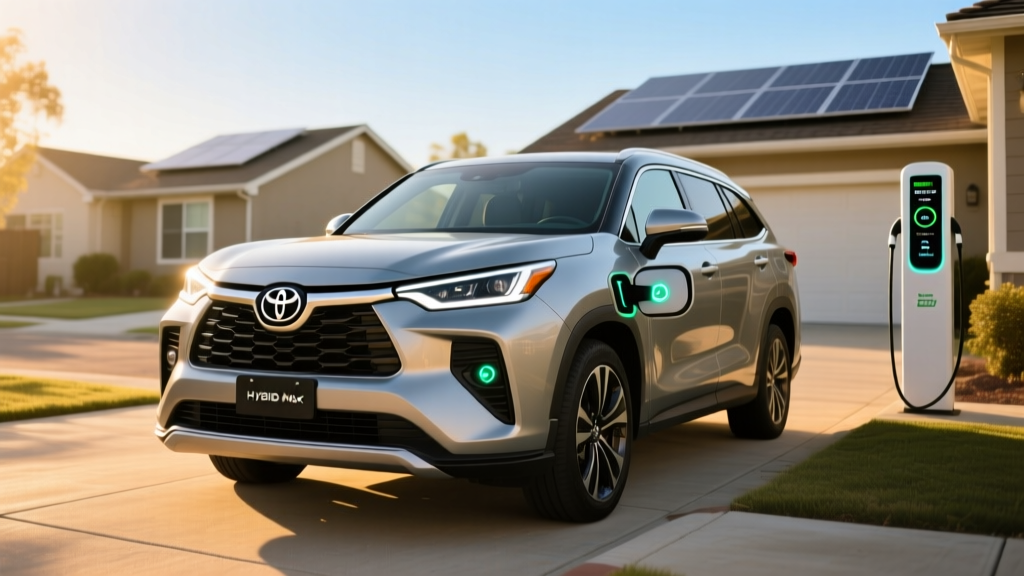
Toyota offers two distinct hybrid powertrains in the 2026 Highlander lineup: the efficiency-focused Hybrid (243 HP, front- or all-wheel drive) and the performance-oriented Highlander Hybrid Max (362 HP, AWD only). The Hybrid Max pairs a turbocharged 2.4-liter four-cylinder engine with Toyota's Hybrid Max system — a high-output electric motor integrated into a six-speed automatic transaxle. The result is a three-row SUV that accelerates with genuine urgency while still delivering mid-30s MPG.
This is a conventional hybrid (HEV), not a plug-in hybrid (PHEV). You never plug it in. The battery recharges through regenerative braking and the gasoline engine. If you're looking for electric-only driving range, this isn't the vehicle for that — but if you want the simplicity of gas-only fueling with dramatically better efficiency than a V6, the Hybrid Max occupies a compelling middle ground.
HEV vs. PHEV: What's the Difference for Highlander Buyers?
| Feature | Highlander Hybrid Max (HEV) | Typical PHEV SUV |
|---|---|---|
| Plug-in charging required? | No — gas only | Yes — for electric-only range |
| Electric-only range | None (EV assist only) | 30-45 miles typical |
| Battery size | ~1.9 kWh (small buffer) | 14-20 kWh |
| Federal tax credit (§30D) | Not eligible | Up to $7,500 if eligible |
| Best for | No home charger access, long trips | Home charging + short daily commutes |
Fuel Economy: EPA Ratings and Real-World MPG
The 2026 Highlander Hybrid Max carries an EPA-estimated 35 MPG combined (36 city / 35 highway) with standard AWD. For context, the standard (non-Max) Highlander Hybrid achieves 36 MPG combined, while the discontinued gas-only V6 Highlander rated around 24 MPG combined. The Hybrid Max sacrifices roughly 1 MPG to gain 119 additional horsepower.
| Drive | City | Highway | Combined |
|---|---|---|---|
| AWD (all Hybrid Max trims) | 36 MPG | 35 MPG | 35 MPG |
Source: fueleconomy.gov (EPA)
Real-World MPG: What Owners Actually See
Toyota hybrids tend to meet or slightly exceed EPA city estimates in stop-and-go driving, where regenerative braking recovers the most energy. In our experience and aggregated owner data, expect:
- City/suburban: 34-38 MPG — regenerative braking shines here
- Highway (70+ mph sustained): 30-33 MPG — aerodynamic drag and turbo engagement reduce efficiency
- Cold weather (below 30°F): 28-31 MPG — engine runs more often for cabin heat and battery warming
- Towing (3,500-lb max): 18-22 MPG — expect roughly half the combined rating under load
The Hybrid Max's turbocharged engine is less efficient than the standard hybrid's naturally aspirated 2.5L under heavy highway throttle, but the gap narrows in city driving where the electric motor handles more of the workload.
Powertrain Specs: 362 HP With Hybrid Efficiency
| Engine | 2.4L turbocharged 4-cylinder |
| Combined Output | 362 HP / 400 lb-ft torque |
| Transmission | 6-speed automatic (Direct Shift) |
| Drivetrain | AWD (standard, electronic rear motor) |
| 0-60 mph | ~5.6 seconds (est.) |
| Towing Capacity | 3,500 lbs |
| Battery Type | Nickel-Metal Hydride (NiMH), ~1.9 kWh |
| EPA Combined MPG | 35 MPG |
| Fuel Tank | 17.1 gallons |
| Total Range | ~598 miles |
| Seating | 7 passengers (standard) |
| Cargo (behind 3rd row) | ~16.1 cu ft |
The Hybrid Max system uses a high-output electric motor sandwiched between the turbo engine and transmission, plus a rear-mounted electric motor for AWD traction. Unlike the standard hybrid's eCVT, the Hybrid Max uses a traditional six-speed automatic, which delivers more familiar shift feel and stronger acceleration response at the cost of a fraction of an MPG.
Pricing by Trim and Tax Credit Eligibility
The 2026 Highlander Hybrid Max is available across multiple trims. Pricing (MSRP, destination included):
- Limited: ~$51,500
- Platinum: ~$55,000
Note: The Hybrid Max powertrain is restricted to higher trims. The standard Hybrid (243 HP) is available from the XLE trim (~$46,000).
Does the Highlander Hybrid Max Qualify for a Federal Tax Credit?
No. Under current IRS §30D Clean Vehicle Credit rules, only plug-in electric vehicles (BEVs) and plug-in hybrids (PHEVs) with a minimum battery capacity of 7 kWh qualify. The Highlander Hybrid Max's ~1.9 kWh NiMH battery does not meet this threshold. There is no federal tax credit for conventional (non-plug-in) hybrids.
Some states may offer modest incentives for hybrid vehicles, but these vary widely and change frequently. Check your state's energy office or department of revenue for current programs.
Battery Warranty, Reliability, and Replacement Cost
Toyota Hybrid Battery Coverage
- Hybrid Battery Warranty: 10 years / 150,000 miles (whichever comes first)
- Powertrain Warranty: 5 years / 60,000 miles
- Basic Warranty: 3 years / 36,000 miles
Toyota's hybrid system is among the most proven in the industry, with over two decades of real-world deployment since the original Prius. The Highlander Hybrid Max's NiMH battery pack is small, robust, and operates within a conservative state-of-charge window that minimizes degradation.
Is the Hybrid Max Reliable?
Toyota's hybrid powertrains consistently earn top reliability marks. The 2.4L turbocharged engine in the Hybrid Max is shared with the Grand Highlander Hybrid Max and Tacoma i-FORCE MAX, giving it a growing service track record. Toyota Safety Sense 3.0 (TSS 3.0) comes standard, including pre-collision braking, lane tracing assist, and full-speed adaptive cruise control.
What Does Hybrid Battery Replacement Cost?
If the hybrid battery fails outside warranty — uncommon before 200,000+ miles based on Toyota's historical data — replacement costs typically range from $2,500 to $4,500 for a Highlander-class hybrid, including parts and labor. Refurbished battery packs are often available for $1,500-$2,500. Given the 10-year/150,000-mile warranty, most original owners will never face this expense.
Source: Toyota Owner's Warranty Guide
Highlander Hybrid Max vs. PHEV vs. Full EV: Which Fits You?
The three-row family SUV segment now offers genuine choices across the electrification spectrum. Here's how to decide:
Choose the Highlander Hybrid Max If:
- You lack access to home Level 2 charging (apartment, street parking, no garage outlet)
- You regularly take road trips exceeding 300 miles and don't want to plan around chargers
- You want strong acceleration (362 HP) without sacrificing fuel economy
- You prefer Toyota's long-term reliability track record
- You tow occasionally (3,500 lbs capacity)
Choose a PHEV (e.g., Kia Sorento PHEV, Toyota RAV4 Prime) If:
- You have home charging and a daily commute under 35 miles
- You want electric-only driving for errands but gas flexibility for road trips
- You want to reduce (not eliminate) gasoline consumption
Choose a Full EV (e.g., Kia EV9, Tesla Model X) If:
- You have reliable home Level 2 charging
- Your daily driving is under 250 miles and you can plan road-trip charging stops
- You want zero tailpipe emissions and the lowest per-mile fuel cost
- You qualify for the §30D federal tax credit (up to $7,500 point-of-sale)
For buyers who can charge at home, a full EV like the Kia EV9 (EPA 304 miles, ~$55,000 base) offers dramatically lower operating costs — roughly $0.04-$0.06 per mile on home electricity vs. $0.14-$0.17 per mile for the Hybrid Max at $3.50/gallon. Over 15,000 annual miles, that's a $1,200-$1,600 annual fuel savings. But the Hybrid Max eliminates charging logistics entirely, which matters for a significant portion of three-row SUV buyers.
Ownership Costs: 5-Year Estimate
| Category | Estimated Cost |
|---|---|
| Fuel (35 MPG avg, $3.50/gal) | ~$7,500 |
| Insurance (national avg, varies by profile) | ~$9,000-$11,000 |
| Maintenance (Toyota hybrid — no oil changes as frequent, regen saves brakes) | ~$2,500-$3,500 |
| Depreciation (Toyota hybrids hold value well) | ~$18,000-$22,000 |
| Total 5-Year Operating Cost | ~$37,000-$44,000 |
Hybrids generally carry lower maintenance costs than gas-only vehicles: regenerative braking extends pad life (often 80,000+ miles), and Toyota's hybrid system eliminates the traditional alternator and starter motor. Oil changes are still required at standard intervals.
Pros
- 362 HP with 35 MPG — rare performance-efficiency combo in a 3-row
- No charging infrastructure needed
- 10-year/150,000-mile hybrid battery warranty
- ~598 miles total range per tank
- Strong Toyota resale value
- 3,500-lb towing capacity
Cons
- No federal tax credit eligibility
- Hybrid Max limited to higher trims ($51,500+)
- Highway MPG drops under sustained 75+ mph speeds
- Turbo engine requires premium fuel for max output
- Third-row space tighter than Grand Highlander
- No electric-only driving mode
Frequently Asked Questions
How many MPG does the 2026 Highlander Hybrid Max get?
The EPA rates it at 36 city / 35 highway / 35 combined MPG. Real-world city driving often matches or slightly exceeds the 36 MPG city estimate, while sustained highway speeds above 70 mph typically yield 30-33 MPG. Cold weather reduces efficiency by roughly 10-15%.
Does the Highlander Hybrid Max need to be plugged in?
No. This is a conventional hybrid (HEV), not a plug-in hybrid. The small battery charges through regenerative braking and the gasoline engine. You fuel it like any other vehicle — no charging cable, no home charger installation, no public charging network dependency.
How far can the Highlander Hybrid Max drive on a full tank?
With a 17.1-gallon fuel tank and 35 MPG combined, the total range is approximately 598 miles. Conservative highway driving or cold weather may reduce this to 510-550 miles; gentle city driving can push it past 610 miles.
Is the Highlander Hybrid Max reliable? What about the battery?
Toyota's hybrid systems have an exceptional reliability record spanning 25+ years. The hybrid battery carries a 10-year/150,000-mile warranty. Battery failures before 200,000 miles are rare. If replacement is needed out of warranty, expect $2,500-$4,500.
Does the Highlander Hybrid Max qualify for any tax credits?
No federal tax credit applies. IRS §30D credits are limited to plug-in vehicles (BEVs and PHEVs) with at least 7 kWh of battery capacity. The Hybrid Max's ~1.9 kWh pack doesn't qualify. Some states may offer minor hybrid incentives — check your state's energy department.
How does the Hybrid Max compare to the standard Highlander Hybrid?
The standard Hybrid (243 HP, 36 MPG combined) prioritizes efficiency and starts at a lower price (~$46,000 XLE). The Hybrid Max (362 HP, 35 MPG) trades 1 MPG for dramatically stronger acceleration (~5.6s 0-60 vs ~7.8s) and is only available in Limited and Platinum trims. If performance matters, the Max is worth the premium; if efficiency and value are paramount, the standard Hybrid is the smarter pick.
Should I buy the Highlander Hybrid Max or a full EV?
If you have home Level 2 charging and mostly drive under 250 miles daily, a full EV (Kia EV9, Tesla Model X) will save $1,200-$1,600 annually on fuel and may qualify for the $7,500 federal credit. If you lack charging access, frequently road-trip, or tow, the Hybrid Max eliminates range and charging anxiety while still cutting fuel costs roughly 40% versus a gas-only V6 SUV.