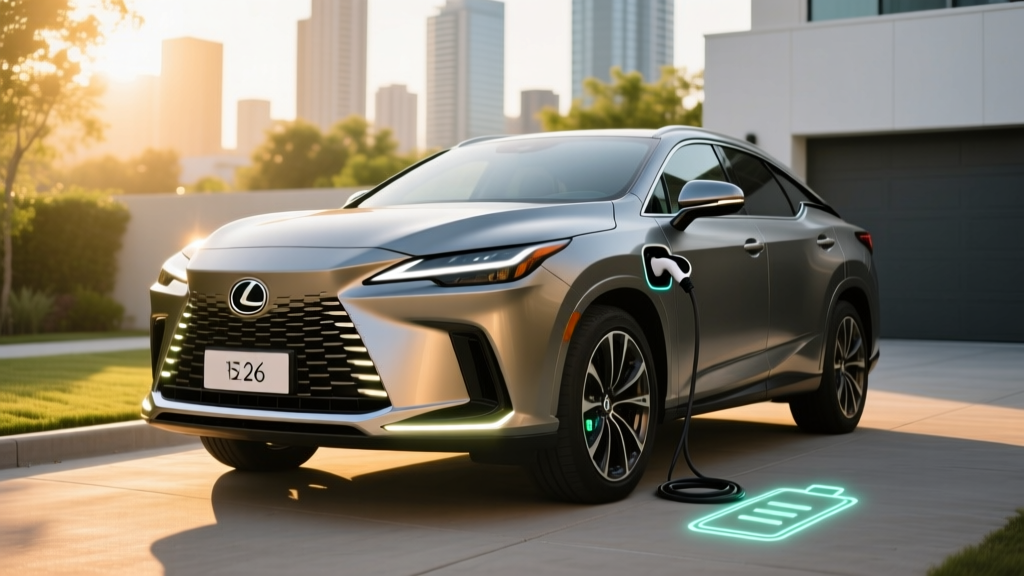
The midsize luxury SUV segment is crowded, but the 2026 Lexus RX 450h+ plug-in hybrid occupies a specific lane: buyers who want daily electric-only commuting without sacrificing the 500-mile road-trip flexibility that a full battery-electric vehicle can't always guarantee. Built on the same TNGA-K platform as the conventional RX 350h hybrid, the 450h+ adds a larger battery pack, more powerful electric motors, and a charge port — transforming it from a self-charging hybrid into a genuine bridge between gas and electric ownership.
After reviewing the powertrain specs, EPA data, and ownership economics, here's what the RX 450h+ actually delivers — and where its limitations live.
The Lexus RX 350h is a conventional hybrid (HEV): it never plugs in, uses regenerative braking and the engine to maintain a small ~1.6 kWh battery, and delivers strong MPG but no meaningful electric-only driving. The Lexus RX 450h+ is a plug-in hybrid (PHEV): it carries an 18.1 kWh battery, plugs into a wall or Level 2 charger, and can drive up to 37 miles on electricity alone before the gas engine engages. If you never plug it in, it still functions as a hybrid — but you'd be paying a premium for capability you're not using.
Spec Sheet: 2026 Lexus RX 450h+ at a Glance
| Specification | 2026 Lexus RX 450h+ (PHEV) |
|---|---|
| Powertrain | 2.5L 4-cyl + 2 electric motors (e-AWD) |
| Combined Horsepower | 302 hp |
| Battery Capacity | 18.1 kWh (lithium-ion) |
| EPA Electric-Only Range | 37 miles |
| EPA MPGe (electric + gas) | 83 MPGe combined |
| EPA MPG (gas-only hybrid mode) | 35 city / 34 hwy / 35 combined |
| Total Combined Range | ~440 miles |
| 0–60 mph | 6.2 seconds |
| Level 2 Charge Time (0–100%) | ~2.5 hours at 6.6 kW |
| DC Fast Charging | Not available |
| Drivetrain | Electronic AWD (e-AWD) |
| Base MSRP | $63,600 (Premium trim) |
| Federal Tax Credit (§30D) | Not eligible |
Source: EPA / fueleconomy.gov
Electric-Only Range and MPGe: What the Numbers Mean
The EPA rates the RX 450h+ at 37 miles of electric-only driving and 83 MPGe combined when operating in EV mode. MPGe (miles per gallon equivalent) converts electrical energy consumption into the same unit as gasoline MPG so you can compare across powertrains — but the number that matters more in daily life is the 37-mile electric range.
For context, the average American one-way commute is roughly 16 miles, according to FHWA data. That means most RX 450h+ owners with home charging can complete a full round-trip commute on battery power alone, only engaging the 2.5-liter engine for longer drives, weekend trips, or when the battery depletes.
In mild weather (60–80°F) with city driving and moderate climate control, expect 35–39 miles of electric range — closely matching the EPA sticker. In winter conditions (below 32°F), battery chemistry and cabin heating demands reduce electric range by roughly 20–30%, bringing realistic EV-only distance down to 25–30 miles. Highway-speed electric driving at 70+ mph also shortens range due to higher energy consumption per mile.
Fuel Economy: MPG in Hybrid Mode
Once the battery is depleted, the RX 450h+ operates as a conventional hybrid, just like the RX 350h but with slightly more weight from the larger battery. The EPA rates it at:
| Condition | MPG |
|---|---|
| City | 35 |
| Highway | 34 |
| Combined | 35 |
Real-world MPG note: Lexus hybrids historically perform very well in city driving, where regenerative braking recaptures energy and the engine runs less frequently. In mixed city driving, owners commonly report 36–38 MPG. Highway-only trips at 75+ mph tend to yield 30–32 MPG due to the aerodynamic drag of a midsize SUV and the absence of regenerative braking opportunities.
Powertrain Deep Dive: 302 Horsepower with e-AWD
The RX 450h+ pairs a 2.5-liter Atkinson-cycle four-cylinder engine with two electric motors — one on the front axle integrated into the transaxle, and one on the rear axle providing electronic all-wheel drive. Combined system output is 302 horsepower, a meaningful step up from the 246 hp in the RX 350h.
The result is a 0–60 mph time of 6.2 seconds, which puts the 450h+ in a different performance bracket than the standard hybrid. Electric torque delivery is immediate, making the RX feel responsive around town and confident during highway merges. The e-AWD system doesn't use a mechanical driveshaft to the rear wheels; instead, the rear electric motor engages on demand for traction, which saves weight and cabin space.
Compared to the non-hybrid RX 350 (275 hp turbo four-cylinder), the 450h+ delivers more power, better fuel economy, and standard AWD — though at a price premium of roughly $10,000–$12,000 depending on trim.
Charging: Level 2 Only, No DC Fast Charging
The RX 450h+ includes an onboard charger rated at 6.6 kW, meaning it can accept Level 2 AC power from a home wallbox or public Level 2 station. A full charge from 0% to 100% takes approximately 2.5 hours.
This is a critical limitation to understand: the RX 450h+ does not support DC fast charging. You cannot pull into an Electrify America or Tesla Supercharger station and top up the battery in 20 minutes. This is typical for PHEVs — the battery is small enough that Level 2 charging is adequate for overnight replenishment, and the cost/complexity of adding a DC fast-charge port isn't justified for an 18.1 kWh pack.
Home charging setup: A standard 120V household outlet (Level 1) will charge the RX 450h+ in roughly 9–10 hours — workable for overnight but slow. A 240V Level 2 home charger (like a ChargePoint Home Flex or Wallbox Pulsar Plus) reduces that to ~2.5 hours and is strongly recommended for PHEV owners who want to start every morning with a full battery. Installation of a Level 2 home circuit typically costs $500–$2,000 depending on electrical panel proximity and local permit requirements.
| Charging Level | Power | Full Charge Time | Miles Added/Hour |
|---|---|---|---|
| Level 1 (120V) | ~1.4 kW | ~9–10 hours | ~4 mi/hr |
| Level 2 (240V) | 6.6 kW | ~2.5 hours | ~15 mi/hr |
| DC Fast Charge | N/A | Not supported | — |
Pricing, Trims, and Tax Credit Eligibility
The 2026 Lexus RX 450h+ is offered in three trims:
- Premium: $63,600
- Premium+: $66,100
- Luxury: $71,600
All trims include the Lexus Safety System+ 3.0 suite, a 14-inch touchscreen, wireless Apple CarPlay and Android Auto, heated front seats, and the e-AWD system. The Luxury trim adds semi-aniline leather, a panoramic moonroof, and a Mark Levinson audio system.
Under current IRS §30D rules, the Lexus RX 450h+ does not qualify for the federal clean vehicle tax credit (up to $7,500). The §30D credit requires that a minimum percentage of battery critical minerals and components be sourced from the U.S. or free-trade-agreement partners — and Toyota/Lexus PHEV battery supply chains do not currently meet these thresholds. Additionally, buyers must meet income caps ($150K single / $300K joint) and the vehicle MSRP must fall under the $80,000 SUV cap. While the RX 450h+ MSRP clears the cap, the sourcing requirements disqualify it. Always consult a tax professional and check the latest IRS guidance, as sourcing compliance can change model year to model year.
Some states offer their own rebates or HOV-lane access for PHEVs (California's Clean Fuel Rebate, for example), but these vary by jurisdiction. Check your state energy office or AFDC incentive database for current local programs.
Battery Warranty, Reliability, and Replacement Costs
Lexus covers the RX 450h+ hybrid battery pack for 10 years or 150,000 miles (whichever comes first) in all 50 states. This is one of the longest hybrid battery warranties in the luxury segment. The powertrain (engine, motors, transaxle) is covered for 6 years / 70,000 miles, and the basic bumper-to-bumper warranty runs 4 years / 50,000 miles.
Reliability: Lexus has an established track record with hybrid powertrains dating back to the 2006 RX 400h. The Atkinson-cycle 2.5L engine is under-stressed, the e-CVT transaxle has no traditional friction clutches or bands to wear, and the hybrid battery management system maintains a state-of-charge buffer (the pack never truly reaches 0% or 100%) to reduce degradation. In NHTSA and IIHS testing, the current-generation RX platform has earned strong safety ratings, including an IIHS Top Safety Pick designation.
Battery replacement cost: If the hybrid battery pack fails outside warranty, replacement typically runs $6,000–$9,000 including parts and labor at a Lexus dealer. However, out-of-warranty failures are uncommon within the first 150,000 miles based on historical Lexus hybrid data. Independent hybrid shops can sometimes refurbish or replace individual modules for $2,000–$4,000, extending the pack's life at lower cost.
Who Should Buy the RX 450h+ — and Who Shouldn't
- Your daily commute is under 35 miles round-trip
- You have access to home Level 2 charging
- You take regular road trips beyond 300 miles
- You want luxury-cabin quietness with strong fuel economy
- You need AWD for snow or rain without a fuel penalty
- You're not ready to rely on public charging infrastructure
- You can't install or access a Level 2 charger (you'll waste the PHEV premium)
- Your commute exceeds 40 miles daily (a full EV or diesel may serve better)
- You need three usable rows of seating (the RX is strictly two-row)
- You want the $7,500 federal tax credit (consider a qualifying BEV)
- You need DC fast charging for frequent long-distance travel
RX 450h+ vs Full EV vs Gas: Which Powertrain Fits?
| Factor | RX 450h+ (PHEV) | Full EV (e.g., Tesla Model X) | Gas RX 350 |
|---|---|---|---|
| Daily Commute Cost | Very low (electric) | Very low (electric) | Higher (gas) |
| Road-Trip Flexibility | Excellent (gas backup) | Requires planning | Excellent |
| Home Charging Needed? | Recommended | Essential | No |
| Federal Tax Credit | No | Up to $7,500 (varies) | No |
| Maintenance Costs | Low–moderate | Low | Moderate |
| Combined MPGe / MPG | 83 MPGe / 35 MPG | 100+ MPGe | 24 MPG |
The PHEV is the pragmatic middle ground. You get most of the daily savings of an EV for short commutes, with the security blanket of a gas engine for long trips. The trade-off is a higher purchase price than the gas RX 350, no federal tax credit to offset that premium, and a smaller electric range than a full BEV.
Frequently Asked Questions
How many MPG does the Lexus RX 450h+ get?
The EPA rates the RX 450h+ at 35 MPG combined (35 city / 34 highway) when operating in hybrid mode after the battery is depleted. In real-world city driving, many owners report 36–38 MPG thanks to regenerative braking. Highway-only trips at 75+ mph typically yield 30–32 MPG.
How far can the RX 450h+ go on electric only?
The EPA rates it at 37 miles of electric-only range. In mild weather with city driving, expect 35–39 miles. In cold weather below freezing, expect 25–30 miles due to battery chemistry limitations and cabin heating demands.
Does the Lexus RX 450h+ qualify for a federal tax credit?
No. Under current IRS §30D rules, the RX 450h+ does not qualify for the federal clean vehicle tax credit due to battery sourcing requirements. State-level incentives may still apply — check your state's energy office or the AFDC database.
Is the RX 450h+ hybrid battery reliable, and what does replacement cost?
Lexus hybrid batteries have an excellent reliability record spanning two decades. The battery is warrantied for 10 years / 150,000 miles. Out-of-warranty replacement runs $6,000–$9,000 at a dealer, though independent hybrid specialists can refurbish packs for less. Failures before 150K miles are uncommon.
Should I get the PHEV RX 450h+ or the regular hybrid RX 350h?
If you have home charging and a short commute (under 35 miles daily), the 450h+ saves meaningful fuel and offers more horsepower (302 vs 246). If you can't charge at home or your commute is long, the RX 350h delivers similar hybrid MPG (36 combined) at a lower price without the PHEV premium you'd never recoup.
Can the RX 450h+ DC fast charge?
No. The RX 450h+ supports only Level 1 (120V) and Level 2 (240V) AC charging. The 6.6 kW onboard charger delivers a full charge in approximately 2.5 hours on Level 2. This is standard for PHEVs — the 18.1 kWh battery is small enough that overnight Level 2 charging is fully adequate.