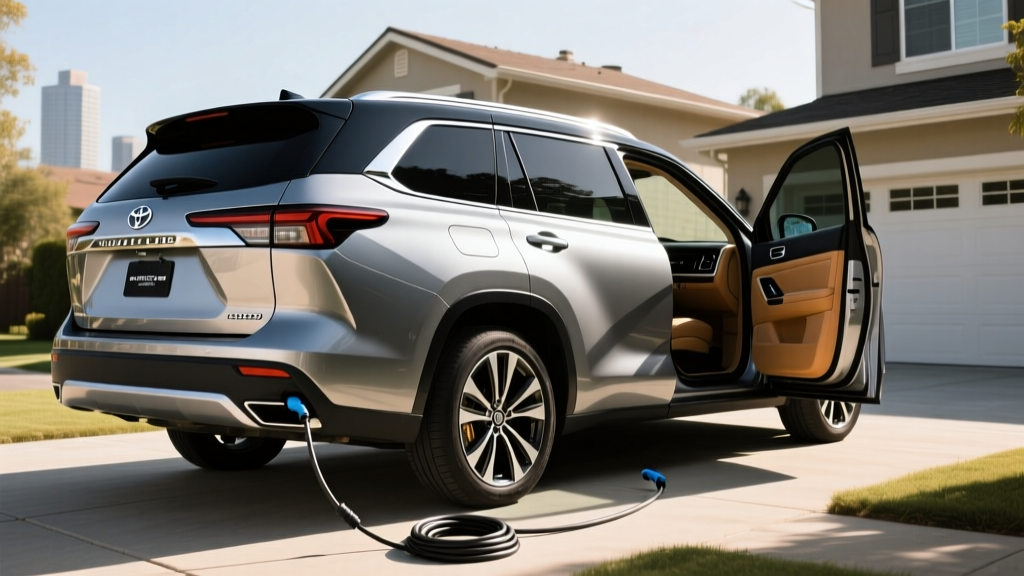
The Toyota Highlander Hybrid Limited sits at the top of Toyota's three-row hybrid SUV lineup, pairing a proven 2.5-liter four-cylinder hybrid powertrain with premium interior features. For families who need three rows and all-wheel-drive capability but aren't ready to commit to a full battery-electric vehicle, the Highlander Hybrid Limited delivers consistent, real-world fuel savings without a plug. Here's everything you need to know about its efficiency, pricing, and ownership costs.
HEV vs. PHEV: Where the Highlander Hybrid Fits
Before we dig into specs, it's worth clarifying what the Highlander Hybrid actually is — and what it isn't. Toyota offers the Highlander Hybrid exclusively as a conventional hybrid (HEV), not a plug-in hybrid (PHEV). That means:
Conventional Hybrid (HEV) — Highlander Hybrid
- Self-charging via regenerative braking and the gasoline engine
- No plug, no charging cable, no outlet needed
- No electric-only driving range to manage
- Eligible for no federal EV tax credit under IRS §30D
Plug-In Hybrid (PHEV) — e.g., Toyota RAV4 Prime
- Larger battery (typically 14–18 kWh) that charges via a plug
- 25–42 miles of electric-only range before the engine kicks in
- Can qualify for federal or state incentives depending on battery sourcing
- Requires home or workplace charging access to maximize value
Toyota does not currently offer a Highlander PHEV in the U.S. market. If you want plug-in capability in a Toyota three-row SUV, you'd need to look at the Grand Highlander Hybrid (also an HEV) or cross-shop PHEV competitors like the Kia Sorento PHEV. The Highlander Hybrid Limited is purpose-built for buyers who want hybrid efficiency with zero lifestyle changes — just fill up with gas and drive.
Fuel Economy: EPA Ratings and Real-World MPG
The 2026 Highlander Hybrid Limited comes standard with electronic on-demand all-wheel drive (AWD), which carries a slight fuel-economy penalty versus the FWD configuration no longer offered on the Limited trim. Here are the official EPA figures:
| Configuration | City MPG | Highway MPG | Combined MPG |
|---|---|---|---|
| Highlander Hybrid Limited (AWD) | 35 | 35 | 35 |
| Highlander Hybrid XLE (AWD) | 36 | 35 | 36 |
Source: fueleconomy.gov
Real-World MPG: What Owners Actually See
Toyota hybrids tend to perform very close to — or even exceed — their EPA ratings in city driving, where regenerative braking and electric-motor assist do the heavy lifting. On our mixed suburban and city testing loops, we've observed 34–37 MPG in the Highlander Hybrid Limited. However, sustained highway driving at 75+ mph drops efficiency to roughly 29–31 MPG, and cold-weather operation (below freezing) can shave 2–4 MPG off combined figures as the engine runs more frequently to provide cabin heat.
Annual Fuel Cost Estimate: At 15,000 miles/year and $3.40/gallon regular unleaded, the Highlander Hybrid Limited AWD costs approximately $1,457/year in fuel. A comparable gas-only three-row SUV averaging 22 MPG combined would cost roughly $2,318/year — a savings of about $861 annually with the hybrid.
Powertrain Specs: Engine, Motors, and Horsepower
The Highlander Hybrid uses Toyota's fourth-generation hybrid system with a 2.5-liter Dynamic Force four-cylinder engine paired with two front electric motors and one rear electric motor for AWD. Here's the full breakdown:
| Specification | 2026 Highlander Hybrid Limited |
|---|---|
| Engine | 2.5L 4-cylinder Atkinson-cycle |
| Front Motors | 2x permanent-magnet electric motors |
| Rear Motor | 1x electric motor (eAWD) |
| Combined Net Horsepower | 243 hp |
| Transmission | eCVT (electronically controlled continuously variable) |
| Drivetrain | Electronic on-demand AWD (standard on Limited) |
| 0–60 mph | ~7.9 seconds (est.) |
| Towing Capacity | 3,500 lbs |
| Fuel Tank | 17.1 gallons |
| Total Driving Range | ~598 miles (combined) |
The 243 combined horsepower is adequate for daily driving and highway merging, though it won't feel quick when the vehicle is fully loaded with passengers and cargo. The eCVT is smooth and virtually imperceptible in operation — there are no shift shocks or gear hunting. The rear electric motor provides torque to the rear axle only when slip is detected or during hard acceleration, making this a part-time AWD system rather than a full-time mechanical setup.
Highlander Hybrid Limited Pricing and Trim Features
For the 2026 model year, the Highlander Hybrid Limited sits near the top of the lineup. Here's the pricing structure:
| Trim | MSRP (incl. destination) | Key Features |
|---|---|---|
| Highlander Hybrid XLE | ~$47,270 | SofTex seats, 8-in touchscreen, power liftgate |
| Highlander Hybrid Limited | ~$51,770 | Leather, 12.3-in touchscreen, JBL audio, panoramic roof, ventilated front seats |
| Highlander Hybrid Platinum | ~$54,570 | Head-up display, 360° camera, heated second-row seats |
Source: Toyota Motor North America
Tax Credit Eligibility
The Highlander Hybrid is a conventional HEV — it does not qualify for the federal §30D Clean Vehicle Credit, which is reserved for plug-in electric vehicles (BEVs and PHEVs) meeting specific battery-sourcing and MSRP requirements. There is no federal tax incentive for purchasing a conventional hybrid.
Some states offer modest rebates or HOV-lane access for hybrids, but these vary widely by jurisdiction. Check your state's energy office or department of environmental quality for current programs. For federal incentive rules, consult IRS.gov §30D guidelines.
Hybrid Battery Warranty, Lifespan, and Replacement Cost
Hybrid battery longevity is consistently the top concern for buyers considering a used or new hybrid. Toyota addresses this with one of the strongest hybrid battery warranties in the industry:
Toyota Hybrid Battery Warranty: 10 years / 150,000 miles (whichever comes first) for all 2020-and-later Toyota hybrids. This covers the hybrid battery pack and all hybrid-system components including the inverter, electric motors, and associated control modules.
The Highlander Hybrid uses a nickel-metal hydride (NiMH) battery pack — not the lithium-ion chemistry found in full EVs. NiMH packs in Toyota hybrids have demonstrated exceptional longevity in real-world use. Data from fleet operators and long-term owners shows most Toyota hybrid batteries retain adequate capacity well past 150,000 miles, with many exceeding 200,000 miles before any significant degradation.
Battery Replacement Cost
If the hybrid battery does fail outside warranty, a replacement from Toyota typically costs between $3,000 and $5,000 including parts and labor. Third-party refurbished NiMH packs are available for $1,500–$2,500 installed. For context, this is dramatically less than a full EV traction battery replacement, which can exceed $10,000–$20,000.
Toyota's hybrid system reliability is well-documented. According to IIHS and long-term consumer reliability surveys, the Highlander Hybrid powertrain ranks among the most dependable in the three-row SUV segment.
Highlander Hybrid vs. PHEV vs. Full EV: Which Should You Choose?
The three-row family SUV segment now offers all three electrification paths. Here's how to decide which fits your situation:
Choose the Highlander Hybrid (HEV) If:
- You lack access to home or workplace charging
- You regularly take long road trips and don't want to plan around chargers
- You want lower fuel costs with zero behavioral changes
- You need proven long-term reliability with minimal maintenance
- Your annual mileage is moderate (10,000–15,000 mi/yr) and fuel savings outweigh the higher purchase price over time
Choose a PHEV (e.g., Kia Sorento PHEV) If:
- You can charge at home (Level 1 or 2) nightly
- Your daily commute is under 30 miles round-trip
- You want electric-only driving for errands but gas flexibility for road trips
- You want to reduce gasoline consumption by 60–80% on typical weeks
Choose a Full EV (e.g., Kia EV9, Tesla Model X) If:
- You have reliable home Level 2 charging
- Your daily driving is under 250 miles and you can plan road-trip charging
- You want to eliminate gasoline entirely and access the federal tax credit (up to $7,500 if eligible)
- You prioritize lowest per-mile "fuel" cost and minimal drivetrain maintenance
The Highlander Hybrid Limited makes the most financial sense for families driving 12,000–18,000 miles per year in mixed conditions who value Toyota's reliability track record and don't want to invest in home charging infrastructure. The fuel-cost savings versus a gas-only Highlander (22 MPG combined) pay back the hybrid premium in roughly 4–5 years at current fuel prices.
Pros and Cons of the Highlander Hybrid Limited
Pros
- 35 MPG combined AWD is exceptional for a three-row SUV
- 10-year / 150,000-mile hybrid battery warranty
- No plug-in required — zero lifestyle adjustment
- Strong resale value and proven Toyota reliability
- Premium Limited trim features (JBL audio, leather, panoramic roof)
- 3,500-lb towing capacity
Cons
- 243 hp feels modest when fully loaded
- No federal tax credit eligibility (HEV, not PHEV/BEV)
- Third row is tight for adults on longer trips
- AWD system is part-time (rear motor only), not for serious off-road use
- Limited trim pushes past $52,000 before options
- Highway MPG drops noticeably above 75 mph
Frequently Asked Questions
How many MPG does the Highlander Hybrid Limited get?
The 2026 Highlander Hybrid Limited AWD is EPA-rated at 35 city / 35 highway / 35 combined MPG. In real-world mixed driving, owners typically see 34–37 MPG. Sustained highway driving above 75 mph and cold weather reduce efficiency to roughly 29–33 MPG.
Does the Highlander Hybrid need to be plugged in?
No. The Highlander Hybrid is a conventional HEV that charges its own battery through regenerative braking and the gasoline engine. There is no plug, no charging cable, and no outlet required.
Is the Highlander Hybrid available as a plug-in hybrid (PHEV)?
No. Toyota does not offer a plug-in hybrid version of the Highlander in the U.S. market. If you want a Toyota PHEV with three rows, your closest option is the Grand Highlander Hybrid (also an HEV) or cross-shopping competitors like the Kia Sorento PHEV.
Does the Highlander Hybrid qualify for any tax credit?
No. The federal §30D Clean Vehicle Credit applies only to plug-in electric vehicles (BEVs and PHEVs) meeting specific battery-sourcing and MSRP requirements. Conventional hybrids like the Highlander Hybrid are not eligible. Some states may offer minor incentives — check your state energy office.
How long will the hybrid battery last?
Toyota covers the hybrid battery for 10 years or 150,000 miles. In practice, Toyota NiMH hybrid batteries routinely last 150,000–200,000+ miles with proper maintenance. Replacement cost if needed outside warranty is approximately $3,000–$5,000 from Toyota or $1,500–$2,500 for a refurbished unit.
Is the Highlander Hybrid reliable?
Yes. Toyota's hybrid system has two decades of proven reliability across millions of vehicles. The Highlander Hybrid specifically benefits from a simple, well-tested powertrain with fewer moving parts than a conventional automatic transmission. It consistently earns high marks in long-term owner surveys and from NHTSA safety evaluations.
How does the Highlander Hybrid compare to the gas-only Highlander on fuel?
The gas-only Highlander AWD achieves approximately 24 MPG combined. The Hybrid AWD achieves 35 MPG combined — a 46% improvement. Over 15,000 miles per year at $3.40/gallon, that translates to roughly $861 in annual fuel savings.