The 2026 Toyota Camry Hybrid: An Efficiency Benchmark
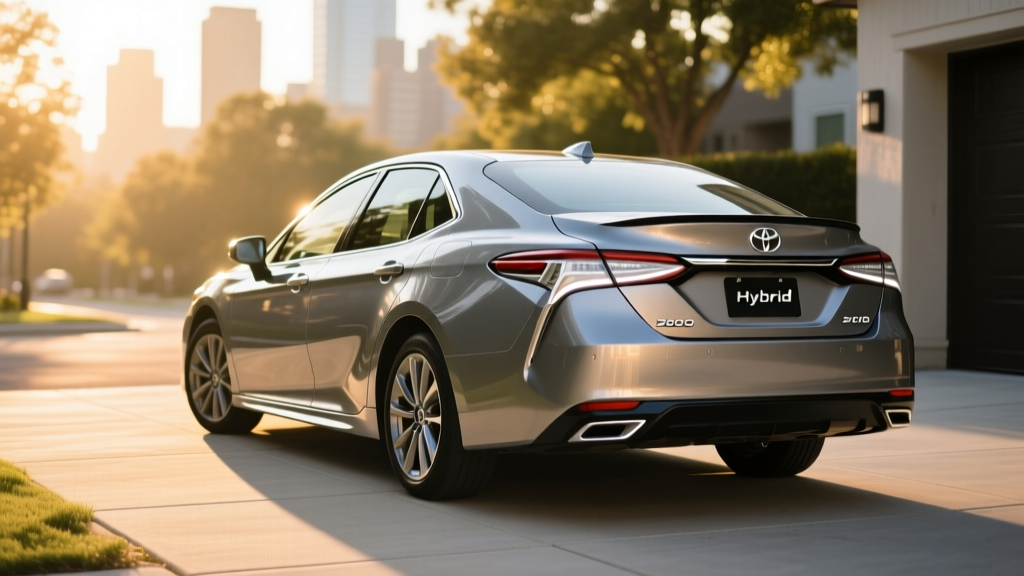
The Toyota Camry has been America's best-selling midsize sedan for years, and the current ninth-generation model — introduced for 2025 and carried into 2026 — is now exclusively hybrid. Toyota dropped the four-cylinder gas-only Camry entirely, meaning every 2026 Camry rolls off the line with the fifth-generation Toyota Hybrid System (THS). The result is a midsize sedan that delivers up to 51 MPG combined, standard front-wheel or available all-wheel drive, and zero plug-in requirement.
If you've searched for "Toyota Camry hybrid" and found yourself sorting through trims, MPG numbers, and wondering whether a hybrid is enough — or whether you should look at a plug-in hybrid or full EV instead — this guide covers every number that matters.
HEV vs PHEV: Why the Camry Hybrid Is a Conventional Hybrid
Before diving into specs, it's essential to understand what the 2026 Camry Hybrid is — and what it isn't.
| Feature | Conventional Hybrid (HEV) | Plug-In Hybrid (PHEV) |
|---|---|---|
| Plug-in charging required? | No — charges via regenerative braking and the gas engine | Yes — plug in to access electric-only range |
| Electric-only range | Very short (under 1 mile at low speed) | Typically 20–45 miles on battery alone |
| Battery size | Small (1.0–1.6 kWh) | Larger (13–20+ kWh) |
| Federal tax credit (§30D) | Not eligible | May qualify — up to $7,500 depending on sourcing, income, MSRP caps |
| Example | 2026 Toyota Camry Hybrid | Toyota RAV4 Prime, Chrysler Pacifica PHEV |
The 2026 Camry Hybrid is a conventional HEV. You never plug it in. Its small lithium-ion traction battery charges through regenerative braking and the gasoline engine. This makes it ideal for buyers who want hybrid efficiency without installing a home charger or relying on public charging infrastructure.
Toyota does not currently offer a Camry Plug-In Hybrid in the United States. If you need electric-only commuting range, you'll need to look at competitors like the Hyundai Sonata PHEV or consider a full BEV.
Fuel Economy: EPA MPG and Real-World Numbers
Every 2026 Camry Hybrid uses a 2.5-liter four-cylinder engine paired with Toyota's fifth-generation hybrid transaxle. Front-wheel-drive models pair the engine with a single front motor; all-wheel-drive models add a second, independent rear motor. The powertrain is shared across all trims, but wheel size and drivetrain affect EPA ratings.
| Trim / Drivetrain | City MPG | Highway MPG | Combined MPG |
|---|---|---|---|
| LE FWD | 53 | 50 | 51 |
| SE FWD | 48 | 47 | 47 |
| XLE FWD | 48 | 47 | 47 |
| SE AWD | 46 | 46 | 46 |
| XLE AWD | 46 | 46 | 46 |
Source: EPA Fuel Economy
Real-World MPG vs. EPA Sticker
Toyota hybrids historically exceed their EPA city estimates in stop-and-go driving because regenerative braking recovers energy that gas cars waste as heat. In real-world city testing, owners commonly report 52–56 MPG in the LE FWD trim during warm-weather commuting.
Highway driving tells a different story. At sustained 75+ mph speeds, the gas engine carries more of the load, and real-world highway fuel economy often drops to 43–46 MPG for FWD trims. Cold weather (below 35°F) further reduces efficiency by 5–10%, as the engine runs more frequently to provide cabin heat and maintain battery temperature.
For a realistic annual estimate: expect approximately 48–50 MPG combined in mixed driving with the LE FWD, and 43–45 MPG combined with AWD trims.
Powertrain Specs: Horsepower, Motors, and Drivetrain
| Specification | 2026 Camry Hybrid |
|---|---|
| Engine | 2.5L DOHC 4-cylinder (A25A-FXS) |
| Combined net horsepower | 225 hp (FWD) / 232 hp (AWD) |
| Front electric motor | 100 kW (134 hp) |
| Rear electric motor (AWD only) | 30 kW (40 hp) |
| Transmission | eCVT (planetary gearset) |
| 0–60 mph (est.) | ~7.1 seconds (FWD) |
| Drivetrain | FWD standard; electronic AWD available |
| Fuel tank | 13.2 gallons |
| Total driving range (est.) | ~620–670 miles (LE FWD) |
The AWD system is not a mechanical driveshaft setup. Instead, the rear motor engages independently when the system detects front-wheel slip — during acceleration, wet roads, or light snow. It operates up to approximately 43 mph in most conditions and can send up to 50% of torque rearward. This adds genuine all-weather capability with only a 1 MPG combined penalty versus the SE/XLE FWD trims.
Hybrid Battery: Size, Warranty, and Replacement Cost
2026 Camry Hybrid Battery Warranty: 10 years / 150,000 miles (whichever comes first) for the hybrid battery pack and hybrid system components, valid in all 50 states.
The 2026 Camry Hybrid uses a lithium-ion traction battery pack rated at approximately 1.6 kWh (gross). This is a small, purpose-built pack designed for frequent shallow charge/discharge cycles rather than deep cycling. It is fundamentally different from the large 60–100 kWh packs in battery-electric vehicles.
Battery Longevity and Degradation
Toyota's hybrid battery management system is deliberately conservative. It never allows the battery to fully charge or fully deplete — operating in a narrow state-of-charge window (roughly 40–80% SoC) to minimize stress. This is why Toyota hybrid batteries routinely last 150,000–200,000+ miles before significant degradation.
Real-world data from iFixit teardowns, fleet operators, and owner forums shows that 10-year-old Toyota hybrid packs (from the Prius and earlier Camry Hybrid generations) often retain 70–80% of original capacity. Because the pack is small and the hybrid system compensates by running the gas engine slightly more, you may not notice meaningful fuel-economy decline even with moderate degradation.
Battery Replacement Cost
If a hybrid battery fails outside warranty, replacement costs for the Camry Hybrid typically range from $2,000 to $4,000 for a new OEM pack installed at a Toyota dealer. Refurbished or aftermarket packs can reduce this to $1,200–$2,500. Individual module replacement (rather than the full pack) is sometimes possible for $500–$1,500, depending on the failure mode.
For context, Toyota's 10-year/150,000-mile warranty means most original owners will never pay for a hybrid battery replacement. Even second and third owners benefit, as the warranty transfers to subsequent owners.
Pricing, Trims, and Tax Credit Eligibility
| Trim | Drivetrain | MSRP (2026) | |
|---|---|---|---|
| LE | FWD | $29,495 | |
| SE | FWD | $31,095 | |
| SE | SE | AWD | $32,495 |
| XLE | FWD | $33,895 | |
| XLE | AWD | $35,295 |
Prices include destination charge. Source: Toyota.com
Does the Camry Hybrid Qualify for a Federal Tax Credit?
No. The 2026 Toyota Camry Hybrid is a conventional hybrid (HEV), not a plug-in vehicle. The federal §30D Clean Vehicle Credit — which provides up to $7,500 — applies only to battery-electric vehicles (BEVs) and plug-in hybrids (PHEVs) that meet battery sourcing, critical mineral, MSRP cap, and buyer income requirements as outlined by the IRS.
Conventional hybrids like the Camry Hybrid are not eligible for §30D. Some states may offer modest rebates or HOV lane access for hybrid vehicles — check your state's energy or DMV website for current programs. However, the Camry Hybrid's low purchase price and strong fuel economy mean its total cost of ownership is competitive even without incentives.
Who Should Buy the Camry Hybrid — and Who Shouldn't
Reasons to Choose It
- Best-in-class midsize sedan fuel economy (51 MPG combined, LE)
- No plug-in charging required — works with any lifestyle
- 620+ mile total range per tank; excellent for road trips
- Strong 10-year/150,000-mile hybrid battery warranty
- Available AWD without a significant MPG penalty
- Competitive starting price under $30,000
- Proven long-term reliability and high resale value
Reasons to Look Elsewhere
- No electric-only driving range — always uses some gasoline
- No plug-in variant available; no federal tax credit eligibility
- Modest 225 hp won't satisfy performance-oriented buyers
- Infotainment system lags behind Hyundai/Kia competitors
- No DC fast charging capability (not applicable to HEVs)
Camry Hybrid vs. PHEV vs. Full EV: Decision Framework
Choose the Camry Hybrid (HEV) if: You don't have access to home or workplace charging, you want maximum simplicity, you drive a mix of city and highway miles, and you want a proven, low-risk powertrain with no plug-in requirement.
Choose a Plug-In Hybrid (e.g., Toyota Prius Prime, Hyundai Tucson PHEV) if: You can install a Level 2 home charger, your daily commute is under 30–40 miles (within electric-only range), and you want the option of zero-emission daily driving with a gas engine for longer trips. PHEVs may qualify for the $7,500 federal credit.
Choose a Full EV (e.g., Tesla Model 3, Hyundai Ioniq 6) if: You have reliable home charging, want zero tailpipe emissions, prefer instant torque and one-pedal driving, and your typical trips fall within 250–350 miles of range. BEVs qualify for the full federal credit and have the lowest per-mile fuel cost.
Ownership Costs: Fuel Savings vs. a Gas-Only Midsize Sedan
With the Camry Hybrid LE rated at 51 MPG combined and regular unleaded fuel, annual fuel cost is remarkably low. Here's a comparison using 15,000 miles/year and $3.40/gallon (national average as of early 2026):
| Vehicle | Combined MPG | Annual Fuel Cost | 5-Year Fuel Cost |
|---|---|---|---|
| 2026 Camry Hybrid LE | 51 | $1,000 | $5,000 |
| 2026 Honda Accord (1.5T) | 33 | $1,545 | $7,727 |
| 2026 Nissan Altima (2.5L) | 32 | $1,594 | $7,969 |
The Camry Hybrid saves approximately $2,500–$3,000 in fuel costs over five years versus comparable gas-only midsize sedans. That nearly closes the gap with the price premium of the hybrid powertrain — and the Camry no longer has a gas-only variant to compare against within its own lineup.
Frequently Asked Questions
How many MPG does the 2026 Toyota Camry Hybrid get?
The most efficient trim, the LE FWD, earns an EPA-estimated 53 city / 50 highway / 51 combined MPG. Sportier SE and XLE trims drop to 47–48 combined (FWD) or 46 combined (AWD) due to larger wheels and additional equipment. Real-world city driving often exceeds EPA estimates; highway driving at 75+ mph typically returns 43–46 MPG.
Can the Camry Hybrid drive on electric power only?
Only at very low speeds (under ~25 mph) for short distances — typically under one mile. The hybrid system uses the electric motor for launch assist and low-speed maneuvering, but the gas engine engages quickly. This is fundamentally different from a PHEV, which can travel 25–40 miles on battery alone.
Is the Toyota Camry Hybrid reliable?
Toyota's hybrid powertrain has an extensive reliability track record spanning over 25 years since the original Prius. The eCVT transmission has no traditional gears or bands to wear — it uses a planetary gearset that is mechanically simple and durable. The 2026 Camry Hybrid carries a 10-year/150,000-mile hybrid system warranty. Toyota consistently ranks at or near the top of J.D. Power and Consumer Reports reliability surveys.
What does a Camry Hybrid battery replacement cost?
Out-of-warranty replacement runs $2,000–$4,000 for a new OEM pack at a dealer, or $1,200–$2,500 for refurbished/aftermarket options. However, Toyota's 10-year/150,000-mile warranty covers most owners, and real-world data shows these packs commonly last 150,000–200,000+ miles with gradual, manageable degradation.
Does the 2026 Camry Hybrid qualify for any tax credits?
No. As a conventional hybrid (HEV), the Camry Hybrid does not qualify for the federal §30D Clean Vehicle Credit, which is reserved for plug-in electric vehicles (BEVs and PHEVs). Some states may offer minor hybrid incentives or HOV lane access — consult your state energy office. The Camry Hybrid's low MSRP and strong fuel economy deliver competitive ownership costs without incentives.
Is the Camry Hybrid available with all-wheel drive?
Yes. Electronic AWD is available on SE and XLE trims. A separate rear electric motor (30 kW / 40 hp) engages automatically when front-wheel slip is detected, providing traction in rain and light snow. AWD costs 1 MPG combined versus equivalent FWD trims and adds approximately $1,400 to the MSRP.
How does the Camry Hybrid compare to the Prius?
The 2026 Prius (LE) achieves up to 57 MPG combined and starts around $28,500 — slightly more efficient and less expensive. However, the Camry Hybrid offers a larger interior, more rear-seat legroom, a bigger trunk (15.1 vs. ~13.7 cu ft), and a more refined ride. If passenger and cargo space matter, the Camry Hybrid is the stronger choice. If absolute maximum MPG is the priority, the Prius wins.