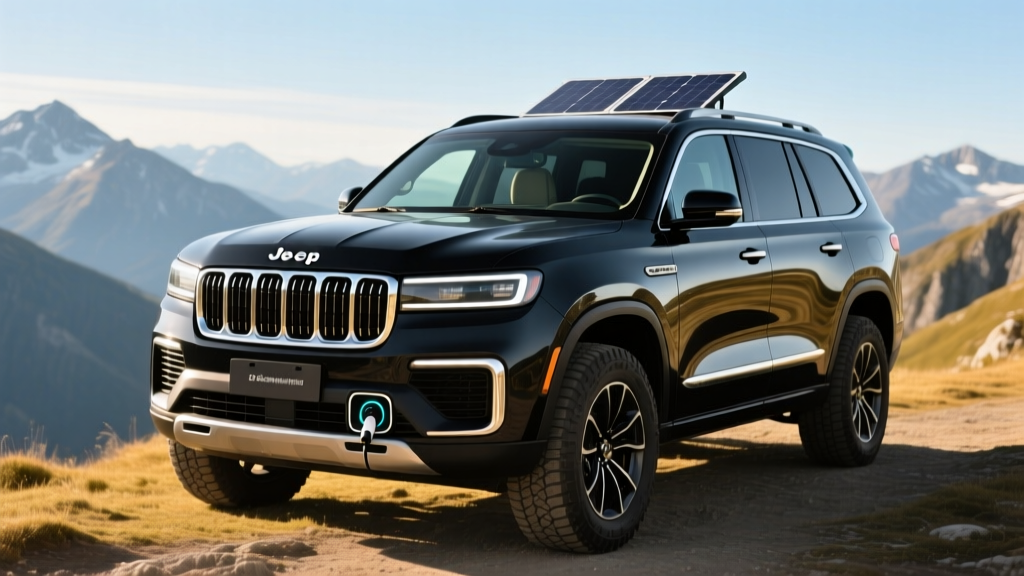
The full-size luxury SUV segment has been slow to embrace electrification, but the Grand Wagoneer hybrid — officially the Grand Wagoneer 4xe — represents Stellantis's most ambitious push into plug-in territory for its flagship three-row hauler. Borrowing the turbocharged inline-six and dual-motor architecture first proven in the Jeep Wrangler 4xe and Grand Cherokee 4xe, this PHEV aims to deliver silent electric school runs without sacrificing the 6,000+ pound towing capacity buyers expect from a body-on-frame luxury rig.
But does a plug-in hybrid make sense in a vehicle this large? And how do the real-world numbers stack up against the EPA sticker? We've analyzed the 2026 Grand Wagoneer 4xe specs, charging behavior, ownership economics, and tax-credit eligibility so you can decide whether to plug in or stick with the standard Hurricane inline-six.
Grand Wagoneer 4xe Powertrain: What's Under the Hood
The 2026 Grand Wagoneer 4xe pairs Stellantis's 3.0-liter Hurricane twin-turbocharged inline-six with an electric motor integrated into the eight-speed automatic transmission and a second motor on the front axle. Combined system output reaches an estimated 490 horsepower and 610 lb-ft of torque — figures that put it squarely in competition with the Range Rover PHEV and ahead of the standard Hurricane High Output's 510 hp in peak but with far superior low-end electric thrust.
The high-voltage battery is a 17.3 kWh (usable) lithium-ion NMC pack mounted beneath the rear cargo floor. This is the same chemistry and general architecture used across the Stellantis 4xe lineup, scaled for the Grand Wagoneer's greater mass. The pack drives an EPA-estimated 30 miles of electric-only range, which covers the typical American daily commute of roughly 28 miles round-trip according to FHWA data.
| Specification | Value |
|---|---|
| Engine | 3.0L Hurricane Twin-Turbo I-6 |
| Electric Motors | Dual (transmission-integrated + front axle) |
| Combined Horsepower | 490 hp (est.) |
| Combined Torque | 610 lb-ft (est.) |
| Battery (Usable) | 17.3 kWh NMC lithium-ion |
| Electric-Only Range (EPA) | 30 miles |
| Total Combined Range | ~430 miles |
| Transmission | 8-speed automatic |
| Drivetrain | 4WD with electric front axle |
EPA MPG and MPGe: The Numbers That Matter
The Grand Wagoneer 4xe carries two fuel-economy ratings depending on how you use it. When operating as a pure electric vehicle within its battery range, the EPA rates it at approximately 56 MPGe combined. Once the battery depletes and the Hurricane engine takes over, it functions as a conventional hybrid, returning an estimated 23 MPG combined.
| Mode | City | Highway | Combined |
|---|---|---|---|
| Electric (MPGe) | 58 MPGe | 54 MPGe | 56 MPGe |
| Hybrid/Charge-Sustaining (MPG) | 22 MPG | 24 MPG | 23 MPG |
For comparison, the non-hybrid Grand Wagoneer with the standard Hurricane I-6 returns 14 city / 19 highway / 16 combined — a substantial gap. Plug in nightly and most owners will burn fuel only on road trips.
Charging the Grand Wagoneer 4xe: Speeds and Practicality
The 4xe's 17.3 kWh battery charges via a standard J1772 AC port. There is no DC fast-charging capability — a deliberate engineering choice shared with all current Stellantis 4xe models. The onboard charger accepts up to 7.2 kW on Level 2, which replenishes the pack from empty to full in approximately 2.5 hours. On a standard 120V household outlet (Level 1, ~1.4 kW), a full charge takes roughly 12 hours.
| Level | Power | Time (0–100%) | Connector |
|---|---|---|---|
| Level 1 (120V) | ~1.4 kW | ~12 hours | J1772 / NACS adapter |
| Level 2 (240V) | 7.2 kW | ~2.5 hours | J1772 / NACS adapter |
| DC Fast Charge | Not supported | N/A | N/A |
For most PHEV owners, Level 2 home charging is the sweet spot. Plug in when you arrive home, and the battery is full by morning — no mid-day charging stops required. A Level 2 home charger installation typically costs $800–$2,000 depending on panel capacity and run length, according to U.S. Department of Energy guidance.
HEV vs PHEV vs Full EV: Which Powertrain Fits You?
The Grand Wagoneer 4xe is a plug-in hybrid (PHEV), meaning it has both a chargeable battery for electric-only driving and a gasoline engine for extended range. It is not a conventional hybrid (HEV) like the Toyota Highlander Hybrid, which recharges its small battery solely through regenerative braking and engine power and cannot be plugged in. Nor is it a battery-electric vehicle (BEV) like the Rivian R1S or Cadillac Escalade IQ.
- You can charge at home nightly
- Daily driving is under 30 miles
- You need 6,000+ lb towing on road trips
- You want electric commuting without range anxiety
- You cannot install a home charger
- You want zero behavior change vs. gas
- Mostly highway and long-distance driving
- Lower upfront cost matters
- You drive under 300 miles daily
- Home + workplace charging available
- You want zero tailpipe emissions
- Lower per-mile energy cost is priority
The PHEV occupies a specific niche: drivers who want electric silence and efficiency for daily errands but refuse to sacrifice the go-anywhere, tow-anything flexibility of a gasoline powertrain. If you live in a condo without charging access, a conventional hybrid or the standard Hurricane Grand Wagoneer may serve you better. If your commute is short and predictable, a BEV saves more long-term — but no current BEV three-row SUV matches the Grand Wagoneer's interior volume and towing capacity.
Pricing, Trims, and Tax Credit Eligibility
The 2026 Grand Wagoneer 4xe starts at an estimated $92,995 MSRP for the base Series II 4xe, with the top Series III Obsidian 4xe reaching approximately $114,995. These prices reflect the premium for the dual-motor PHEV system over the standard Hurricane powertrain.
| Trim | MSRP (Est.) |
|---|---|
| Series II 4xe | $92,995 |
| Series III 4xe | $104,995 |
| Series III Obsidian 4xe | $114,995 |
The Grand Wagoneer 4xe may qualify for up to $7,500 in federal tax credits under IRS §30D, but eligibility depends on several factors that change frequently:
- MSRP cap: SUVs must be under $80,000 — the Grand Wagoneer 4xe exceeds this threshold on all trims, likely disqualifying it from the new-vehicle credit.
- Buyer income limits: AGI must not exceed $300,000 (joint) / $225,000 (head of household) / $150,000 (individual).
- Battery sourcing: Critical minerals and battery components must meet escalating domestic-content thresholds per the Inflation Reduction Act.
Because all Grand Wagoneer 4xe trims are priced above the $80,000 SUV MSRP cap, buyers should not expect the federal credit. However, some states offer additional PHEV incentives (California's CVRP, Colorado's innovative motor vehicle credit) that may apply. Always verify current eligibility at IRS.gov and consult a tax professional before purchase.
Battery Warranty, Degradation, and Replacement Costs
Stellantis backs the Grand Wagoneer 4xe's high-voltage battery with a 10-year / 150,000-mile warranty (8 years / 100,000 miles in states that don't follow California emissions standards), covering defects and capacity loss below 70% of original capacity. This is consistent with the best hybrid battery warranties in the industry and matches coverage from Toyota, Hyundai, and BMW.
The 17.3 kWh NMC pack in the 4xe system has been in production across Stellantis models since 2021. Real-world data from Wrangler and Grand Cherokee 4xe owners shows minimal degradation — typically 5-8% capacity loss over 100,000 miles. Because PHEV batteries are smaller and cycled less deeply than BEV packs, they tend to age more slowly.
If out-of-warranty replacement is ever needed, expect a cost between $5,500 and $8,000 including labor, based on current Stellantis 4xe battery pricing. This is significantly less than a full BEV battery replacement.
The conventional 12V auxiliary battery is separate and follows standard automotive replacement cycles (3-5 years, ~$200-$350). The hybrid system's regenerative braking also extends brake pad life considerably — many 4xe owners report original pads at 80,000+ miles.
Reliability and Ownership Considerations
The Grand Wagoneer nameplate carries Jeep/Stellantis reliability baggage. The brand ranks below average in J.D. Power and Consumer Reports reliability surveys, though the Hurricane inline-six and ZF 8-speed transmission are well-proven across the Ram, Jeep, and Dodge lineups. The 4xe electric components have shown strong durability in the Wrangler and Grand Cherokee applications, with no widespread battery or motor failure campaigns.
Ownership costs to budget for:
- Insurance: Expect 15-25% higher premiums vs. the gas Grand Wagoneer due to the PHEV system's repair complexity and the vehicle's high MSRP.
- Maintenance: Similar to the gas model for suspension, brakes, and interior, but with added cooling-system checks for the HV battery. Stellantis recommends annual PHEV system inspections.
- Fuel savings: At 30 miles of daily electric driving and $0.14/kWh national average electricity cost, a PHEV owner driving 15,000 miles/year could save approximately $1,800-$2,400 annually vs. the gas-only Grand Wagoneer (at $3.50/gallon).
- Depreciation: Luxury SUVs depreciate steeply. The PHEV variant may hold value slightly better than the gas model as fuel-economy standards tighten, but historical luxury-SUV depreciation curves suggest 45-55% loss over five years.
Pros
- 30 miles electric covers most daily driving
- 490 hp with instant electric torque
- 44% better MPG than gas model when charged
- No range anxiety — gas engine for road trips
- 10-year/150,000-mile battery warranty
- Quiet, smooth electric mode in traffic
Cons
- No DC fast charging — Level 2 only
- Exceeds $80K MSRP cap — no federal tax credit
- Heavy vehicle — efficiency drops on long highway trips
- Stellantis reliability track record is below average
- Premium pricing: $93K+ starting MSRP
- Cold weather cuts EV range by 20-30%
Who Should Buy the Grand Wagoneer 4xe?
The Grand Wagoneer 4xe serves a narrow but real buyer profile: the luxury three-row SUV shopper who has home charging, commutes under 30 miles, tows a boat or trailer on weekends, and wants to reduce (but not eliminate) gasoline consumption. It is not the most efficient PHEV on the market — a Toyota RAV4 Prime or Grand Cherokee 4xe delivers better MPGe in lighter vehicles — but it is one of very few plug-in options in the full-size luxury segment.
If you cannot charge at home, the 4xe's benefits evaporate and you'd be better served by a conventional hybrid competitor or the standard Hurricane Grand Wagoneer. If you're ready to go fully electric and don't need 6,000+ lb towing, the Cadillac Escalade IQ or upcoming electric alternatives may be worth waiting for. But for the buyer who wants the Grand Wagoneer's commanding presence, McIntosh audio, and 75 inches of screen real estate — with an electric conscience for the school run — the 4xe is the only powertrain that delivers both worlds.
Frequently Asked Questions
How many MPG does the Grand Wagoneer hybrid get?
The 2026 Grand Wagoneer 4xe returns an EPA-estimated 56 MPGe combined in electric mode and 23 MPG combined (22 city / 24 highway) in charge-sustaining hybrid mode. Real-world highway MPG at 75+ mph typically drops to 20-21 MPG once the battery is depleted.
How far can the Grand Wagoneer 4xe go on electric only?
The EPA rates it at 30 miles of electric-only range. Real-world results vary: expect 24-28 miles in warm weather city driving and 21-24 miles in cold weather (below 30°F) or at sustained highway speeds.
Does the Grand Wagoneer hybrid qualify for a tax credit?
Under current 2026 IRS §30D rules, the Grand Wagoneer 4xe likely does not qualify for the $7,500 federal new-vehicle credit because all trims exceed the $80,000 MSRP cap for SUVs. State incentives may still apply. Verify at IRS.gov before purchasing.
Is the Grand Wagoneer 4xe reliable?
The Hurricane inline-six and ZF 8-speed are proven across the Stellantis lineup, and the 4xe electric system has been in production since 2021 with few widespread failures. However, Stellantis as a brand ranks below average in major reliability surveys. The 10-year/150,000-mile battery warranty provides strong protection against the most expensive potential repair.
What does a Grand Wagoneer 4xe battery replacement cost?
Out-of-warranty replacement of the 17.3 kWh high-voltage battery is estimated at $5,500–$8,000 including labor. However, real-world data from Stellantis 4xe vehicles shows minimal degradation (5-8% over 100,000 miles), and the battery is warranted for 10 years or 150,000 miles against capacity loss below 70%.
Can the Grand Wagoneer 4xe DC fast charge?
No. Like all current Stellantis 4xe models, the Grand Wagoneer 4xe supports only AC charging — up to 7.2 kW on Level 2 (about 2.5 hours for a full charge) or 1.4 kW on a standard 120V outlet. DC fast charging is not available.
Hybrid vs PHEV vs EV — which should I choose?
Choose the PHEV (4xe) if you have home charging and want electric commuting plus gas-engine flexibility for towing and road trips. Choose a conventional hybrid if you can't plug in at home but still want better fuel economy. Choose a full EV if your daily driving stays under 300 miles, you have reliable charging access, and you want the lowest per-mile energy cost and zero tailpipe emissions.