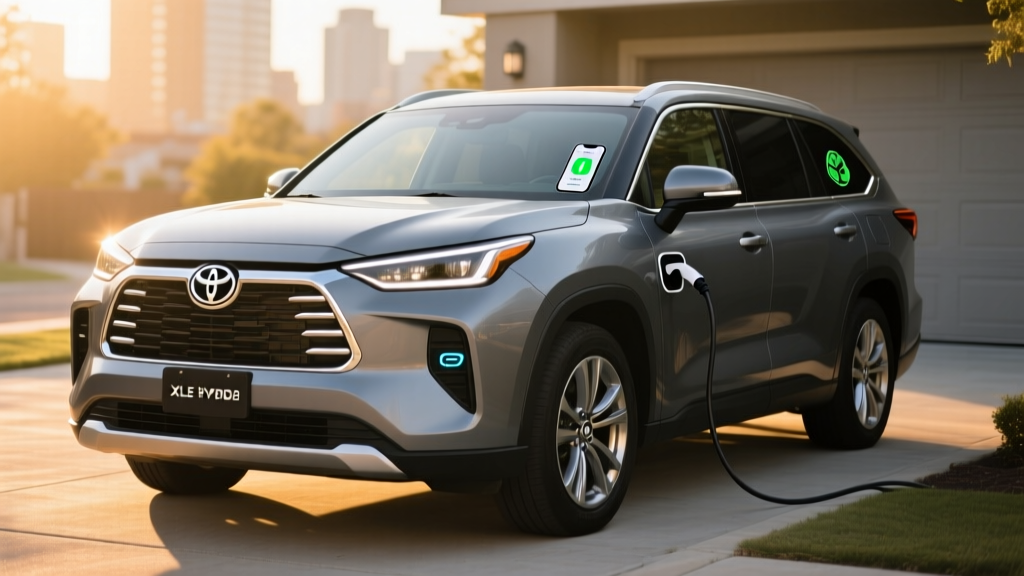
The 2026 Toyota Grand Highlander XLE Hybrid occupies a rare sweet spot in the three-row SUV market: it delivers genuine hybrid efficiency without requiring a plug, a change in driving habits, or a price premium that breaks the family budget. If you've been searching for a grand highlander xle hybrid to understand whether it's the right electrified family hauler for your household, this guide breaks down every critical number — from EPA fuel economy to battery warranty coverage — so you can make a data-driven decision.
Quick Verdict: Who the Grand Highlander XLE Hybrid Is For
The XLE Hybrid trim sits in the middle of the Grand Highlander Hybrid lineup, balancing premium features with a sub-$47,000 starting price. It's engineered for families who want three-row seating, all-wheel-drive confidence, and fuel costs that rival a compact sedan — all without ever plugging in. This is a conventional hybrid (HEV), not a plug-in hybrid (PHEV). You fuel it with gasoline and the hybrid system handles the rest.
Choose the Grand Highlander XLE Hybrid if: You drive 15,000+ miles per year, want AWD standard, need three rows, and have no reliable home charging access for a PHEV or EV.
Consider a PHEV or full EV instead if: You have Level 2 home charging, your daily commute is under 30 miles, and you want to drive primarily on electricity.
HEV vs PHEV vs EV: Where This Hybrid Fits
Before examining the numbers, it's essential to distinguish the three electrified powertrain types available in today's SUV market. The Grand Highlander Hybrid is an HEV — Toyota's fourth-generation hybrid system that captures energy from braking and the gasoline engine to charge a small battery, which then assists the engine during acceleration and low-speed driving.
| Feature | HEV (Grand Highlander Hybrid) | PHEV (e.g., RAV4 Prime-style) | Full EV (BEV) |
|---|---|---|---|
| Plug-in required? | No | Yes | Yes |
| Electric-only range | ~1 mile at low speed | 30–45 miles typical | 250–400 miles |
| Fuel/energy source | Gasoline only | Gasoline + grid electricity | Grid electricity only |
| Home charging needed? | No | Recommended (Level 2) | Essential |
| Federal tax credit (§30D) | Not eligible | Up to $7,500 (if eligible) | Up to $7,500 (if eligible) |
| Best for | High-mileage drivers, no plug access | Short commutes + road trips | Home charging + lower running costs |
The Grand Highlander does not currently offer a PHEV variant in the U.S. market. Toyota's plug-in hybrid technology (branded "Prime") is available on the RAV4 and Prius, but as of the 2026 model year, the Grand Highlander is offered exclusively as a conventional HEV or as the higher-output Hybrid MAX powertrain.
Fuel Economy: EPA Ratings and Real-World MPG
The headline number for the Grand Highlander Hybrid with standard all-wheel drive is an EPA-estimated 34 MPG combined. Here's the full breakdown per fueleconomy.gov:
| Driving Condition | EPA Estimate | Real-World Expectation |
|---|---|---|
| City | 34 MPG | 35–38 MPG (hybrids excel in stop-and-go) |
| Highway | 34 MPG | 30–33 MPG (aerodynamic drag reduces hybrid advantage) |
| Combined | 34 MPG | 32–36 MPG depending on driving mix |
Why real-world city MPG often exceeds the EPA sticker: Toyota's hybrid system relies heavily on the electric motor at low speeds and during stop-and-go traffic, where regenerative braking continuously recaptures energy. Owners who do the majority of their driving in urban and suburban environments frequently report 36–38 MPG on the trip computer. Conversely, sustained 75+ MPH highway driving, mountain grades, and cold-weather operation can pull combined figures down to the low 30s.
For context, the non-hybrid Grand Highlander with the turbocharged 2.4L engine and AWD returns an EPA-estimated 24 MPG combined — a 10 MPG gap that translates to roughly $400–$500 in annual fuel savings for a driver covering 15,000 miles per year at $3.40/gallon.
Powertrain Specs: 245 Horsepower and Standard AWD
| Specification | 2026 Grand Highlander XLE Hybrid AWD |
|---|---|
| Powertrain | 2.5L 4-cylinder + 3 electric motors (Toyota Hybrid System) |
| Combined horsepower | 245 hp |
| Transmission | eCVT (electronically controlled continuously variable) |
| Drivetrain | Electronic AWD (rear electric motor) |
| 0–60 mph | ~7.8 seconds |
| Towing capacity | 3,500 lbs |
| Seating | 7 passengers (XLE) or 8 (with second-row bench option) |
| Cargo volume (behind 3rd row) | 20.6 cu ft |
| Cargo volume (max, all rows folded) | 97.5 cu ft |
The XLE Hybrid pairs a 2.5-liter Atkinson-cycle four-cylinder engine with three electric motors — two integrated into the front transaxle and one powering the rear axle for electronic all-wheel drive. The system's combined output of 245 horsepower provides confident highway merging and adequate passing power, though it's not a performance-oriented powertrain. Drivers accustomed to the Hybrid MAX's 362 hp will notice the difference, but for daily commuting and family hauling, the standard hybrid's smoothness and efficiency are the primary virtues.
The eCVT transmission operates without traditional gear shifts, delivering seamless acceleration. This design is inherently reliable — there are no clutch packs, bands, or torque converters to wear — but it does produce a characteristic engine drone under heavy acceleration that some drivers find unrefined.
Pricing, Trim Value, and Tax Credit Eligibility
The 2026 Toyota Grand Highlander XLE Hybrid AWD carries a starting MSRP of approximately $46,770 (including destination). Key standard equipment at this trim level includes:
- SofaTex-trimmed heated front seats
- 12.3-inch Toyota Audio Multimedia touchscreen
- Wireless Apple CarPlay and Android Auto
- Toyota Safety Sense 3.0 (adaptive cruise, lane-keeping, automatic emergency braking)
- Power liftgate
- 7 USB-C ports across all three rows
- Tri-zone automatic climate control
Federal Tax Credit Status: NOT ELIGIBLE
- The IRS §30D Clean Vehicle Credit applies only to plug-in electric vehicles (PHEVs and BEVs) with a minimum battery capacity of 7 kWh.
- Conventional hybrids (HEVs) like the Grand Highlander Hybrid do not qualify for the federal $7,500 credit.
- Some states offer modest rebates for HEVs (typically $250–$1,000), but these vary by jurisdiction and change frequently. Check your state's energy office or AFDC state incentive database for current programs.
- The fuel savings alone — approximately $400–$500/year vs. the gas-only Grand Highlander — offset the lack of a federal credit over a typical ownership period.
Hybrid Battery Warranty, Longevity, and Replacement Cost
Toyota Hybrid Battery Warranty: 10 years / 150,000 miles (whichever comes first) in all 50 states. This covers the hybrid battery pack against defects and capacity loss below a defined threshold.
Hybrid System Components Warranty: 8 years / 100,000 miles for the inverter, transaxle, and related control modules.
The Grand Highlander Hybrid uses a nickel-metal hydride (NiMH) battery pack — a chemistry Toyota has deployed across millions of hybrids over two decades. Unlike the lithium-ion packs in full EVs, NiMH hybrid batteries are small (roughly 1.6 kWh), experience shallow charge/discharge cycles, and are managed conservatively by the vehicle's computer. This design philosophy is a key reason Toyota hybrid batteries routinely exceed 200,000 miles without replacement.
Battery replacement cost (out of warranty): A replacement hybrid battery pack for the Grand Highlander Hybrid is estimated at $3,000–$4,500 including labor at a Toyota dealership. Independent hybrid specialists may offer refurbished packs for $2,000–$3,000. However, given the 10-year/150,000-mile warranty and the proven longevity of Toyota's NiMH systems, most owners will never face this expense.
For comparison, a full EV battery replacement (e.g., a large 80+ kWh lithium-ion pack) can cost $10,000–$20,000+. The Grand Highlander Hybrid's small, conservatively managed battery is one of the lowest-risk electrified components in the automotive market.
Reliability and Ownership Costs
Toyota's hybrid powertrain is among the most thoroughly validated in the industry. The company has sold over 25 million hybrid vehicles globally since the original Prius in 1997. The 2.5L Atkinson-cycle engine used in the Grand Highlander Hybrid is a naturally aspirated design with no turbocharger, no direct-injection carbon buildup issues, and a proven track record in the Camry Hybrid, RAV4 Hybrid, and Highlander Hybrid.
The eCVT transmission eliminates the most failure-prone component in conventional vehicles — the multi-speed automatic transmission — by using a planetary gearset with no clutches or bands. There is no transmission fluid to change on a scheduled basis under normal driving conditions.
5-year estimated ownership cost advantages vs. gas-only Grand Highlander:
| Cost Category | Gas-Only AWD (24 MPG) | Hybrid AWD (34 MPG) | 5-Year Hybrid Savings |
|---|---|---|---|
| Fuel (75,000 mi @ $3.40/gal) | $10,625 | $7,500 | $3,125 |
| Maintenance (estimated) | $3,200 | $2,800 | $400 |
| Insurance (estimated avg) | $8,500 | $8,700 | -$200 |
| Total (fuel + maint + ins) | $22,325 | $19,000 | $3,325 |
The hybrid's regenerative braking system also extends brake pad life significantly — many Toyota hybrid owners report original brake pads at 80,000+ miles because the electric motors handle most deceleration.
Pros and Cons at a Glance
Pros
- 34 MPG combined is exceptional for a 3-row AWD SUV
- Standard AWD with no fuel-economy penalty vs. FWD
- 10-year/150,000-mile hybrid battery warranty
- No plug-in required — zero lifestyle change from a gas car
- Proven, low-risk powertrain with decades of real-world validation
- Strong cargo space: 97.5 cu ft max with rows folded
- Toyota Safety Sense 3.0 standard across all trims
Cons
- No federal tax credit eligibility (HEV, not PHEV/BEV)
- 245 hp is adequate but not quick — 7.8s 0–60 mph
- eCVT drone under hard acceleration
- 3,500-lb tow rating (Hybrid MAX tows 5,000 lbs)
- XLE lacks ventilated seats and premium audio (step up to Limited)
- Third row fits children comfortably, adults only on short trips
Frequently Asked Questions
How many MPG does the Grand Highlander XLE Hybrid get?
The EPA rates the Grand Highlander Hybrid AWD at 34 MPG city, 34 MPG highway, and 34 MPG combined. Real-world results typically range from 30–33 MPG on long highway trips to 36–38 MPG in city and suburban driving where regenerative braking maximizes the hybrid system's efficiency.
Does the Grand Highlander Hybrid need to be plugged in?
No. The Grand Highlander Hybrid is a conventional hybrid (HEV). It charges its small battery through regenerative braking and the gasoline engine. You simply fill it with regular unleaded gasoline — no plug, no charging cable, no change in routine.
Is there a Grand Highlander plug-in hybrid (PHEV)?
Not as of the 2026 model year. Toyota does not offer a PHEV version of the Grand Highlander in the U.S. If you need plug-in hybrid capability with three rows, competitors like the Jeep Grand Cherokee 4xe or Mazda CX-90 PHEV offer 25–30 miles of electric-only range, though typically at lower combined MPG once the battery is depleted.
Is the hybrid battery reliable and what does replacement cost?
Toyota's hybrid battery is covered by a 10-year/150,000-mile warranty and uses proven NiMH chemistry with shallow cycling that minimizes degradation. Replacement cost out of warranty is estimated at $3,000–$4,500 at a dealership, but most Toyota hybrid batteries last well beyond 200,000 miles. The risk of premature battery failure is extremely low based on two decades of fleet data.
Does the Grand Highlander Hybrid qualify for any tax credit?
No. The federal §30D Clean Vehicle Credit requires a plug-in vehicle with at least 7 kWh of battery capacity. As a conventional hybrid, the Grand Highlander Hybrid does not qualify. Some states may offer small incentives for HEVs — check the Alternative Fuels Data Center for your state's current programs.
How does the Hybrid differ from the Hybrid MAX?
The standard Hybrid produces 245 hp and achieves 34 MPG combined with a 3,500-lb tow rating. The Hybrid MAX is a performance-oriented variant producing 362 hp with a 5,000-lb tow rating, but it drops to an EPA-estimated 27 MPG combined and commands a $5,000–$7,000 price premium. For most family buyers prioritizing efficiency, the standard Hybrid is the more rational choice.
Hybrid vs EV: Which should I choose for a 3-row family SUV?
Choose the Grand Highlander Hybrid if you lack reliable home charging, regularly drive more than 300 miles between stops, or want the lowest-risk path to better fuel economy. Choose a full EV like the Kia EV9 or Tesla Model X if you have Level 2 home charging, your daily driving is under 250 miles, and you want to eliminate gasoline costs entirely. A PHEV offers a middle ground but isn't available in the Grand Highlander lineup.