Quick Verdict: The Three-Row Hybrid to Beat
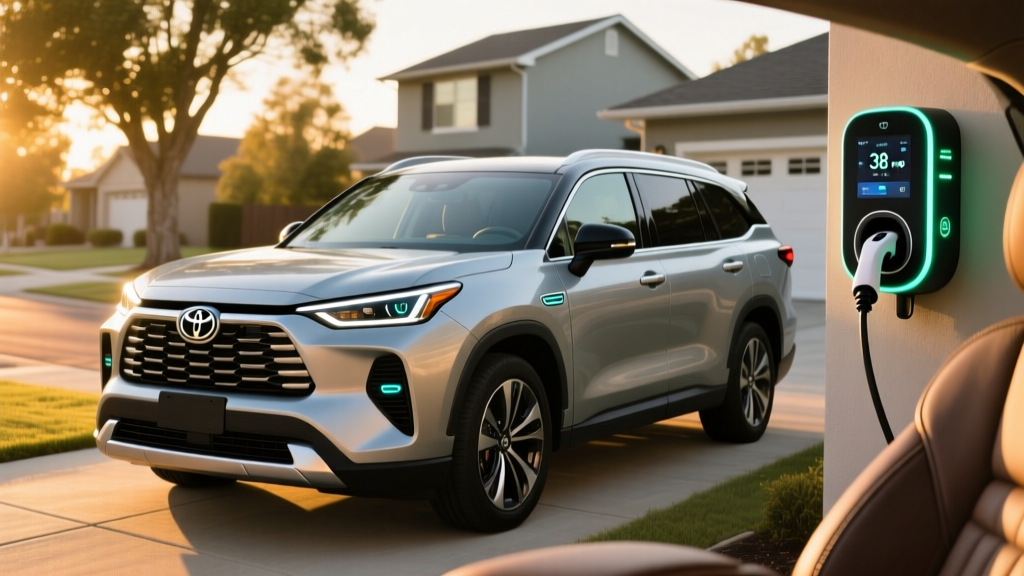
The 2024 Toyota Grand Highlander Hybrid fills a gap Toyota itself created: the standard Highlander Hybrid is efficient but cramped in the third row, while the Sequoia is spacious but thirsty and truck-based. The Grand Highlander Hybrid splits the difference — genuine adult-sized third-row seating, up to 36 MPG combined on the EPA cycle, and a starting price around $40,670. For families who need three rows but refuse to pay the fuel penalty of a body-on-frame SUV, this is the default choice in the segment.
Two hybrid powertrains are available: a 2.5-liter four-cylinder hybrid making 245 hp and the Hybrid MAX turbo hybrid producing 362 hp. Neither is a plug-in hybrid (PHEV) — both are conventional self-charging hybrids (HEVs), meaning you never plug them in. Let's break down the specs, real-world efficiency, and whether this is the right electrified vehicle for your garage.
HEV vs PHEV: What the Grand Highlander Hybrid Actually Is
Conventional Hybrid (HEV) — this vehicle: A gasoline engine and one or more electric motors work together, with a small battery recharged by regenerative braking and the engine. You never plug in. The Grand Highlander Hybrid uses this system.
Plug-in Hybrid (PHEV): A larger battery (typically 12–20 kWh) provides 20–50 miles of electric-only driving before the gas engine engages. You plug in at home or a public charger to replenish the battery. Examples: Toyota RAV4 Prime, Chrysler Pacifica Hybrid.
Toyota does not currently offer the Grand Highlander as a PHEV. If you need electric-only commuting in a three-row package, you'd need to look at the Chrysler Pacifica Hybrid (minivan) or wait for potential future PHEV variants. The HEV system here is simpler: no charging infrastructure required, no range anxiety about depleted batteries, and lower upfront cost than a PHEV equivalent.
Fuel Economy: EPA Ratings and Real-World MPG
The Grand Highlander Hybrid's headline number is its EPA-estimated fuel economy, which varies by powertrain and drivetrain configuration:
| Powertrain | Drivetrain | City MPG | Highway MPG | Combined MPG |
|---|---|---|---|---|
| 2.5L Hybrid (245 hp) | FWD | 37 | 34 | 36 |
| 2.5L Hybrid (245 hp) | AWD | 36 | 32 | 34 |
| Hybrid MAX (362 hp) | AWD | 27 | 28 | 27 |
Source: fueleconomy.gov
Real-World MPG: What to Actually Expect
The 2.5L hybrid powertrain is one of Toyota's most mature systems, shared with the Highlander, Camry, and RAV4. In real-world driving, owners and reviewers consistently report that the FWD hybrid achieves or slightly exceeds its EPA city rating in stop-and-go traffic — a common trait of Toyota hybrids, which rely heavily on electric motor assist at low speeds. Expect 34–37 MPG in mixed suburban driving, dropping to roughly 30–32 MPG on sustained highway trips at 75+ mph where the gasoline engine carries more of the load.
The Hybrid MAX is a different animal. Its turbocharged 2.4-liter engine and performance-tuned hybrid system prioritize acceleration (0–60 mph in approximately 6.3 seconds) over efficiency. Real-world testing shows 25–27 MPG in mixed driving — still respectable for a 362-hp three-row SUV, but a significant step down from the standard hybrid.
Hybrid Battery Warranty: Toyota covers the hybrid battery pack for 10 years or 150,000 miles (whichever comes first) on 2024 models. This applies to both the standard hybrid and Hybrid MAX. The conventional 12V auxiliary battery carries a separate warranty. Hybrid battery replacement, should it be needed outside warranty, typically runs $2,000–$4,000 for a Toyota hybrid system — though failures before 200,000 miles are uncommon based on long-term data from the Camry and Highlander Hybrid fleets.
Powertrain Specs: Two Hybrid Systems Compared
| Spec | 2.5L Hybrid | Hybrid MAX |
|---|---|---|
| Engine | 2.5L inline-4 | 2.4L turbo inline-4 |
| Combined Output | 245 hp | 362 hp / 400 lb-ft torque |
| Transmission | eCVT (planetary gearset) | 6-speed automatic |
| Drivetrain | FWD or AWD (electronic rear motor) | AWD standard |
| 0–60 mph | ~7.8 sec (est.) | ~6.3 sec |
| Towing Capacity | 3,500 lbs | 5,000 lbs |
| Hybrid Battery | ~1.6 kWh NiMH (self-charging) | ~1.9 kWh NiMH (self-charging) |
The standard 2.5L hybrid uses Toyota's series-parallel hybrid architecture with an electronically controlled continuously variable transmission (eCVT). This is not a belt-driven CVT — it uses a planetary gearset to blend engine and motor power, which is both smoother and more durable than conventional CVTs. The AWD variant adds a rear-mounted electric motor (no mechanical driveshaft) that engages automatically for traction.
The Hybrid MAX pairs the turbo 2.4L with a traditional 6-speed automatic and a more powerful hybrid motor sandwiched between engine and transmission. It feels more like a conventional SUV to drive — linear power delivery, actual gear shifts — at the cost of some efficiency.
Pricing, Trims, and Tax Credit Eligibility
The 2024 Grand Highlander Hybrid is available across five trims:
| Trim | Powertrain | Starting MSRP |
|---|---|---|
| LE | 2.5L Hybrid | $40,670 |
| XLE | 2.5L Hybrid | $43,670 |
| Limited | 2.5L Hybrid | $48,270 |
| Limited | Hybrid MAX | $53,075 |
| Platinum | Hybrid MAX | $58,125 |
Federal Tax Credit: Does It Qualify?
No. Under current IRS §30D rules, the federal clean vehicle credit ($3,750–$7,500) applies only to battery electric vehicles (BEVs) and plug-in hybrids (PHEVs) that meet battery-sourcing, critical-mineral, MSRP, and buyer-income requirements. Because the Grand Highlander Hybrid is a conventional HEV with no plug-in capability, it does not qualify for the federal EV tax credit.
Some states offer separate incentives for conventional hybrids, but these are increasingly rare as state programs shift toward BEVs and PHEVs. Check your state's energy or DMV website for current programs.
Hybrid vs PHEV vs EV: Which Fits Your Family?
Choose the Grand Highlander Hybrid (HEV) if:
- You don't have access to home charging (apartment, street parking, no garage outlet)
- You want three-row seating with minimal complexity — no plugs, no charging apps, no range planning
- You drive a mix of city and highway and want 34–36 MPG without behavioral changes
- You want the lowest upfront price in the electrified three-row SUV segment
Consider a PHEV (e.g., Chrysler Pacifica Hybrid) if:
- You can charge at home and your daily commute is under 32 miles (the Pacifica's electric-only range)
- You want to drive most weekdays on electricity but need gas flexibility for road trips
- You want to capture some fuel-cost savings without full EV commitment
Consider a full EV (e.g., Kia EV9, Rivian R1S) if:
- You have reliable home Level 2 charging
- Your daily driving is under 250 miles and you road-trip infrequently
- You want to eliminate gasoline costs entirely and qualify for the $7,500 federal credit (income/MSRP permitting)
- You're willing to accept longer refueling stops on road trips (30–45 min DC fast charging)
The Grand Highlander Hybrid's advantage is its zero-compromise simplicity. You fuel it like any gas car, it returns 34–36 MPG, and you never think about charging. The tradeoff is that you'll always burn gasoline — there's no electric-only mode for short trips. For families in apartments or homes without easy charging access, this is a feature, not a limitation.
Reliability, Longevity, and Ownership Costs
Toyota's hybrid systems have accumulated over two decades of real-world data since the original Prius. The eCVT planetary gearset has no belts or clutches to wear, and the hybrid battery operates within a narrow state-of-charge window (roughly 40–80%) that minimizes degradation. Long-term fleet data from the Highlander Hybrid (which shares architecture) shows hybrid battery packs routinely lasting 150,000–200,000+ miles before capacity loss triggers a replacement.
Toyota's 10-year/150,000-mile hybrid battery warranty is among the best in the industry and applies to all 50 states (California's PZEV states may see extended coverage). If a battery does fail out of warranty, replacement cost at a Toyota dealer typically falls between $2,000 and $4,000 — a fraction of full EV battery replacement costs, which can exceed $10,000–$15,000.
The Grand Highlander earned the IIHS Top Safety Pick designation for the 2024 model year, with Good ratings across crashworthiness tests. Toyota Safety Sense 3.0 is standard on all trims, including pre-collision braking, lane departure alert, dynamic radar cruise control, and lane tracing assist — all SAE Level 1 driver-assist features that require full driver engagement.
Pros, Cons, and Final Assessment
Pros
- 36 MPG combined (FWD) — best-in-class for three-row SUVs
- Genuine adult-sized third row with 33.5 inches of legroom
- No plug-in required — zero charging infrastructure needed
- 10-year/150,000-mile hybrid battery warranty
- 3,500–5,000 lb towing depending on powertrain
- Toyota Safety Sense 3.0 standard on all trims
Cons
- No PHEV option — can't drive on electric-only power
- No federal tax credit eligibility
- Hybrid MAX drops to 27 MPG combined for 362 hp
- eCVT can drone under hard acceleration (standard hybrid)
- Cargo space behind third row (20.6 cu ft) trails some rivals
- Base LE trim lacks premium features found on competitors
The 2024 Grand Highlander Hybrid doesn't try to be revolutionary — it applies Toyota's most proven hybrid technology to the exact body style families actually need. If you want three rows, low fuel costs, and zero lifestyle change from your current gas car, it's the segment benchmark. If you want electric-only commuting or federal tax credits, you'll need to look at PHEVs or full EVs — but those come with charging requirements and higher upfront costs that many three-row buyers aren't ready for.
Frequently Asked Questions
How many MPG does the 2024 Grand Highlander Hybrid get?
The EPA rates the 2.5L Hybrid FWD at 37 city / 34 highway / 36 combined MPG. The AWD version drops slightly to 36/32/34 MPG. The Hybrid MAX AWD is rated at 27/28/27 MPG. Real-world driving typically matches or slightly exceeds city ratings in stop-and-go traffic, with highway MPG dropping to 30–32 at speeds above 75 mph.
Does the Grand Highlander Hybrid need to be plugged in?
No. It is a conventional hybrid (HEV), not a plug-in hybrid (PHEV). The small hybrid battery recharges through regenerative braking and the gasoline engine. You fuel it exactly like a conventional gas vehicle.
How far can the Grand Highlander Hybrid drive on electric only?
Not far — the standard hybrid can creep short distances (under a mile) at low speeds on electric power alone, but it is not designed for electric-only commuting. If you need meaningful electric-only range, you need a PHEV like the Chrysler Pacifica Hybrid (32 miles electric-only).
Is the Grand Highlander Hybrid reliable? What about battery replacement cost?
Toyota's hybrid systems have a 25-year track record, and the eCVT transmission has no wear-prone belts or clutches. The hybrid battery is warranted for 10 years / 150,000 miles. Out-of-warranty replacement typically costs $2,000–$4,000, though most Toyota hybrid batteries last 150,000–200,000+ miles based on long-term fleet data.
Does the Grand Highlander Hybrid qualify for any tax credit?
No. Under current IRS §30D rules, only battery electric vehicles (BEVs) and plug-in hybrids (PHEVs) qualify for the federal clean vehicle credit. The Grand Highlander Hybrid is a conventional HEV and is not eligible. Some states may offer minor hybrid incentives — check your state's energy office for details.
Grand Highlander Hybrid vs. a full EV like the Kia EV9?
The EV9 offers 279–304 miles of EPA range, qualifies for up to $7,500 in federal tax credits (income/MSRP permitting), and has lower per-mile fueling costs if you charge at home. But it requires home Level 2 charging infrastructure (~$500–$1,500 install), costs more upfront ($54,900+), and requires 30–45 minute DC fast charging stops on road trips. The Grand Highlander Hybrid costs less, needs no charging setup, and refuels in 5 minutes — at the cost of burning gasoline at 34–36 MPG instead of running on electricity.
How does the Hybrid MAX compare to the standard hybrid?
The Hybrid MAX trades 9 MPG combined (27 vs 36) for 117 additional horsepower (362 vs 245), a 6.3-second 0–60 time, and 5,000 lb towing capacity (vs 3,500). It also uses a traditional 6-speed automatic instead of the eCVT, which some drivers prefer for its natural shift feel. If you tow a boat or prioritize acceleration, the MAX justifies its premium. If fuel economy is your priority, the standard hybrid is the clear choice.