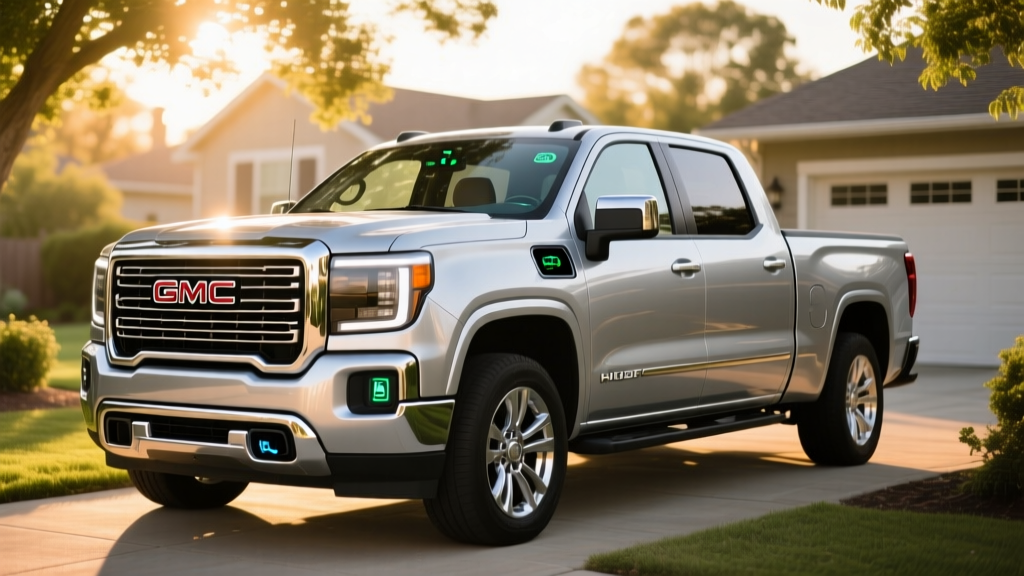
If you need a full-size pickup but want to trim fuel costs without plugging in, the 2026 GMC Sierra Hybrid truck deserves a serious look. GMC offers the Sierra 1500 with a mild-hybrid system that integrates seamlessly into the familiar V8 powertrain — no plug required, no range anxiety, and no compromise on towing or payload. This guide breaks down every spec that matters: EPA fuel economy, real-world MPG expectations, powertrain output, pricing across trims, tax credit eligibility, and the battery warranty details that separate a smart buy from an expensive mistake.
HEV vs PHEV: Which GMC Sierra Hybrid Truck Are We Talking About?
Before diving into specs, it is critical to distinguish between two fundamentally different electrified approaches, because GMC uses the word "hybrid" in a specific way for the Sierra 1500.
Conventional Hybrid (HEV)
The 2026 GMC Sierra 1500 Hybrid uses a mild-hybrid system paired with the 5.3L V8 engine. It recovers energy during braking and assists the engine during acceleration and stop-start events. You never plug it in — the small battery recharges through regenerative braking and engine operation. This is the same category as the Toyota RAV4 Hybrid or Ford Maverick Hybrid.
Plug-In Hybrid (PHEV)
A PHEV has a larger battery (typically 12–25 kWh) that you plug in to charge, offering 20–50 miles of electric-only driving before the gas engine engages. Examples include the Jeep Wrangler 4xe and Toyota RAV4 Prime. GMC does not currently offer the Sierra 1500 as a PHEV. If plug-in capability is essential, you would need to look at competitors or wait for future announcements.
The Sierra's mild-hybrid system is not designed for electric-only driving. Instead, it smooths out stop-start events, provides a modest torque fill during acceleration, and improves fuel economy by 1–3 MPG combined compared to the non-hybrid V8. Think of it as efficiency enhancement, not electrification in the BEV or PHEV sense.
2026 GMC Sierra Hybrid MPG: EPA Estimates and Real-World Numbers
Fuel economy is the primary reason buyers consider the Sierra Hybrid. Here is how the EPA rates the 2026 GMC Sierra 1500 Hybrid with the 5.3L V8 mild-hybrid system, compared to the standard non-hybrid 5.3L V8:
| Powertrain | City MPG | Highway MPG | Combined MPG |
|---|---|---|---|
| 5.3L V8 + Mild Hybrid (2WD) | 17 | 23 | 19 |
| 5.3L V8 + Mild Hybrid (4WD) | 16 | 22 | 18 |
| 5.3L V8 Standard (4WD, no hybrid) | 15 | 20 | 17 |
Source: fueleconomy.gov — EPA estimates for the 2026 GMC Sierra 1500. Verify exact figures for your trim and drivetrain configuration.
Real-World MPG Expectations
EPA stickers are a starting point, not a guarantee. With full-size trucks, real-world results depend heavily on how you drive and what you haul:
- City driving (unloaded): Expect 16–18 MPG in 4WD. The mild hybrid's stop-start assist and regenerative braking shine here, where conventional V8s waste the most fuel at idle.
- Highway cruising (unloaded, 70 mph): 20–22 MPG is realistic. Aerodynamic drag dominates at highway speed, and the hybrid system provides less benefit than in stop-and-go traffic.
- Towing (5,000+ lb trailer): Expect 10–13 MPG. Hybrid assist cannot overcome the physics of towing heavy loads. This is a modest improvement over the 9–11 MPG a non-hybrid Sierra returns while towing.
- Cold weather: Subtract 1–2 MPG in sub-freezing temperatures due to increased engine load, winter fuel blends, and reduced regenerative braking efficiency.
Real-World Bottom Line: The mild hybrid delivers its biggest advantage in city and suburban driving. If your commute is mostly highway, the MPG gap between hybrid and non-hybrid narrows to roughly 1 MPG combined. The hybrid system is most valuable for drivers who spend significant time in traffic, at job sites with frequent stop-start, or on suburban errands.
Powertrain Specs: What's Under the Hood
The 2026 GMC Sierra 1500 Hybrid pairs the proven 5.3-liter EcoTec3 V8 with an integrated mild-hybrid module. Here are the key specifications:
| Specification | Value |
|---|---|
| Engine | 5.3L EcoTec3 V8 with Dynamic Fuel Management |
| Hybrid System | Mild-hybrid (eAssist-style) with belt-integrated motor-generator |
| Combined Horsepower | 355 hp (engine) + ~10 hp electric assist |
| Combined Torque | 383 lb-ft (engine) + electric torque fill |
| Transmission | 10-speed automatic |
| Max Towing Capacity | ~9,300 lbs (4WD, properly equipped) |
| Drivetrain | 2WD or 4WD |
| Battery Type | Lithium-ion, under 1 kWh (mild-hybrid pack) |
| Plug-In Required? | No — self-charging via regen and engine |
The mild-hybrid motor-generator sits between the engine and transmission, connected via an enhanced accessory belt. It cannot propel the truck on electric power alone. Instead, it:
- Enables smoother, faster engine stop-start (the engine shuts off at stops and restarts nearly instantly)
- Provides electric torque fill during initial acceleration, reducing the load on the V8
- Captures kinetic energy during deceleration and braking to recharge the small lithium-ion pack
- Powers electrical accessories while the engine is stopped, so A/C and infotainment continue running
The result is a driving experience that feels like a conventional Sierra V8 — because it fundamentally is one — with slightly improved refinement at stops and marginally better fuel economy.
Pricing, Trims, and Tax Credit Eligibility
The hybrid powertrain is available on select Sierra 1500 trims. Here is the approximate 2026 MSRP breakdown:
| Trim | Approx. MSRP (4WD) | Hybrid Availability |
|---|---|---|
| SLE | $54,000 | Available |
| SLT | $58,500 | Available |
| AT4 | $65,000 | Available |
| Denali | $69,000 | Available |
| Denali Ultimate | $78,000 | Available |
Pricing is approximate and based on GMC's published MSRP for the 2026 model year. Destination charges, dealer options, and regional variations apply. Confirm with your dealer.
Federal Tax Credit: Does the Sierra Hybrid Qualify?
This is where expectations need calibration. Under IRS §30D rules for 2026:
- Conventional hybrids (HEV): Do not qualify for the federal §30D clean vehicle credit. This credit applies only to plug-in electric vehicles (BEVs and PHEVs) with a battery capacity of at least 7 kWh.
- The Sierra 1500 Hybrid is an HEV — its mild-hybrid battery is well under 1 kWh. No federal purchase credit is available.
- State incentives: Some states offer rebates or tax benefits for any electrified vehicle, including conventional hybrids. Check your state's energy office or AFDC state incentive database for current programs.
- The fully electric GMC Sierra EV (a separate model) may qualify for federal credits depending on battery sourcing and your income. That vehicle is covered in our Sierra EV review.
If a federal tax credit is a dealbreaker, the Sierra Hybrid is not the right choice. Consider a PHEV truck (like the upcoming Ram 1500 REV with range extender) or a full BEV for credit eligibility. See the IRS §30D guidelines for complete eligibility rules including MSRP caps, income limits, and battery component sourcing requirements.
Battery Warranty, Reliability, and Replacement Costs
Hybrid battery longevity is the number-one concern for truck buyers considering an electrified powertrain. Here is what GMC covers and what you can expect:
GMC Hybrid Battery Warranty
Hybrid/Electric Battery Component Warranty: 8 years / 100,000 miles (whichever comes first), consistent with GM's standard hybrid battery coverage.
Powertrain Warranty: 5 years / 60,000 miles on the engine, transmission, and hybrid motor-generator.
Bumper-to-Bumper: 3 years / 36,000 miles.
Reliability Outlook
The 5.3L EcoTec3 V8 is one of GM's most proven engines, with millions of units on the road. The mild-hybrid system adds relatively few components compared to a full hybrid or PHEV — there is no large traction battery, no high-voltage system, and no electric-only drivetrain to maintain. The belt-integrated motor-generator is a compact, sealed unit with minimal failure points.
Based on historical data from GM's eAssist mild-hybrid systems (used in previous-generation vehicles) and the current Sierra platform:
- The mild-hybrid battery pack is small and operates within a narrow state-of-charge window, which significantly reduces degradation compared to full hybrid or BEV batteries.
- Expected battery lifespan: 150,000–200,000+ miles before meaningful capacity loss, based on similar GM mild-hybrid platforms.
- Most owners will never need a hybrid battery replacement during typical ownership (5–8 years).
Battery Replacement Cost
If the mild-hybrid battery does need replacement outside of warranty:
- Estimated cost: $800–$1,500 for the battery pack itself, plus $200–$400 in labor.
- This is dramatically lower than full hybrid battery replacements ($3,000–$6,000) or BEV battery replacements ($10,000–$20,000+), because the mild-hybrid pack is small (under 1 kWh).
- The motor-generator unit, if it fails, runs $1,200–$2,000 for parts and labor.
For comparison, a conventional Sierra V8 with no hybrid system will eventually need a new starter motor ($400–$700) and may experience more wear on the 12V battery from traditional stop-start systems. The mild hybrid essentially replaces the starter with a more robust motor-generator, which can improve long-term reliability of the starting system.
Sierra Hybrid vs. Full EV vs. Gas: Which Truck Fits You?
The right choice depends on your driving patterns, infrastructure access, and budget. Here is a decision framework:
Choose the GMC Sierra Hybrid (HEV) If:
- You tow regularly and need the full V8 capability without range compromise
- You do not have access to home or workplace charging
- You want modest fuel savings (1–3 MPG) without changing your driving habits
- You want a proven powertrain with minimal new technology risk
- You live in a rural area with limited charging infrastructure
Choose a Plug-In Hybrid (PHEV) Truck If:
- You have home charging and a short commute (20–40 miles) you want to drive on electric
- You want to reduce fuel consumption significantly on weekdays but need gas range for weekend towing
- You want to qualify for potential federal or state PHEV incentives
Choose a Full EV Truck (e.g., GMC Sierra EV, Ford F-150 Lightning) If:
- You have reliable home Level 2 charging
- Your daily driving is under 250 miles and you rarely tow long distances
- You want maximum fuel cost savings ($0.04–$0.08/mile on electricity vs. $0.18–$0.25/mile on gas)
- You want to qualify for the full §30D federal tax credit (up to $7,500, subject to eligibility)
- You want zero tailpipe emissions and minimal powertrain maintenance
| Factor | Sierra Hybrid (HEV) | PHEV Truck (e.g., Ram 1500 PHEV) | Full EV (e.g., Sierra EV) |
|---|---|---|---|
| Plug In Required? | No | Yes (recommended) | Yes (required) |
| Electric-Only Range | 0 miles | 25–50 miles (est.) | 300–400+ miles |
| Combined MPG / MPGe | 18–19 MPG | 25–30 MPG + MPGe | 70–80 MPGe |
| Towing Capability | Excellent (~9,300 lbs) | Good (varies) | Good–Excellent (~10,000 lbs) |
| Federal Tax Credit | None | Up to $7,500* | Up to $7,500* |
| Home Charging Needed? | No | Recommended | Essential |
| Starting Price (approx.) | $54,000 | $60,000+ | $60,000+ |
*Federal tax credit subject to IRS §30D eligibility including buyer income caps, vehicle MSRP caps, and battery component/critical mineral sourcing requirements. Confirm at IRS.gov.
Pros and Cons: The Honest Assessment
Pros
- No plug-in charging required — works with existing gas infrastructure
- Smoother stop-start experience than non-hybrid V8 Sierra
- 1–3 MPG improvement in city and combined driving
- Full V8 towing and payload capability maintained
- Modest hybrid battery replacement cost ($800–$1,500)
- 8-year/100,000-mile hybrid battery warranty
- Available across popular trims (SLE through Denali Ultimate)
Cons
- No federal tax credit eligibility (HEV, not PHEV or BEV)
- Modest MPG gains — not transformative for fuel costs
- No electric-only driving capability whatsoever
- Highway MPG improvement is minimal (~1 MPG)
- Higher base price than non-hybrid Sierra by ~$1,500–$2,500
- Not a path to significant emissions reduction
- Cannot precondition cabin on grid power like a PHEV or BEV
Frequently Asked Questions
How many MPG does the GMC Sierra Hybrid truck get?
The 2026 GMC Sierra 1500 Hybrid with 4WD is EPA-rated at 16 city / 22 highway / 18 combined MPG. The 2WD version rates 17/23/19. Real-world results vary: expect 16–18 MPG in mixed city driving and 10–13 MPG while towing. The hybrid system provides the most benefit in stop-and-go traffic.
How far can the Sierra Hybrid go on electric only?
Zero miles. The Sierra 1500 Hybrid uses a mild-hybrid system that cannot propel the truck on electric power alone. The electric motor-generator only assists the gas engine during acceleration and enables smoother stop-start operation. If electric-only driving is important, you need a PHEV or BEV.
Is the GMC Sierra Hybrid reliable?
The 5.3L EcoTec3 V8 is a well-proven engine with a strong reliability track record. The mild-hybrid system adds a belt-integrated motor-generator and a small lithium-ion battery, both of which are simpler and less failure-prone than full hybrid or PHEV systems. GM covers the hybrid battery for 8 years/100,000 miles. Based on similar GM mild-hybrid platforms, the battery should last 150,000+ miles.
What does it cost to replace the Sierra Hybrid battery?
Outside of warranty, expect $800–$1,500 for the mild-hybrid battery pack plus $200–$400 in labor — roughly $1,000–$1,900 total. This is far less than full hybrid or BEV battery replacements because the mild-hybrid pack is under 1 kWh. The motor-generator, if it needs replacement, runs $1,200–$2,000.
Does the GMC Sierra Hybrid qualify for any tax credit?
No federal tax credit. The IRS §30D clean vehicle credit requires a plug-in vehicle with at least 7 kWh of battery capacity. The Sierra Hybrid's mild-hybrid battery is under 1 kWh, so it does not qualify. Some states may offer incentives for conventional hybrids — check your state's energy office or the AFDC database.
Hybrid vs PHEV vs EV — which Sierra should I buy?
Choose the hybrid (HEV) if you want no-hassle efficiency gains without plugging in and need full towing capability. Choose a PHEV if you have home charging and want 25–50 miles of electric commuting with gas backup for longer trips. Choose the Sierra EV if you have reliable charging, drive under 300 miles daily, and want maximum operating cost savings and federal tax credit eligibility.
Does the hybrid system affect towing capacity?
No. The 2026 Sierra 1500 Hybrid maintains a maximum towing capacity of approximately 9,300 pounds (4WD, properly equipped) — essentially identical to the non-hybrid 5.3L V8. The mild-hybrid system does not reduce payload or towing ratings.
The Verdict: Who Should Buy the GMC Sierra Hybrid Truck?
The 2026 GMC Sierra Hybrid truck is a pragmatic choice for a specific buyer: someone who wants a full-size V8 pickup, values proven mechanical simplicity, and appreciates incremental fuel savings without the lifestyle changes that come with plugging in. It is not a stepping stone to electrification — it is a refinement of the gas truck formula.
If you drive 15,000 miles per year at the EPA combined 18 MPG with gas at $3.50/gallon, your annual fuel cost is approximately $2,917. A non-hybrid Sierra at 17 MPG combined would cost about $3,088 — a savings of roughly $171 per year with the hybrid. Over five years, that is about $855 in fuel savings, which partially offsets the hybrid premium but does not fully pay for it.
However, the hybrid system's value extends beyond fuel. The smoother stop-start, the slightly reduced wear on the starter and brakes (thanks to regenerative braking), and the potential resale value advantage of an electrified powertrain all factor in. For fleet buyers and high-mileage drivers, these marginal gains compound.
If you need transformative fuel savings, electric-only commuting, or federal tax credits, look at the GMC Sierra EV or a PHEV competitor. But if you simply want a better version of the gas truck you already know — one that sips slightly less fuel and starts slightly smoother — the Sierra Hybrid delivers exactly that, with no compromises on the capability that makes a Sierra a Sierra.