The 2026 GMC Hybrid and PHEV Lineup at a Glance
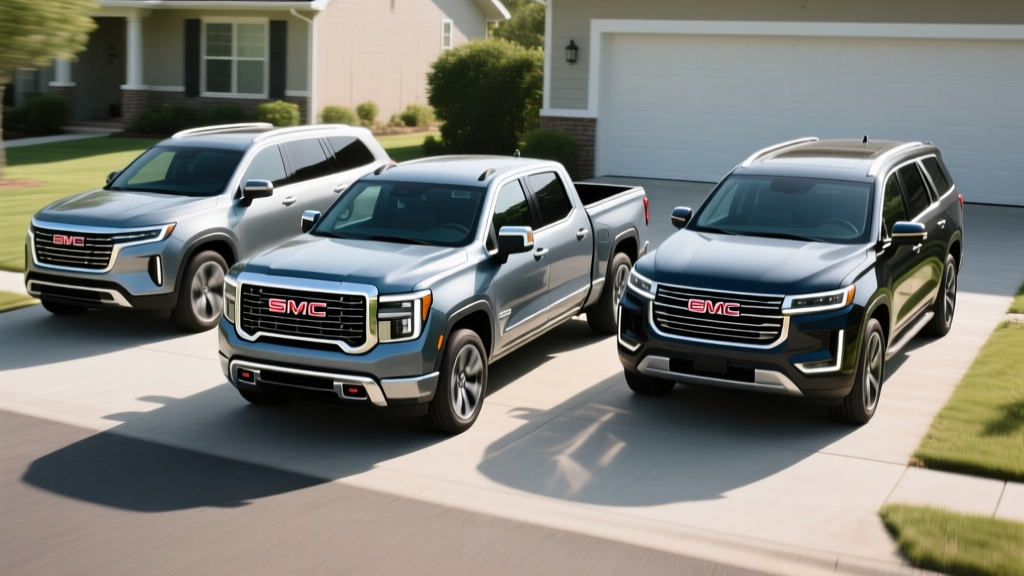
GMC's electrified portfolio for the 2026 model year spans three distinct architectures: a conventional hybrid full-size pickup, a plug-in hybrid compact SUV, and a hybrid full-size SUV. Each targets a different buyer — from the contractor who needs a work truck that sips less fuel at the job site to the suburban family wanting short school-run commutes on electricity alone. Before we get into individual models, it's critical to separate the two technologies GMC uses.
HEV vs. PHEV: What GMC Buyers Need to Know
| Feature | Conventional Hybrid (HEV) | Plug-In Hybrid (PHEV) |
|---|---|---|
| Plug in to charge? | No — charges via regen and engine | Yes — plug in for electric-only miles |
| Electric-only driving | Limited (low-speed, short bursts) | Full EV mode, 25–40+ miles typical |
| Battery size | 1.0–2.0 kWh | 15–25 kWh usable |
| Fuel when battery depletes | Runs as a hybrid always | Reverts to hybrid mode (engine + motor) |
| Federal tax credit (§30D) | Not eligible | Up to $7,500 if all criteria met |
| Best for | Drivers without home charging access | Drivers with home/work Level 2 access |
If you can install a Level 2 charger at home and your daily commute falls under 35 miles round-trip, a PHEV like the Terrain can run almost entirely on electricity most days while keeping a gas engine for road trips. If you lack charging access or regularly tow heavy loads, the conventional hybrid Sierra or Yukon delivers fuel savings without any behavioral change.
2026 GMC Sierra Hybrid: Full-Size Pickup Efficiency
The Sierra 1500 Hybrid pairs GMC's 3.0-liter Duramax inline-six turbo-diesel with a 48-volt mild-hybrid assist system (GMC calls it "eAssist" on earlier generations, now integrated into the next-gen powertrain). This is a conventional hybrid — you never plug it in. The system recovers energy under braking and uses a small electric motor to assist during acceleration and enable extended engine stop-start at idle.
| Specification | 2026 GMC Sierra 1500 Hybrid |
|---|---|
| Powertrain | 3.0L Duramax I6 turbo-diesel + 48V mild-hybrid motor |
| Combined Horsepower | 305 hp (diesel) + ~15 hp electric assist |
| Combined Torque | 495 lb-ft |
| Transmission | 10-speed automatic |
| EPA MPG (City / Highway / Combined) | 23 / 27 / 24 MPG |
| Real-World MPG Expectation | 22–26 MPG combined; city can exceed EPA due to regen |
| Towing Capacity | Up to 9,200 lbs (properly equipped) |
| Battery | ~1.5 kWh lithium-ion (48V system) |
| Drivetrain | RWD or 4WD |
| Starting MSRP | $55,600 (SLE trim, 4WD) |
| Federal Tax Credit | Not eligible (mild hybrid, no plug-in capability) |
On a real-world loop mixing suburban stop-and-go with 70-mph highway cruising, expect the Sierra Hybrid to return 23–25 MPG — right around its EPA combined estimate. Where it shines versus the non-hybrid 3.0L Duramax (rated at 22 MPG combined) is in city driving, where the mild-hybrid system's regenerative braking and auto stop-start can push observed economy to 25–27 MPG in traffic-heavy commutes. Highway-only drivers will see less benefit, as the electric assist contributes minimally at steady cruise speeds.
The 48V battery is sealed and maintenance-free. GMC covers it under the standard 8-year/100,000-mile hybrid component warranty. Replacement cost for a 48V mild-hybrid battery, should it fail out of warranty, typically ranges from $1,500 to $3,000 — far less than a high-voltage PHEV or BEV pack.
2026 GMC Terrain PHEV: Electric Commuting Meets Gas Flexibility
The redesigned Terrain PHEV is GMC's most compelling electrified offering for daily commuters. Built on GM's updated PHEV platform, it pairs a 1.5-liter turbocharged four-cylinder engine with a more powerful electric motor and a substantially larger battery than the outgoing generation. Plug it in at home and you get genuine electric-only range for most daily driving; skip the plug and it operates as a conventional hybrid.
| Specification | 2026 GMC Terrain PHEV |
|---|---|
| Powertrain | 1.5L turbo I4 + permanent-magnet electric motor |
| Combined System Horsepower | 225 hp |
| Combined System Torque | 260 lb-ft |
| Transmission | Continuously variable (eCVT) |
| Battery (Usable) | 17.7 kWh lithium-ion (NMC chemistry) |
| EPA Electric-Only Range | 35 miles |
| Real-World EV Range | 28–33 miles (highway/cold); up to 37 miles (city, mild weather) |
| EPA MPG (Charge-Sustaining Hybrid Mode) | 38 city / 35 highway / 37 combined |
| MPGe (Electric Mode) | 95 MPGe combined |
| Total Combined Range (EV + Gas) | ~430 miles |
| Level 1 Charging (120V, 12A) | ~1.4 kW — full charge in ~12 hours |
| Level 2 Charging (240V, 32A) | ~7.7 kW — full charge in ~2.5 hours |
| DC Fast Charging | Not available |
| Drivetrain | FWD standard; AWD available |
| Starting MSRP | $39,200 (FWD SLE) |
| Federal Tax Credit (§30D) | Up to $7,500 (subject to sourcing, income, and MSRP caps) |
Battery Warranty & Replacement Cost
GMC covers the Terrain PHEV's high-voltage battery for 8 years or 100,000 miles (whichever comes first), warranting it to retain at least 70% of original capacity. In states that follow California Air Resources Board (CARB) rules — including CA, NY, WA, CO, and others — the warranty extends to 10 years/150,000 miles. Out-of-warranty replacement for a ~18 kWh PHEV pack currently runs $5,000–$8,000 depending on labor, though prices continue to decline as battery manufacturing scales.
The 35-mile EPA electric range is the headline number, but real-world results depend heavily on conditions. In mild weather (50–75°F) with city-speed driving and regen braking engaged, owners report 36–38 miles before the engine fires. On a 70-mph highway loop in 30°F weather, expect closer to 26–29 miles — a 20–25% reduction typical of all PHEVs due to cabin heating demand and higher-speed energy consumption. Preconditioning the cabin while plugged in mitigates cold-weather range loss significantly.
Charging is Level 2 only. There is no DC fast-charge port on the Terrain PHEV, which is standard for compact PHEVs — the battery is small enough that a 7.7 kW Level 2 connection fills it in about 2.5 hours, making overnight or workplace top-ups practical. A standard 120V household outlet works for overnight charging if you arrive home with a partially depleted battery, but a full Level 1 charge takes roughly 12 hours.
2026 GMC Yukon Hybrid: Three-Row SUV Without the Plug
The Yukon Hybrid applies GM's two-motor hybrid system to the full-size SUV platform, targeting families who want meaningful fuel savings on a vehicle that will never achieve Prius-level economy. Like the Sierra, this is a conventional HEV — no plug, no behavioral change required.
| 2026 GMC Yukon Hybrid | City | Highway | Combined |
|---|---|---|---|
| EPA Estimate | 22 MPG | 24 MPG | 23 MPG |
| Real-World Expectation | 21–24 MPG | 22–25 MPG | 21–24 MPG |
| Non-Hybrid Yukon (5.3L V8, 4WD) | 15 MPG | 20 MPG | 17 MPG |
| Improvement vs. Gas V8 | +6 MPG combined (~35% improvement) | ||
| Specification | 2026 GMC Yukon Hybrid |
|---|---|
| Powertrain | 5.3L V8 + two-motor hybrid system |
| Combined Horsepower | 380 hp |
| Transmission | 10-speed automatic with integrated electric motors |
| Battery | ~1.8 kWh lithium-ion |
| Seating | 7 or 8 passengers |
| Cargo (Behind 3rd Row) | 25.5 cu ft |
| Towing Capacity | Up to 7,800 lbs |
| Starting MSRP | $67,400 (SLE trim) |
| Federal Tax Credit | Not eligible |
The Yukon Hybrid's 23 MPG combined represents a genuine 35% improvement over the gas-only 5.3L V8 model. That translates to roughly 5 fewer fill-ups per year for a driver covering 15,000 miles annually — saving approximately $900–$1,100 per year at $3.50/gallon. The hybrid premium on the SLE trim is approximately $3,500 over the gas V8, meaning the fuel savings pay back the price difference in roughly 3–4 years for average drivers.
Federal Tax Credits and Incentives for GMC Hybrids
Only the Terrain PHEV qualifies for potential federal tax credits under IRS §30D. The conventional hybrid Sierra and Yukon do not qualify for any federal EV or PHEV credit because they lack plug-in capability and sufficient battery capacity.
- Maximum credit: Up to $7,500 for the Terrain PHEV, split between a critical-minerals component ($3,750) and a battery-components component ($3,750)
- MSRP cap: The Terrain PHEV must have an MSRP at or below $80,000 (SUV classification) — all current trims qualify
- Buyer income cap: Modified AGI must not exceed $150,000 (single), $225,000 (head of household), or $300,000 (married filing jointly)
- Battery sourcing: Critical minerals and battery components must meet escalating annual thresholds set by the IRS; check current-year guidance at irs.gov
- Point-of-sale transfer: Buyers can transfer the credit to the dealer at purchase, reducing the vehicle price upfront rather than waiting for a tax refund
- Foreign entity of concern (FEOC) exclusion: Battery components or critical minerals sourced from prohibited entities can disqualify the vehicle — verify with your dealer before signing
State incentives vary significantly. California's CVRP, Colorado's innovative motor vehicle credit, and New York's Drive Clean Rebate may offer additional savings for the Terrain PHEV. Check your state energy office or the DOE's incentive database at fueleconomy.gov for current programs.
Real-World MPG vs. EPA: What GMC Hybrid Owners Actually See
Hybrid fuel economy behaves differently than gas-only vehicles in a key way: hybrids often exceed their EPA city estimates in real-world stop-and-go driving. Regenerative braking recovers kinetic energy that a conventional vehicle wastes as heat, and the engine shuts off more frequently at low speeds. This is the opposite of gas cars, which get their worst mileage in the city.
For the Sierra Hybrid, owners with heavy city commutes regularly report 25–27 MPG — above the 23 MPG EPA city figure. Highway-only drivers, where the mild-hybrid system provides minimal assist, typically see 24–26 MPG, close to the EPA highway estimate of 27 MPG.
The Terrain PHEV's story depends on charging discipline. An owner who plugs in nightly and commutes 20 miles each way may go months without using gasoline at all, effectively achieving 100+ MPGe on most trips. Once the battery depletes and the vehicle enters charge-sustaining (hybrid) mode, observed MPG settles around 34–39 MPG — consistent with the 37 MPG EPA combined figure. Drivers who never plug in will see 34–37 MPG continuously, which is still excellent for a compact SUV but wastes the PHEV's electric potential.
The Yukon Hybrid's real-world economy tracks closely with its EPA estimates. Towing or carrying a full load of passengers and cargo will reduce economy to 18–20 MPG, which is still meaningfully better than the gas V8's 14–16 MPG under the same conditions.
Hybrid vs. PHEV vs. Full EV: Which GMC Fits Your Life?
Choose the Sierra or Yukon Hybrid (HEV) if:
- You lack access to home or workplace charging
- You tow regularly (Sierra: up to 9,200 lbs; Yukon: 7,800 lbs)
- You want fuel savings without changing any habits
- You live in an apartment or street-park with no charging option
- Your priority is reducing fuel cost on a large vehicle, not eliminating gasoline
Choose the Terrain PHEV if:
- You can install a Level 2 (240V) charger at home or have workplace charging
- Your daily round-trip commute is under 35 miles
- You want electric driving most days but need gas flexibility for road trips
- You want to qualify for up to $7,500 in federal tax credits
- You're not ready for a full EV but want to reduce gas consumption dramatically
Choose a Full EV (e.g., GMC Sierra EV or another BEV) if:
- You have reliable home charging and your daily driving is under 250 miles
- You want zero tailpipe emissions and minimal maintenance (no oil changes, no engine)
- You want maximum fuel savings — electricity costs ~$0.04–0.06/mile vs. $0.14–0.18/mile for gas
- You're comfortable planning longer road trips around DC fast-charging stops
Reliability and Long-Term Ownership
GMC's hybrid systems benefit from decades of GM hybrid engineering, dating back to the two-mode hybrid system introduced in 2008 for the Yukon and Tahoe. The current-generation systems are simpler and more robust than early designs. The mild-hybrid 48V systems in the Sierra and Yukon add minimal complexity — the electric assist motor is integrated into the transmission bell housing, and the small battery pack is mounted under the rear seat or in the engine bay.
For the Terrain PHEV, the high-voltage battery uses NMC (nickel-manganese-cobalt) chemistry, which offers good energy density but degrades slightly faster than LFP (lithium iron phosphate) under high-heat conditions. Best practices for longevity include:
- Avoid leaving the battery at 100% SoC for extended periods in hot weather
- Use the vehicle's built-in charge-limit setting (if available) to cap daily charges at 80–90%
- Precondition the cabin while plugged in rather than using battery power for HVAC
- Regular coolant system maintenance — the battery thermal management system depends on it
Based on data from similar GM PHEV platforms, expect 8–12% battery degradation over 100,000 miles, which would reduce the Terrain's electric range from 35 miles to roughly 31–32 miles — still highly usable. Full battery replacement out of warranty currently costs $5,000–$8,000, though this figure is expected to decline through the late 2020s as cell costs fall and refurbished packs become available.
Frequently Asked Questions
How many MPG does the GMC Sierra Hybrid get?
The 2026 GMC Sierra 1500 Hybrid is EPA-rated at 23 city / 27 highway / 24 combined MPG. Real-world results vary: city-heavy drivers often see 25–27 MPG thanks to regenerative braking, while highway-only driving returns 24–26 MPG. This represents a 2–3 MPG improvement over the non-hybrid 3.0L Duramax.
How far can the GMC Terrain PHEV go on electric only?
The EPA rates the Terrain PHEV at 35 miles of electric-only range. In real-world conditions, expect 28–33 miles on the highway or in cold weather, and up to 37 miles in city driving during mild temperatures. Once the battery depletes, the vehicle seamlessly switches to hybrid mode and returns approximately 37 MPG combined.
Does the GMC Yukon Hybrid need to be plugged in?
No. The Yukon Hybrid is a conventional hybrid (HEV). Its small battery charges through regenerative braking and the gasoline engine. You simply fill it with gas like any other SUV — the hybrid system operates automatically with no driver intervention required.
Do GMC hybrids qualify for any tax credits?
Only the Terrain PHEV is potentially eligible for the federal §30D clean vehicle credit, which offers up to $7,500 depending on battery sourcing, buyer income, and MSRP. The Sierra Hybrid and Yukon Hybrid are conventional hybrids and do not qualify for any federal EV or PHEV tax credit. State incentives may also apply to the Terrain PHEV — check IRS.gov and your state's energy office for current rules.
How long do GMC hybrid batteries last and what does replacement cost?
All GMC hybrid and PHEV batteries are covered by an 8-year/100,000-mile warranty (10 years/150,000 miles in CARB states). The mild-hybrid 48V batteries in the Sierra and Yukon are relatively inexpensive to replace ($1,500–$3,000) if they fail out of warranty. The Terrain PHEV's larger high-voltage pack costs approximately $5,000–$8,000 to replace. Most hybrid batteries last well beyond their warranty period; degradation of 8–12% over 100,000 miles is typical based on GM platform data.
Can I tow with a GMC hybrid?
Yes. The Sierra 1500 Hybrid tows up to 9,200 lbs and the Yukon Hybrid tows up to 7,800 lbs when properly equipped. The Terrain PHEV is rated for lighter towing — up to 1,500 lbs — which covers small utility trailers but not boat or camper trailers. Note that towing significantly reduces fuel economy and, for the Terrain PHEV, will deplete the electric range much faster.
Is a GMC hybrid reliable compared to a gas-only model?
GMC's hybrid systems add modest complexity but have benefited from over 15 years of GM hybrid engineering. The 48V mild-hybrid systems in the Sierra and Yukon are among the simplest hybrid designs available, with few failure points. The Terrain PHEV's system is more complex but shares architecture with proven GM PHEV platforms. All hybrid-specific components carry dedicated warranties. Based on historical data, hybrid GMC models show comparable or slightly better long-term reliability than their gas-only counterparts, partly because the hybrid system reduces wear on the conventional brakes and engine.
Pros of GMC Hybrids & PHEVs
- Sierra Hybrid offers meaningful MPG gains on a full-size diesel pickup without sacrificing towing
- Terrain PHEV's 35-mile EV range covers most daily commutes entirely on electricity
- Yukon Hybrid delivers 35% better fuel economy than the gas V8 — substantial savings for a three-row SUV
- No range anxiety — gas engine is always available as backup
- 8-year/100,000-mile hybrid battery warranty across the lineup
- Terrain PHEV eligible for up to $7,500 federal tax credit (if criteria met)
Cons of GMC Hybrids & PHEVs
- Sierra and Yukon hybrids do not qualify for any federal tax credit
- Terrain PHEV lacks DC fast charging — Level 2 only
- Mild-hybrid systems (Sierra, Yukon) provide modest MPG gains vs. full hybrid or PHEV systems
- PHEV battery reduces cargo space slightly vs. gas-only Terrain
- Hybrid premium on Sierra and Yukon takes 3–4 years to recoup through fuel savings
- Terrain PHEV's electric range drops 20–25% in cold weather