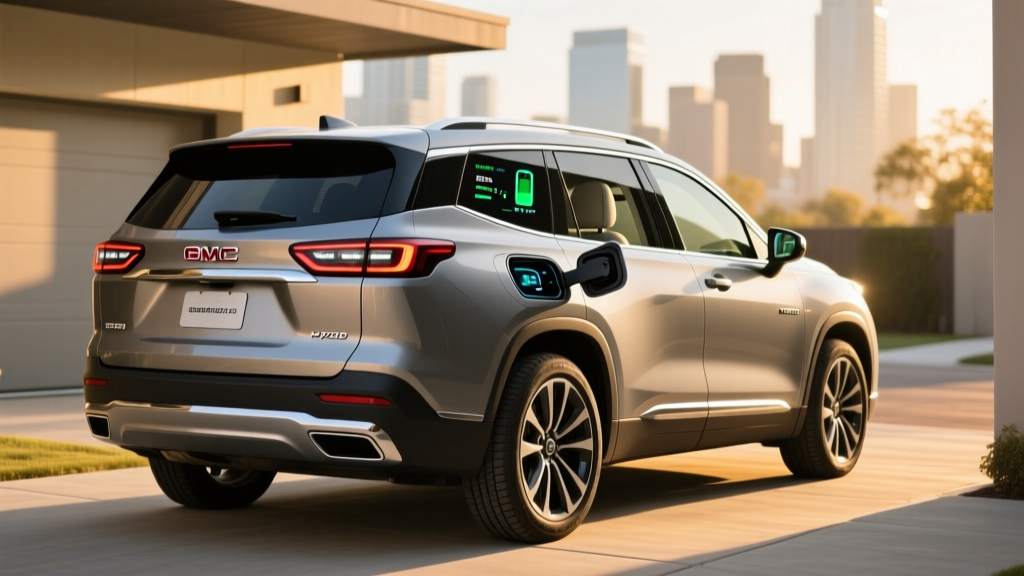
Family SUV buyers eyeing the GMC Acadia often land on a specific question: is there a hybrid version, and does it actually save fuel without sacrificing the three-row utility the Acadia is known for? For 2026, GMC continues to offer a mild-hybrid assist system on the Acadia's turbocharged powertrain — but it is not a full hybrid (HEV) in the Toyota Highlander Hybrid sense, nor is it a plug-in hybrid (PHEV). Understanding exactly what GMC's electrified Acadia delivers — and what it doesn't — is critical before you sign a purchase order.
This guide walks through the 2026 GMC Acadia's hybrid-assist powertrain, EPA fuel economy, real-world efficiency expectations, warranty coverage, pricing, and how it stacks up against true hybrids, PHEVs, and battery-electric rivals in the midsize three-row SUV segment.
What Kind of Hybrid Is the 2026 GMC Acadia?
The 2026 GMC Acadia uses a 48-volt mild-hybrid system paired with GM's 2.5-liter turbocharged inline-4 engine. This is fundamentally different from the full-parallel hybrid systems found in competitors like the Toyota Highlander Hybrid or Kia Sorento Hybrid. Here's the distinction:
HEV vs. Mild Hybrid vs. PHEV — Where the Acadia Fits
| Type | How It Works | Plug In? | Electric-Only Driving? | Typical MPG Gain |
|---|---|---|---|---|
| Mild Hybrid (MHEV) — Acadia | Small 48V motor assists gas engine during acceleration and enables smoother stop/start | No | No (motor cannot drive wheels alone) | ~1–2 MPG combined vs. non-hybrid |
| Full Hybrid (HEV) — e.g., Highlander Hybrid | Larger electric motor + battery; can drive on electric at low speeds; regenerative braking recharges | No | Briefly, at low speeds | ~8–14 MPG combined improvement |
| Plug-in Hybrid (PHEV) — e.g., Grand Cherokee 4xe | Full hybrid system with larger battery you can plug in; substantial electric-only range | Yes | Yes, typically 25–45 miles | MPGe 50+; 25–35 MPG once battery is depleted |
The Acadia's mild-hybrid system is best understood as a refinement technology, not a fuel-economy revolution. It smooths out the engine's stop-start behavior, provides a small torque fill during initial acceleration, and powers accessories when the engine is off at stops. You will not see the dramatic MPG gains that full hybrids deliver.
2026 GMC Acadia Powertrain Specs
| Specification | 2026 GMC Acadia (Mild Hybrid) |
|---|---|
| Engine | 2.5L Turbocharged Inline-4 |
| Hybrid System | 48V eAssist mild-hybrid (motor/generator unit) |
| Combined Horsepower | 328 hp (engine) |
| Combined Torque | 326 lb-ft |
| Transmission | 8-speed automatic |
| Drivetrain | FWD standard; AWD available |
| Towing Capacity | 5,000 lbs (properly equipped) |
| Seating | Up to 8 passengers (bench) or 7 (captain's chairs) |
The 2.5L turbo four-cylinder is the sole engine for the current-generation Acadia, replacing the older 3.6L V6. The 48V mild-hybrid assist does not change the peak output figures but does improve low-speed responsiveness and reduces the lurch typically felt during auto stop-start events. On the highway, the system's contribution is minimal — the turbo engine does the heavy lifting.
Fuel Economy: EPA Ratings and Real-World MPG
| Drivetrain | City MPG | Highway MPG | Combined MPG |
|---|---|---|---|
| FWD | 20 | 27 | 23 |
| AWD | 19 | 25 | 21 |
Source: EPA Fuel Economy (fueleconomy.gov). Figures reflect current-generation Acadia 2.5L turbo with mild-hybrid assist.
Real-World MPG Expectations
Mild-hybrid systems tend to show their benefit in stop-and-go city driving, where the electric assist during acceleration and the smoother stop-start reduce wasted fuel. Expect the Acadia FWD to achieve 21–24 MPG combined in mixed suburban/highway driving. In predominantly highway cruising at 70+ mph, real-world numbers may dip to 24–26 MPG for FWD models — close to the EPA sticker but not dramatically above it, as hybrids like the Highlander Hybrid often manage.
In cold weather (below 30°F), expect a 5–8% reduction in fuel economy due to increased engine warm-up time, thicker fluids, and greater accessory loads (heated seats, defroster). This is less severe than the range loss experienced by full EVs but still noticeable over a winter tank.
Pros
- Smooth stop/start behavior — one of the least intrusive in the segment
- 328 hp provides confident merging and passing power
- 5,000-lb towing capacity beats most hybrid competitors
- No plug-in requirement or charging behavior change
- Premium GMC interior with available Denali trim
Cons
- MPG barely exceeds non-hybrid midsize SUVs — not a true efficiency play
- Combined 21–23 MPG trails Highlander Hybrid (35–36 combined) by a wide margin
- No electric-only driving capability whatsoever
- No federal tax credit eligibility for mild-hybrid systems
- Turbo four-cylinder lacks the refinement of V6 rivals under hard acceleration
Pricing, Trims, and Tax Credit Eligibility
The 2026 GMC Acadia starts at approximately $39,900 MSRP for the base SLE trim (FWD), with the mild-hybrid system included across all trims since the 2.5L turbo is the standard engine. Key trim pricing:
- SLE (FWD): ~$39,900
- SLT (FWD): ~$43,500
- AT4 (AWD): ~$47,200
- Denali (AWD): ~$53,800
Adding AWD typically adds $2,000–$2,500 depending on trim.
Tax Credit Reality
The 2026 Acadia mild hybrid does not qualify for the federal §30D Clean Vehicle Credit. Under IRS rules, the §30D credit applies only to plug-in electric vehicles (BEVs and PHEVs) with a battery capacity of at least 7 kWh that meet critical-mineral and battery-component sourcing requirements. A 48V mild-hybrid system does not meet these thresholds.
Some states offer modest incentives for hybrid vehicles through utility rebates or state-level programs, but these vary significantly by jurisdiction. Check your state energy office or utility provider for current programs.
Battery Warranty and Long-Term Reliability
48V Battery and Hybrid Component Coverage
- Hybrid/Electric Components: 8 years / 100,000 miles
- Powertrain (engine, transmission): 5 years / 60,000 miles
- Bumper-to-Bumper: 3 years / 36,000 miles
The 48V lithium-ion battery pack in the Acadia is compact — typically under 1 kWh of capacity — and far less expensive to replace than the large traction batteries in full hybrids or EVs. If replacement is ever needed out of warranty, expect costs in the $800–$1,500 range for the 48V battery module, plus labor. This is a fraction of the $4,000–$8,000+ that full-hybrid or EV battery replacements can command.
GM's mild-hybrid systems have proven reliable since their introduction across the brand's lineup. The motor/generator unit is integrated into the engine accessory drive and has no high-voltage cabling or complex power electronics comparable to a full hybrid. Long-term degradation of the 48V battery is minimal because it operates within a narrow state-of-charge window and never undergoes deep discharge cycles.
Acadia Hybrid vs. True Hybrid, PHEV, and EV Alternatives
If fuel economy is your primary motivation, the Acadia's mild-hybrid system may leave you looking at alternatives. Here's how it compares across the electrified three-row SUV landscape:
| Vehicle | Type | Combined MPG / MPGe | Electric-Only Range | Starting MSRP |
|---|---|---|---|---|
| GMC Acadia (2.5T MHEV) | Mild Hybrid | 21–23 MPG | None | ~$39,900 |
| Toyota Highlander Hybrid | Full Hybrid (HEV) | 35–36 MPG | None | ~$42,300 |
| Kia Sorento Hybrid | Full Hybrid (HEV) | 34–37 MPG | None | ~$39,000 |
| Jeep Grand Cherokee L 4xe | PHEV | 56 MPGe / 26 MPG (gas) | ~26 miles | ~$58,000 |
| Kia EV9 | BEV (Full Electric) | 88–99 MPGe | 230–304 mi (EPA) | ~$54,900 |
Which Electrified SUV Fits Your Situation?
Choose the GMC Acadia mild hybrid if: You want a premium American three-row SUV with strong towing capacity (5,000 lbs), confident turbo power, and a refined stop-start experience — and you're not chasing maximum MPG.
Choose a full hybrid (Highlander/Sorento Hybrid) if: You drive 15,000+ miles per year in mixed or city-heavy conditions and want 34–36 MPG without ever plugging in. You sacrifice some towing capacity (3,500–5,000 lbs) for 50%+ better fuel economy.
Choose a PHEV if: Your daily commute is under 30 miles round-trip, you have access to Level 2 home charging, and you want electric-only weekday driving with gas-engine flexibility for road trips. PHEVs qualify for the federal §30D credit (up to $7,500) if they meet IRS sourcing and income requirements.
Choose a full EV (Kia EV9) if: You have reliable home charging, your daily driving is under 250 miles, you want zero tailpipe emissions, and you're ready to manage public charging on road trips. EVs offer the lowest per-mile fuel cost and qualify for the full §30D credit when eligible.
Who Should Buy the 2026 GMC Acadia Hybrid?
The 2026 Acadia with its mild-hybrid powertrain is the right call for buyers who prioritize GMC's premium cabin, available Super Cruise hands-free driving technology, strong towing capability, and a comfortable highway ride — and who view fuel economy as a secondary concern. It's a refinement upgrade, not an efficiency play.
If you're cross-shopping the Acadia specifically for its hybrid credentials, know that the fuel savings relative to a non-hybrid midsize SUV are modest — perhaps 1–2 MPG combined, translating to roughly $100–$150 per year in fuel savings at 15,000 miles annually and $3.50/gallon. The real value of the 48V system is in drivetrain smoothness, not at the pump.
For buyers whose primary goal is reducing fuel costs and emissions, a full hybrid like the Highlander Hybrid will save approximately $800–$1,000 annually in fuel over the Acadia, while a PHEV or BEV can cut fuel costs even further depending on your electricity rate and driving patterns.
Frequently Asked Questions
How many MPG does the 2026 GMC Acadia hybrid get?
The 2026 Acadia with its 2.5L turbo mild-hybrid powertrain achieves an EPA-estimated 20 city / 27 highway / 23 combined MPG with FWD, and 19 city / 25 highway / 21 combined with AWD. Real-world mixed driving typically yields 21–24 MPG combined.
Can the GMC Acadia drive on electric power only?
No. The Acadia's 48V mild-hybrid system cannot propel the vehicle on electric power alone. The electric motor/generator only assists the gas engine during acceleration and smooths stop-start transitions. There is no EV mode or electric-only range.
Does the 2026 GMC Acadia hybrid qualify for a federal tax credit?
No. Under IRS §30D rules, the federal Clean Vehicle Credit requires a plug-in vehicle with at least 7 kWh of battery capacity. The Acadia's 48V mild-hybrid battery is well below this threshold and does not qualify for any federal EV or PHEV tax credit.
Is the GMC Acadia hybrid reliable, and what does battery replacement cost?
GM's 48V mild-hybrid system has a strong reliability track record with fewer failure points than full-hybrid or PHEV systems. The 48V battery is covered under GM's 8-year/100,000-mile hybrid component warranty. Out-of-warranty replacement, if ever needed, typically costs $800–$1,500 — far less than full-hybrid or EV battery replacements.
Should I get the Acadia hybrid or a Toyota Highlander Hybrid?
If maximum fuel economy is your priority, the Highlander Hybrid (35–36 MPG combined) saves roughly $800–$1,000 per year in fuel over the Acadia at 15,000 miles. Choose the Acadia if you prefer GMC's premium interior, stronger towing capacity (5,000 vs. 3,500 lbs for the Highlander), available Super Cruise, and don't mind the lower MPG.
Does the Acadia mild hybrid need to be plugged in?
No. The 48V battery recharges through regenerative braking and the engine-driven generator. There is no plug, no charging cable, and no change to your fueling routine. You simply fill up with gasoline as you would with any conventional vehicle.