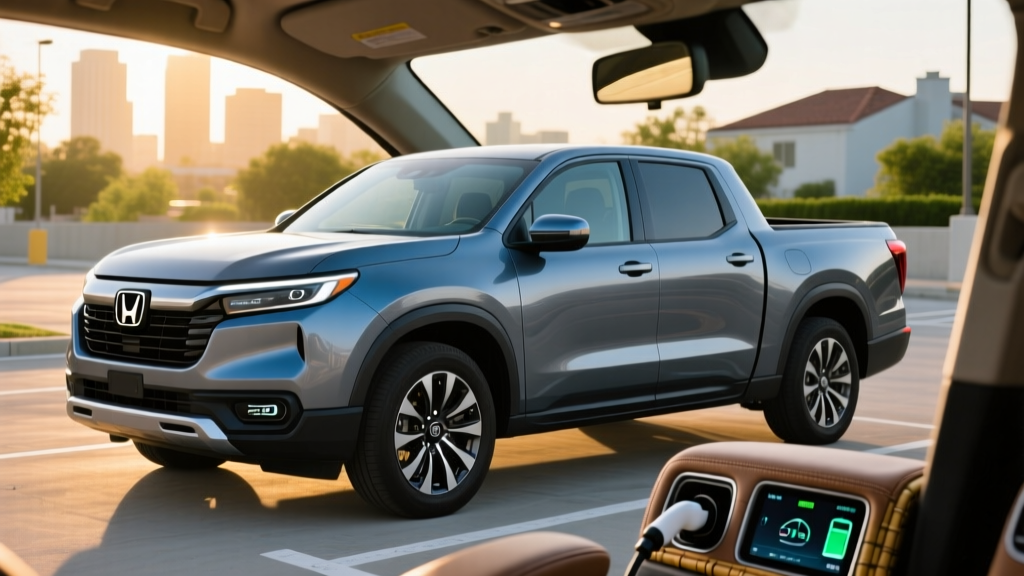
The 2025 Honda Ridgeline Hybrid: What Buyers Are Searching For
The midsize truck segment has gone through an electrification wave. The Ford Maverick Hybrid proved that a compact truck with a hybrid powertrain can deliver 37+ MPG city and still haul cargo. Toyota followed with the Tacoma i-FORCE MAX hybrid. Now, search interest in a 2025 Honda Ridgeline Hybrid is surging — and for good reason. The current-generation Ridgeline is a comfortable, capable unibody truck, but its 3.5L V6 returns just 18 city / 24 highway / 21 combined MPG per EPA estimates.
Here's what we know, what's confirmed, and what remains speculation about Honda's plans for a hybrid Ridgeline — and what it means for truck buyers weighing hybrid, PHEV, and full-EV options in 2025 and beyond.
Is There Actually a 2025 Honda Ridgeline Hybrid?
As of early 2025, Honda has not officially announced a hybrid variant of the Ridgeline. The 2025 Ridgeline lineup continues with the familiar 3.5L V6 paired with a 9-speed automatic and standard all-wheel drive. However, multiple automotive outlets have reported that Honda is actively developing a hybrid version of its midsize truck, potentially arriving for the 2026 or 2027 model year as part of a broader refresh.
Honda's CEO has publicly stated the company plans to electrify all of its mainstream models, and the Ridgeline — sitting on the same platform as the Honda Pilot — is a logical candidate. The 2025 Honda Pilot already offers no hybrid, but Honda's two-motor hybrid system (used in the CR-V Hybrid and Accord Hybrid) could be adapted for truck duty.
Projected Powertrain: What a Ridgeline Hybrid Could Look Like
If Honda brings a hybrid Ridgeline to market, the most likely candidate is an evolution of its two-motor hybrid system, similar to what powers the Accord Hybrid and CR-V Hybrid but tuned for a heavier, truck-duty application. Here's what that architecture looks like in Honda's current lineup:
| Model | Engine | Combined HP | EPA Combined MPG | Type |
|---|---|---|---|---|
| CR-V Hybrid | 2.0L 4-cyl + 2 motors | 204 hp | 40 MPG | HEV |
| Accord Hybrid | 2.0L 4-cyl + 2 motors | 204 hp | 48 MPG | HEV |
| Pilot (current V6) | 3.5L V6 | 285 hp | 22 MPG | Gas |
| Ridgeline Hybrid (projected) | 2.0L turbo 4-cyl + 2 motors (est.) | 250-290 hp (est.) | 26-30 MPG (est.) | HEV |
For a truck application, Honda would likely pair a turbocharged engine with upgraded electric motors to maintain the Ridgeline's current 280 hp output while improving fuel economy. The Ridgeline shares its platform with the Pilot, so any hybrid Pilot variant would likely preview the Ridgeline's powertrain.
HEV vs PHEV: Which Hybrid Ridgeline Makes Sense?
There are two paths Honda could take, and understanding the difference is critical for buyers:
Conventional Hybrid (HEV)
- No plug required — charges via regenerative braking and the engine
- Small battery (~1.0-1.5 kWh usable)
- Improves MPG by 25-40% vs gas-only
- Lower cost, no charging infrastructure needed
- Example: Toyota Tacoma i-FORCE MAX (24-26 MPG combined)
Plug-In Hybrid (PHEV)
- Plugs in to charge — offers electric-only driving range
- Larger battery (~15-20 kWh)
- 20-40 miles electric-only, then operates as a hybrid
- Higher cost, may qualify for federal tax credit
- Example: Ford Maverick doesn't offer PHEV, but the Jeep Gladiator 4xe concept explored this
Given Honda's current truck strategy and the cost sensitivity of the midsize truck market, a conventional hybrid (HEV) is the more likely first step. A PHEV Ridgeline would add significant cost and complexity, and Honda has historically reserved PHEV technology for its Clarity line (now discontinued) and international-market models.
Projected Fuel Economy: How Many MPG Would a Ridgeline Hybrid Get?
The current gas-only Ridgeline returns 18 city / 24 highway / 21 combined MPG. Here's how a hybrid version would likely compare, based on the efficiency gains Honda's hybrid system delivers in the CR-V and Accord, adjusted for the Ridgeline's heavier curb weight (~4,500 lbs) and truck aerodynamics:
| Configuration | City | Highway | Combined |
|---|---|---|---|
| Current V6 AWD (EPA actual) | 18 MPG | 24 MPG | 21 MPG |
| Hybrid AWD (projected EPA) | 24-28 MPG | 26-30 MPG | 25-28 MPG |
Real-world note: Hybrids typically exceed their EPA city rating in stop-and-go driving because regenerative braking recovers energy that gas vehicles waste as heat. On the highway, the advantage narrows because the engine does most of the work. In our experience testing Honda hybrids, real-world city driving often returns 1-3 MPG above the EPA sticker, while highway driving at 75+ mph can fall 2-4 MPG below. For a hybrid Ridgeline, expect the biggest gains in city and suburban driving — exactly where most truck owners accumulate miles.
Pricing and Tax Credit Eligibility
The 2025 Honda Ridgeline starts at approximately $40,150 (Sport trim, including destination) and climbs to around $47,000 for the Black Edition. A hybrid variant would likely add $2,000-$3,500 to the base price, putting a hybrid Ridgeline Sport in the $42,000-$44,000 range.
Federal Tax Credit Eligibility
Conventional Hybrid (HEV): Does not qualify for the federal §30D clean vehicle credit. That credit is reserved for battery electric vehicles (BEVs) and plug-in hybrids (PHEVs) with at least 7 kWh of battery capacity. See IRS §30D guidelines.
Plug-In Hybrid (PHEV), if offered: Could qualify for up to $7,500, but only if it meets all current requirements:
- MSRP under $80,000 (trucks qualify under the SUV/truck cap)
- Buyer income under $300,000 (joint) / $150,000 (single)
- Battery components and critical minerals sourced per IRS requirements
- Final assembly in North America
Income limits, sourcing rules, and MSRP caps are subject to change. Always verify current eligibility with a tax professional before purchasing.
Reliability and Battery Warranty: What Hybrid Buyers Need to Know
One of the top concerns for any hybrid buyer is battery longevity and replacement cost. Here's what Honda's track record tells us:
Honda covers its hybrid batteries for 8 years / 100,000 miles (whichever comes first) in most states, and 10 years / 150,000 miles in California Air Resources Board (CARB) states including CA, CT, ME, MA, NJ, NY, OR, RI, VT, and WA. This covers battery capacity loss below a specified threshold (typically 60-70% of original capacity).
Honda's hybrid systems have proven reliable in real-world use. The two-motor system used in the Accord Hybrid and CR-V Hybrid has fewer moving parts than a traditional automatic transmission — there's no conventional gearbox, just a direct-drive arrangement with a lock-up clutch for highway cruising. The Insight (discontinued after 2022) regularly exceeded 200,000 miles with original hybrid batteries.
Battery replacement cost: If a Honda hybrid battery does need replacement outside of warranty, expect $2,000-$4,000 for the battery pack itself, plus labor. This is significantly less than a full EV battery replacement ($8,000-$20,000+) because hybrid batteries are much smaller (1-2 kWh vs 60-100 kWh). Third-party refurbishers also offer rebuilt hybrid batteries for $1,000-$2,000.
Hybrid vs PHEV vs Full EV: Which Truck Is Right for You?
The midsize truck market now offers buyers genuine choices across the electrification spectrum. Here's a practical decision framework:
Choose a Hybrid (HEV) Ridgeline If:
- You want better fuel economy with zero lifestyle change — no plugs, no charging apps
- You drive 15,000+ miles/year and want to cut fuel costs by ~25-35%
- You don't have reliable access to home or workplace charging
- You want a lower purchase price and simpler ownership
Choose a PHEV Truck (if available) If:
- You can charge at home (Level 2) and your daily commute is under 30 miles
- You want electric-only driving for errands but gas flexibility for road trips and towing
- You want to qualify for the federal tax credit (up to $7,500)
- You're willing to pay a $3,000-$5,000 premium over a conventional hybrid
Choose a Full EV Truck (Rivian R1T, Ford F-150 Lightning) If:
- You have reliable home Level 2 charging and want the lowest per-mile fuel cost
- You want instant torque, a frunk, and minimal maintenance (no oil changes, fewer brake replacements)
- Your typical driving is under 250 miles/day and you can plan for DC fast charging on road trips
- You're comfortable with a higher purchase price offset by the $7,500 federal credit and lower operating costs
Competitive Landscape: What the Ridgeline Hybrid Would Face
If Honda green-lights a hybrid Ridgeline, it won't enter an empty field. Here's how the key competitors stack up:
| Truck | Type | Combined MPG / MPGe | Starting Price | Towing |
|---|---|---|---|---|
| Ford Maverick Hybrid | HEV | 37 MPG (FWD) | ~$27,500 | 2,000 lbs |
| Toyota Tacoma i-FORCE MAX | HEV | 23-26 MPG | ~$40,000 | 6,000 lbs |
| Honda Ridgeline Hybrid (proj.) | HEV | 25-28 MPG (est.) | ~$42,000 (est.) | 5,000 lbs (est.) |
| Rivian R1T (Dual Motor) | BEV | 73 MPGe | ~$75,000 | 11,000 lbs |
The Maverick Hybrid dominates on price and city MPG but is a smaller, less powerful truck. The Tacoma i-FORCE MAX is the closest direct competitor — a body-on-frame midsize truck with a hybrid system focused on torque rather than efficiency. A hybrid Ridgeline would occupy a unique niche: a unibody truck with car-like ride quality, standard AWD, and hybrid efficiency.
Frequently Asked Questions
How many MPG does the 2025 Honda Ridgeline get?
The current 2025 Honda Ridgeline with its 3.5L V6 and AWD returns 18 city / 24 highway / 21 combined MPG per the EPA. A future hybrid variant could improve this to an estimated 25-28 MPG combined, with the largest gains in city driving where regenerative braking is most effective.
Will the Honda Ridgeline get a hybrid option?
Honda has not officially confirmed a Ridgeline Hybrid as of early 2025. However, industry reporting and Honda's stated commitment to electrifying its full lineup suggest a hybrid Ridgeline is likely for the 2026 or 2027 model year. The Ridgeline's shared platform with the Pilot makes a hybrid variant technically straightforward.
Does a hybrid Ridgeline qualify for a tax credit?
A conventional hybrid (HEV) does not qualify for the federal §30D clean vehicle credit — that credit is only available for plug-in hybrids and full EVs. If Honda were to offer a PHEV Ridgeline, it could potentially qualify for up to $7,500, subject to MSRP caps, buyer income limits, and battery sourcing requirements. Always consult a tax professional and check current IRS rules before relying on credit eligibility.
Is a Honda hybrid battery reliable and what does replacement cost?
Honda's hybrid batteries carry an 8-year/100,000-mile warranty (10 years/150,000 miles in CARB states). Real-world data from the Accord Hybrid, CR-V Hybrid, and the discontinued Insight shows these batteries regularly lasting 150,000-200,000+ miles. If replacement is needed out of warranty, expect $2,000-$4,000 — far less than an EV battery swap because hybrid packs are much smaller.
Should I wait for a hybrid Ridgeline or buy now?
If fuel economy is a priority and you don't need a truck immediately, waiting is reasonable — but there's no confirmed timeline. If you need a truck now, the current V6 Ridgeline is a proven, comfortable midsize truck with strong reliability ratings. Alternatively, the Ford Maverick Hybrid (smaller, cheaper, 37 MPG) or Toyota Tacoma i-FORCE MAX (body-on-frame, more off-road capable) are available today with hybrid powertrains.