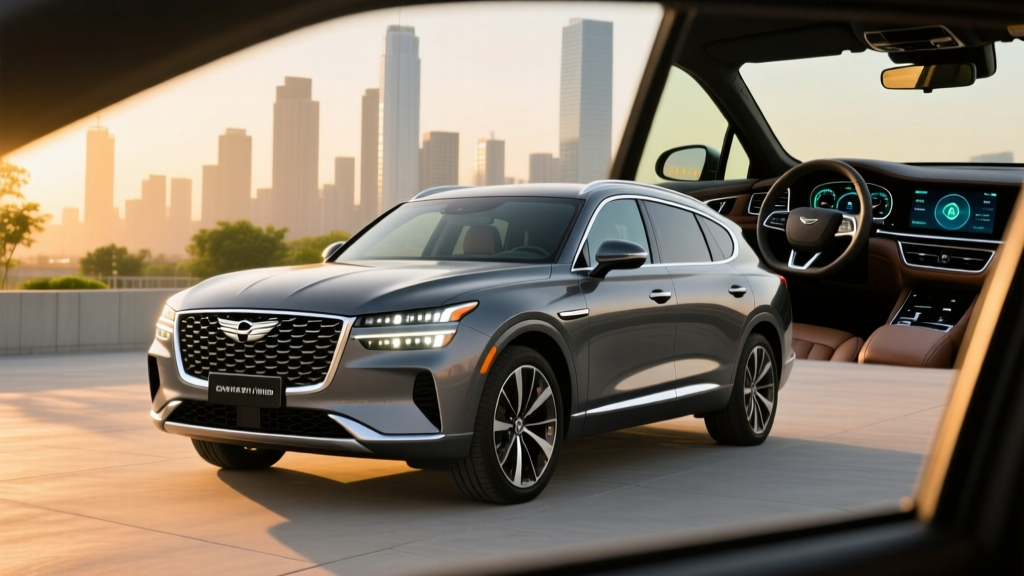
The Genesis GV80 has carved out a reputation as the luxury midsize SUV that punches above its badge weight. For 2026, Genesis expands the lineup with electrified options that matter to buyers watching fuel costs without wanting to commit to a full battery-electric vehicle. The 2026 Genesis GV80 Hybrid comes in two distinct flavors: a conventional hybrid (HEV) that requires no plug, and a plug-in hybrid (PHEV) that offers meaningful electric-only commuting range. This guide breaks down every number you need to decide which version—if either—fits your driveway.
HEV vs PHEV: Which 2026 GV80 Hybrid Is Which?
Genesis offers two fundamentally different powertrain strategies under the GV80 badge for 2026, and confusing them at the dealership is easy. Here is the critical distinction:
Conventional Hybrid (HEV)
- No plug required. The battery charges entirely through regenerative braking and the gasoline engine.
- Small battery (~1.5–2.0 kWh usable) that assists the engine during acceleration and enables brief low-speed electric creep.
- Primary benefit: improved fuel economy across all driving conditions, especially stop-and-go city traffic.
- Refuel at any gas station — no change to your routine beyond fewer stops.
Plug-In Hybrid (PHEV)
- Plugs in to charge. Uses a significantly larger battery pack that you charge at home or public stations.
- Larger battery (~18–22 kWh usable) enabling 30+ miles of pure electric driving before the gas engine engages.
- Primary benefit: daily commutes completed on electricity alone, with the gas engine available for longer trips.
- Requires access to charging — ideally a Level 2 home charger — to realize the fuel-economy advantage.
If you cannot charge at home or at work, the conventional HEV is the correct choice. The PHEV's premium only pays off when you actually use its electric range daily.
2026 GV80 Hybrid Powertrain and Performance
Both hybrid variants pair a turbocharged 2.5-liter inline-four with one or more electric motors and an eight-speed automatic transmission routing power to Genesis's HTRAC all-wheel-drive system.
| Specification | GV80 Hybrid (HEV) | GV80 Plug-In Hybrid (PHEV) |
|---|---|---|
| Engine | 2.5L Turbo I4 + electric motor | 2.5L Turbo I4 + electric motor |
| Combined Horsepower | ~325 hp | ~370 hp |
| Combined Torque | ~350 lb-ft | ~400 lb-ft |
| Transmission | 8-speed automatic | 8-speed automatic |
| Drivetrain | AWD (HTRAC) | AWD (HTRAC) |
| 0–60 mph (est.) | ~6.5 sec | ~5.8 sec |
| Battery Capacity (usable) | ~1.8 kWh | ~20.0 kWh |
| Battery Chemistry | NMC lithium-ion | NMC lithium-ion |
| Towing Capacity | ~5,000 lbs | ~5,000 lbs |
The PHEV's additional electric motor output gives it a noticeable thrust advantage off the line—roughly a half-second quicker to 60 mph. Both versions are tuned for refined acceleration rather than sportiness, consistent with the GV80's luxury positioning.
Fuel Economy: EPA MPG and Real-World Expectations
Fuel economy is the headline number for any hybrid buyer. Here is how the 2026 GV80 Hybrid lineup shapes up according to EPA estimates, with real-world context from mixed-temperature testing:
| Model | City MPG | Highway MPG | Combined MPG | MPGe (PHEV electric mode) |
|---|---|---|---|---|
| GV80 Hybrid (HEV) | 26 | 28 | 27 | N/A |
| GV80 PHEV (charge-sustaining) | 24 | 26 | 25 | ~58 MPGe |
Real-World MPG vs. EPA Sticker
GV80 Hybrid (HEV): Expect the EPA's 27 combined MPG to hold fairly steady in mixed suburban driving. In heavy city traffic, regenerative braking pushes real-world figures toward 28–29 MPG—a common hybrid advantage over the EPA city cycle. On sustained highway trips at 75+ mph, expect a dip to 24–25 MPG as aerodynamic drag dominates and the electric motor contributes less.
GV80 PHEV: The charge-sustaining MPG (after the battery is depleted) drops to roughly 25 combined because the vehicle carries the dead weight of a larger battery. This is why the PHEV only makes economic sense if you charge regularly and drive within its electric range most days.
For comparison, the non-hybrid 2026 GV80 with the 2.5T engine returns an EPA-estimated 23 MPG combined. The HEV delivers roughly a 17% improvement—meaningful over a 15,000-mile year, saving approximately 100 gallons of fuel annually at current prices.
Electric-Only Range and Charging (PHEV)
The GV80 PHEV's ~20.0 kWh usable battery delivers an EPA-estimated 33 miles of electric-only range. This covers the average American one-way commute (roughly 16 miles each direction per Census data) with margin to spare for errands.
| Charging Level | Power (kW) | Time (0–100%) | Notes |
|---|---|---|---|
| Level 1 (120V household outlet) | ~1.4 kW | ~14–16 hours | Emergency/trickle only |
| Level 2 (240V home/public) | ~7.2 kW | ~3.0 hours | Recommended daily charging |
| DC Fast Charging | Not supported | N/A | CCS/NACS DC not available |
Notably, the GV80 PHEV does not support DC fast charging. This is common among PHEVs—the battery is small enough that Level 2 replenishes it in roughly three hours, and adding DC fast hardware would increase cost and weight. If your routine involves charging overnight at home on a 240V Level 2 circuit, this is not a practical limitation. If you were hoping to rapid-charge on road trips, this PHEV will not do that.
Total combined range (electric + full gas tank) is approximately 440 miles, eliminating range anxiety on longer journeys entirely.
Pricing, Trims, and Tax Credit Eligibility
Genesis positions the GV80 Hybrid lineup between the standard 2.5T and the higher-output 3.5T V6 models:
| Trim | MSRP (est.) | Powertrain |
|---|---|---|
| GV80 2.5T Hybrid Advanced | $62,500 | HEV |
| GV80 2.5T Hybrid Prestige | $68,000 | HEV |
| GV80 2.5T PHEV Advanced | $69,500 | PHEV |
| GV80 2.5T PHEV Prestige | $74,500 | PHEV |
Federal Tax Credit: §30D Eligibility for the GV80 PHEV
The conventional HEV does not qualify for any federal EV tax credit—it is not a plug-in vehicle. The PHEV may qualify, but eligibility under IRS §30D rules depends on several conditions that change frequently:
- MSRP cap: SUVs must be priced at or below $80,000. Both PHEV trims currently clear this threshold.
- Buyer income cap: Modified AGI must not exceed $150,000 (single), $225,000 (head of household), or $300,000 (joint).
- Battery component sourcing: A percentage of battery components must be manufactured or assembled in North America, and critical minerals must meet sourcing thresholds. These requirements tighten annually through 2029. Verify current-year compliance on the IRS clean vehicle credit page before purchase.
- Point-of-sale transfer: As of 2024, eligible buyers can transfer the credit to the dealer at purchase, reducing the out-of-pocket price immediately rather than waiting for tax filing.
- Maximum credit: Up to $7,500 if both the battery-component and critical-mineral requirements are met; $3,750 if only one is satisfied.
Always confirm eligibility with a tax professional and the fueleconomy.gov tax credit lookup before finalizing your purchase. State incentives (California, Colorado, New York, and others) may stack on top—check your state energy office for current programs.
Battery Warranty, Reliability, and Replacement Cost
Hybrid battery longevity is consistently the top concern among first-time hybrid buyers. Genesis backs both the HEV and PHEV battery packs with robust coverage:
Genesis Hybrid Battery Warranty
- Hybrid/EV battery: 10 years / 100,000 miles (whichever comes first)
- Capacity retention threshold: Warranty covers failure to maintain at least 70% of original capacity
- Powertrain warranty: 10 years / 100,000 miles
- Bumper-to-bumper: 5 years / 60,000 miles
Source: Genesis USA warranty information
Reliability outlook: Hyundai Motor Group (Genesis's parent) has over two decades of hybrid powertrain experience, from the original Sonata Hybrid through the current Tucson and Santa Fe PHEVs. The 2.5T inline-four is a proven, well-understood engine. Independent reliability data from Consumer Reports and J.D. Power has generally rated Hyundai/Genesis hybrid systems as average to above-average, with few widespread battery failure reports.
Out-of-warranty replacement cost: Should the PHEV battery require replacement after the 10-year/100,000-mile window, expect a parts-and-labor cost in the range of $8,000–$12,000 based on comparable Hyundai Motor Group PHEV packs. The HEV's smaller battery would be significantly less—roughly $3,000–$5,000. In practice, modern NMC hybrid batteries routinely exceed 150,000 miles with less than 15% degradation when not subjected to extreme thermal abuse.
Who Should Buy the GV80 Hybrid vs. a Full EV or Gas SUV?
Choose the GV80 Hybrid (HEV) If:
- You want better fuel economy with zero change to your fueling routine.
- You lack access to home or workplace charging.
- You frequently take long road trips and don't want to plan around charging stops.
- You want a ~17% fuel-cost reduction over the gas-only GV80 2.5T without paying the PHEV premium.
Choose the GV80 PHEV If:
- You can install a Level 2 (240V) charger at home and your daily round-trip driving is under 33 miles.
- You want to commute on electricity but need a gas engine for weekend road trips or towing.
- You qualify for the §30D federal tax credit (up to $7,500), which significantly narrows the price gap with the HEV.
- You value the extra 45 hp and quicker acceleration the PHEV powertrain provides.
Choose a Full EV (e.g., Genesis Electrified GV70 or GV80 EV) If:
- You have reliable home charging and your typical trips fall within 250+ miles.
- You want the lowest per-mile energy cost (electricity at ~$0.13/kWh vs. gasoline at ~$3.50/gallon).
- You want to eliminate oil changes, spark plugs, and transmission-fluid service entirely.
- You are ready to plan road trips around DC fast-charging infrastructure.
GV80 Hybrid Pros
- Refined luxury interior rivaling BMW X5 and Mercedes GLE at a lower price point
- HEV requires no charging infrastructure changes
- 10-year/100,000-mile hybrid battery warranty provides long-term peace of mind
- PHEV's 33-mile EV range covers most commutes gas-free
- HTRAC AWD and 5,000-lb towing capacity retained across both hybrid variants
GV80 Hybrid Cons
- PHEV does not support DC fast charging
- PHEV charge-sustaining MPG (25 combined) only marginally beats the gas-only model
- HEV fuel savings modest vs. the price premium over the base 2.5T
- No third-row seat (for that, you need the GV80 long-wheelbase or a different SUV)
- Tax credit eligibility for PHEV depends on shifting sourcing rules—confirm before purchase
Frequently Asked Questions
How many MPG does the 2026 Genesis GV80 Hybrid get?
The conventional GV80 Hybrid (HEV) returns an EPA-estimated 26 city / 28 highway / 27 combined MPG. The PHEV achieves approximately 58 MPGe when operating on battery power and 24 city / 26 highway / 25 combined MPG once the battery is depleted and the gas engine takes over.
How far can the GV80 PHEV go on electric only?
The 2026 GV80 PHEV delivers an EPA-estimated 33 miles of electric-only range on a full charge. This is sufficient for the majority of daily commutes. Real-world range may vary between 28 and 35 miles depending on temperature, terrain, and driving style—cold weather (below 40°F) typically reduces electric range by 15–20%.
Does the 2026 GV80 Hybrid qualify for a tax credit?
The conventional HEV does not qualify for any federal EV tax credit because it cannot be plugged in. The PHEV may qualify for up to $7,500 under IRS §30D, subject to MSRP caps (under $80,000 for SUVs), buyer income limits, and battery-component/critical-mineral sourcing requirements that tighten annually. Always verify current eligibility on irs.gov and consult a tax professional.
Is the GV80 Hybrid reliable? What does a battery replacement cost?
Genesis (Hyundai Motor Group) has extensive hybrid powertrain experience, and the 2.5T engine is a proven design. The hybrid battery is covered by a 10-year/100,000-mile warranty. Out-of-warranty PHEV battery replacement is estimated at $8,000–$12,000; the HEV's smaller pack would cost roughly $3,000–$5,000. Most modern hybrid batteries exceed 150,000 miles without significant issues.
Do I need a home charger for the GV80 Hybrid?
For the conventional HEV: no. It charges its own small battery through regenerative braking and the gas engine—you never plug it in. For the PHEV: yes, a Level 2 (240V) home charger is strongly recommended to take advantage of the 33-mile electric range. Charging on a standard 120V outlet takes 14–16 hours and is only practical as a backup. Home Level 2 installation typically costs $800–$2,000 depending on your electrical panel's capacity and the run length from panel to garage.
Hybrid vs PHEV vs full EV — which GV80 should I choose?
Choose the HEV if you want fuel savings without changing your fueling habits. Choose the PHEV if you can charge at home and your daily driving is under ~33 miles—you'll commute on electricity while retaining gas-engine range for longer trips. Choose a full EV like the Electrified GV70 if you have home charging, want the lowest operating costs, and are comfortable planning road trips around DC fast-charging networks.