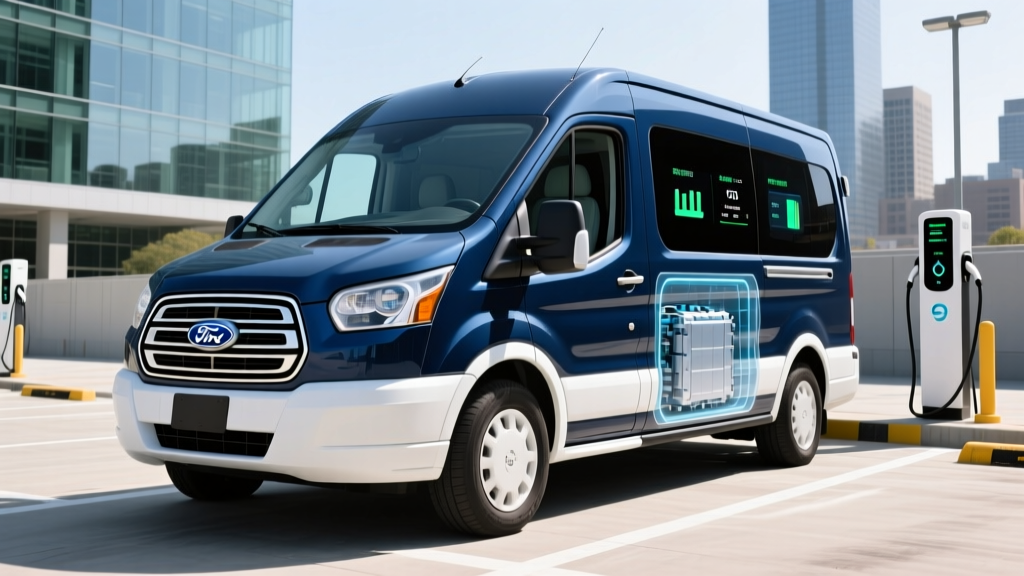
The commercial van segment is undergoing a quiet efficiency revolution, and the Ford Transit Hybrid sits at the center of it. Unlike Ford's fully electric E-Transit, the Transit Hybrid uses a conventional hybrid electric vehicle (HEV) powertrain — no plug required — pairing a 1.5-liter EcoBoost engine with an electric motor to squeeze more miles from every gallon. For fleet managers and owner-operators weighing fuel savings against the infrastructure demands of full electrification, this van occupies a compelling middle ground.
In this guide, we break down the 2026 Ford Transit Hybrid's real-world fuel economy, powertrain specs, battery longevity, warranty coverage, and total cost of ownership to help you decide if it's the right tool for your routes.
HEV vs. PHEV vs. Full EV: Where the Transit Hybrid Fits
Before examining specs, it's critical to understand what the Ford Transit Hybrid is — and what it isn't.
| Powertrain Type | Plug Required? | Electric-Only Range | Ford Transit Variant |
|---|---|---|---|
| HEV (Hybrid) | No — self-charging via regen + engine | Very short (low-speed maneuvering only) | Transit Hybrid (this review) |
| PHEV (Plug-in Hybrid) | Yes — 20-40 mi electric range typical | 20-40 miles | Not offered in US Transit lineup |
| BEV (Full Electric) | Yes — full charge required | 100-126 mi (E-Transit) | E-Transit |
The Ford Transit Hybrid is a conventional HEV. It does not plug in. It recovers energy through regenerative braking and the gasoline engine, storing it in a small battery that assists acceleration and enables brief engine-off operation at low speeds. There is no PHEV version of the Transit currently sold in the United States. If you need plug-in electric range, Ford offers the E-Transit as a separate all-electric model.
Fuel Economy: EPA MPG and Real-World Expectations
The headline question for any hybrid buyer: how many MPG does it actually get?
| Metric | Ford Transit Hybrid (EPA) | Gas-Only Transit 2.0L EcoBoost |
|---|---|---|
| City MPG | ~24 MPG | ~14-15 MPG |
| Highway MPG | ~24 MPG | ~18-19 MPG |
| Combined MPG | ~24 MPG | ~16 MPG |
The hybrid's biggest advantage shows up in city and stop-and-go driving, where regenerative braking recaptures energy that a gas-only van wastes as heat. Delivery routes with frequent stops — think last-mile logistics, plumbing, electrical service calls — see the largest efficiency gap between the hybrid and its gas counterpart.
For context, fueleconomy.gov lists official EPA ratings, which vary slightly by roof height, wheelbase, and axle ratio. Always confirm the specific configuration you're ordering.
Powertrain Specs: What's Under the Hood
| Specification | 2026 Ford Transit Hybrid |
|---|---|
| Engine | 1.5L EcoBoost I-3 (turbocharged) |
| Electric Motor | Integrated belt-driven motor/generator |
| Combined Horsepower | ~180 hp (combined system output) |
| Combined Torque | ~230 lb-ft |
| Transmission | CVT (continuously variable) |
| Drivetrain | Rear-wheel drive (RWD) |
| Hybrid Battery | ~1.1 kWh (lithium-ion), self-charging HEV |
| Max Payload | Up to ~3,200 lbs (config dependent) |
| Max Towing | Up to ~4,500 lbs (properly equipped) |
| Cargo Volume | 246.7 - 487.3 cu ft (by wheelbase/roof) |
The 1.5-liter three-cylinder EcoBoost engine may sound small for a full-size van, but the electric motor fills in low-RPM torque gaps that a turbo engine alone would struggle with when launching from a stop with cargo. The CVT keeps the engine in its most efficient RPM range, which is where much of the fuel savings come from in mixed driving.
One trade-off: the hybrid powertrain is optimized for efficiency, not maximum towing or heavy-haul performance. If your fleet regularly tows near the upper limits or operates in mountainous terrain with full payloads, the gas-only 3.5L EcoBoost V6 variant may still be the better fit.
Battery Warranty, Lifespan, and Replacement Cost
Hybrid battery longevity is the top concern we hear from fleet buyers. Here's the factual picture:
- Warranty Coverage: 8 years / 100,000 miles (whichever comes first)
- California & CARB states: 10 years / 150,000 miles on hybrid battery components
- Capacity Threshold: Warranty covers defects and significant capacity loss that impairs hybrid system function
- Replacement Cost (out of warranty): Estimated $2,500 - $4,000 for the HEV battery pack, plus labor (~$500-$800)
Because the Transit Hybrid uses a small ~1.1 kWh battery that never fully charges or fully depletes (the system keeps it in a narrow state-of-charge window), degradation is minimal compared to full EV batteries. Real-world data from Ford's earlier hybrid systems — including the Escape Hybrid and Fusion Hybrid — shows these packs routinely lasting 150,000+ miles without significant issues.
The battery operates in a shallow cycle: typically between 40% and 60% state of charge. This dramatically reduces wear compared to a BEV battery that cycles from 10% to 90%. For fleet operators running 20,000-30,000 miles per year, the battery should outlast the vehicle's useful economic life under normal conditions.
Pricing, Tax Credits, and Total Cost of Ownership
The Ford Transit Hybrid carries a price premium over the gas-only model, but the fuel savings can close that gap depending on your mileage.
| Trim / Config | Approximate MSRP |
|---|---|
| Transit T-150 Cargo Van (Low Roof, Regular WB) | ~$52,000 - $54,000 |
| Transit T-250 Cargo Van (Med Roof, Regular WB) | ~$55,000 - $58,000 |
| Transit T-350 Cargo Van (High Roof, Extended WB) | ~$58,000 - $62,000 |
| Transit Hybrid Premium (over gas equivalent) | + $3,000 - $4,500 |
Does the Ford Transit Hybrid Qualify for a Federal Tax Credit?
No. Under current IRS §30D rules, the federal clean vehicle tax credit of up to $7,500 applies only to plug-in electric vehicles — battery electric vehicles (BEVs) and plug-in hybrids (PHEVs) with at least 7 kWh of battery capacity. Because the Transit Hybrid is a conventional HEV with a ~1.1 kWh battery and no plug, it does not qualify for the §30D federal tax credit.
- ❌ Federal §30D Clean Vehicle Credit — not eligible (HEV, not plug-in)
- ❌ Commercial Clean Vehicle Credit (§45W) — not eligible (requires plug-in)
- ⚠️ Some state/local incentives may apply for hybrid commercial vehicles — check your state's energy office
- ✅ Standard business deductions (Section 179 expensing, bonus depreciation) still apply to the full purchase price
For full details on federal credit eligibility, consult the IRS Clean Vehicle Credits page.
5-Year Fuel Savings vs. Gas-Only Transit
Here's where the hybrid makes its case. Assuming 25,000 miles/year, $3.50/gallon average fuel cost:
| Cost Factor | Transit Hybrid (~24 MPG) | Gas Transit (~16 MPG) |
|---|---|---|
| Annual fuel (25k mi/yr) | ~$3,646 | ~$5,469 |
| 5-year fuel cost | ~$18,230 | ~$27,344 |
| 5-year fuel savings | ~$9,114 savings with hybrid | |
| Hybrid premium (upfront) | ~$3,000 - $4,500 | |
| Net 5-year benefit | ~$4,600 - $6,100 in favor of hybrid | |
The breakeven point typically arrives between years 2 and 3 for high-mileage urban fleets. If your vans run fewer than 15,000 miles per year or spend most of their time on open highway, the payback period extends and may not justify the premium.
Reliability and Fleet Maintenance Considerations
Ford's hybrid system in the Transit is derived from technology used across millions of vehicles globally, including the Ford Escape Hybrid (in production since 2020 for the current generation) and the Maverick Hybrid. Key reliability notes:
- No plug, no charging infrastructure needed. This eliminates the biggest operational hurdle of the E-Transit for fleets without depot charging.
- Regenerative braking reduces brake pad wear. Fleet operators report 30-50% longer brake pad life on hybrid vans due to regen handling much of the deceleration.
- CVT transmission. Ford's hybrid CVT has fewer moving parts than a conventional automatic. Long-term durability data from the Escape Hybrid shows no systemic issues.
- Routine maintenance mirrors the gas Transit: oil changes, air filters, tire rotations. The hybrid system adds no regular maintenance items.
- The 12V battery remains a standard maintenance item — separate from the hybrid traction battery.
For safety ratings, check the latest NHTSA ratings, as commercial vans are not always crash-tested by IIHS.
Who Should Choose the Ford Transit Hybrid?
- Your routes are primarily urban/suburban with frequent stops (delivery, service calls, shuttle)
- You drive 20,000+ miles per year per vehicle
- You lack depot or home charging infrastructure for a plug-in EV
- You want fuel savings without changing operational workflows
- Range anxiety or charging downtime is a dealbreaker for your business
- You primarily drive highway miles with few stops
- You regularly tow near maximum capacity or haul heavy loads in mountainous terrain
- Annual mileage is under 12,000 miles (payback period too long)
- Upfront budget is extremely tight and every dollar counts
- You have reliable depot Level 2 charging installed
- Your daily routes are under 100 miles and predictable
- You want to qualify for the §45W Commercial Clean Vehicle Credit (up to $7,500 for light-duty, $40,000 for heavy-duty)
- Zero tailpipe emissions are a corporate sustainability requirement
Pros and Cons at a Glance
- ~50% better city MPG than gas-only Transit
- No plug-in charging infrastructure required
- Reduced brake wear from regenerative braking
- Strong 8yr/100k-mile hybrid battery warranty
- Familiar Transit cargo configurations (low/med/high roof, multiple wheelbases)
- Proven hybrid tech from Ford's broader lineup
- $3,000-$4,500 price premium over gas equivalent
- No federal tax credit eligibility (HEV, not PHEV/BEV)
- Not ideal for heavy towing or sustained high-speed highway hauling
- Small HEV battery means no meaningful electric-only driving range
- Limited real-world long-term fleet data specific to Transit Hybrid (newer offering)
Frequently Asked Questions
How many MPG does the Ford Transit Hybrid get?
The Ford Transit Hybrid achieves approximately 24 MPG combined (city/highway) according to EPA estimates. In real-world urban delivery routes with frequent stops, drivers often match or slightly exceed this figure thanks to regenerative braking. Highway-only driving at sustained speeds drops efficiency to roughly 21-22 MPG.
Does the Ford Transit Hybrid need to be plugged in?
No. The Transit Hybrid is a conventional HEV (hybrid electric vehicle). It charges its own battery through regenerative braking and the gasoline engine. There is no plug, no charging cable, and no need for any charging infrastructure.
Is there a plug-in hybrid (PHEV) version of the Ford Transit?
As of the 2026 model year, Ford does not offer a PHEV version of the Transit in the United States. The Transit lineup includes the gas-only model, the Transit Hybrid (HEV), and the E-Transit (fully electric). European markets have had a Transit Custom PHEV, but it is not available in the US.
How long will the Transit Hybrid battery last?
Ford warranties the hybrid battery for 8 years or 100,000 miles (10 years/150,000 miles in California and CARB-adopting states). Because the HEV battery operates in a narrow charge window (roughly 40-60% SoC), degradation is minimal. Based on data from other Ford hybrid vehicles, these packs commonly last 150,000+ miles without issues.
What does it cost to replace the hybrid battery?
Out-of-warranty replacement for the Transit Hybrid's ~1.1 kWh HEV battery is estimated at $2,500-$4,000 for the pack, plus $500-$800 in labor. This is significantly less than a full EV battery replacement because the HEV pack is much smaller. Most owners will never need to replace it.
Does the Ford Transit Hybrid qualify for any tax credits?
The Transit Hybrid does not qualify for the federal §30D Clean Vehicle Credit or the §45W Commercial Clean Vehicle Credit, as both require plug-in capability (PHEV or BEV). However, standard business tax deductions — including Section 179 expensing and bonus depreciation — apply to the full purchase price. Some states may offer additional incentives for hybrid commercial vehicles; check your local regulations.
How does the Transit Hybrid compare to the E-Transit?
The E-Transit offers zero tailpipe emissions, lower per-mile energy cost (roughly $0.04-$0.06/mile vs. $0.15-$0.18/mile for the hybrid on gas), and eligibility for the §45W commercial credit. However, it has a 126-mile EPA range, requires depot Level 2 charging infrastructure ($2,000-$7,000+ per charger installed), and carries a higher MSRP. The Transit Hybrid is the pragmatic choice for fleets that can't yet commit to charging infrastructure or have routes exceeding 126 miles.
Can the Transit Hybrid tow and haul as much as the gas version?
Nearly, but not identically. The hybrid's payload and towing ratings are slightly reduced in some configurations due to the added weight of the hybrid system (~150-200 lbs). Maximum payload remains around 3,200 lbs and towing up to ~4,500 lbs when properly equipped, but check the specific door-jamb sticker for your configuration. For maximum towing, the 3.5L EcoBoost V6 gas model still holds the edge.