The Compact Truck Renaissance: Efficiency Meets Utility
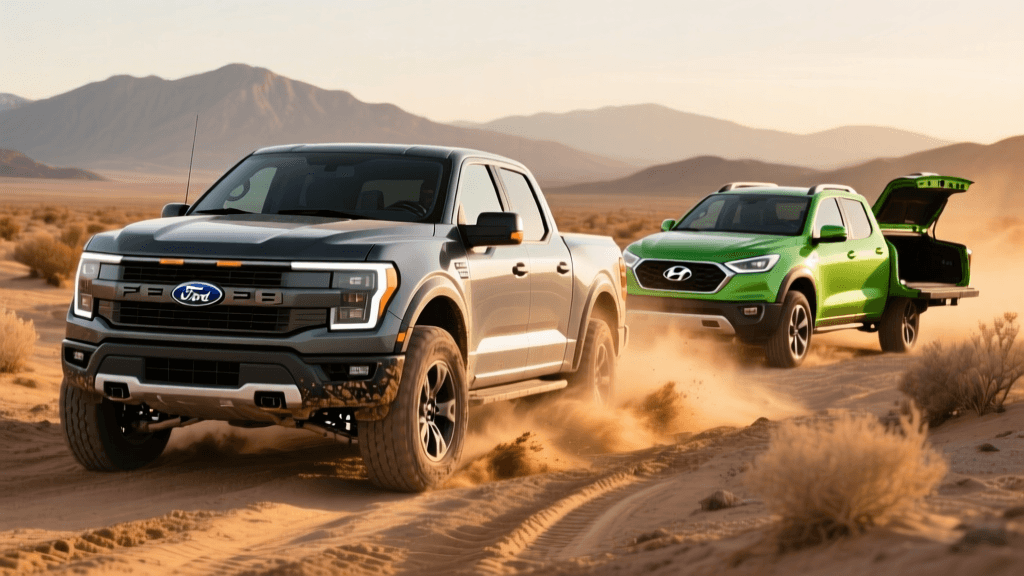
For decades, the truck market was dominated by full-size, body-on-frame behemoths that prioritized maximum towing capacity over daily livability and fuel economy. However, the recent resurgence of the unibody compact truck has completely disrupted the segment, offering consumers a right-sized alternative that fits in standard garages and sips fuel. Leading this charge are two wildly different interpretations of what a modern truck should be: the Ford Maverick Hybrid and the Hyundai Santa Cruz.
In this head-to-head product showdown, we are putting the segment-defining Ford Maverick Hybrid up against its closest market rival, the Hyundai Santa Cruz (equipped with the 2.5-liter turbocharged engine). While the Santa Cruz leans heavily into lifestyle performance, premium materials, and SUV-like dynamics, the Maverick Hybrid champions unmatched urban efficiency, clever DIY utility, and a remarkably low barrier to entry. If you are cross-shopping these two unibody trucks, the decision ultimately comes down to a battle of priorities: raw MPG and pragmatic utility versus all-weather traction and premium horsepower.
Powertrain and Real-World MPG Showdown
The most significant differentiator in this comparison is the powertrain architecture. The Ford Maverick Hybrid pairs a 2.5-liter Atkinson-cycle four-cylinder engine with an electric motor and a 1.1 kWh lithium-ion battery pack. This setup routes a combined 191 horsepower to the front wheels via an electronic continuously variable transmission (e-CVT). The result is an EPA-estimated 42 mpg in the city, 33 mpg on the highway, and 37 mpg combined. According to the EPA's official fuel economy database, the Maverick Hybrid is currently one of the most efficient trucks ever sold in the United States. In real-world testing conducted by automotive journalists, the Maverick Hybrid frequently exceeds its EPA estimates in urban environments, with some drivers reporting upwards of 45 mpg in stop-and-go traffic thanks to its aggressive regenerative braking profile.
Conversely, the Hyundai Santa Cruz aims for a more traditional, performance-oriented truck experience. Its top-tier 2.5-liter turbocharged four-cylinder engine produces 281 horsepower and 311 lb-ft of torque, mated to an eight-speed wet dual-clutch automatic transmission and HTRAC all-wheel drive. While this gives the Santa Cruz a massive advantage in highway passing power, towing, and off-road traction, it comes at a severe penalty at the pump. The turbocharged Santa Cruz is rated at just 19 mpg city, 27 mpg highway, and 22 mpg combined.
For buyers whose daily routine involves heavy city commuting, school runs, and suburban errands, the Maverick Hybrid's powertrain is a masterclass in efficiency, saving thousands of dollars annually at the pump compared to the Santa Cruz.
Utility, Payload, and Towing Capacity
When evaluating a truck, utility is paramount. Both vehicles utilize a unibody architecture, which carves out interior cabin space and improves ride quality but inherently limits extreme heavy-duty capabilities compared to traditional body-on-frame trucks like the Toyota Tacoma or Ford Ranger. However, there are distinct differences in how they handle work.
The Ford Maverick features a 4.5-foot bed, while the Santa Cruz offers a slightly shorter 4.25-foot bed. Where the Maverick Hybrid truly shines is its payload capacity relative to its size. Despite the added weight of the hybrid battery system, the Maverick Hybrid maintains an impressive 1,500-pound payload rating. The Santa Cruz, due to its heavier turbocharged AWD powertrain and complex multi-link rear suspension, maxes out at around 1,753 pounds in its lower trims, but drops to roughly 1,600 pounds on fully loaded Limited trims.
Towing is where the Santa Cruz strikes back. The Maverick Hybrid is strictly limited to a 2,000-pound towing capacity, which is sufficient for a small teardrop trailer, a utility trailer, or a couple of dirt bikes, but inadequate for larger boats or campers. The turbocharged Santa Cruz, when equipped with the factory tow package, boasts a robust 5,000-pound towing capacity, bridging the gap toward mid-size trucks.
Head-to-Head Utility Data Table
| Specification | Ford Maverick Hybrid (FWD) | Hyundai Santa Cruz (2.5T AWD) |
|---|---|---|
| Powertrain | 2.5L 4-Cyl Hybrid + e-CVT | 2.5L Turbo 4-Cyl + 8-Speed DCT |
| Horsepower / Torque | 191 hp / 155 lb-ft | 281 hp / 311 lb-ft |
| EPA Fuel Economy (City/Hwy/Comb) | 42 / 33 / 37 mpg | 19 / 27 / 22 mpg |
| Bed Length | 54 inches (4.5 feet) | 51 inches (4.25 feet) |
| Max Payload Capacity | 1,500 lbs | 1,609 lbs (Limited Trim) |
| Max Towing Capacity | 2,000 lbs | 5,000 lbs (with Tow Package) |
| Drivetrain | Front-Wheel Drive (FWD) | HTRAC All-Wheel Drive (AWD) |
Bed Innovation: DIY vs. Premium Storage
Ford and Hyundai took radically different approaches to bed utility. As highlighted in Car and Driver's extensive coverage of the Maverick, Ford embraced the DIY community with the Ford Integrated Tether System (FITS). The Maverick's bed features pre-stamped slots and standard 1/4-inch and M6 threaded bolts, allowing owners to 3D-print their own dividers, tie-downs, and custom storage solutions. Furthermore, the Maverick Hybrid offers available 110V and 12V power outlets in the bed, making it a mobile workstation or tailgate power hub. The Maverick's tailgate can also be locked in a mid-position to support 4x8 sheets of plywood, a crucial feature for contractors that the Santa Cruz cannot replicate as easily.
Hyundai, on the other hand, focused on secure, hidden storage. The Santa Cruz features dual lockable, weather-sealed under-bed storage bins accessible from the sides of the truck. These bins are perfect for storing wet gear, muddy boots, or tools out of sight. Additionally, the Santa Cruz offers an available integrated tonneau cover that slides seamlessly into a hidden cassette, preserving the truck's sleek profile. While the Maverick wins for customizable, open-bed work, the Santa Cruz wins for secure, lifestyle-oriented storage.
Interior Space and Daily Drivability
Because both trucks are built on unibody platforms derived from compact SUVs (the Escape for Ford, the Tucson for Hyundai), their ride quality and interior ergonomics are vastly superior to traditional trucks. The Maverick's interior is unapologetically utilitarian. It uses exposed screw heads, modular door panels, and hard plastics that are designed to be wiped down and replaced easily. However, it offers excellent rear-seat legroom and a highly intuitive infotainment system with a standard 8-inch touchscreen.
The Santa Cruz feels like a luxury SUV with a bed attached. Higher trims offer leather seating, a premium Bose audio system, and a more sophisticated digital gauge cluster. The rear seat is slightly tighter than the Maverick's, and the sloping roofline cuts into headroom, but the overall material quality is a tier above Ford's entry-level offerings. From a driving dynamics perspective, the Santa Cruz's available multi-link rear suspension provides a more composed and independent ride over rough pavement compared to the Maverick Hybrid's torsion-beam rear axle, which can feel slightly bouncy when the bed is completely empty.
Total Cost of Ownership: The 5-Year Projection
When analyzing the total cost of ownership, the Maverick Hybrid's initial MSRP advantage is compounded by its massive fuel savings. The base Maverick Hybrid XL starts in the low $25,000 range, while a comparably equipped Santa Cruz with the turbocharged engine and AWD often pushes past $38,000.
Assuming 15,000 miles driven annually and a national average gas price of $3.50 per gallon, the Maverick Hybrid (at 37 mpg combined) will consume roughly 405 gallons of fuel per year, costing about $1,417. The Santa Cruz Turbo (at 22 mpg combined) will consume 681 gallons, costing roughly $2,383. Over five years, the Maverick Hybrid saves the owner nearly $5,000 in fuel costs alone, not including the initial purchase price discrepancy, insurance variations, and maintenance. For budget-conscious buyers, the financial argument for the Maverick Hybrid is undeniable.
The Verdict: Which Compact Truck Wins?
The outcome of this head-to-head showdown depends entirely on your lifestyle requirements. The Hyundai Santa Cruz is the superior choice for buyers who need all-weather AWD capability, frequent highway towing, and a premium, quiet cabin that mimics a luxury crossover. It is a fantastic lifestyle vehicle that refuses to compromise on highway passing power.
However, the Ford Maverick Hybrid takes the crown for the majority of compact truck buyers. Its staggering 42 mpg city rating, lower starting price, brilliant DIY bed features, and superior rear-seat space make it the ultimate daily driver. As noted by experts at MotorTrend, the Maverick Hybrid proves that you do not need to sacrifice truck utility to achieve hybrid-car efficiency. If your towing needs are light and your daily commute is heavy, the Ford Maverick Hybrid is the undisputed champion of the compact truck segment.