The Hybrid Pickup That Actually Makes Sense for Most Buyers
When shoppers search for a hybrid pickup, they're usually weighing two frustrations: the fuel cost of a traditional truck and the range or charging constraints of a full electric one. The 2026 Ford Maverick Hybrid lands squarely in the middle — a compact unibody truck with a conventional hybrid (HEV) powertrain that delivers car-like fuel economy without requiring a single plug-in session.
Now in its fifth model year, the Maverick Hybrid continues to be the only mainstream compact hybrid pickup on the U.S. market. The midsize Toyota Tacoma offers a turbo-four and the larger Ford F-150 and Toyota Tundra offer hybrid V6 options, but at a significantly higher price and weight penalty. For urban and suburban truck buyers who need a bed occasionally but commute daily, the Maverick Hybrid remains the efficiency benchmark.
| Spec | Value |
|---|---|
| Powertrain | 2.5L Atkinson-cycle I-4 + electric motor (HEV) |
| Combined Horsepower | 194 hp |
| Drivetrain | FWD standard; AWD available |
| EPA Fuel Economy (FWD) | 42 city / 33 highway / 37 combined MPG |
| EPA Fuel Economy (AWD) | 40 city / 34 highway / 37 combined MPG |
| Fuel Tank | 16.5 gallons |
| Total Driving Range | ~610 miles (FWD combined) |
| Max Towing (w/ 4K Tow Pkg) | 4,000 lbs |
| Max Payload | 1,500 lbs |
| Bed Length | 4.5 ft (54.4 cu ft volume) |
| 0–60 mph | ~7.9 seconds |
| Base MSRP (XL FWD) | $28,990 |
| Hybrid Battery Warranty | 8 years / 100,000 miles |
HEV vs PHEV: What Kind of Hybrid Is the Maverick?
A common source of confusion among truck shoppers is the difference between a conventional hybrid (HEV) and a plug-in hybrid (PHEV). The Maverick is an HEV — it never needs to be plugged in. Here's how the two types compare:
| Feature | Conventional Hybrid (HEV) — Maverick | Plug-In Hybrid (PHEV) |
|---|---|---|
| Plug-in charging required? | No | Yes (for electric-only range) |
| Electric-only range | ~1 mile at low speed | Typically 25–45 miles |
| Battery size | ~1.1 kWh (small buffer) | 13–20+ kWh |
| Regenerative braking | Yes — recaptures energy | Yes — recaptures energy |
| Federal tax credit (§30D) | Not eligible | Up to $7,500 if eligible |
| Best for | No home charging; city commuting | Home charging; short daily commutes |
The Maverick's 1.1 kWh nickel-metal-hydride (NiMH) traction battery is charged entirely by the gasoline engine and regenerative braking. You drive it exactly like a conventional truck — fill up at the pump and go. There is no charging port, no DC fast-charging capability, and no electric-only highway driving. What you get instead is seamless engine-motor blending that dramatically cuts city fuel consumption.
How Many MPG Does the Maverick Hybrid Actually Get?
| Configuration | City MPG | Highway MPG | Combined MPG |
|---|---|---|---|
| FWD | 42 | 33 | 37 |
| AWD | 40 | 34 | 37 |
Source: EPA fueleconomy.gov
The headline number is the Maverick Hybrid's 42 MPG city rating (FWD), which is remarkable for any vehicle, let alone a pickup. But the story is more nuanced when you look at real-world driving patterns:
City and suburban driving: This is where the Maverick Hybrid excels. The electric motor handles low-speed launches, stop-and-go traffic, and parking-lot crawling, while the Atkinson-cycle engine kicks in only when needed. Many owners report exceeding the EPA city figure, with real-world city loops yielding 43–46 MPG in warm weather. Hybrid systems always perform best in stop-and-go conditions where regenerative braking continuously recharges the small battery.
Highway driving: The 33 MPG highway figure is accurate but can dip to 29–31 MPG at sustained 75–80 mph speeds, especially with a loaded bed or headwinds. The aerodynamic profile of a pickup and the engine doing all the work at highway speeds (the electric motor provides minimal assist above ~45 mph) explain the city-highway split. This is normal hybrid behavior.
Cold weather: Expect a 10–15% efficiency drop in sub-40°F temperatures. The engine runs more frequently to maintain cabin heat and battery temperature, reducing the electric motor's contribution. Winter city MPG typically falls to 35–38 MPG for FWD models.
Loaded/towing: With a near-max payload or a trailer in the 2,500–4,000 lb range, fuel economy drops to the low-to-mid 20s. This is a meaningful limitation compared to diesel trucks, but the Maverick was never designed as a heavy-haul work truck.
Powertrain Deep Dive: 194 HP From a 2.5L Hybrid
The Maverick Hybrid pairs Ford's 2.5-liter Atkinson-cycle inline-four with a permanent-magnet electric motor integrated into the transmission housing. Combined output is 194 horsepower — split between 162 hp from the gasoline engine and supplemental torque from the electric motor. Power is routed through an electronically controlled continuously variable transmission (eCVT), not a traditional belt-driven CVT.
Ford's eCVT uses a planetary gearset to blend engine and motor power seamlessly. There are no rubber bands or slipping belts. Acceleration is linear and predictable, with the electric motor filling in torque gaps during gear transitions. The 0–60 mph time of approximately 7.9 seconds is adequate for merging and passing, though noticeably slower than the available 2.0L EcoBoost turbo model (5.9 seconds).
AWD models add a rear-mounted electric motor that engages the rear wheels on demand — for launch traction, slippery conditions, or hard cornering. Unlike a mechanical AWD system with a driveshaft, the rear motor operates independently, which is why the AWD Maverick Hybrid loses only 2 MPG in the city versus FWD.
Towing, Payload, and the 4K Tow Package
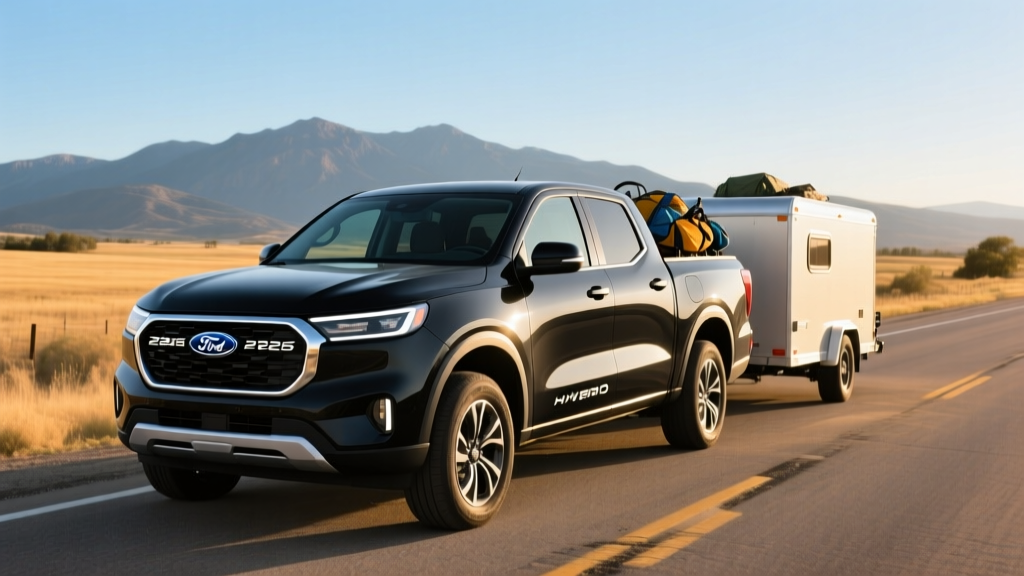
The standard Maverick Hybrid is rated for 2,000 lbs of towing. With the optional 4K Tow Package (available on Lariat and select trims), that capacity doubles to 4,000 lbs — enough for a small boat trailer, a pair of ATVs, or a lightweight camping trailer.
Key towing considerations for hybrid buyers:
- Trailer brake controller: Included with the 4K Tow Package. Required for trailers over 1,500 lbs in most states.
- Tongue weight: Maximum 400 lbs. Keep payload in the bed minimal when towing near the limit.
- Real-world fuel economy while towing: Expect 20–25 MPG combined with a 2,500–3,500 lb trailer. The hybrid system provides minimal efficiency benefit under sustained towing load.
- No hybrid AWD with 4K Tow: The 4K Tow Package is available with FWD only on the hybrid. AWD hybrid models are limited to 2,000 lbs towing.
Maximum payload is 1,500 lbs across all hybrid trims — competitive for the compact truck segment but significantly less than midsize trucks like the Tacoma (1,700+ lbs) or full-size options.
Pricing, Trims, and Tax Credit Eligibility
The 2026 Maverick Hybrid is available across multiple trims:
| Trim | Drivetrain | MSRP (incl. destination) |
|---|---|---|
| XL | FWD | $28,990 |
| XLT | FWD | $30,990 |
| Lariat | FWD | $34,490 |
| Lobo (performance-oriented) | AWD | $36,490 |
| Tremor (off-road) | AWD | $38,490 |
Federal tax credit: The Maverick Hybrid does not qualify for the IRS §30D Clean Vehicle Credit. That credit applies only to plug-in electric vehicles (BEVs and PHEVs) with battery capacities of at least 7 kWh. The Maverick's ~1.1 kWh NiMH battery falls well below the threshold. There is no federal hybrid-specific purchase incentive as of 2026.
Some states and municipalities offer rebates or HOV lane access for hybrid vehicles, but these vary widely. Check your state's energy office or the Alternative Fuels Data Center for local incentives.
Total cost of ownership advantage: Where the Maverick Hybrid saves money is at the pump. At $3.50/gallon and 15,000 miles/year, a Maverick Hybrid (37 MPG combined) costs approximately $1,419/year in fuel. A comparable gas-only compact truck at 23 MPG combined costs $2,283/year — a savings of roughly $864/year, or $4,320 over five years. Factor in the hybrid's competitive base price (no premium over many gas-only competitors), and the payback period is immediate.
Battery Warranty, Reliability, and Replacement Cost
Hybrid Battery Warranty: Ford covers the Maverick Hybrid's high-voltage battery for 8 years or 100,000 miles, whichever comes first. In California Air Resources Board (CARB) states, that extends to 10 years or 150,000 miles under emissions warranty requirements. The warranty covers capacity loss below a defined threshold and any manufacturing defects.
Longevity data: Ford's 2.5L hybrid system has been in production since the 2020 Escape Hybrid and shares architecture with the Toyota-derived hybrid synergy drive (Ford and Toyota cross-licensed hybrid patents in the early 2000s). NiMH batteries in this class of hybrid have demonstrated strong longevity — Toyota Prius and Ford Escape Hybrid taxis routinely surpass 200,000 miles on the original battery. The Maverick's relatively small battery undergoes shallow charge-discharge cycles (never fully depleted, never fully charged), which is the gentlest possible usage pattern for battery chemistry.
Replacement cost: If the hybrid battery does fail out of warranty, a replacement pack currently costs between $2,500 and $4,000 including labor at a Ford dealer. Third-party refurbishers offer reconditioned packs for $1,500–$2,500. This is significantly less than BEV battery replacements ($8,000–$20,000+) because the pack is small (~1.1 kWh).
General reliability: The Maverick Hybrid has earned strong reliability marks. The eCVT transmission has no traditional friction clutches or torque converters to wear out. Brake pad life is extended by regenerative braking — many hybrid owners report 60,000+ miles on original brake pads. The main maintenance items remain oil changes, tire rotations, and cabin air filters.
Hybrid vs PHEV vs Full EV Pickup: Which Fits You?
The Maverick Hybrid competes not just with other trucks but with alternative powertrain philosophies. Here's a practical decision framework:
Choose the Maverick Hybrid (HEV) if:
- You don't have access to home Level 2 charging (apartment, street parking, no garage)
- Your driving is mostly city/suburban with frequent stops
- You want a truck bed but don't need to tow over 4,000 lbs regularly
- You want the lowest fuel cost without changing your refueling habits
- Budget matters — starting under $29,000 with no charging infrastructure investment
Choose a PHEV truck (e.g., upcoming options) if:
- You have home charging and a daily commute under 30–40 miles
- You want electric-only daily driving but gas flexibility for road trips
- You qualify for the §30D federal tax credit (up to $7,500 with income/MSRP/sourcing requirements)
Choose a full EV truck (e.g., Ford F-150 Lightning, Rivian R1T) if:
- You have reliable home Level 2 charging
- You want maximum torque, a frunk, and zero tailpipe emissions
- Your daily driving is under 250 miles and you road-trip infrequently
- You qualify for the full §30D credit and your budget allows $50,000+
For 2026, the Maverick Hybrid remains the only compact hybrid pickup available new in the U.S. The Hyundai Santa Cruz offers a turbo engine but no hybrid option. The Ford Ranger and Toyota Tacoma do not offer hybrid powertrains in their current generations. If you specifically need a hybrid pickup at a compact size and accessible price, the Maverick is a segment of one.
Pros and Cons at a Glance
Pros
- Best-in-class city fuel economy (42 MPG EPA)
- No plug-in charging required — zero lifestyle change
- Lowest base price in the new-truck market (~$29K)
- 4,000-lb towing with 4K Tow Package
- Proven hybrid powertrain with 8yr/100K battery warranty
- Extended brake pad life from regenerative braking
- AWD available with minimal MPG penalty
Cons
- Highway MPG (33) is only average — no hybrid advantage at speed
- AWD hybrid cannot get the 4K Tow Package (2,000-lb limit)
- No federal tax credit eligibility
- 4.5-ft bed is shorter than most compact/midsize competitors
- Not suited for heavy towing or commercial-grade payloads
- eCVT drone under hard acceleration
- No DC fast charging (not applicable — HEV, not PHEV)
Frequently Asked Questions
How many MPG does the 2026 Maverick Hybrid get in real-world driving?
Real-world results vary by driving pattern. In city and suburban use, owners consistently report 40–46 MPG, often exceeding the EPA's 42 MPG city estimate. Highway driving at 70–80 mph typically yields 29–33 MPG. Combined real-world MPG for mixed driving averages 35–39 MPG. Cold weather (below 40°F) reduces city efficiency by roughly 10–15%.
Does the Maverick Hybrid need to be plugged in?
No. The Maverick Hybrid is a conventional hybrid (HEV), not a plug-in hybrid (PHEV). The small traction battery charges through regenerative braking and the gasoline engine. You refuel it at a gas station like any other vehicle. There is no charging port on the truck.
How far can the Maverick Hybrid drive on electric power alone?
Effectively zero miles at meaningful speeds. The electric motor can propel the truck at very low speeds (under ~25 mph in parking lots) for brief distances, but the engine engages almost immediately for normal driving. This is standard HEV behavior — the motor assists the engine rather than replacing it. If you want meaningful electric-only range, you need a PHEV or BEV.
Does the Maverick Hybrid qualify for any federal tax credit?
No. The IRS §30D Clean Vehicle Credit requires a battery capacity of at least 7 kWh and plug-in charging capability. The Maverick Hybrid's ~1.1 kWh NiMH battery does not meet these requirements. As of 2026, there is no federal purchase incentive specifically for conventional hybrids. Check IRS.gov for current credit rules and the Alternative Fuels Data Center for state-level incentives.
Is the Maverick Hybrid battery reliable, and what does replacement cost?
Ford covers the hybrid battery for 8 years/100,000 miles (10 years/150,000 miles in CARB states). The 2.5L hybrid system has been in production since 2020 and uses proven NiMH chemistry with shallow cycling — the gentlest battery usage pattern. Out-of-warranty replacement costs $2,500–$4,000 at a dealer, or $1,500–$2,500 through third-party refurbishers. Based on data from similar Ford and Toyota hybrid systems, battery failure before 150,000 miles is uncommon.
Can the Maverick Hybrid tow a camper trailer?
With the 4K Tow Package (FWD only), the Maverick Hybrid can tow up to 4,000 lbs — suitable for lightweight teardrop campers, pop-up trailers, or small travel trailers. Without the package, the limit is 2,000 lbs. AWD hybrid models are limited to 2,000 lbs regardless. Expect fuel economy to drop to the low-to-mid 20s while towing.
How does the Maverick Hybrid compare to the F-150 PowerBoost hybrid?
The F-150 PowerBoost is a full-size truck with a 3.5L twin-turbo V6 hybrid producing 430 hp and 570 lb-ft of torque, rated for up to 12,700 lbs of towing. Its combined fuel economy is approximately 23–25 MPG. The Maverick Hybrid is smaller, less powerful, and far less capable for heavy work — but costs $15,000–$25,000 less and delivers roughly 50% better city fuel economy. They serve fundamentally different use cases.