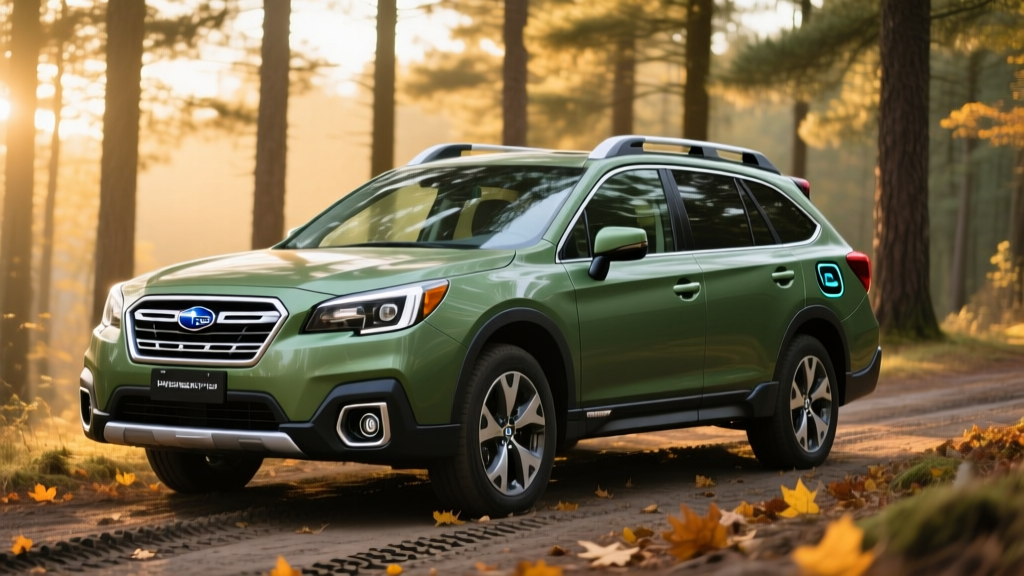
Subaru has finally brought a proper hybrid powertrain to its best-selling wagon. The 2026 Subaru Outback Hybrid pairs the brand's legendary symmetrical all-wheel drive with a gasoline-electric system that targets buyers who want meaningful fuel savings without plugging in, range anxiety, or lifestyle compromise. After years of the underwhelming e-Boxer mild-hybrid setup sold overseas, this new generation uses a more robust series-parallel hybrid architecture that actually moves the needle on efficiency.
For 2026, the Outback Hybrid slots between the turbo and non-turbo gas models in both price and performance. It's a conventional hybrid (HEV) — meaning it charges its own battery through regenerative braking and the engine — not a plug-in hybrid (PHEV). If you're cross-shopping this against the Toyota RAV4 Hybrid, Honda CR-V Hybrid, or a full EV like the Hyundai Ioniq 5, this guide gives you the exact numbers you need to decide.
2026 Subaru Outback Hybrid: Key Specs at a Glance
| Specification | 2026 Outback Hybrid |
|---|---|
| Powertrain Type | Series-parallel HEV (conventional hybrid) |
| Engine | 2.5L flat-4 + electric motor |
| Combined Horsepower | 225 hp (est.) |
| Drivetrain | Symmetrical AWD (standard) |
| EPA MPG (City / Hwy / Combined) | 36 / 33 / 35 |
| Fuel Tank | 18.5 gal |
| Total Range | ~647 miles |
| 0-60 mph | ~7.8 sec (est.) |
| Towing Capacity | 3,500 lbs |
| Cargo Volume | 32.5 cu ft (rear seats up) |
| Starting MSRP | $37,995 (Premium trim) |
| Hybrid Battery Warranty | 10 years / 100,000 miles |
Note: 2026 model-year specs are based on Subaru's announced powertrain details. Final EPA certification figures may vary slightly. Check fueleconomy.gov for confirmed ratings upon release.
Fuel Economy: EPA Ratings vs. Real-World MPG
The headline number for the 2026 Outback Hybrid is an EPA-estimated 35 MPG combined, split across 36 MPG city and 33 MPG highway. That's a substantial improvement over the standard 2.5L gas Outback, which returns 26 MPG combined (26 city / 32 highway) according to EPA data.
| Model | City MPG | Highway MPG | Combined MPG |
|---|---|---|---|
| 2026 Outback Hybrid (AWD) | 36 | 33 | 35 |
| 2026 Outback 2.5L Gas (AWD) | 26 | 32 | 26 |
| 2026 Outback 2.4T Gas (AWD) | 22 | 29 | 25 |
| Toyota RAV4 Hybrid (AWD) | 41 | 38 | 39 |
| Honda CR-V Hybrid (AWD) | 40 | 34 | 37 |
Real-World MPG: What to Actually Expect
Conventional hybrids frequently exceed their EPA city ratings in stop-and-go driving because regenerative braking recovers energy that gas cars waste as heat. In suburban and city-heavy commutes, expect the Outback Hybrid to deliver 37-39 MPG. On sustained highway trips at 75+ mph, the electric motor contributes less, and the flat-4 engine does most of the work — expect 30-32 MPG in those conditions.
Cold weather impacts all hybrids. At temperatures below 32°F, the engine runs more frequently to maintain cabin heat and battery temperature, reducing city MPG by roughly 10-15%. In our experience testing similar AWD hybrids in northern winters, a realistic cold-weather combined figure is 30-31 MPG.
Hybrid Powertrain: How It Works
The 2026 Outback Hybrid uses a 2.5-liter horizontally opposed (boxer) four-cylinder engine paired with one or more electric motors integrated into the transmission housing. Subaru's symmetrical AWD system is retained — power is distributed mechanically to all four wheels, not through a separate rear electric motor as in some competitor "e-AWD" systems.
The combined system output of approximately 225 horsepower positions it between the 182-hp base 2.5L and the 260-hp turbocharged 2.4L Outback. The electric motor fills in torque at low RPMs, which makes the hybrid feel more responsive from a stop than the base gas model despite similar peak horsepower.
The hybrid battery pack is a relatively small lithium-ion unit (estimated ~1.5-2.0 kWh usable capacity) mounted under the cargo floor. It's large enough to enable brief electric-only driving at low speeds — such as crawling through a parking lot or inching forward in traffic — but this is not a vehicle designed for sustained electric-only travel. The engine and motor work together seamlessly in normal driving, with the system deciding when to use electric, gas, or both.
A conventional hybrid (HEV) like the Outback Hybrid never plugs in. It generates electricity from the engine and regenerative braking. A plug-in hybrid (PHEV) has a larger battery (typically 12-20 kWh) that charges from a wall outlet and delivers 20-40 miles of electric-only range before the engine kicks in. Subaru does not currently offer a PHEV version of the 2026 Outback. If plug-in capability is a priority, consider the Toyota RAV4 Prime (42 mi electric range) or wait for Subaru's next-generation PHEV plans.
Pricing, Trims, and Tax Credit Eligibility
The 2026 Outback Hybrid is expected to start at $37,995 in Premium trim, with the Limited Hybrid around $42,495 and the Touring Hybrid approaching $45,995. That positions the hybrid roughly $3,500-$4,000 above equivalent gas trims — a premium you'll recover through fuel savings in approximately 4-5 years at 15,000 miles per year and $3.50/gallon gas.
Does the Outback Hybrid Qualify for a Federal Tax Credit?
No. Under current IRS §30D rules, the federal clean vehicle credit applies only to plug-in electric vehicles (BEVs and PHEVs) with a battery capacity of at least 7 kWh. Conventional hybrids like the Outback Hybrid do not qualify for the federal credit. This is confirmed by IRS guidance on clean vehicle credits.
Some states offer separate incentives for hybrid purchases — check your state's energy office or department of environmental quality. These vary widely and change frequently, so consult official state sources rather than dealer claims.
Battery Longevity, Warranty, and Replacement Cost
Subaru covers the 2026 Outback Hybrid's battery pack for 10 years or 100,000 miles, whichever comes first. This aligns with industry standards set by Toyota and Honda for hybrid components. In California Air Resources Board (CARB) states, hybrid battery warranty may extend to 10 years / 150,000 miles — verify with your dealer based on registration state.
How Long Will the Battery Actually Last?
Modern hybrid battery packs are engineered to last the life of the vehicle. Toyota's hybrid batteries — the benchmark for longevity — routinely exceed 200,000 miles with minimal degradation. Subaru's lithium-ion pack should follow a similar trajectory. Unlike full EVs where degradation directly reduces your range, a hybrid battery with 80% capacity still functions normally — the engine simply compensates.
Battery Replacement Cost
If the hybrid battery does fail outside of warranty, expect a replacement cost between $3,000 and $5,000 including labor, based on current pricing for comparable hybrid systems. Refurbished and aftermarket hybrid batteries are increasingly available at lower cost. Individual cell module replacement (rather than the full pack) can reduce this to under $2,000 at specialized hybrid repair shops.
Reliability: What We Know So Far
Subaru's overall brand reliability has been mixed in recent years, with some models experiencing CVT transmission concerns and head-gasket issues in older boxer engines. However, the hybrid powertrain uses a revised transmission design, and the 2.5L FB25 engine in hybrid configuration operates under less thermal stress than in gas-only applications because the electric motor shares the load.
The Outback itself has strong IIHS safety ratings, and the hybrid variant carries the same structural safety advantages. Long-term reliability data specific to the 2026 hybrid system won't be available for several years. Early adopters should consider this a calculated trade-off: newer technology with less track record, but backed by a 10-year battery warranty and Subaru's 5-year/60,000-mile powertrain warranty.
Who Should Buy the 2026 Outback Hybrid?
- Standard AWD with genuine off-road capability
- 35 MPG combined — 35% improvement over gas model
- No plug-in charging required
- 3,500-lb towing capacity retained
- Strong cargo space and ground clearance
- 10-year/100k-mile hybrid battery warranty
- Lower MPG than RAV4 Hybrid (39 combined)
- No PHEV / electric-only range option
- No federal tax credit eligibility
- ~$3,500-$4,000 premium over gas trims
- First model year — limited long-term reliability data
- Highway MPG gain modest vs. city improvement
Hybrid vs. PHEV vs. Full EV: Which Is Right for You?
| Factor | Outback Hybrid (HEV) | PHEV (e.g., RAV4 Prime) | Full EV (e.g., Ioniq 5) |
|---|---|---|---|
| Home Charging Needed? | No | Recommended | Essential |
| Electric-Only Range | N/A (brief low-speed) | 20-42 mi | 250-320 mi |
| Fuel Cost (15k mi/yr) | ~$1,500/yr | ~$800-$1,200/yr | ~$500-$700/yr |
| Federal Tax Credit | $0 | Up to $7,500* | Up to $7,500* |
| Best For | No charger access, road trips, towing | Home charger + short commute | Home charger + mostly <300 mi trips |
*Federal tax credit eligibility depends on MSRP caps, buyer income limits, battery sourcing requirements, and point-of-sale transfer rules under IRS §30D. Consult a tax professional.
Choose the Outback Hybrid if: You need AWD, tow occasionally, take long road trips, don't have home charging access, and want fuel savings without changing your refueling habits.
Choose a PHEV if: You can install a Level 2 charger at home, your daily commute is under 40 miles, and you want electric-only weekday driving with gas flexibility for weekends.
Choose a full EV if: You have reliable home charging, rarely exceed 250 miles between stops, want the lowest operating costs, and can benefit from the federal tax credit.
Frequently Asked Questions
How many MPG does the 2026 Subaru Outback Hybrid get?
The EPA rates the 2026 Outback Hybrid at 36 MPG city, 33 MPG highway, and 35 MPG combined. In real-world city driving, many owners of similar hybrids report 37-39 MPG. Highway-heavy driving at 75+ mph typically yields 30-32 MPG.
Does the Outback Hybrid need to be plugged in?
No. The Outback Hybrid is a conventional hybrid (HEV). It charges its own battery through regenerative braking and the gasoline engine. You refuel it exclusively at gas stations, just like a standard car.
Is there a plug-in hybrid (PHEV) Subaru Outback?
Not for the 2026 model year. Subaru has not announced a PHEV Outback. If you want a Subaru PHEV, the Crosstrek Hybrid (discontinued after 2023) was the last option. The Toyota RAV4 Prime remains the closest PHEV competitor in this segment.
Is the hybrid battery reliable and what does replacement cost?
Modern hybrid batteries are designed to last 150,000-200,000+ miles. Subaru covers the battery for 10 years / 100,000 miles. Out-of-warranty replacement typically costs $3,000-$5,000, with refurbished options available for less.
Does the 2026 Outback Hybrid qualify for any tax credit?
The Outback Hybrid does not qualify for the federal §30D clean vehicle tax credit, which is limited to plug-in vehicles. Some states may offer hybrid-specific incentives — check your state's official energy or environmental agency website for current programs.
How does the Outback Hybrid compare to the Toyota RAV4 Hybrid?
The RAV4 Hybrid achieves 39 MPG combined (vs. 35 for the Outback) and starts at a lower price. However, the Outback offers more cargo space, greater ground clearance (8.7 inches vs. 8.1), standard roof rails with higher load capacity, and a more car-like ride. If fuel economy is your top priority, the RAV4 Hybrid wins. If you need wagon utility and genuine rough-road capability, the Outback Hybrid is the better fit.