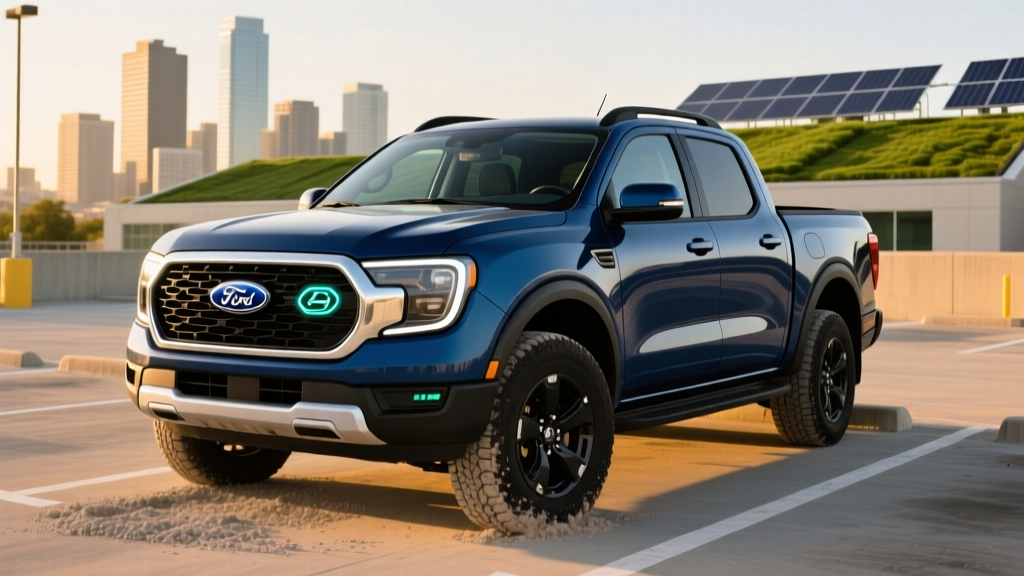
If you've been searching for a car truck hybrid that doesn't force you to choose between utility and fuel economy, the 2026 Ford Maverick Hybrid remains the segment benchmark. Built on a unibody car platform rather than a traditional body-on-frame truck chassis, the Maverick Hybrid pairs a 2.5-liter Atkinson-cycle four-cylinder with an electric motor to deliver pickup capability at sedan-like fuel costs. For the 2026 model year, Ford has expanded the hybrid powertrain availability across more trims and added an updated infotainment system, but the core formula that made it a breakout hit remains intact.
This guide breaks down every number that matters — EPA MPG, real-world efficiency, powertrain output, towing capacity, pricing, and battery longevity — so you can decide whether the Maverick Hybrid fits your driveway better than a full EV, a conventional gas truck, or a plug-in hybrid alternative.
HEV vs PHEV: What Kind of Hybrid Is the Maverick?
Before examining the specs, it's essential to clarify a common point of confusion. The Ford Maverick Hybrid is a conventional hybrid (HEV), not a plug-in hybrid (PHEV). That distinction changes everything about how you own it.
| Feature | HEV (Maverick Hybrid) | PHEV (e.g., Toyota RAV4 Prime) |
|---|---|---|
| Plug-in charging required? | No — self-charging via regen & engine | Yes — plug in for EV-only range |
| Electric-only driving | Limited (low-speed, short bursts) | 25–42 miles typical |
| Battery size | 1.1 kWh (small buffer) | 14–18 kWh |
| Federal tax credit (§30D) | Not eligible | Up to $7,500 (if criteria met) |
| Home charger needed? | No | Recommended (Level 2) |
The Maverick Hybrid recovers energy through regenerative braking and the gasoline engine to keep its small battery charged. You never plug it in. You simply fuel it with regular 87-octane gasoline and drive. This makes it ideal for buyers who lack access to home charging infrastructure but still want meaningful fuel savings over a gas-only truck.
Fuel Economy: EPA Ratings and Real-World MPG
The headline number is why most buyers land on this page. Here's what the EPA officially rates for the 2026 Ford Maverick Hybrid (FWD):
| Driving Cycle | EPA MPG | Real-World Expectation |
|---|---|---|
| City | 42 MPG | 40–45 MPG (hybrids often exceed EPA in stop-and-go) |
| Highway | 33 MPG | 29–33 MPG (aerodynamic drag hurts at 75+ mph) |
| Combined | 37 MPG | 34–38 MPG depending on driving mix |
Why hybrids often beat EPA in the city: Conventional hybrids like the Maverick shine in urban driving because the electric motor handles low-speed propulsion, regenerative braking recaptures energy at every stoplight, and the engine shuts off at idle. In contrast, highway driving relies more heavily on the gasoline engine and faces sustained aerodynamic drag, which is why the highway number drops to 33 MPG.
AWD penalty: If you opt for the available AWD hybrid configuration (introduced for 2025 and continued for 2026), expect a 2–3 MPG reduction across the board. The EPA rates the AWD hybrid at approximately 40 city / 31 highway / 35 combined.
Real-world range estimate: With a 16.5-gallon fuel tank and 37 MPG combined, the Maverick Hybrid can cover roughly 610 miles between fill-ups in mixed driving. In predominantly city driving at 42 MPG, range extends past 690 miles. That's fewer fuel stops than any gas-only compact truck on the market.
Powertrain Specs: Engine, Motor, and Horsepower
| Specification | 2026 Ford Maverick Hybrid |
|---|---|
| Engine | 2.5L Atkinson-cycle I-4 |
| Electric Motor | Permanent-magnet synchronous (integrated in transaxle) |
| Combined System Output | 191 hp |
| Transmission | eCVT (planetary gearset, not a belt-driven CVT) |
| Drivetrain (standard) | Front-wheel drive |
| Drivetrain (optional) | AWD (hybrid available with AWD since 2025) |
| 0–60 mph | ~7.8 seconds (FWD) |
| Battery Capacity | 1.1 kWh (lithium-ion, self-charging) |
| Fuel Requirement | 87 octane regular unleaded |
| Towing Capacity | 1,500 lbs (standard); 2,000 lbs with 4K Tow package |
| Payload Capacity | 1,500 lbs |
| Bed Length | 4.5 feet (54.4 inches) |
The 191-horsepower combined output is adequate for daily driving and highway merging, though it won't match the 250 hp of the available 2.0L EcoBoost gas model. The eCVT uses a planetary gearset — the same proven architecture Toyota has used in the Prius and Camry Hybrid for decades — rather than the rubber-belt CVTs found in some competitors. This design has no fixed gear ratios to shift, resulting in seamless acceleration and fewer wear components.
Towing reality check: The hybrid's 1,500-lb standard tow rating (2,000 lbs with the 4K Tow package) covers a small utility trailer, a pair of dirt bikes, or a lightweight pop-up camper. If you need to tow a 5,000-lb boat or a full-size travel trailer, you'll need the EcoBoost gas engine with the 4K Tow package (rated at 4,000 lbs) or a larger truck. The hybrid powertrain is not designed for heavy towing — the battery and motor assist with efficiency, not brute pulling power.
Pricing, Trims, and Tax Credit Eligibility
For the 2026 model year, the Maverick Hybrid is available across multiple trims. Here's the MSRP breakdown (destination charge included):
| Trim | MSRP (FWD Hybrid) | AWD Hybrid Add-On |
|---|---|---|
| XL | $28,490 | +$1,500 |
| XLT | $30,690 | +$1,500 |
| Lariat | $34,290 | +$1,500 |
| Tremor (Hybrid) | $38,490 | Standard AWD |
Federal Tax Credit Status
The Maverick Hybrid is a conventional HEV, which means it does not qualify for the federal §30D new clean vehicle tax credit (up to $7,500). That credit applies only to plug-in electric vehicles (BEVs and PHEVs) that meet battery sourcing, MSRP caps, and buyer income requirements under current IRS rules.
However, some states and local utilities offer rebates or incentives for conventional hybrids. Check your state energy office and local utility for potential programs — these vary widely by jurisdiction and change frequently.
Ford Hybrid Battery Warranty: The Maverick Hybrid's battery pack and hybrid-specific components are covered under Ford's hybrid/electric component warranty for 8 years or 100,000 miles, whichever comes first. In states that follow California Air Resources Board (CARB) emissions standards (including CA, NY, MA, WA, OR, and others), the warranty extends to 10 years or 150,000 miles. This covers defects and capacity loss below a defined threshold.
Battery Longevity, Reliability, and Replacement Cost
Hybrid battery anxiety is the number one concern we hear from truck buyers considering their first hybrid. Here's what the data shows:
Degradation reality: The Maverick's 1.1 kWh battery is small and operates within a narrow state-of-charge window (roughly 40–60% SoC in normal driving). This shallow cycling is extremely gentle on lithium-ion cells. Toyota's earlier hybrid systems with similar shallow-cycle strategies have demonstrated battery packs lasting 200,000+ miles with minimal degradation. Ford's hybrid system in the Fusion Hybrid and Escape Hybrid has shown comparable longevity in fleet and taxi service.
Replacement cost if out of warranty: Based on current parts pricing for Ford's 2.5L hybrid battery pack, a replacement runs approximately $2,500–$4,000 including labor at a dealership. Independent hybrid specialists can often perform the same job for $1,800–$2,800. Refurbished packs are also becoming available at lower cost. Compare this to a transmission replacement on a conventional truck ($3,500–$5,500) — the hybrid battery is not the financial boogeyman many assume.
Reliability track record: The Maverick has earned generally favorable reliability ratings. The hybrid powertrain, shared in concept with Ford's Escape Hybrid, has fewer moving parts than a conventional truck powertrain (no traditional starter motor, no alternator, no belt-driven accessories, no multi-speed transmission to fail). The eCVT planetary gearset is one of the most durable transmission designs in the automotive industry. According to IIHS testing, the Maverick has performed well in crashworthiness evaluations, adding to its appeal as a daily driver.
Hybrid vs PHEV vs Full EV: Which Truck Fits Your Life?
Choosing between a hybrid, a plug-in hybrid, and a full battery-electric truck depends on your driving patterns, charging access, and budget. Here's a decision framework:
Choose the Maverick Hybrid (HEV) if:
- You don't have access to home or workplace charging (apartment, street parking, no garage)
- Your driving is predominantly city/suburban stop-and-go where hybrids excel
- You want truck utility (bed, towing) without the fuel cost of a full-size pickup
- You want the lowest purchase price in the electrified-truck segment
- You don't want to think about charging — just fill up with gas and go
Choose a PHEV truck (e.g., upcoming electrified midsize options) if:
- You have Level 2 home charging and a commute under 30 miles each way
- You want to drive on electricity most weekdays but need gas range for weekend trips
- You want the federal tax credit (up to $7,500 if eligible under §30D)
Choose a full EV truck (e.g., Ford F-150 Lightning, Rivian R1T, Chevrolet Silverado EV) if:
- You have reliable home Level 2 charging
- Your daily driving is within the truck's real-world range (typically 230–340 miles)
- You want maximum torque, a frunk, and near-zero maintenance
- You qualify for the federal tax credit and/or state EV incentives
Pros and Cons: The Maverick Hybrid at a Glance
Pros
- 42 MPG city — best-in-class for any pickup truck sold in the US
- No plug-in charging required — works with existing gas station infrastructure
- 610+ mile total range between fill-ups
- Lowest starting MSRP of any hybrid or electrified truck
- Proven eCVT planetary gearset with minimal wear components
- 1,500-lb payload and usable 4.5-foot bed for real truck tasks
- 8-year/100,000-mile hybrid battery warranty (10 yr/150k in CARB states)
- Runs on regular 87-octane fuel — no premium required
Cons
- 1,500-lb tow rating (2,000 with package) limits heavy-duty use
- 191 hp feels modest when merging onto highways fully loaded
- 4.5-foot bed is shorter than most compact truck competitors
- No federal tax credit eligibility (HEV, not PHEV or BEV)
- AWD hybrid adds cost and reduces MPG by 2–3
- Rear seat space is adequate but not generous for taller passengers
- Cabin materials on XL/XLT trims reflect the budget price point
Total Cost of Ownership: Maverick Hybrid vs Gas Maverick vs Gas Compact Truck
Fuel savings are the Maverick Hybrid's strongest argument. Here's a 5-year / 75,000-mile ownership comparison assuming $3.50/gallon regular fuel and 15,000 miles driven annually:
| Vehicle | Combined MPG | Gallons Used (75k mi) | Fuel Cost (5 yr) | Fuel Savings vs Maverick Gas |
|---|---|---|---|---|
| Maverick Hybrid (FWD) | 37 MPG | 2,027 gal | $7,095 | +$3,605 saved |
| Maverick 2.0L EcoBoost (Gas) | 26 MPG | 2,885 gal | $10,098 | — |
| Toyota Tacoma (4-cyl gas) | 22 MPG | 3,409 gal | $11,932 | +$4,837 saved vs Tacoma |
| Chevrolet Colorado (Turbo gas) | 22 MPG | 3,409 gal | $11,932 | +$4,837 saved vs Colorado |
Over five years, the Maverick Hybrid saves roughly $3,000–$4,800 in fuel costs compared to gas alternatives. Since the hybrid powertrain typically adds only $1,000–$1,500 to the MSRP over the equivalent gas trim, the payback period is approximately 1.5 to 2.5 years for most drivers. After that, every mile is a net saving.
Frequently Asked Questions
How many MPG does the Ford Maverick Hybrid get?
The EPA rates the 2026 Maverick Hybrid FWD at 42 city / 33 highway / 37 combined MPG. In real-world city driving with frequent stops, many owners report matching or slightly exceeding the 42 MPG city figure. Highway-heavy commutes at 75+ mph will see numbers closer to 29–31 MPG.
Does the Maverick Hybrid need to be plugged in?
No. The Maverick Hybrid is a conventional HEV. It charges its 1.1 kWh battery through regenerative braking and the gasoline engine. You never plug it in — just refuel at any gas station with regular 87-octane.
Is the Maverick Hybrid reliable, and what does battery replacement cost?
Ford's hybrid system uses a proven planetary eCVT with no belts, clutches, or traditional transmission components to fail. The hybrid battery is warranted for 8 years/100,000 miles (10 years/150,000 miles in CARB states). Out-of-warranty replacement costs approximately $2,500–$4,000 at a dealer, or $1,800–$2,800 at an independent hybrid specialist. Based on industry data from similar hybrid systems, most packs last well beyond 150,000 miles with proper maintenance.
Does the Maverick Hybrid qualify for any tax credit?
The Maverick Hybrid is not eligible for the federal §30D clean vehicle tax credit because it is a conventional hybrid (HEV), not a plug-in vehicle. That credit requires a vehicle with a battery capacity of at least 7 kWh that can be recharged from an external source. Some state and utility programs offer smaller incentives for HEVs — check your local programs for current availability.
Can the Maverick Hybrid tow a trailer?
Yes. The standard tow rating is 1,500 lbs. With the optional 4K Tow package (which adds an upgraded radiator, trailer brake controller, and enhanced cooling), the rating increases to 2,000 lbs. This covers small utility trailers, bike racks with hitch-mounted platforms, and lightweight campers. For loads above 2,000 lbs, consider the EcoBoost gas engine (4,000 lbs with 4K Tow) or a larger truck.
How does the Maverick Hybrid compare to a full EV truck?
The Maverick Hybrid offers lower upfront cost, no charging infrastructure requirements, and unlimited range via gas stations — ideal for buyers without home charging. A full EV truck like the F-150 Lightning offers far more power, lower per-mile "fuel" cost when charging at home, a frunk, and near-zero drivetrain maintenance, but requires reliable charging access and carries a significantly higher purchase price. For most compact-truck buyers who lack home charging, the Maverick Hybrid is the pragmatic bridge to electrification.