Quick Verdict: The Efficiency King of Compact Trucks
The 2026 Ford Maverick Hybrid remains the only compact pickup that delivers midsize-sedan fuel economy without asking you to plug in. With an EPA-estimated 42 MPG city and a starting price under $28,000, it occupies a lane no other truck can touch — genuine utility wrapped around a hybrid powertrain that sips fuel in stop-and-go commuting where conventional trucks guzzle it.
For 2026, Ford continues the fourth-generation 2.5-liter Atkinson-cycle hybrid system paired with an eCVT, now available with front-wheel drive (FWD) or all-wheel drive (AWD). The AWD hybrid, introduced for the 2025 model year, carries into 2026 with minimal changes, giving buyers in snow-belt states a compelling reason to choose hybrid without sacrificing traction.
This guide covers everything a buyer needs: exact EPA figures, real-world MPG expectations, towing limits, powertrain details, battery warranty coverage, and whether the Maverick Hybrid is the right choice versus a full EV or a traditional gas truck.
Fuel Economy: EPA Numbers and Real-World MPG
The Maverick Hybrid's headline number is its city efficiency — a domain where conventional hybrids shine because regenerative braking recaptures energy that gas-only trucks waste as heat at every stoplight.
| Drivetrain | City MPG | Highway MPG | Combined MPG |
|---|---|---|---|
| FWD Hybrid | 42 | 33 | 38 |
| AWD Hybrid | 40 | 32 | 36 |
Source: EPA Fuel Economy
The Maverick Hybrid's EPA city number of 42 MPG is one of the few cases where real-world driving can match or exceed the sticker — provided your commute involves frequent stops, moderate speeds, and warm ambient temperatures. Owners reporting on fuel-tracking platforms regularly log 43-46 MPG in suburban and urban driving during spring and fall.
Highway driving tells a different story. At 75 MPH with the aerodynamic profile of a pickup, expect 30-32 MPG from the FWD model. Cold weather (below 35°F) drops city efficiency to roughly 35-37 MPG as the engine runs more frequently to heat the cabin and the battery operates less efficiently.
For mixed driving (60% city / 40% highway), plan on 37-40 MPG from the FWD hybrid in moderate climates — right at or slightly above the EPA combined figure.
HEV vs PHEV vs EV: Where the Maverick Hybrid Fits
A common question from truck shoppers new to electrification: is the Maverick Hybrid a plug-in? The answer is no — and that distinction matters for your daily routine.
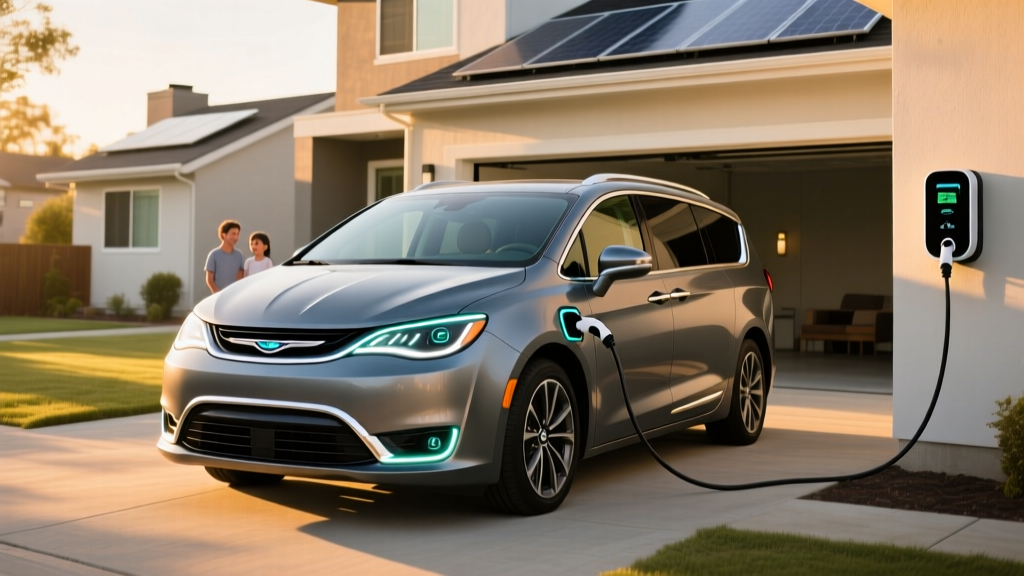
| Feature | HEV (Maverick Hybrid) | PHEV (e.g., Chrysler Pacifica) | BEV (e.g., Ford F-150 Lightning) |
|---|---|---|---|
| Plug-in Required? | No | Yes | Yes |
| Electric-Only Range | ~1 mile at low speed | 30-40 miles typical | 230-320+ miles |
| Fueling/Charging | Gas station only | Gas + Level 2 home charging | Home + DC fast charging |
| Best For | No home charging access; wants simplicity | Short commute + home charger; wants gas backup | Home charging available; wants zero tailpipe emissions |
| Tax Credit (Federal) | None (§30D requires plug-in) | Up to $7,500 if eligible | Up to $7,500 if eligible |
The Maverick Hybrid is a conventional hybrid (HEV). It uses a small 1.1 kWh lithium-ion battery that charges exclusively through regenerative braking and the gasoline engine. You never plug it in. The electric motor assists the gas engine during acceleration and can propel the truck at very low speeds (parking lots, stop-and-go creep) for brief distances, but the engine is always doing the heavy lifting on the highway.
This makes the Maverick Hybrid ideal for buyers who:
- Cannot install a home charger (apartment dwellers, street parking)
- Want fuel savings without changing their refueling habits
- Drive primarily in city and suburban conditions where hybrid efficiency peaks
- Need a truck bed but don't want to pay the premium for a full EV truck
If you have home charging access and a commute under 35 miles, a PHEV delivers more electric driving. If you want zero tailpipe emissions and have reliable charging, a BEV like the F-150 Lightning or Rivian R1T offers capabilities the Maverick can't match — but at roughly double the price.
Powertrain: 2.5L Hybrid System Specs
The 2026 Maverick Hybrid uses Ford's fourth-generation hybrid architecture, shared in concept with the Ford Escape Hybrid and Lincoln Corsair Hybrid, but tuned for truck duty.
| Specification | Detail |
|---|---|
| Engine | 2.5L Atkinson-cycle 4-cylinder |
| Engine Horsepower | 162 hp @ 5,600 rpm |
| Engine Torque | 155 lb-ft @ 4,000 rpm |
| Electric Motor | Permanent-magnet synchronous AC motor |
| Combined System Output | 191 hp |
| Transmission | eCVT (planetary gearset, not belt-driven) |
| Hybrid Battery | 1.1 kWh lithium-ion (NMC chemistry) |
| Drivetrain | FWD standard; AWD available |
| 0-60 MPH | ~7.8 seconds (FWD, estimated) |
| Towing Capacity (FWD) | 2,000 lbs |
| Towing Capacity (AWD, 4K Tow Pkg) | 2,000 lbs (hybrid AWD does not offer 4K tow package) |
| Payload Capacity | ~1,500 lbs (varies by trim) |
Two points deserve emphasis for truck-minded buyers:
Towing limitation. The Maverick Hybrid is rated for 2,000 pounds across all configurations. The 4,000-pound 4K Tow Package is exclusive to the 2.0L EcoBoost gas model with AWD. If you regularly tow a boat, camper, or car trailer above 2,000 lbs, the hybrid is not the right powertrain for you — the EcoBoost is the correct choice.
The eCVT is not a traditional CVT. Ford's eCVT uses a planetary gearset to blend engine and motor power. There is no belt, no rubber band feeling, and none of the reliability concerns associated with some belt-driven CVTs. Toyota has used a nearly identical planetary eCVT design in the Prius for over two decades with excellent longevity.
Pricing, Trims, and Tax Credit Eligibility
The 2026 Maverick Hybrid is available across all trim levels, making it one of the most affordable hybrid vehicles on the market — not just the most affordable hybrid truck.
| Trim | FWD Hybrid MSRP | AWD Hybrid MSRP |
|---|---|---|
| XL | $27,995 | $29,495 |
| XLT | $29,495 | $30,995 |
| Lariat | $33,495 | $34,995 |
| Lobo (performance-oriented) | N/A (EcoBoost only) | N/A |
Destination charge (~$1,495) not included. Prices reflect Ford's published MSRP at launch; dealer markups or discounts may apply.
The Maverick Hybrid does not qualify for the IRS §30D Clean Vehicle Credit (up to $7,500). This credit is available only to plug-in electric vehicles — both battery-electric (BEV) and plug-in hybrid (PHEV) — that meet battery sourcing, critical mineral, MSRP cap, and buyer income requirements. Conventional hybrids like the Maverick are excluded by statute.
However, the Maverick Hybrid's low base price means many buyers pay less out of pocket than they would for a credit-eligible EV after the credit is applied. A $28,000 Maverick XL Hybrid with no credit still costs less than a $55,000 F-150 Lightning minus $7,500.
Some states offer their own incentives for hybrid purchases. Check your state's energy office or department of revenue for current programs, as these vary widely and change frequently. Source: IRS §30D Clean Vehicle Credit
Battery Warranty, Lifespan, and Replacement Cost
Hybrid battery longevity is consistently the top concern for first-time hybrid buyers. The data is reassuring: modern lithium-ion hybrid batteries in Ford's system are engineered for the life of the vehicle.
Hybrid Battery: 8 years / 100,000 miles (whichever comes first) in all 50 states. In California Air Resources Board (CARB) states — including CA, CO, CT, ME, MD, MA, NJ, NY, OR, RI, VT, WA — the warranty extends to 10 years / 150,000 miles on emissions-related hybrid components.
What's Covered: The high-voltage hybrid battery pack, battery control module, and associated hybrid system components. Coverage applies if battery capacity drops below a functional threshold that impairs vehicle operation — unlike EV batteries, the Maverick's 1.1 kWh pack is so small that measurable degradation has negligible impact on drivability.
Hybrid System Components: The electric motor, eCVT, and inverter are covered under the same hybrid/emissions warranty period.
Replacement cost if out of warranty. Based on current parts pricing and independent hybrid shop data, a Maverick Hybrid battery replacement runs approximately $2,500 to $3,500 including labor. This is dramatically lower than a full EV battery replacement ($10,000-$20,000+) because the pack is small (1.1 kWh) and the labor is straightforward.
Real-world longevity data. Ford's hybrid system shares architecture with Toyota's well-documented Hybrid Synergy Drive (Ford and Toyota cross-licensed hybrid patents in the early 2000s). Toyota Prius and Camry Hybrid batteries routinely exceed 200,000 miles with minimal degradation. The Maverick's battery is stress-tested to similar standards. Because the pack is only 1.1 kWh and operates in a narrow state-of-charge window (roughly 40-60%), the cells experience far less cycling stress than a full EV battery.
Source: Ford Warranty Guide
Who Should Buy the 2026 Maverick Hybrid?
Choose the Maverick Hybrid If:
- Your commute is primarily city or suburban with frequent stops
- You cannot install a home Level 2 charger
- You want truck-bed utility without the fuel cost of a body-on-frame truck
- Your towing needs stay under 2,000 pounds
- You want the lowest total cost of ownership in a compact truck
- You value proven, simple hybrid tech over plug-in complexity
Look Elsewhere If:
- You regularly tow more than 2,000 lbs (choose EcoBoost AWD with 4K Tow Package)
- You want electric-only driving for zero-emission commutes (look at PHEV trucks or BEVs)
- You need heavy off-road capability (the Maverick is a unibody crossover truck, not a body-on-frame trail rig)
- You want a federal tax credit to reduce purchase cost (hybrids are ineligible)
- You drive predominantly highway miles at 75+ MPH (the gas EcoBoost is nearly as efficient on the highway and offers more power)
The Maverick Hybrid vs the Maverick EcoBoost (gas) decision is straightforward: If your driving is more than 50% city, the hybrid saves roughly $500-$700 per year in fuel compared to the 2.0L EcoBoost AWD (assuming 15,000 miles/year and $3.40/gallon). The hybrid premium over the equivalent gas trim is approximately $1,000-$1,500, meaning payback occurs in 2-3 years. After that, every mile is savings.
If your driving is more than 70% highway, the advantage narrows. The EcoBoost AWD achieves 23 city / 30 highway EPA, and highway driving doesn't leverage the hybrid's regenerative braking advantage. At sustained highway speeds, both powertrains are within a few MPG of each other.
Frequently Asked Questions
How many MPG does the 2026 Ford Maverick Hybrid actually get?
The EPA rates the FWD Maverick Hybrid at 42 city / 33 highway / 38 combined. The AWD hybrid drops slightly to 40/32/36. In real-world city driving, many owners report matching or exceeding the 42 MPG city figure, especially in warm weather with moderate traffic. Highway driving at 75 MPH typically yields 30-32 MPG. Cold weather reduces city MPG to approximately 35-37.
Does the Maverick Hybrid need to be plugged in?
No. The Maverick Hybrid is a conventional hybrid (HEV), not a plug-in hybrid (PHEV). The 1.1 kWh battery charges through regenerative braking and the gasoline engine. You fuel it exclusively at a gas station — there is no charging port and no electric-only driving range beyond very low-speed creeping.
Is the Maverick Hybrid reliable? What about the battery?
Ford's hybrid system is one of the most proven in the industry, sharing design principles with Toyota's Hybrid Synergy Drive. The hybrid battery carries an 8-year/100,000-mile warranty (10 years/150,000 miles in CARB states). Replacement cost, if ever needed out of warranty, is approximately $2,500-$3,500 — far less than an EV battery. The eCVT uses a planetary gearset with no belt, eliminating a common failure point in other transmission types.
Can the Maverick Hybrid tow?
Yes, but with limits. The hybrid is rated for 2,000 pounds across all configurations (FWD and AWD). The 4,000-pound 4K Tow Package is only available on the 2.0L EcoBoost gas model with AWD. For light-duty towing — a small utility trailer, a pair of dirt bikes, a light boat — the hybrid is adequate. For anything heavier, choose the EcoBoost.
Does the 2026 Maverick Hybrid qualify for a federal tax credit?
No. The IRS §30D Clean Vehicle Credit is limited to plug-in vehicles (BEVs and PHEVs) that meet battery sourcing, MSRP, and income requirements. Conventional hybrids are not eligible. The Maverick Hybrid's low purchase price (starting under $28,000) means many buyers still come out ahead on total cost versus a more expensive credit-eligible EV.
Hybrid vs PHEV vs EV — which truck is right for me?
Choose the Maverick Hybrid (HEV) if you want fuel savings with zero lifestyle change — no charging, no plugs, just better MPG. Choose a PHEV if you have home charging and a short commute (under 35 miles) and want electric-only daily driving with gas-engine backup for road trips. Choose a BEV (like the F-150 Lightning or Rivian R1T) if you have reliable home charging, want zero tailpipe emissions, need maximum torque for towing, and are comfortable with higher upfront cost and charging logistics on road trips. The Maverick Hybrid occupies the simplest, most accessible point on this spectrum.