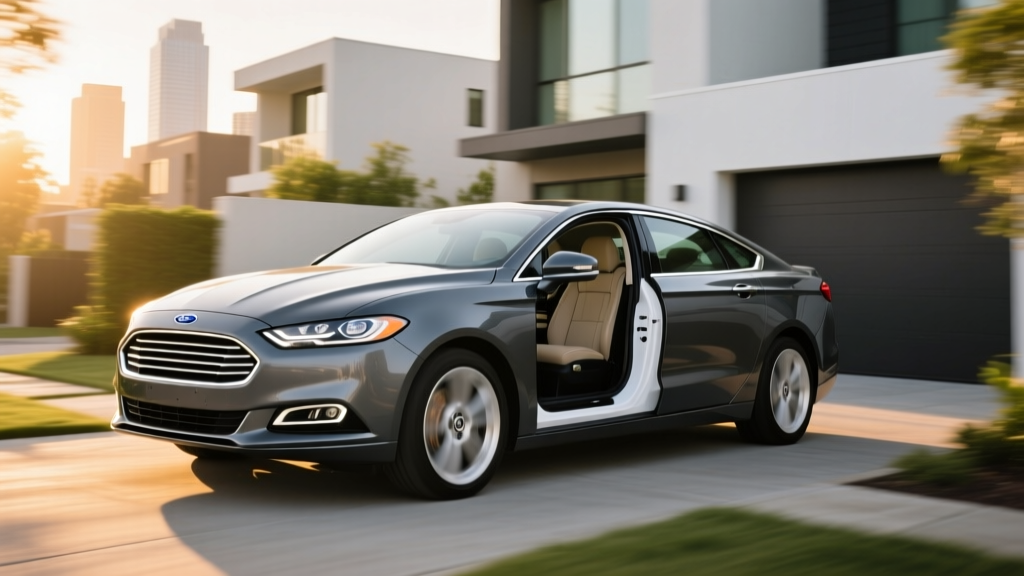
The Ford Fusion Hybrid in 2026: A Used-Market Standout
Ford discontinued the Fusion after the 2020 model year, but the Ford Fusion Hybrid remains one of the most searched midsize hybrid sedans on the used market. With strong EPA fuel economy, a proven Atkinson-cycle powertrain, and replacement parts still widely available, it's a practical choice for buyers who want hybrid efficiency without the premium pricing of a new vehicle.
This guide covers the final-generation Fusion Hybrid (2013–2020) and its plug-in sibling, the Fusion Energi, with exact MPG figures, battery longevity data, real-world efficiency observations, and what you need to know before buying one today.
Ford Fusion Hybrid vs. Fusion Energi: HEV or PHEV?
Ford sold two electrified Fusion variants. Understanding the difference is critical before shopping:
| Feature | Fusion Hybrid (HEV) | Fusion Energi (PHEV) |
|---|---|---|
| Plugs in? | No — self-charging via engine & regen | Yes — Level 1 (120V) or Level 2 (240V) |
| Electric-only driving | Short bursts at low speed (~0.5 mi) | Up to 26 miles (2019–2020) |
| Battery size | 1.4 kWh (2013–2019) | 7.6 kWh usable (2013–2016); 9.0 kWh (2017–2020) |
| DC fast charging | N/A | No — AC charging only |
| Cargo space | 12.0 cu ft | 8.2 cu ft (battery intrudes) |
| Best for | No home charging access; high-mileage commuters | Short commutes with home Level 2 charging |
The conventional Hybrid never needs a plug — it charges its small battery through regenerative braking and the gasoline engine. The Energi is a plug-in hybrid that can complete most daily commutes on electricity alone before the gas engine kicks in.
Fuel Economy: EPA MPG and Real-World Numbers
Fuel efficiency is the main reason buyers seek out the Fusion Hybrid. Here's the full EPA breakdown by generation:
| Model Year | City MPG | Highway MPG | Combined MPG |
|---|---|---|---|
| 2013–2016 Hybrid | 44 | 41 | 42 |
| 2017–2020 Hybrid | 43 | 41 | 42 |
| 2013–2016 Energi (charge-sustaining) | 40 | 36 | 38 |
| 2017–2020 Energi (charge-sustaining) | 43 | 41 | 42 |
The 2017–2020 Energi also carries an EPA rating of 97 MPGe combined when operating on its electric charge, with an electric-only range of 26 miles (2019–2020) or 21 miles (2017–2018). Total combined range with a full tank and full charge reaches approximately 520 miles.
Source: fueleconomy.gov
Real-World MPG: What Owners Actually See
Hybrids tend to perform better in city driving, where regenerative braking recovers energy at every stop. The Fusion Hybrid is no exception:
- City / stop-and-go: Many owners report 44–47 MPG, exceeding the EPA city estimate.
- Highway cruising at 70+ mph: Expect 37–40 MPG — the engine runs more often without regen opportunities.
- Cold weather (below 32°F): A 10–15% drop is typical as the engine runs more frequently for cabin heat.
For the Energi, real-world electric-only range typically falls to 20–23 miles in moderate weather and 15–18 miles in winter, due to battery chemistry limitations and cabin heating demands.
Powertrain Specs: Engine, Motor, and Combined Output
| Engine | 2.0L Atkinson-cycle 4-cylinder |
| Engine horsepower | 141 hp @ 6,000 rpm |
| Electric motor | Permanent-magnet AC synchronous, 118 hp |
| Combined net output | 188 hp |
| Transmission | eCVT (planetary gearset, not a belt CVT) |
| Drivetrain | Front-wheel drive |
| 0–60 mph | ~7.8 seconds (Hybrid); ~7.5 seconds (Energi) |
| Fuel tank | 13.5 gallons (Hybrid); 14.0 gallons (Energi) |
Ford's eCVT is a power-split device, not the rubber-band-style continuously variable transmission found in some competitors. It delivers smooth, linear acceleration without the droning sensation that traditional CVTs produce. The combined 188 hp is adequate for merging and passing, though it won't win any stoplight drag races.
Battery Longevity, Warranty, and Replacement Cost
Fusion Hybrid Battery Warranty
Original coverage: 8 years / 100,000 miles (whichever comes first) in most states. California and states adopting CARB emissions standards: 10 years / 150,000 miles.
Capacity threshold: Ford's warranty covers the hybrid battery if it drops below approximately 60–70% of original capacity, though exact thresholds were specified in the original warranty booklet.
How Long Do Fusion Hybrid Batteries Actually Last?
The Fusion Hybrid uses a lithium-ion battery pack (sourced from LG Chem for later model years). Real-world data from owner forums and fleet usage suggests:
- Typical lifespan: 150,000–200,000 miles before significant degradation, with many units exceeding 200,000 miles.
- Degradation pattern: Most owners see a gradual 1–2% capacity loss per year. A 10-year-old Fusion Hybrid with 120,000 miles may show 85–90% battery health — still well within usable range.
- Taxi/fleet evidence: Fusion Hybrids were popular in taxi fleets (notably New York City), where many exceeded 250,000 miles on the original battery.
Battery Replacement Cost
If the battery does fail outside warranty:
- New OEM replacement: $2,500–$4,000 installed at a Ford dealer (prices vary by region and model year).
- Refurbished / aftermarket: $1,500–$2,500 from independent hybrid specialists.
- Individual cell replacement: Some hybrid shops can replace failed modules for $500–$1,000, though this is less common on the Fusion than on the Toyota Prius.
For a used Fusion Hybrid purchase, the battery is generally not the dealbreaker it's perceived to be. A pre-purchase diagnostic scan showing state-of-health (SoH) above 80% is a strong buy signal.
Pricing: What You'll Pay in 2026
Because Ford ended Fusion production after 2020, all Fusion Hybrids on the market are used or certified pre-owned (CPO). Current approximate pricing:
- 2017–2020 Fusion Hybrid (SE, Titanium): $14,000–$22,000 depending on mileage, condition, and trim.
- 2017–2020 Fusion Energi (Titanium): $15,000–$24,000.
- 2013–2016 models: $8,000–$14,000 — higher mileage, out of factory warranty.
Tax Credit Eligibility
The Fusion Energi originally qualified for a $4,007 federal tax credit under the pre-2023 IRS §30D rules, but that credit structure has been fully replaced. As of 2026:
- New PHEV credit (§30D): Does not apply — the Fusion is no longer manufactured.
- Used EV/PHEV credit (§25E): The Fusion Energi may qualify for up to $4,000 or 30% of the sale price (whichever is less) under the used clean vehicle credit, provided the buyer meets income caps ($75,000 single / $150,000 joint), the vehicle is purchased from a dealer for under $25,000, and it's at least two model years old. Verify current eligibility at irs.gov.
- Fusion Hybrid (HEV): Does not qualify for any federal tax credit — conventional hybrids without plug-in capability are excluded from §25E and §30D.
Fusion Hybrid vs. EV vs. Gas: Which Is Right for You?
Choose the Fusion Hybrid if:
- You lack access to home or workplace charging
- You drive 30+ miles daily in mixed city/highway conditions
- You want lower fuel costs without any behavioral change (no plugging in)
- Budget is under $22,000 and you want proven reliability
- You live in a region with extreme cold that hampers full EV range
Consider a full EV instead if:
- You can install a Level 2 home charger
- Your daily commute is under 80 miles round-trip
- You want to eliminate oil changes, spark plugs, and transmission fluid
- You qualify for the full $7,500 §30D credit on a new EV (e.g., Hyundai Ioniq 6, Tesla Model 3)
- You want the lowest per-mile "fuel" cost (electricity at $0.12/kWh ≈ $0.04/mi vs. hybrid at ~$0.09/mi)
The Fusion Energi occupies a middle ground: ideal if you have Level 2 charging and a sub-25-mile commute, but the compromised 8.2 cu ft trunk and higher used-market pricing make the conventional Hybrid the stronger value pick for most buyers.
Charging the Fusion Energi: What PHEV Buyers Need to Know
The Energi charges via a standard J1772 connector. Because the battery is small, charging is straightforward:
| Charging Level | Power | 0–100% Time | Notes |
|---|---|---|---|
| Level 1 (120V household) | ~1.4 kW | ~7 hours | Adequate for overnight charging |
| Level 2 (240V, 32A) | ~3.3 kW (vehicle-limited) | ~2.5 hours | Vehicle caps at 3.3 kW even on a 7.2 kW charger |
| DC fast charge | N/A | N/A | Energi does not support DC fast charging |
A key limitation: the Energi's onboard charger maxes out at 3.3 kW. Even if you plug into a 7.2 kW or 11.5 kW Level 2 station, the car will only draw 3.3 kW. For overnight home charging, this is rarely an issue — 2.5 hours from empty is more than enough to wake up with a full battery. But it means you can't "top up" quickly during a midday stop.
Reliability Ratings and Known Issues
The Fusion Hybrid's powertrain is one of Ford's most dependable. The 2.0L Atkinson-cycle engine is under-stressed, and the eCVT has no belts or clutches to wear out. Common considerations for used buyers:
- Hybrid system: Very few reported failures. The inverter and electric motor are largely trouble-free.
- 12V battery: Like all hybrids, the Fusion has a standard 12V battery that can die if the car sits unused for weeks. This is separate from the hybrid traction battery and costs ~$200 to replace.
- Brakes: Regenerative braking significantly reduces pad wear — many owners report 80,000+ miles on original brake pads.
- Infotainment: SYNC 3 (2016+) is reliable; earlier SYNC/MyFord Touch systems (2013–2015) are prone to freezing and should be avoided or updated.
- NHTSA safety: The 2017–2020 Fusion earned a 5-star overall rating. Check specific model-year results at nhtsa.gov.
Frequently Asked Questions
How many MPG does the Ford Fusion Hybrid get?
The 2017–2020 Fusion Hybrid is EPA-rated at 43 city / 41 highway / 42 combined MPG. Real-world city driving often exceeds 44 MPG thanks to regenerative braking, while sustained highway driving above 70 mph typically returns 37–40 MPG.
How far can the Fusion Energi go on electric only?
The 2019–2020 Fusion Energi delivers 26 miles of EPA-rated electric-only range. Real-world range is typically 20–23 miles in moderate temperatures and 15–18 miles in freezing weather. After the battery depletes, the gas engine takes over and the car operates as a conventional hybrid at 42 MPG combined.
Does the Ford Fusion Hybrid qualify for a tax credit?
The conventional Fusion Hybrid (HEV) does not qualify for any federal tax credit. The Fusion Energi (PHEV) may qualify for the used clean vehicle credit (§25E) of up to $4,000 if purchased from a dealer for under $25,000 and the buyer meets income limits. Confirm current rules at irs.gov.
Is the Fusion Hybrid reliable, and what does a battery replacement cost?
Yes — the Fusion Hybrid is among Ford's most reliable nameplates. The hybrid battery typically lasts 150,000–200,000+ miles with minimal degradation. If replacement is needed out of warranty, expect $2,500–$4,000 for a new OEM pack or $1,500–$2,500 for a refurbished unit. Original warranty coverage was 8 years/100,000 miles (10/150,000 in CARB states).
Hybrid vs. PHEV vs. EV — which should I choose?
Choose the Hybrid (HEV) if you have no home charging and want zero behavior change. Choose the Energi (PHEV) if you can charge at home and commute under 25 miles — you'll drive mostly on electricity with a gas backup. Choose a full EV if you have Level 2 home charging, want the lowest operating cost, and are ready to plan longer road trips around DC fast charging stops.
Does the Fusion Hybrid need to be plugged in?
No. The conventional Fusion Hybrid charges its battery entirely through the gasoline engine and regenerative braking. You never plug it in. Only the Fusion Energi (PHEV) requires plugging in to access its electric-only range.