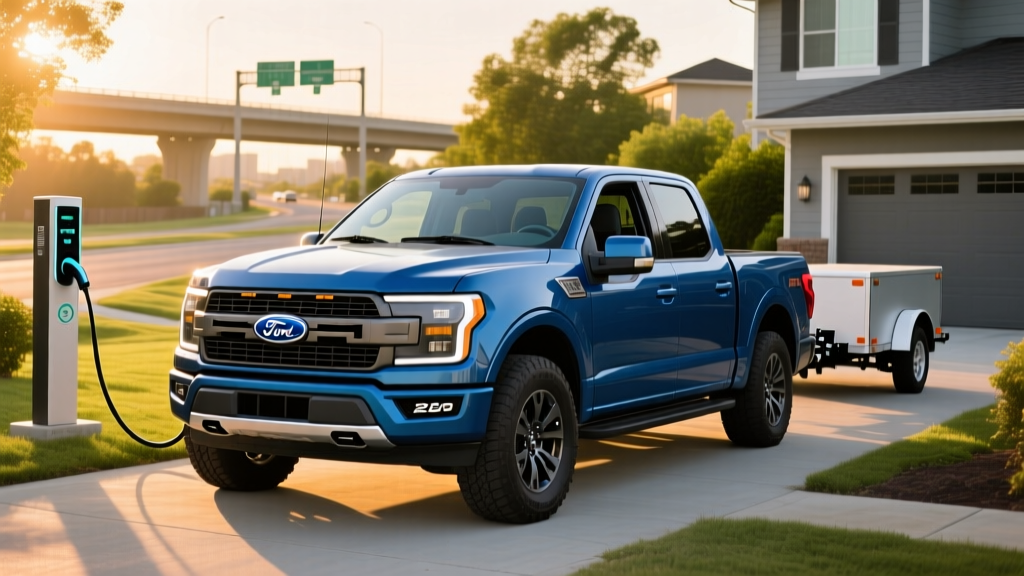
Quick Verdict: The Ford Truck Hybrid That Tows Like a Diesel
The 2026 Ford F-150 PowerBoost hybrid remains the only full-hybrid pickup in the half-ton segment that doesn't sacrifice payload or towing for efficiency. With an EPA-estimated 25 MPG combined and a maximum towing capacity of 12,700 pounds, it occupies a practical middle ground between a gas-only F-150 and a fully electric truck like the F-150 Lightning. If you need a work-capable truck but want to cut fuel costs without plugging in, this is the powertrain to spec.
Let's be clear about what the PowerBoost is and isn't: it's a conventional hybrid (HEV), not a plug-in hybrid (PHEV). You never plug it in. The 1.5 kWh battery charges through regenerative braking and the engine. If you're looking for electric-only driving range, you'll need to look at the F-150 Lightning (full EV) or wait for Ford's next-generation PHEV truck plans. But if you want 500+ miles of total range without changing your fueling habits, the PowerBoost delivers.
Ford F-150 PowerBoost Hybrid: Core Specifications
| Specification | 2026 F-150 PowerBoost Hybrid |
|---|---|
| Powertrain | 3.5L twin-turbo V6 + 47-hp electric motor (integrated in 10-speed auto) |
| Combined Horsepower | 430 hp |
| Combined Torque | 570 lb-ft |
| Hybrid Battery | 1.5 kWh lithium-ion (HEV — no plug-in) |
| EPA Fuel Economy (4x2) | 25 city / 26 highway / 25 combined MPG |
| EPA Fuel Economy (4x4) | 23 city / 24 highway / 24 combined MPG |
| Fuel Tank | 30.6 gallons |
| Total Range (4x4) | ~734 miles |
| Max Towing Capacity | 12,700 lbs (properly equipped) |
| Max Payload | 2,120 lbs |
| 0-60 mph | ~5.8 seconds |
| Starting MSRP (XLT trim) | ~$60,035 |
| Hybrid Battery Warranty | 8 years / 100,000 miles |
Fuel Economy: EPA Numbers vs Real-World MPG
The EPA rates the 4x2 F-150 PowerBoost at 25 MPG combined (25 city / 26 highway), while the 4x4 drops slightly to 24 combined (23 city / 24 highway). These figures come from fueleconomy.gov and represent the official test-cycle estimates.
| Drivetrain | City MPG | Highway MPG | Combined MPG |
|---|---|---|---|
| 4x2 (RWD) | 25 | 26 | 25 |
| 4x4 | 23 | 24 | 24 |
Real-World MPG: What to Actually Expect
Hybrid trucks behave differently than their EPA stickers suggest depending on driving conditions. Here's what real-world ownership data and testing show:
- City driving: Expect to match or slightly exceed the EPA city number — 24-27 MPG is common. The hybrid system recovers energy during stop-and-go traffic, which is where the PowerBoost shines.
- Highway cruising (70-75 mph): Expect 21-23 MPG with an empty bed. Aerodynamic drag dominates at highway speed, and the hybrid system's advantage diminishes. This is lower than the EPA highway estimate.
- Towing: Expect 12-16 MPG depending on trailer weight and terrain. A 7,000-lb travel trailer on flat interstate yields roughly 14-15 MPG; heavier loads or mountain passes drop this further.
- Unloaded mixed driving: Most owners report 22-25 MPG in mixed use without payload, aligning closely with the EPA combined figure.
The key insight: the PowerBoost's efficiency advantage over the standard 3.5L EcoBoost V6 is most pronounced in city and suburban driving. On long highway runs, the gap narrows to 1-2 MPG. If your driving is 70%+ highway, the fuel savings versus a gas model are modest.
Powertrain Deep Dive: How the PowerBoost System Works
The PowerBoost pairs Ford's 3.5-liter twin-turbocharged V6 with a 47-horsepower electric motor sandwiched between the engine and the 10-speed automatic transmission. This isn't a mild hybrid system that simply assists the engine — the electric motor can propel the truck at low speeds independently, and it fills in torque during turbo spool-up, eliminating the lag typical of turbocharged engines.
Combined output is 430 horsepower and 570 lb-ft of torque. That torque figure is available near-instantly thanks to the electric motor, which makes the PowerBoost feel more responsive than its EPA numbers suggest. The 0-60 mph time of approximately 5.8 seconds is quick for a full-size truck, especially one rated to tow over 12,000 pounds.
The 1.5 kWh lithium-ion hybrid battery sits under the rear seat. It's small by EV standards — for comparison, the F-150 Lightning uses a 98 or 131 kWh battery — but it's appropriately sized for an HEV. Its job is to buffer regenerative braking energy and provide short bursts of electric assist, not to enable extended electric-only driving. You'll notice the engine shut off at stoplights and in very low-speed creep situations, but the truck cannot drive on electric power alone for meaningful distances.
Pro Power Onboard: The Hidden Advantage
Every PowerBoost F-150 includes Ford's Pro Power Onboard system, which uses the hybrid battery and engine to generate up to 7.2 kW of continuous AC power through bed-mounted outlets. This is a genuine jobsite and campsite advantage — you can run power tools, a welder, or an entire campsite without a separate generator. The hybrid system is uniquely suited for this because the engine can cycle on and off to maintain the battery while delivering power, running far quieter and more efficiently than a standalone gas generator.
Hybrid vs PHEV vs Full EV: Which Ford Truck Fits You?
Ford offers three distinct F-150 powertrains, and choosing the right one depends on your driving patterns, charging access, and use case.
| Factor | F-150 PowerBoost (HEV) | F-150 Lightning (BEV) |
|---|---|---|
| Plug-in required? | No | Yes — Level 2 strongly recommended |
| Electric-only range | None (engine cycles at low speed) | 230-320 miles (EPA, depending on battery) |
| Total range | ~734 miles | 230-320 miles |
| Fueling/charging time | 5 minutes at gas station | 30-45 min DC fast charge (10-80%); 8-10 hr Level 2 |
| Max towing | 12,700 lbs | 10,000 lbs |
| City fuel cost (est.) | ~$0.16/mile ($3.50/gal) | ~$0.04-0.06/mile (home charging) |
| Highway range impact | Minimal | Significant — expect 20-30% range loss at 75 mph |
| Cold-weather impact | Minimal MPG loss | 20-35% range loss below freezing |
| Base MSRP (2026) | ~$60,035 | ~$55,000 (after recent price cuts) |
| Federal tax credit | None (§30D is BEV/PHEV only) | Up to $7,500 (subject to §30D rules) |
Decision Framework
Choose the F-150 PowerBoost Hybrid if:
- You tow frequently (especially over 8,000 lbs) and need maximum range between fuel stops
- You lack reliable access to Level 2 home charging
- Your driving is a mix of city and highway, with regular long-distance trips
- You want Pro Power Onboard for jobsite or overlanding use
- You want to reduce fuel costs without changing your fueling routine
Choose the F-150 Lightning (full EV) if:
- You can install a Level 2 home charger (240V, 40-80 amp circuit)
- Your daily driving is under 200 miles and you rarely tow heavy loads
- You want the lowest per-mile fuel cost and minimal maintenance
- You qualify for the §30D federal tax credit (see eligibility below)
Choose the gas-only F-150 EcoBoost if:
- Upfront cost is the primary concern (base gas models start ~$10,000 less)
- You drive primarily highway miles where the hybrid advantage is minimal
- You plan to keep the truck under 5 years and want the lowest purchase price
Pricing, Trims, and Tax Credit Eligibility
The 2026 F-150 PowerBoost hybrid is available across multiple trims, with pricing that reflects Ford's positioning of the hybrid as a premium powertrain option:
- XLT: ~$60,035 (hybrid powertrain adds approximately $3,300 over the 3.5L EcoBoost)
- Lariat: ~$66,500
- King Ranch: ~$75,000
- Platinum: ~$77,500
Federal Tax Credit: Not Available for the PowerBoost
This is a critical point that catches many buyers off guard: the F-150 PowerBoost hybrid does not qualify for the §30D federal clean vehicle tax credit. The IRS §30D credit applies only to battery electric vehicles (BEVs) and plug-in hybrids (PHEVs) with battery capacities of at least 7 kWh. The PowerBoost's 1.5 kWh battery falls well below this threshold, and it lacks plug-in capability entirely.
If the federal tax credit is a key part of your purchase math, the F-150 Lightning (BEV) is the Ford truck that qualifies — subject to the current §30D requirements:
- Buyer AGI must not exceed $150,000 (single) / $300,000 (joint)
- Vehicle MSRP must not exceed $80,000 for trucks
- Battery components and critical minerals must meet phased sourcing requirements
- Credit can be transferred to the dealer at point of sale for an upfront price reduction
Some states offer separate incentives for conventional hybrids, though these are increasingly rare. Check your state's energy office or department of environmental quality for current programs.
Battery Longevity, Warranty, and Replacement Cost
The hybrid battery is the number-one reliability concern for prospective hybrid truck buyers, and it's worth addressing directly.
F-150 PowerBoost Hybrid Battery Warranty
Coverage: 8 years or 100,000 miles (whichever comes first), federally mandated for hybrid/EV battery components.
What's covered: Battery capacity loss below a defined threshold, cell failures, and hybrid system component defects (inverter, electric motor, control electronics).
What's not covered: Normal gradual capacity reduction above the threshold, damage from accidents or modifications.
Real-World Hybrid Battery Reliability
Ford's hybrid system in the F-150 is relatively new (introduced for the 2021 model year), so we don't yet have decade-long ownership data specific to this truck. However, the broader track record for Ford's hybrid systems — particularly in the Escape Hybrid and Fusion Hybrid — is strong. Those vehicles routinely reach 150,000-200,000 miles on the original hybrid battery.
The 1.5 kWh battery in the PowerBoost is small and conservatively managed. Unlike EV batteries that regularly cycle between 10% and 90% state of charge, the hybrid battery operates in a narrow band — typically between 40% and 60% SoC. This shallow cycling dramatically reduces cell stress and extends lifespan. The battery also benefits from active thermal management.
Battery Replacement Cost
If the hybrid battery does fail outside of warranty, replacement costs for the F-150 PowerBoost battery pack currently range from approximately $3,000 to $5,000 including parts and labor at a Ford dealer. This is significantly less than an EV battery replacement (which can exceed $15,000-$20,000) because the pack is small. Third-party hybrid battery rebuilders may offer lower-cost options as the platform ages.
For comparison, a full engine or transmission replacement on a gas-only F-150 can cost $5,000-$8,000. The hybrid system doesn't introduce outsized financial risk.
Towing and Payload: No Compromise vs Gas Models
One of the PowerBoost's strongest selling points is that hybridization doesn't meaningfully reduce work capability:
- Max towing: 12,700 lbs (with Max Trailer Tow Package, 4x2 configuration)
- Max payload: 2,120 lbs
- Towing MPG: Expect 12-16 MPG depending on trailer weight, compared to 10-14 MPG for the gas 3.5L EcoBoost under similar loads
The electric motor's instant torque actually improves low-speed trailer maneuvering and initial acceleration with a load. The PowerBoost also benefits from standard Pro Power Onboard, which can power trailer brakes, electric trailer accessories, or jobsite equipment directly from the bed outlets.
One practical note: when towing near maximum capacity, the hybrid battery depletes more quickly during sustained climbs, at which point the engine carries the full load. You won't see the same MPG improvement while towing heavy as you do in unloaded driving, but the 1-3 MPG advantage over the gas model still holds.
Ownership Costs: 5-Year Total Cost Breakdown
Let's compare the PowerBoost hybrid against the gas-only 3.5L EcoBoost and the F-150 Lightning over 5 years and 75,000 miles of mixed driving (55% city, 45% highway):
| Cost Category | PowerBoost HEV (4x4) | 3.5L EcoBoost Gas (4x4) | Lightning BEV (Extended Range) |
|---|---|---|---|
| Purchase Price (est.) | $62,000 | $55,000 | $65,000 |
| Federal Tax Credit | $0 | $0 | -$7,500* |
| Effective Purchase | $62,000 | $55,000 | $57,500 |
| Fuel/Energy (75k mi) | $10,500 | $12,600 | $3,750 |
| Maintenance (est.) | $3,200 | $3,800 | $1,500 |
| Insurance (est.) | $9,500 | $8,800 | $10,200 |
| 5-Year Depreciation (est.) | $28,000 | $26,000 | $30,000 |
| Total 5-Year Cost | $113,200 | $106,200 | $102,950 |
*Tax credit eligibility depends on income, MSRP, and battery sourcing rules. Verify at irs.gov.
The PowerBoost saves roughly $2,100 in fuel over the gas model across 75,000 miles — enough to offset most of the $3,300 hybrid powertrain premium, but not all of it. The financial case strengthens if you drive more city miles or if gas prices rise above $3.50/gallon. The Lightning wins on operating cost but requires home charging infrastructure and sacrifices some towing and range flexibility.
Pros and Cons at a Glance
Pros
- 25 MPG combined (4x2) with no plug-in requirement
- 12,700-lb max towing — no compromise vs gas models
- 570 lb-ft torque with instant electric motor response
- Pro Power Onboard (7.2 kW) standard with hybrid
- 734-mile total range — no range anxiety on road trips
- Hybrid battery warranty: 8 yr / 100,000 mi
- Minimal cold-weather efficiency loss vs EVs
Cons
- No federal §30D tax credit (HEV excluded)
- Highway MPG advantage over gas model is small (1-2 MPG)
- Hybrid premium adds ~$3,300 to purchase price
- No electric-only driving mode for zero-emission zones
- Higher upfront cost than base gas F-150
- Real-world towing MPG still drops to 12-16 MPG
Frequently Asked Questions
How many MPG does the Ford F-150 hybrid get?
The EPA rates the 2026 F-150 PowerBoost at 25 city / 26 highway / 25 combined MPG for the 4x2 model, and 23 city / 24 highway / 24 combined MPG for the 4x4. In real-world driving, expect to match or exceed city MPG figures (24-27 MPG) but see lower highway numbers (21-23 MPG) at sustained speeds above 70 mph. Towing drops fuel economy to 12-16 MPG.
Does the Ford F-150 hybrid need to be plugged in?
No. The F-150 PowerBoost is a conventional hybrid (HEV), not a plug-in hybrid. The 1.5 kWh battery charges entirely through regenerative braking and the gasoline engine. You fuel it exactly like a standard gas truck — at a gas station, in about five minutes.
Is there a plug-in hybrid (PHEV) Ford F-150?
As of the 2026 model year, Ford does not offer a plug-in hybrid F-150 in the US market. The choices are the PowerBoost conventional hybrid (HEV), the gas-only EcoBoost, or the fully electric F-150 Lightning. Ford has not announced a PHEV variant for the current F-150 generation.
Is the F-150 hybrid reliable, and what does battery replacement cost?
Ford's hybrid system has a solid track record in other vehicles (Escape Hybrid, Fusion Hybrid), with batteries commonly lasting 150,000+ miles. The F-150 PowerBoost battery is covered by an 8-year/100,000-mile warranty. Out-of-warranty replacement costs approximately $3,000-$5,000, which is far less than an EV battery replacement. The small 1.5 kWh pack and conservative charge management contribute to long cell life.
Does the Ford F-150 hybrid qualify for any tax credit?
The F-150 PowerBoost hybrid does not qualify for the federal §30D clean vehicle tax credit, which requires plug-in capability and a minimum 7 kWh battery. The hybrid's 1.5 kWh battery and lack of plug-in charging exclude it. Some states may offer minor hybrid incentives — check your state energy office. If the federal credit is important to your purchase decision, the F-150 Lightning (BEV) qualifies, subject to income and MSRP caps.
How does the F-150 hybrid compare to the Toyota Tundra hybrid?
The Toyota Tundra i-FORCE MAX hybrid produces 437 hp and 583 lb-ft (slightly more torque) and is rated at 20-22 MPG combined depending on configuration — roughly 3-4 MPG less than the F-150 PowerBoost. The Tundra hybrid also has a lower max tow rating (12,000 lbs vs 12,700 lbs) and lacks an equivalent to Ford's Pro Power Onboard system. The F-150 PowerBoost is the more efficient and more capable hybrid truck in direct comparison, though the Tundra's hybrid system is also proven and well-regarded.
What is the total driving range of the F-150 hybrid?
With a 30.6-gallon fuel tank and 24 MPG combined (4x4), the F-150 PowerBoost delivers approximately 734 miles of total range. The 4x2 model achieves roughly 765 miles. This exceeds the range of most full-size trucks and far surpasses the F-150 Lightning's 230-320 mile EV range, making the hybrid the clear choice for drivers who regularly cover long distances without wanting to plan charging stops.