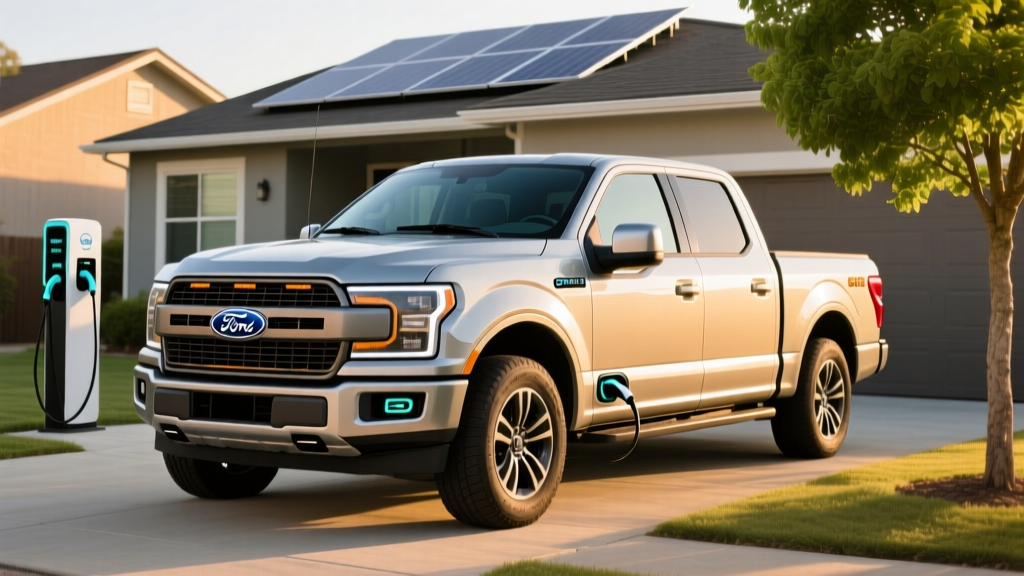
If you've been searching for a full-size pickup that doesn't force you to choose between capability and fuel efficiency, the Ford F-150 equipped with the 3.5 PowerBoost hybrid powertrain is the most compelling answer on the market. This isn't a plug-in hybrid or a range-extended EV — it's a conventional self-charging hybrid (HEV) that pairs Ford's twin-turbo 3.5-liter V6 with an electric motor integrated directly into the 10-speed automatic transmission. The result: 430 horsepower, 570 lb-ft of torque, up to 12,700 pounds of towing capacity, and EPA-rated fuel economy that embarrasses most gas-only trucks in its class.
We've spent significant time analyzing EPA data, real-world owner reports, and Ford's latest spec sheets to bring you the most precise breakdown of what the 3.5 PowerBoost hybrid actually delivers — on paper and on the pavement.
What Is the 3.5 PowerBoost Hybrid Powertrain?
The 3.5 PowerBoost is Ford's full-hybrid system, exclusive to the F-150. It combines:
- Engine: 3.5-liter twin-turbocharged V6 (EcoBoost) producing 400 hp and 500 lb-ft on its own
- Electric motor: 35 kW (47 hp) motor integrated into the 10-speed automatic transmission housing
- Combined output: 430 hp and 570 lb-ft of torque
- Battery: 1.5 kWh lithium-ion pack (sealed, air-cooled, mounted under the bed)
- Transmission: Modular 10-speed automatic with hybrid-specific calibration
HEV vs. PHEV: Where Does PowerBoost Fit?
The 3.5 PowerBoost is a conventional hybrid (HEV), not a plug-in hybrid (PHEV). You never plug it in. The 1.5 kWh battery recharges through regenerative braking and the gas engine. This is fundamentally different from a PHEV like the Jeep Wrangler 4xe or Toyota RAV4 Prime, which offers 20-40 miles of electric-only range from a larger battery you charge at home or at a public station.
What this means for you: No home charger required, no range anxiety about finding a plug, and no electric-only driving mode for commutes. The electric motor assists the gas engine during acceleration, low-speed driving, and start-stop events — smoothing out the power delivery and reducing fuel consumption, especially in city traffic.
| Specification | Value |
|---|---|
| Combined Horsepower | 430 hp |
| Combined Torque | 570 lb-ft |
| Engine | 3.5L twin-turbo V6 + 35 kW electric motor |
| Battery Capacity | 1.5 kWh lithium-ion |
| Transmission | 10-speed automatic |
| Drivetrain | RWD or 4WD |
| Max Towing Capacity | 12,700 lbs (properly equipped) |
| Max Payload | 2,120 lbs |
| Pro Power Onboard | Up to 7.2 kW (available) |
| 0-60 mph | ~5.8 seconds (4WD) |
Fuel Economy: EPA Ratings vs. Real-World MPG
Fuel economy is the headline reason buyers cross-shop the 3.5 PowerBoost hybrid against the standard 3.5L EcoBoost or 5.0L V8. Here's what the EPA says, and what you should actually expect.
| Configuration | City MPG | Highway MPG | Combined MPG |
|---|---|---|---|
| 4x2 (RWD) | 25 | 26 | 25 |
| 4x4 (4WD) | 23 | 24 | 24 |
Source: fueleconomy.gov
Real-World MPG: What Owners Actually Report
The EPA numbers are strong for a 5,500+ pound truck, but real-world results vary by driving style:
- City-heavy commuting: Many owners report 22-26 MPG on the 4WD model, with some exceeding the EPA city rating thanks to frequent regenerative braking at low speeds — a classic hybrid advantage.
- Highway cruising (70-80 mph): Expect 20-23 MPG. Aerodynamic drag dominates at speed, and the hybrid system provides minimal benefit above 65 mph.
- Towing: Fuel economy drops to 10-14 MPG when towing near max capacity — comparable to the non-hybrid 3.5L EcoBoost under load.
- Mixed driving (50/50): Most owners land between 21-24 MPG in the 4WD configuration.
The hybrid system's biggest fuel savings come in stop-and-go traffic and suburban driving, where the electric motor handles low-speed movement and the engine shuts off at stops. If your commute is mostly highway miles, the fuel-economy gap between the PowerBoost and the standard 3.5L EcoBoost narrows considerably.
Power, Towing, and the Pro Power Onboard Advantage
The 3.5 PowerBoost isn't just about saving fuel — it's the most powerful engine option in the F-150 lineup short of the Raptor's high-output tune. With 430 hp and 570 lb-ft, it out-torques the 5.0L V8 (which makes 410 lb-ft) and delivers that torque lower in the rev range thanks to electric motor assist.
Towing capacity peaks at 12,700 pounds when properly equipped (4x2, Max Trailer Tow Package, appropriate axle ratio). That puts it within striking distance of the 3.5L EcoBoost's 14,000-pound max, and well ahead of most half-ton competitors.
The standout feature unique to the PowerBoost is Pro Power Onboard. Available in 2.4 kW and 7.2 kW configurations, it turns the F-150 hybrid into a mobile generator:
- 2.4 kW: Two 120V/20A outlets in the bed — enough for power tools, a small air compressor, or tailgate electronics
- 7.2 kW: Four 120V/20A outlets plus one 240V/30A outlet — capable of running a welder, large air compressor, or providing emergency backup power to a home circuit during an outage
The 7.2 kW system can run continuously for approximately 32 hours on a full tank at quarter-load, or about 8 hours at full load. For contractors, job-site workers, or anyone in an area with unreliable grid power, this feature alone can justify the PowerBoost premium.
Pricing, Trim Availability, and Tax Credit Eligibility
The 3.5 PowerBoost hybrid is available across multiple F-150 trims, but not all of them. For the current model year, Ford offers it on:
- XLT (starting around $52,000 with the PowerBoost option)
- Lariat (starting around $58,000)
- King Ranch (starting around $67,000)
- Platinum (starting around $70,000)
The PowerBoost option itself typically adds $2,500-$3,300 over the standard 3.5L EcoBoost on comparable trims. That premium buys you the extra torque, the hybrid fuel economy benefit, and eligibility for Pro Power Onboard.
Federal Tax Credit: Does the PowerBoost Qualify?
Short answer: No. Under current IRS §30D Clean Vehicle Credit rules, the federal EV tax credit of up to $7,500 applies only to battery electric vehicles (BEVs) and plug-in hybrids (PHEVs) with a minimum battery capacity of 7 kWh. The PowerBoost's 1.5 kWh battery falls well below that threshold.
The F-150 PowerBoost is classified as a conventional hybrid (HEV), which does not qualify for the §30D federal credit. There is currently no federal tax credit specifically for conventional hybrids.
State incentives: A handful of states offer modest rebates or HOV lane access for hybrids, but these vary widely by jurisdiction and change frequently. Check your state's energy office or DMV for current programs. Do not assume state incentives apply without verifying directly.
Reliability, Battery Warranty, and Long-Term Ownership Costs
Hybrid reliability is a top concern for truck buyers who plan to keep their vehicles for 150,000+ miles. Here's what the data shows:
Ford Hybrid Battery Warranty
Ford covers the PowerBoost hybrid battery and hybrid-specific components with a 8-year / 100,000-mile warranty (whichever comes first). In states that follow California Air Resources Board (CARB) emissions standards — including California, New York, Massachusetts, and several others — that extends to 10 years / 150,000 miles.
This warranty covers defects and capacity loss that causes the battery to fall below a defined performance threshold. It is transferable to subsequent owners, which supports resale value.
Battery replacement cost: If the 1.5 kWh hybrid battery fails outside of warranty, replacement costs typically range from $2,500 to $4,500 including parts and labor at a Ford dealer. This is significantly less than the $10,000-$20,000+ replacement cost for a full EV traction battery, because the PowerBoost pack is small and relatively simple.
General reliability: The 3.5L EcoBoost V6 is one of Ford's most proven engines, now in its second generation with extensive real-world track records. The hybrid system adds complexity (electric motor, inverter, hybrid-specific transmission calibration), but the components are less stressed than in a full EV. Ford's hybrid system in the F-150 has been on sale since the 2021 model year, giving it several years of field data. Owner forums and NHTSA complaint databases show no systemic pattern of hybrid-component failures, though isolated reports of 12V auxiliary battery issues and minor software glitches exist — common in modern vehicles regardless of powertrain.
| Factor | 3.5 PowerBoost Hybrid | 3.5L EcoBoost (Gas) | 5.0L V8 (Gas) |
|---|---|---|---|
| Combined MPG (4WD) | 24 | 20 | 19 |
| Horsepower | 430 hp | 400 hp | 400 hp |
| Torque | 570 lb-ft | 500 lb-ft | 410 lb-ft |
| Max Towing | 12,700 lbs | 14,000 lbs | 13,000 lbs |
| Hybrid Battery Warranty | 8 yr / 100k mi | N/A | N/A |
| Pro Power Onboard | Up to 7.2 kW | Up to 2.0 kW | Up to 2.0 kW |
| Estimated Annual Fuel Cost* | ~$2,300 | ~$2,760 | ~$2,900 |
*Based on 15,000 miles/year, $3.50/gallon regular unleaded, 55% city / 45% highway driving. Actual costs vary with fuel prices and driving patterns. Source: fueleconomy.gov estimates.
Who Should Choose the 3.5 PowerBoost Hybrid?
Powertrain Decision Framework
Choose the 3.5 PowerBoost Hybrid if:
- You do a lot of city or suburban driving where hybrid stop-start efficiency pays off
- You need onboard power for tools, job sites, or emergency backup (Pro Power Onboard 7.2 kW)
- You want maximum torque for towing and acceleration without stepping up to a Super Duty
- You can't charge a PHEV or EV at home but still want to reduce fuel consumption
- You plan to keep the truck long-term and value the 8-10 year hybrid battery warranty
Choose the standard 3.5L EcoBoost (gas) if:
- You need maximum towing capacity (14,000 lbs vs. 12,700 lbs)
- Your driving is overwhelmingly highway miles, where the hybrid advantage is minimal
- You want the lowest upfront purchase price and don't mind slightly higher fuel costs
Consider a full EV (like the F-150 Lightning) if:
- You have reliable home Level 2 charging and a daily commute under 230 miles
- You want zero tailpipe emissions and the lowest per-mile "fuel" cost
- You qualify for the §30D federal tax credit (up to $7,500, subject to income and sourcing rules)
- You don't regularly tow heavy loads over long distances (EV range drops significantly while towing)
Pros and Cons at a Glance
Pros
- Best-in-class fuel economy for a full-size 4WD truck (24 MPG combined)
- 570 lb-ft of torque — highest in the F-150 lineup below Raptor
- Pro Power Onboard 7.2 kW turns the truck into a mobile generator
- No plug-in charging required — works with existing gas infrastructure
- 8-year / 100,000-mile hybrid battery warranty (10/150k in CARB states)
- Strong resale value supported by hybrid demand
Cons
- No federal tax credit eligibility (HEV, not PHEV/BEV)
- Lower max towing than the standard 3.5L EcoBoost (12,700 vs. 14,000 lbs)
- $2,500-$3,300 price premium over the gas 3.5L EcoBoost
- Highway-only fuel economy advantage is modest vs. gas engines
- Added hybrid system complexity (though well-warrantied)
- Not available on base XL or entry-level trims
Frequently Asked Questions
How many MPG does the 3.5 PowerBoost hybrid get?
The EPA rates the F-150 3.5 PowerBoost hybrid at 25 MPG city / 26 MPG highway / 25 MPG combined for the 4x2 model, and 23 city / 24 highway / 24 combined for the 4x4. Real-world results typically fall between 21-26 MPG depending on driving conditions, with city-heavy routes often matching or slightly exceeding EPA estimates thanks to regenerative braking.
Does the PowerBoost hybrid need to be plugged in?
No. The 3.5 PowerBoost is a conventional self-charging hybrid (HEV). The 1.5 kWh battery recharges automatically through regenerative braking and the gas engine. There is no plug, no charging port, and no electric-only driving mode. You fuel it exactly like a standard gasoline truck.
Is the 3.5 PowerBoost hybrid reliable?
Early data is encouraging. The 3.5L EcoBoost engine is a proven design in its second generation, and the hybrid components add relatively modest complexity compared to a full EV. Ford backs the hybrid battery and related components with an 8-year/100,000-mile warranty (10 years/150,000 miles in CARB states). NHTSA complaint data has not revealed systemic hybrid-specific failures. Long-term data beyond 100,000 miles is still accumulating, as the PowerBoost debuted for the 2021 model year.
What does it cost to replace the hybrid battery?
Out-of-warranty replacement of the 1.5 kWh PowerBoost hybrid battery typically runs $2,500 to $4,500 at a Ford dealer, including parts and labor. This is far less expensive than a full EV battery replacement because the pack is small. The 8-10 year warranty means most owners will never face this cost during typical ownership.
Does the F-150 PowerBoost qualify for any tax credit?
No. Under current IRS §30D rules, the federal clean vehicle credit requires a minimum battery capacity of 7 kWh and applies to BEVs and PHEVs only. The PowerBoost's 1.5 kWh battery classifies it as a conventional hybrid, which is ineligible. Some states may offer minor hybrid incentives, but these vary by jurisdiction and should be verified with your state energy office.
How does the PowerBoost compare to the F-150 Lightning for daily use?
The F-150 Lightning offers 230-320 miles of EPA range (depending on battery pack), qualifies for the federal tax credit (subject to eligibility), and has far lower per-mile energy costs if you charge at home. However, it cannot match the PowerBoost for long-distance towing (range drops 40-50% under heavy load), and it requires home Level 2 charging infrastructure to be practical for most owners. If you tow frequently, drive long rural routes, or lack home charging access, the PowerBoost hybrid is the more versatile choice. If you commute, rarely tow, and can charge at home, the Lightning saves more money over time.
Can the PowerBoost run on electric power alone?
Only at very low speeds for very short distances — think creeping through a parking lot or moving in stop-and-go traffic for a few hundred yards. The 1.5 kWh battery is too small to sustain meaningful electric-only driving. The system is designed for electric assist, not electric propulsion. If you want electric-only commuting capability, you need a PHEV or a full BEV.
Specs and pricing reflect the most recent model year data available from Ford and fueleconomy.gov at time of publication. Federal and state incentive rules change frequently — always verify eligibility with the IRS and your state authorities before making a purchase decision based on tax credits.