The compact crossover segment is crowded with electrified options, but the Ford plug-in hybrid Escape occupies a specific niche: buyers who want meaningful electric-only commuting without committing to a full battery-electric vehicle. For 2026, Ford continues the Escape PHEV with a 14.4 kWh battery pack, an EPA-estimated 37 miles of electric-only range, and a combined 105 MPGe rating — figures that make it one of the more practical PHEVs in its class for daily drivers with short-to-moderate commutes.
But spec sheets only tell half the story. In this guide, we break down the real-world efficiency, charging logistics, powertrain behavior, federal tax credit eligibility under current IRS §30D rules, and whether the Escape PHEV actually fits your driving life — or whether a conventional hybrid or full EV would serve you better.
HEV vs. PHEV: What the Escape Plug-In Hybrid Actually Is
Before evaluating the numbers, it's critical to understand the distinction between the two electrified Escape variants Ford offers:
- Escape Hybrid (HEV): A self-charging hybrid. A small battery (typically ~1.1 kWh) is replenished entirely by regenerative braking and the gasoline engine. You never plug it in. EPA-rated around 39–42 MPG combined depending on trim and drivetrain.
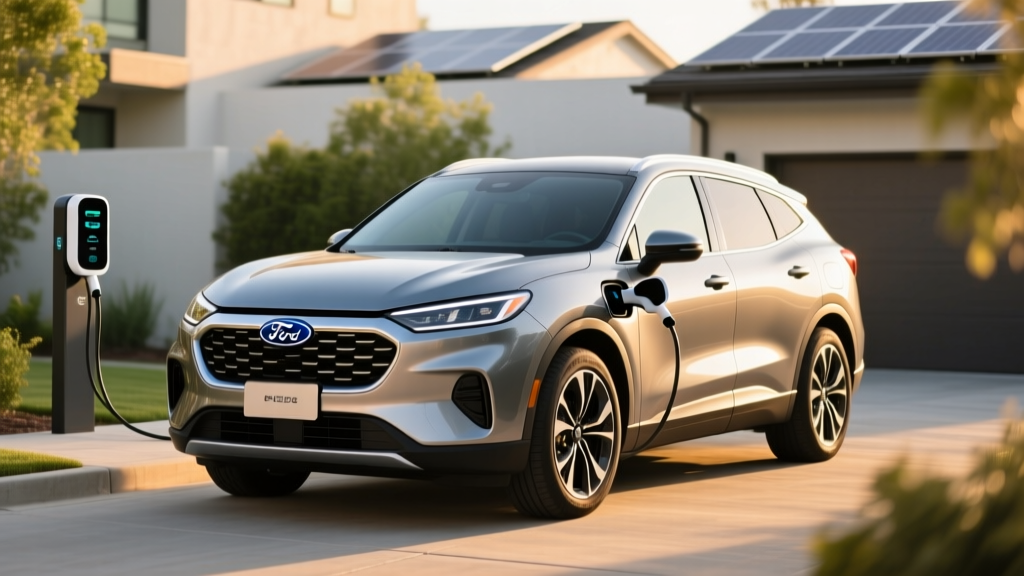
- Escape Plug-In Hybrid (PHEV): A larger 14.4 kWh battery that you do plug in — at home on a standard 120V outlet or a 240V Level 2 charger. It can drive on electricity alone for a meaningful distance before the gasoline engine activates, then operates like a conventional hybrid.
If you see "Escape Hybrid" on a window sticker and it lacks a charge port, that's the HEV. The PHEV has a visible charging port on the driver-side front fender and badging that reads "Plug-In Hybrid."
Electric-Only Range and Total Driving Range
The 2026 Ford Escape PHEV carries an EPA-estimated 37 miles of electric-only range. That number is derived from a combined city/highway cycle and assumes moderate temperatures and typical driving behavior.
Real-World Range Expectation: In mixed suburban driving at 35–50 mph in mild weather (55–75°F), many PHEV owners report achieving 34–40 miles on a full charge. Highway driving at 70+ mph reduces electric-only range to roughly 25–30 miles due to increased aerodynamic drag. In cold weather (below 32°F), expect 20–28 miles of electric range — the battery's usable capacity shrinks, and cabin heating draws significant energy. The Escape PHEV does not come standard with a heat pump, which would otherwise improve cold-weather electric efficiency.
Once the battery is depleted, the Escape PHEV operates as a conventional hybrid. Ford lists the total combined range (electric + gasoline) at approximately 520 miles, based on the 11.1-gallon fuel tank and hybrid-mode efficiency. On long road trips, you'll refuel like any other gasoline vehicle — no range anxiety beyond normal stops.
Fuel Economy: EPA MPG and Real-World Results
When the battery is depleted and the Escape PHEV runs in hybrid mode, the EPA rates it at:
| Metric | EPA Rating | Real-World Expectation |
|---|---|---|
| Combined (hybrid mode) | 40 MPG | 37–42 MPG |
| City (hybrid mode) | 42 MPG | 40–46 MPG |
| Highway (hybrid mode) | 37 MPG | 34–39 MPG |
| Combined MPGe (with charge) | 105 MPGe | Varies with electric usage |
How to read MPGe: MPGe (miles per gallon equivalent) converts electricity consumption into a gasoline-equivalent figure. The 105 MPGe rating only applies when you're driving on a mix of electric and gasoline power with regular charging. If you never plug in, your effective fuel economy drops to the ~40 MPG hybrid-mode figure — which is still excellent, but you're leaving the PHEV's biggest advantage on the table.
Real-world insight: Hybrids and PHEVs in hybrid mode tend to exceed their EPA city ratings because stop-and-go traffic maximizes regenerative braking. Highway driving is less efficient due to the engine running at sustained load. Drivers who charge nightly and commute under 35 miles may go weeks without visiting a gas station.
For the latest official figures, the EPA's fueleconomy.gov listing provides the definitive source for Escape PHEV efficiency data.
Powertrain, Battery, and Charging Specifications
| Specification | 2026 Ford Escape PHEV |
|---|---|
| Engine | 2.5L Atkinson-cycle 4-cylinder |
| Electric Motor | Permanent-magnet synchronous (integrated in eCVT) |
| Combined System Output | 210 hp |
| Transmission | eCVT (electronically controlled continuously variable) |
| Drivetrain | Front-wheel drive only (no AWD option on PHEV) |
| Battery Capacity | 14.4 kWh (lithium-ion, NMC chemistry) |
| Electric-Only Range (EPA) | 37 miles |
| Level 1 Charging (120V) | ~10–11 hours (full charge) |
| Level 2 Charging (240V, 32A) | ~3.5 hours (full charge) |
| DC Fast Charging | Not available |
| Charge Port | J1772 (driver-side front fender) |
| Fuel Tank | 11.1 gallons |
| Total Combined Range | ~520 miles |
| 0–60 mph | ~8.0 seconds (est.) |
Charging Reality: No DC Fast Charging
The Escape PHEV uses a J1772 connector for Level 1 (120V household) and Level 2 (240V) AC charging. It does not support DC fast charging — a limitation common to nearly all PHEVs in this class. The onboard charger maxes out at approximately 3.3 kW on Level 2.
For daily use, this isn't a practical limitation. Plug in at home overnight on a standard 120V outlet and you'll recover roughly 3–4 miles of range per hour — enough to fully replenish the 37-mile battery in about 10–11 hours. A 240V Level 2 home charger cuts that to roughly 3.5 hours, meaning you can top off during an evening at home or at a workplace charger during a shift.
Since the battery is small, the lack of DC fast charging is a non-issue for most PHEV use cases. You're not road-tripping on electric-only power; the gasoline engine handles that.
Pricing, Trims, and Federal Tax Credit Eligibility
The 2026 Ford Escape PHEV is offered in a single well-equipped trim, typically starting at an MSRP of approximately $39,500 (including destination). Options packages for technology, premium audio, and panoramic sunroof can push a loaded example to around $44,000–$46,000.
Does the Ford Escape PHEV Qualify for the Federal Tax Credit?
Under current IRS §30D rules, the Escape PHEV's eligibility for the up-to-$7,500 federal clean vehicle credit depends on several criteria that shift periodically:
- Battery sourcing requirements: A percentage of critical minerals and battery components must be sourced from the U.S. or free-trade-agreement countries. Ford's battery supply chain for the Escape PHEV has evolved, and eligibility may cover the full $7,500, a partial $3,750, or zero — check the current IRS qualified vehicle list before purchasing.
- MSRP cap: SUVs and vans must have an MSRP at or below $80,000. The Escape PHEV clears this easily.
- Buyer income cap: Modified adjusted gross income must not exceed $150,000 (single), $225,000 (head of household), or $300,000 (joint filers).
- Point-of-sale transfer: As of 2024, eligible buyers can transfer the credit to the dealer at purchase, reducing the out-of-pocket price immediately rather than waiting for tax filing.
- Assembly: The vehicle must undergo final assembly in North America. The Escape is built in Hermosillo, Mexico — verify current assembly eligibility on the IRS qualified list, as this has historically affected some Ford models.
Bottom line: Do not assume the Escape PHEV qualifies for the full $7,500 credit. Check the fueleconomy.gov tax credit database and confirm with your tax professional before signing a purchase agreement. State-level incentives (such as those in California, Colorado, and New York) may stack on top of federal credits — consult your state's energy office for current programs.
Reliability, Battery Warranty, and Replacement Costs
Ford Hybrid/PHEV Battery Warranty: The Escape PHEV's high-voltage battery is covered by Ford's Hybrid Component Warranty for 8 years or 100,000 miles (whichever comes first). In states that follow California Air Resources Board (CARB) standards — including California, New York, Massachusetts, and several others — the warranty extends to 10 years or 150,000 miles.
The warranty covers battery capacity loss below a defined threshold (typically around 70% of original capacity) and defects in hybrid-system components including the electric motor, inverter, and eCVT.
How Reliable Is the Escape PHEV?
Ford's 2.5L Atkinson-cycle hybrid powertrain has been in production across multiple models (Fusion Hybrid, Maverick Hybrid, Escape Hybrid) for over a decade. The architecture is well-proven, and the eCVT design — which uses planetary gearsets rather than belts or chains — is among the most durable transmission types in the industry.
The PHEV variant adds complexity with its larger battery and onboard charger, but the core hybrid system remains the same. Real-world battery degradation on Ford's 14.4 kWh PHEV pack has been modest: most owners report 90%+ capacity retention after 3–4 years of daily charging.
Battery Replacement Cost
Should the high-voltage battery fail outside of warranty, replacement costs for the Escape PHEV battery pack typically range from $4,000 to $7,000 including parts and labor at a Ford dealer. However, outright battery failure on modern Ford PHEVs is rare. More commonly, individual cell modules can be serviced rather than replacing the entire pack, reducing costs significantly.
For comparison, the conventional 12V auxiliary battery (which powers electronics, not propulsion) is a standard $150–$250 replacement item every 4–6 years, same as any vehicle.
Escape PHEV vs. Full EV vs. Gas: Which Fits Your Life?
The decision between the Ford plug-in hybrid Escape, a full battery-electric vehicle (like the Tesla Model Y or Ford Mustang Mach-E), and a conventional gas or hybrid vehicle comes down to three factors: your commute distance, your charging access, and your road-trip frequency.
Choose the Escape PHEV If:
- Your daily commute is under 35 miles round-trip
- You have home or workplace Level 1/2 charging access
- You take frequent road trips and don't want to plan around DC fast chargers
- You want to reduce fuel consumption without full EV commitment
- You live in an apartment or area with limited public charging infrastructure
Look Elsewhere If:
- Your daily commute exceeds 50 miles — a full EV with 250+ mile range makes more economic sense
- You have zero access to home or workplace charging — without plugging in, you're just driving a heavy, expensive hybrid
- You want all-wheel drive — the Escape PHEV is FWD only; the conventional Escape Hybrid offers AWD
- You want the lowest possible operating cost — a full EV charged on off-peak home electricity costs 3–5¢ per mile vs. the PHEV's 6–10¢ per mile in mixed use
The Math: PHEV vs. Gas vs. EV Annual Fuel Cost
Assuming 12,000 miles per year, 80% of which is within the 37-mile electric range (charged at home at $0.14/kWh national average), and 20% on gasoline at $3.40/gallon:
| Vehicle Type | Annual Fuel/Energy Cost | Cost Per Mile |
|---|---|---|
| Escape PHEV (charged regularly) | ~$850 | ~$0.07 |
| Escape Hybrid (HEV, no plug) | ~$1,020 | ~$0.085 |
| Gas-only compact SUV (28 MPG) | ~$1,460 | ~$0.12 |
| Full EV (3.5 mi/kWh, home charging) | ~$480 | ~$0.04 |
The PHEV saves roughly $600/year over a gas-only SUV and $170/year over the conventional Escape Hybrid — but only if you charge regularly. Never plugging in eliminates the PHEV's advantage entirely.
Driving Impressions and Daily Ownership
The Escape PHEV defaults to electric-only mode at startup, providing quiet, smooth acceleration up to roughly 85 mph before the gasoline engine engages. The transition from electric to hybrid mode is seamless — most drivers won't notice it without watching the power-flow display on the instrument cluster.
With 210 combined horsepower, the PHEV is adequate for highway merging and passing but not quick. The 0–60 mph time of approximately 8.0 seconds is unremarkable but sufficient for the segment. Regenerative braking is moderate; the Escape PHEV does not offer true one-pedal driving like a full EV, but the "L" gear position increases regen for stop-and-go traffic.
Cargo space is slightly reduced compared to the gas-only Escape due to the larger battery pack beneath the rear seat, but the difference is modest — roughly 1–2 cubic feet of under-floor storage is lost. Passenger space remains unchanged.
Frequently Asked Questions
How many MPG does the Ford Escape plug-in hybrid get?
In hybrid mode (battery depleted), the EPA rates the Escape PHEV at 42 city / 37 highway / 40 combined MPG. With regular charging, the combined rating is 105 MPGe. Real-world city driving in hybrid mode often exceeds 42 MPG thanks to regenerative braking; highway driving typically returns 34–39 MPG.
How far can the Ford Escape PHEV go on electric only?
The EPA estimates 37 miles of electric-only range. Real-world results vary: expect 34–40 miles in mild suburban driving, 25–30 miles at highway speeds, and 20–28 miles in freezing temperatures. Total combined range (electric + gasoline) is approximately 520 miles.
Does the Ford Escape PHEV qualify for a federal tax credit?
Eligibility depends on current IRS §30D rules, including battery component and critical mineral sourcing, final assembly location, buyer income limits, and the $80,000 MSRP cap for SUVs. The Escape PHEV clears the MSRP cap, but assembly and sourcing requirements may limit or eliminate the credit. Always check the IRS qualified vehicle list and consult a tax professional before purchasing.
Is the Ford Escape PHEV reliable, and what does a battery replacement cost?
Ford's 2.5L hybrid powertrain has a strong reliability track record across multiple models. The high-voltage battery is warranted for 8 years/100,000 miles (10 years/150,000 miles in CARB states). Out-of-warranty battery replacement costs approximately $4,000–$7,000, though full pack failure is rare. Individual module service is often possible at lower cost.
Should I get the Escape PHEV or the regular Escape Hybrid?
Choose the PHEV if you can charge at home or work and your daily driving is under 35–40 miles — you'll use minimal gasoline. Choose the conventional Hybrid (HEV) if you lack charging access, want all-wheel drive (available on the HEV but not the PHEV), or prefer a lower purchase price (the HEV typically starts $4,000–$5,000 less). Both are efficient; the PHEV simply rewards charging access with lower operating costs.
Can the Escape PHEV charge at public DC fast chargers?
No. The Escape PHEV only supports AC charging via a J1772 connector at Level 1 (120V) or Level 2 (240V). This is standard for PHEVs — the 14.4 kWh battery is small enough that Level 2 charging fully replenishes it in about 3.5 hours, making DC fast charging unnecessary for the use case.
Sources: EPA fueleconomy.gov, Ford Motor Company official specifications, IRS §30D Clean Vehicle Credit guidelines. All specifications reflect 2026 model-year data available at time of publication. Tax credit eligibility is subject to change; verify current status with the IRS and a qualified tax professional.