The Ford Escape compact crossover has offered a hybrid powertrain for over a decade, and the current generation pairs a 2.5-liter Atkinson-cycle four-cylinder with electric motors in both conventional hybrid (HEV) and plug-in hybrid (PHEV) configurations. For buyers searching through Ford Escape Hybrid reviews, the key decision isn't whether to go hybrid — it's whether the standard HEV or the plug-in PHEV better fits your driving pattern, charging access, and budget. This guide breaks down the exact EPA numbers, real-world fuel economy, battery warranties, and ownership economics for both versions.
HEV vs PHEV: Which Ford Escape Hybrid Is Which?
Before comparing specs, it's critical to understand the fundamental difference between the two Escape Hybrid variants:
Conventional Hybrid (HEV)
The Escape HEV uses a small battery (roughly 1.1 kWh) that charges exclusively through regenerative braking and the gasoline engine. You never plug it in. The electric motor assists the engine during acceleration and enables brief low-speed electric driving, but the gas engine remains the primary energy source. Think of it as a more efficient gas car.
Plug-In Hybrid (PHEV)
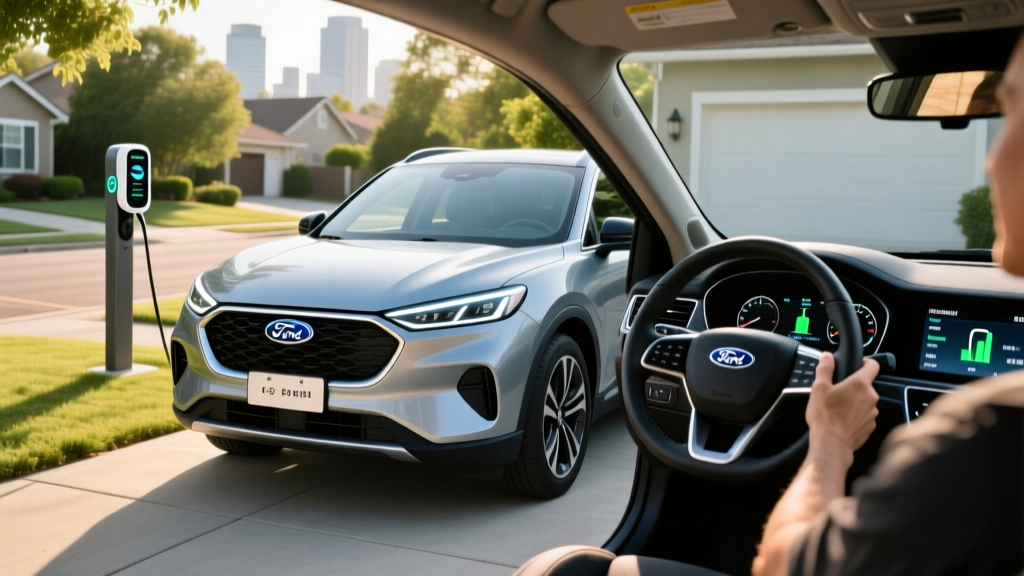
The Escape PHEV carries a significantly larger battery (14.4 kWh usable) that you charge via a standard wall outlet or Level 2 charger. It can drive roughly 37 miles on electricity alone before the gasoline engine engages. Once the battery depletes, it operates exactly like a conventional hybrid. Think of it as an EV for short commutes and a hybrid for longer trips.
If you have no ability to charge at home or work, the PHEV's larger battery becomes dead weight — you'll get better overall efficiency from the lighter HEV.
2026 Ford Escape Hybrid Fuel Economy: EPA and Real-World MPG
Fuel economy is the headline number for any hybrid buyer. Here's what the EPA rates for the current-generation Escape Hybrid lineup:
| Model | City MPG | Highway MPG | Combined MPG | Combined MPGe (PHEV) |
|---|---|---|---|---|
| Escape HEV FWD | 42 | 36 | 39 | — |
| Escape HEV AWD | 42 | 36 | 39 | — |
| Escape PHEV (electric + gas) | — | — | 40 (gas-only) | 105 MPGe |
Real-World MPG: What to Actually Expect
Hybrids typically exceed their EPA city rating in stop-and-go traffic because regenerative braking recovers energy that a gas car wastes as heat. In our experience and owner reports, the Escape HEV consistently returns 41–45 MPG in city driving. Highway mileage is the weak point — sustained 70+ mph cruising reduces regenerative opportunities and increases aerodynamic drag, where the electric motor provides little assistance. Expect 33–36 MPG on the highway, sometimes below the EPA sticker.
For the PHEV, if your daily commute falls within the electric-only range and you charge nightly, you may use almost no gasoline for weeks. On a 20-mile round-trip commute charged at home, owners report using the engine only a handful of times per month.
Ford Escape PHEV: Electric-Only Range, Charging, and Battery Specs
The Escape PHEV's 14.4 kWh usable battery delivers an EPA-rated 37 miles of electric-only range. Combined with the 11.1-gallon fuel tank and 40 MPG hybrid operation once the battery depletes, total range reaches approximately 480 miles — enough to drive from Los Angeles to San Francisco and back on one tank if you start fully charged.
| Specification | Escape PHEV |
|---|---|
| Battery Capacity (usable) | 14.4 kWh |
| EPA Electric-Only Range | 37 miles |
| Total Combined Range | ~480 miles |
| Level 1 Charging (120V) | ~10–12 hours (0–100%) |
| Level 2 Charging (240V, 3.3 kW) | ~3.5 hours (0–100%) |
| DC Fast Charging | Not supported |
| Charge Port | J1772 (Level 1/2) |
Critical note on DC fast charging: The Escape PHEV does not support DC fast charging. This is standard for nearly all PHEVs — the battery is too small to justify the cost and weight of DC hardware. Charging happens at home or at work via Level 1 (standard outlet) or Level 2 (240V). A standard 120V outlet delivers roughly 3–4 miles of range per hour of charging, which is sufficient if you park for 10+ hours overnight. A Level 2 home charger cuts a full charge to about 3.5 hours.
Powertrain Output: Horsepower and Driving Dynamics
Both the HEV and PHEV use Ford's 2.5-liter Atkinson-cycle inline-four paired with an electric motor through an electronically controlled continuously variable transmission (eCVT). Output differs between the two:
- Escape HEV: 198 combined horsepower (163 hp engine + electric motor contribution)
- Escape PHEV: 210 combined horsepower (163 hp engine + more powerful electric motor)
The eCVT is smooth and eliminates shift shock, but it produces the characteristic "motorboat" drone under hard acceleration as the engine holds a steady RPM while vehicle speed increases. Around town, both versions feel responsive thanks to instant electric torque. Highway merging is adequate but not quick — 0–60 mph times are in the 7.5–8.5 second range depending on trim and drivetrain. The AWD HEV uses a rear-mounted electric motor rather than a mechanical driveshaft, providing all-weather traction without the efficiency penalty of a traditional AWD system.
Pricing, Trims, and Tax Credit Eligibility
The Escape Hybrid lineup spans several trims. Current MSRP pricing (before destination):
- Escape HEV Base (ST-Line): ~$33,000
- Escape HEV Premium trims: $36,000–$40,000
- Escape PHEV: ~$39,000–$43,000 depending on trim
Does the Ford Escape Hybrid Qualify for a Federal Tax Credit?
Here's where the HEV and PHEV diverge sharply:
Escape HEV (conventional hybrid): Does NOT qualify for any federal tax credit. The IRS §30D clean vehicle credit applies only to plug-in electric vehicles with a minimum battery capacity. Conventional hybrids are excluded.
Escape PHEV: As of the 2026 tax year, the Escape PHEV's eligibility for the IRS §30D clean vehicle credit depends on several requirements that change frequently:
- MSRP must not exceed $80,000 for SUVs (Escape qualifies)
- Buyer modified adjusted gross income must not exceed $150,000 (single) or $300,000 (joint)
- Battery components and critical minerals must meet domestic sourcing thresholds that increase annually
- The credit can now be transferred to the dealer as a point-of-sale discount
Because battery sourcing requirements tighten each year, a PHEV that qualified in 2024 may not qualify in 2026. Always verify current eligibility on the fueleconomy.gov tax credit lookup before purchasing. Consult a tax professional for your specific situation.
Some states offer additional rebates for PHEVs. California's CVRP, for instance, has offered rebates for qualifying PHEVs, though funding and eligibility fluctuate. Check your state energy office for current programs.
Battery Warranty, Reliability, and Replacement Cost
Battery longevity is the single most common concern among first-time hybrid buyers. Here's what Ford provides:
| Coverage | Escape HEV | Escape PHEV |
|---|---|---|
| Hybrid Battery Warranty | 8 years / 100,000 miles | 8 years / 100,000 miles |
| Hybrid Components Warranty | 8 years / 100,000 miles | 8 years / 100,000 miles |
| Powertrain Warranty | 5 years / 60,000 miles | 5 years / 60,000 miles |
In California Air Resources Board (CARB) states, the hybrid battery warranty extends to 10 years / 150,000 miles by mandate.
How Long Do Escape Hybrid Batteries Actually Last?
Ford's hybrid system has been in production since 2004 (the first Escape Hybrid). Real-world data from two decades of operation shows that hybrid battery packs routinely last 150,000–200,000+ miles before significant degradation. The HEV's small battery undergoes shallow charge-discharge cycles (typically operating between 40% and 60% state of charge), which dramatically extends cell life. The PHEV battery sees deeper cycles but is still managed conservatively by the battery management system.
If replacement is needed out of warranty, expect:
- HEV battery replacement: $2,500–$4,000 (parts and labor)
- PHEV battery replacement: $6,000–$9,000 (parts and labor)
Refurbished and aftermarket options are increasingly available at lower cost. For context, the average Escape Hybrid owner will spend $15,000–$20,000 less on fuel over 150,000 miles compared to a gas-only compact SUV — far exceeding even the PHEV battery replacement cost.
Reliability Track Record
The Escape Hybrid's powertrain is one of the most proven in the industry. The eCVT has no traditional gears, clutches, or torque converter to fail — it uses a planetary gearset with far fewer moving parts than a conventional automatic transmission. Common maintenance items are limited to standard brakes (which last longer due to regenerative braking reducing pad wear), tires, and fluid changes. The gasoline engine operates under reduced load thanks to electric assist, which can extend engine life.
Escape Hybrid vs PHEV vs Full EV: Which Fits Your Life?
Choose the Escape HEV if:
- You have no access to home or workplace charging
- You want maximum simplicity — no plugs, no charging apps, no range planning
- Your budget is tighter and you want the lower MSRP
- You drive mostly city miles where the 42 MPG city rating shines
- You want AWD availability (not offered on the PHEV)
Choose the Escape PHEV if:
- You can charge at home (even a standard 120V outlet works overnight)
- Your daily round-trip commute is under 35 miles
- You want to drive mostly on electricity but need gas flexibility for road trips
- You may qualify for the federal tax credit, narrowing the price gap with the HEV
- You want the quiet, smooth EV driving experience for daily errands
Choose a Full EV (like the Ford Mustang Mach-E) if:
- You have reliable home Level 2 charging
- Your typical trips fall within 250+ miles or you're comfortable with DC fast charging on road trips
- You want to eliminate gasoline entirely and minimize maintenance
- You qualify for the full $7,500 federal credit, making the EV price-competitive
Pros and Cons at a Glance
Pros
- Class-leading city MPG (42 city HEV)
- PHEV offers 37 miles electric-only — covers most commutes
- No range anxiety — gas backup always available
- Proven hybrid powertrain with 20+ year track record
- 8-year/100,000-mile hybrid battery warranty
- AWD available on HEV without major efficiency penalty
- Regenerative braking extends brake pad life significantly
Cons
- Highway MPG falls below EPA estimate at sustained 70+ mph
- PHEV does not support DC fast charging
- PHEV not available with AWD
- eCVT drone under hard acceleration
- PHEV price premium (~$5,000–$6,000 over HEV)
- HEV does not qualify for any federal tax credit
- Cargo space slightly reduced vs gas-only Escape (PHEV battery packaging)
Frequently Asked Questions
How many MPG does the Ford Escape Hybrid get?
The Escape HEV is EPA-rated at 42 city / 36 highway / 39 combined MPG for both FWD and AWD. In real-world city driving, many owners report 41–45 MPG thanks to aggressive regenerative braking. Highway mileage typically runs 33–36 MPG at sustained speeds above 70 mph. The PHEV achieves 105 MPGe when operating on its electric charge, and 40 MPG combined once the battery is depleted and the gas engine takes over.
How far can the Ford Escape PHEV go on electric only?
The EPA rates the Escape PHEV at 37 miles of electric-only range. In mild weather at city speeds, some drivers report stretching this to 40+ miles. In cold weather (below 35°F) or at highway speeds, expect 28–33 miles before the gas engine engages. After the battery depletes, the PHEV operates as a conventional hybrid with 40 MPG combined.
Does the Ford Escape Hybrid need to be plugged in?
The conventional Escape HEV does NOT plug in. It charges its small battery entirely through regenerative braking and the gasoline engine. Only the Escape PHEV requires (or benefits from) plugging in. If you never plug in the PHEV, it functions as a slightly heavier conventional hybrid with 40 MPG — you won't damage anything, but you'll miss the efficiency and cost benefits.
Is the Ford Escape Hybrid reliable?
Ford's hybrid system is one of the oldest and most proven in the market, dating to the 2004 Escape Hybrid. The eCVT transmission has fewer moving parts than a conventional automatic, and the hybrid battery is managed conservatively to maximize lifespan. Most hybrid batteries last 150,000–200,000+ miles. The system is backed by an 8-year/100,000-mile warranty (10 years/150,000 miles in CARB states).
How much does it cost to replace a Ford Escape Hybrid battery?
Out-of-warranty replacement for the HEV battery runs approximately $2,500–$4,000. The PHEV battery, being larger, costs $6,000–$9,000. Refurbished options are available at lower prices. However, widespread battery failure is uncommon — the vast majority of Escape Hybrids reach high mileage on the original pack.
Does the Ford Escape Hybrid qualify for a tax credit?
The conventional HEV does not qualify for any federal tax credit. The PHEV may qualify for up to $3,750–$7,500 under the IRS §30D clean vehicle credit, depending on current battery sourcing rules, your income, and the vehicle's MSRP. Eligibility changes annually as domestic sourcing thresholds increase. Check fueleconomy.gov and consult a tax professional before relying on credit availability.
Can I charge the Escape PHEV on a regular outlet?
Yes. The Escape PHEV includes a Level 1 charging cord that plugs into a standard 120V household outlet. A full charge takes approximately 10–12 hours, which works well for overnight charging. A 240V Level 2 charger reduces this to about 3.5 hours but requires professional installation ($500–$1,500 depending on your electrical panel).