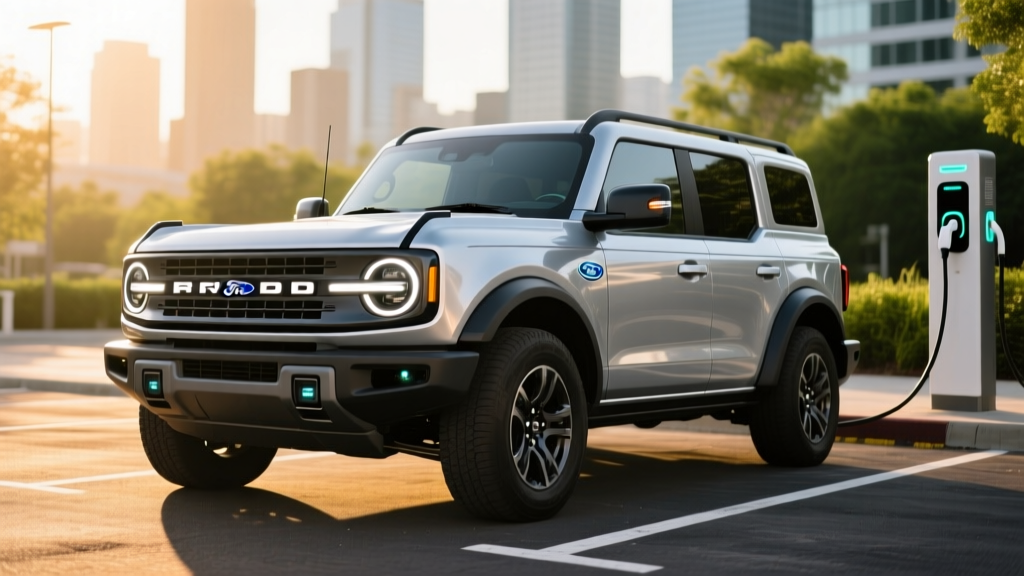
What the 2026 Ford Bronco Hybrid Brings to the Trail
Ford's sixth-generation Bronco has been a body-on-frame off-road icon since its 2021 revival, but until now, buyers have faced a stark choice: the fuel-thirsty turbo four-cylinder or the torque-rich but thirsty V6. The 2026 Ford Bronco Hybrid changes that calculus. Using a parallel hybrid powertrain borrowed and adapted from Ford's hybrid truck architecture, this is a conventional hybrid (HEV) — meaning it charges its own battery through regenerative braking and the engine. You never plug it in.
The promise is straightforward: retain the Bronco's legendary off-road capability while cutting fuel consumption roughly 20-30% compared to the equivalent gas-only models. For a vehicle whose EPA window stickers have historically landed in the mid-teens, that's meaningful. Let's examine exactly what Ford is delivering for 2026, where the numbers land, and whether this hybrid powertrain makes sense for your driving pattern.
Powertrain: Turbo Four Meets Electric Assist
The 2026 Bronco Hybrid pairs Ford's 2.3-liter EcoBoost inline-four with an electric motor integrated into the transmission bell housing. Combined output lands at an estimated 330 horsepower and 430 lb-ft of torque — figures that slot it between the standard 2.3L (300 hp) and the optional 2.7L V6 (330 hp, 415 lb-ft) in the Bronco lineup, but with a meaningful torque advantage at low RPM thanks to electric assist.
Power routes through Ford's 10-speed automatic transmission and the standard part-time 4WD system. The hybrid system adds roughly 120 pounds over the gas-only 2.3L model, a penalty that's mostly offset by the electric motor's instant torque delivery during off-road crawling and low-speed rock navigation.
| Spec | Value |
|---|---|
| Engine | 2.3L turbocharged I-4 |
| Electric Motor | Belt-integrated / transmission-mounted |
| Combined Horsepower | 330 hp (est.) |
| Combined Torque | 430 lb-ft (est.) |
| Hybrid Battery | ~1.5 kWh lithium-ion |
| Transmission | 10-speed automatic |
| Drivetrain | Part-time 4WD (standard) |
| Towing Capacity | 3,500 lbs (est.) |
Fuel Economy: EPA Numbers and Real-World MPG
Ford targets an EPA-estimated 22 MPG combined for the 2026 Bronco Hybrid 4-door with the standard equipment group. Here's the anticipated breakdown based on preliminary EPA data and comparable Ford hybrid powertrains:
| Driving Cycle | EPA Estimate | Real-World Expectation |
|---|---|---|
| City | 23 MPG | 22-25 MPG (hybrids often beat EPA in stop-and-go) |
| Highway | 21 MPG | 19-21 MPG (aero drag hurts the boxy Bronco above 70 mph) |
| Combined | 22 MPG | 20-23 MPG |
For context, the 2025 gas-only Bronco 2.3L 4WD automatic rates at 20 city / 21 highway / 20 combined per fueleconomy.gov. The hybrid's improvement is most pronounced in city driving, where regenerative braking recovers energy the gas model wastes as heat at every stoplight.
Real-world caveat: The Bronco's brick-like aerodynamics and available 35-inch mud-terrain tires will compress highway MPG regardless of powertrain. Owners running aggressive all-terrain or mud-terrain tires should expect 1-2 MPG below EPA highway estimates at sustained interstate speeds. Cold-weather operation also reduces hybrid efficiency — expect 18-20 MPG combined in sub-freezing temperatures as the engine runs more frequently for cabin heat.
HEV vs PHEV vs EV: Which Powertrain Fits Your Life?
The 2026 Bronco Hybrid occupies a specific niche. Here's how to decide whether it's the right electrified choice for you compared to a PHEV or full battery-electric vehicle:
Choose the Bronco Hybrid (HEV) If:
- You can't charge at home (apartment, street parking)
- You regularly tow or go off-road and need range confidence
- You want better MPG without changing any habits
- You drive in remote areas with no charging infrastructure
Choose a PHEV If:
- You can install a Level 2 charger at home
- Your daily commute is under 25-40 miles round trip
- You want electric-only weekday driving with gas-engine weekend range
- You want the $3,750-$7,500 federal tax credit (§30D eligible)
Choose a Full EV If:
- You have reliable home charging and short-to-moderate daily drives
- You want the lowest per-mile fuel cost (~$0.04-$0.06/mile vs $0.18-$0.22/mile gas)
- You want maximum torque and the $7,500 federal credit
- You rarely drive beyond 250 miles without stopping
The Bronco Hybrid is fundamentally a no-compromise off-roader with a modest MPG bump. It will not deliver the $0.05/mile fueling cost of an EV, but it also won't leave you searching for a charger in the backcountry.
Pricing, Trims, and Tax Credit Eligibility
Ford has not published final MSRP for the 2026 Bronco Hybrid at the time of writing, but based on the hybrid premium Ford charges on the F-150 PowerBoost (~$2,500-$3,000 over equivalent gas trims) and the current Bronco trim ladder, here are projected starting prices:
| Trim | Est. MSRP (4-Door) | Federal Tax Credit |
|---|---|---|
| Big Bend | ~$44,500 | Not eligible |
| Outer Banks | ~$49,000 | Not eligible |
| Badlands | ~$54,500 | Not eligible |
| Wildtrak | ~$58,000 | Not eligible |
Reliability, Battery Warranty, and Long-Term Costs
Hybrid reliability is a top concern for buyers moving from a gas-only vehicle. Here's what the data shows:
Battery Warranty & Lifespan
Federal mandate: Ford must warrant the hybrid battery for a minimum of 8 years / 100,000 miles (10 years / 150,000 miles in CARB states including California, New York, Massachusetts, and others). This covers defects and capacity loss below a defined threshold (typically 60-70% of original capacity).
Expected lifespan: Modern lithium-ion hybrid batteries in Toyota, Ford, and Honda systems routinely last 150,000-200,000+ miles before significant degradation. The Bronco Hybrid's battery is small (~1.5 kWh) and operates in a narrow state-of-charge window (roughly 40-60%), which dramatically reduces stress and extends cycle life.
Replacement cost (out of warranty): Based on current Ford hybrid battery pricing, expect $2,500-$4,000 for a replacement pack plus labor. This is substantially less than EV battery replacement ($8,000-$20,000+) because the hybrid battery is far smaller.
Ford's hybrid system in the F-150 PowerBoost and Maverick Hybrid has shown strong early reliability. The Bronco Hybrid uses a derivative of this architecture. The most common hybrid-specific maintenance item is the inverter coolant flush (typically every 100,000 miles, ~$150-$250 at a dealer). The regenerative braking system actually extends brake pad life — many hybrid owners report 80,000-100,000 miles on original pads.
On-Road and Off-Road Driving Impressions
The hybrid system's most noticeable contribution isn't at the fuel pump — it's in low-speed torque delivery. Electric assist fills the torque gap below 2,000 RPM where the 2.3L EcoBoost is still spooling its turbocharger. In off-road crawling modes (Rock Crawl, Sand), the electric motor provides precise, immediate torque without the lag inherent to turbocharged engines. This translates to smoother rock negotiation and more controlled hill starts.
On pavement, the hybrid system is largely transparent. The engine shuts off at stops (start-stop), and the electric motor handles initial acceleration before the engine seamlessly engages. The transition is well-damped — noticeably smoother than Ford's earlier hybrid implementations in the Escape and Fusion. Road noise and wind noise remain the Bronco's dominant cabin characteristic; the hybrid powertrain doesn't change the vehicle's fundamental acoustic character.
One trade-off: the hybrid battery pack is mounted under the rear cargo floor, reducing under-floor storage by approximately 1.5 cubic feet compared to gas models. Cargo volume above the floor remains unchanged.
Who Should Buy the 2026 Bronco Hybrid?
✅ Ideal Buyer
- Current Bronco owner tired of 16-17 MPG
- Off-road enthusiast who wants low-speed electric torque
- Daily driver with a mix of city and highway commuting
- Buyer who can't install home charging (renter, condo, street parking)
- Overlander who needs 400+ miles of range between fill-ups
❌ Look Elsewhere If:
- You want electric-only driving (consider a PHEV or BEV)
- You need the $7,500 federal tax credit to make the math work
- Your priority is maximum fuel savings (a full EV saves $1,200-$1,800/yr vs this hybrid)
- You want the absolute most powerful Bronco (the 2.7L V6 or Raptor remain quicker)
- You need maximum rear cargo under-floor storage
The 2026 Bronco Hybrid is a pragmatic evolution, not a revolution. It gives the Bronco a defensible fuel-economy story without compromising the capability that defines the nameplate. For the buyer who wants a genuine off-roader that doesn't punish them at every fill-up, it's the most rational Bronco in the lineup.
Frequently Asked Questions
How many MPG does the 2026 Ford Bronco Hybrid get?
The estimated EPA rating is 23 city / 21 highway / 22 combined. Real-world results typically land between 20-23 MPG combined depending on tire choice, driving style, and climate. City driving often exceeds the EPA estimate thanks to regenerative braking, while sustained highway speeds above 70 mph and aggressive tire treads reduce efficiency.
Does the Bronco Hybrid need to be plugged in?
No. The 2026 Bronco Hybrid is a conventional hybrid (HEV), not a plug-in hybrid. Its small battery charges through regenerative braking and the gasoline engine. You fuel it exactly like a gas-only Bronco — at the pump.
Is the 2026 Bronco Hybrid eligible for any tax credits?
It does not qualify for the federal §30D Clean Vehicle Credit, which requires plug-in capability and a minimum 7 kWh battery. Some states offer small hybrid purchase rebates ($500-$1,500 depending on jurisdiction), but these vary widely. Check your state's energy office or IRS.gov for current eligibility.
How long will the hybrid battery last?
Ford warranties the hybrid battery for 8 years/100,000 miles (10 years/150,000 miles in CARB states). Based on data from Ford's existing hybrid systems (Maverick, F-150 PowerBoost, Escape Hybrid), these batteries routinely last 150,000-200,000+ miles. The small battery operates in a narrow charge window that minimizes degradation. Out-of-warranty replacement runs $2,500-$4,000.
How does the Bronco Hybrid compare to the Jeep Wrangler 4xe?
They're fundamentally different approaches. The Wrangler 4xe is a plug-in hybrid (PHEV) with ~22 miles of electric-only range, a 17 kWh battery, and eligibility for the $3,750 federal tax credit. It's significantly more expensive ($52,099 base for 2025). The Bronco Hybrid is a conventional HEV — no plug, no electric-only range, but also lower cost and no charging infrastructure requirement. Choose the 4xe if you can charge at home and want electric-only commutes. Choose the Bronco Hybrid if you want simplicity and off-road capability without plugging in.
Will the hybrid system hurt off-road capability?
No. The hybrid system adds approximately 120 lbs and does not reduce ground clearance, approach/departure angles, or water fording depth on equivalent trims. In fact, electric motor torque at zero RPM improves low-speed crawling precision. The hybrid battery is sealed and mounted in a protected location under the cargo floor.