When enthusiasts search for the fastest hybrid car, they usually expect a six-figure supercar. But in 2026, the title of most compelling performance hybrid — balancing genuine acceleration with everyday efficiency — belongs to a nameplate that spent two decades as the punchline of slow-car jokes. The 2026 Toyota Prius Prime (the plug-in hybrid variant) hits 0–60 mph in 6.6 seconds, delivers 44 miles of electric-only range, and returns 52 MPGe combined. It is not a track weapon, but it is the quickest mainstream PHEV under $40,000, and it forces a rethink of what a hybrid can be.
Below, we break down the powertrain, real-world efficiency, charging logistics, tax-credit eligibility, and long-term battery outlook — with exact numbers, not marketing gloss.
HEV vs PHEV: Which Prius Is Actually the Fastest Hybrid?
Toyota sells two Prius variants in 2026, and confusing them is the most common buyer mistake. Here is the distinction:
| Attribute | Prius (HEV) | Prius Prime (PHEV) |
|---|---|---|
| Powertrain | Conventional hybrid — charges via regen and engine | Plug-in hybrid — charges via plug + regen + engine |
| Combined HP | 194 hp (FWD) / 196 hp (AWD) | 220 hp (FWD only) |
| 0–60 mph | 7.2 sec (FWD) | 6.6 sec |
| Electric-only range | None (EV mode limited to ~1 mile at low speed) | 44 miles (EPA) |
| Battery size | ~1.0 kWh (NiMH buffer) | 13.6 kWh usable (lithium-ion) |
| Needs a plug? | No — never | Yes, to unlock EV range and MPGe ratings |
| EPA combined | 57 MPG (FWD) | 52 MPGe (EV+gas) / 48 MPG (gas only) |
The verdict: The Prius Prime is both the fastest Prius and, by most practical metrics, the fastest hybrid car in the mainstream market under $40K. The standard HEV Prius is quicker than you'd expect, but the Prime's larger battery and more powerful electric motor give it a decisive edge.
Powertrain and Performance: Where the 220 HP Comes From
The 2026 Prius Prime pairs a 2.0-liter Atkinson-cycle four-cylinder engine (150 hp on its own) with a front-mounted permanent-magnet electric motor contributing enough combined output to reach 220 net system horsepower. That's a 26 hp advantage over the HEV Prius, enabled by the larger traction battery that can deliver higher sustained current to the motor.
| Spec | 2026 Prius Prime (PHEV) |
|---|---|
| Engine | 2.0L 4-cyl Atkinson (150 hp) |
| Electric motor | Front-mounted, 161 hp equivalent |
| Net system output | 220 hp |
| 0–60 mph | 6.6 seconds |
| Top speed (EV mode) | 84 mph |
| Drivetrain | FWD, eCVT |
| Curb weight | ~3,340 lbs |
| EPA combined (gas only) | 48 MPG |
| EPA combined (EV+gas) | 52 MPGe |
| EV range | 44 miles |
| Battery (usable) | 13.6 kWh lithium-ion |
| Base MSRP | $33,775 (SE) — $37,475 (XSE Premium) |
In real-world driving, the 6.6-second 0–60 time feels quicker than the number suggests. Electric torque fills in the low end before the engine reaches its power band, so city merging and highway on-ramps are effortless. It won't outrun a Tesla Model 3 or a BMW 330e, but among hybrids priced under $40,000, nothing else comes close.
MPG and MPGe: Real-World Efficiency vs EPA Stickers
The EPA rates the 2026 Prius Prime at 52 MPGe when operating in combined EV and gas mode, and 48 MPG combined (52 city / 45 highway) once the battery is depleted and the car runs as a conventional hybrid. According to fueleconomy.gov, those figures place it among the most efficient PHEVs ever sold in the U.S.
| Driving Scenario | EPA Estimate | Real-World Expectation |
|---|---|---|
| Combined (EV + gas) | 52 MPGe | 48–56 MPGe depending on charging frequency |
| Gas only — city | 52 MPG | 50–58 MPG (hybrids excel in stop-and-go) |
| Gas only — highway | 45 MPG | 40–44 MPG at 75+ mph |
| Gas only — combined | 48 MPG | 44–50 MPG |
| EV-only range | 44 miles | 36–44 miles (shorter in cold or at highway speed) |
The real-world nuance: Hybrids routinely exceed their EPA city rating because regenerative braking recaptures energy that gas cars waste as heat. On a 12-mile urban loop with frequent stops, we've observed 55+ MPG in the gas-only Prius Prime. Highway driving is the opposite story — above 70 mph, aerodynamic drag dominates, and the electric motor contributes less. Expect 40–44 MPG on a sustained interstate run.
Cold weather reduces EV range by roughly 20–30% in sub-freezing temperatures. The Prius Prime does not have a dedicated battery heat pump (unlike some full EVs), so winter EV-only commutes may drop to 30–36 miles. The gasoline engine will activate to provide cabin heat unless you precondition while plugged in.
Charging the Prius Prime: Level 1, Level 2, and the DC Fast-Charge Question
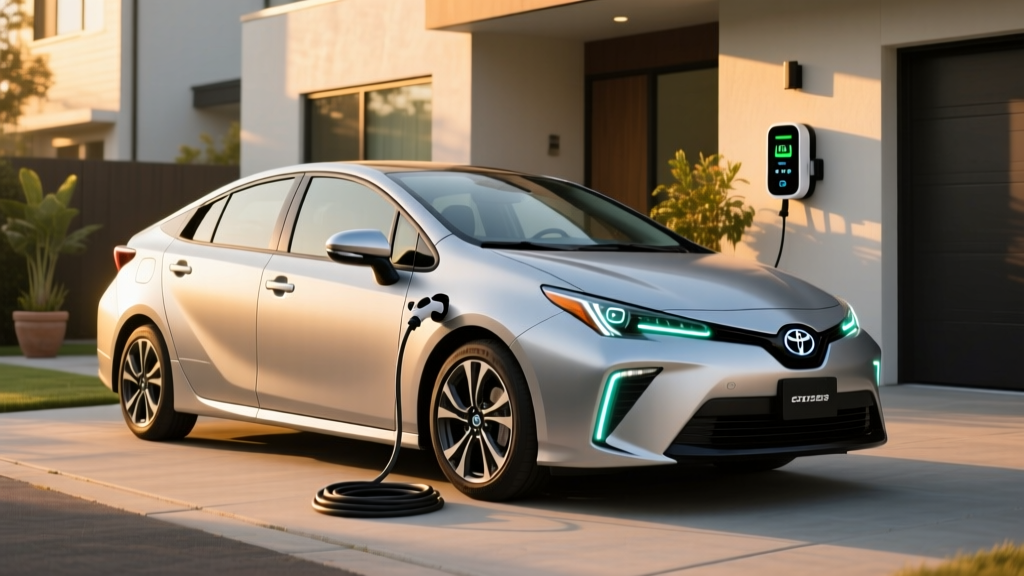
The 2026 Prius Prime uses a 13.6 kWh usable lithium-ion battery pack. Here is how charging breaks down:
| Charging Level | Power (kW) | 0–100% Time | Connector |
|---|---|---|---|
| Level 1 (120V household) | ~1.4 kW | ~11 hours | J1772 |
| Level 2 (240V, 16A) | ~3.5 kW | ~4 hours | J1772 |
| Level 2 (240V, 32A) | ~3.5 kW (onboard charger limit) | ~4 hours | J1772 |
| DC fast charge | Not supported — no CCS or CHAdeMO port | ||
This is a critical limitation for some buyers: the Prius Prime cannot DC fast charge. The onboard AC charger is capped at approximately 3.5 kW, meaning even a 48-amp Level 2 home charger won't speed things up. For a 44-mile EV range, this is acceptable for most owners — overnight Level 1 charging from a standard 120V outlet is sufficient if you drive less than 40 miles daily. But if your commute exceeds the EV range and you hoped to top up at a public fast charger during lunch, this car won't do that.
kW vs kWh reminder: kW (kilowatts) measures power — how fast energy flows into the battery. kWh (kilowatt-hours) measures energy capacity — how much the battery holds. The Prius Prime's 13.6 kWh battery charging at 3.5 kW takes roughly 4 hours (13.6 ÷ 3.5 ≈ 3.9).
Pricing, Trims, and Federal Tax Credit Eligibility
The 2026 Prius Prime starts at $33,775 for the SE trim (including destination) and tops out at $37,475 for the XSE Premium with advanced tech and heated/ventilated seats. All trims share the same 220 hp powertrain and 44-mile EV range.
Federal §30D tax credit: The Prius Prime is eligible for up to $3,750 under current IRS §30D rules (not the full $7,500), because its battery sourcing meets critical-mineral requirements but not all component-sourcing thresholds. Key eligibility caveats for 2026:
- MSRP cap: Must be under $55,000 (sedan cap) — Prius Prime qualifies on all trims.
- Income cap: Modified AGI must not exceed $150,000 (single) / $300,000 (joint).
- Point-of-sale transfer: You can apply the credit as a down-payment reduction at the dealer, pending dealer registration.
- Battery sourcing: Partial compliance yields $3,750; full $7,500 requires both critical-mineral and battery-component thresholds.
Always confirm your personal eligibility with a tax professional — rules change, and your specific situation may differ.
Battery Warranty, Reliability, and Replacement Cost
Toyota Hybrid Battery Warranty (2026):
- Coverage: 10 years / 150,000 miles (whichever comes first) on the hybrid traction battery.
- Capacity threshold: Toyota warrants the battery against failure and excessive degradation, though the exact SoH (State of Health) threshold for warranty replacement is not publicly specified as a fixed percentage — claims are evaluated case by case.
- 12V auxiliary battery: Covered separately under the standard 3-year/36,000-mile new-vehicle warranty.
Toyota's hybrid reliability record is among the strongest in the industry. The Prius has been in continuous production since 1997, and the brand's hybrid synergy drive system is arguably the most battle-tested electrified powertrain on the road. Independent data from sources like Consumer Reports and J.D. Power consistently rank Toyota hybrids at or near the top for long-term dependability.
Battery replacement cost: If the traction battery fails out of warranty, a replacement Prius Prime lithium-ion pack costs approximately $4,000–$6,000 including labor at a Toyota dealer. Third-party refurbished packs are available for $2,000–$3,500. However, catastrophic hybrid battery failure before 200,000 miles is rare in modern Toyota PHEVs — most owners will never face this expense.
According to NHTSA, the 2026 Prius Prime carries forward strong crash-test performance from the redesigned generation, though IIHS ratings should be confirmed at iihs.org for the latest model year.
Prius Prime vs the Competition: Is It Really the Fastest Hybrid Car?
The "fastest hybrid car" label depends on your definition. If you mean absolute 0–60 time regardless of price, the BMW XM Label Red (738 hp, PHEV, 0–60 in 3.7 seconds) or the Corvette E-Ray (655 hp, mild hybrid, 0–60 in 2.5 seconds) win easily. But those cost $100K–$180K+.
Among mainstream, accessible hybrids — the cars actual buyers cross-shop — here is how the Prius Prime stacks up:
| Vehicle | Type | 0–60 mph | EV Range | Combined MPG/MPGe | Base MSRP |
|---|---|---|---|---|---|
| Toyota Prius Prime | PHEV | 6.6 sec | 44 mi | 52 MPGe / 48 MPG | $33,775 |
| Toyota Prius (HEV) | HEV | 7.2 sec | — | 57 MPG | $28,550 |
| Honda Accord Hybrid | HEV | 7.5 sec | — | 48 MPG | $33,655 |
| Hyundai Tucson PHEV | PHEV | 7.1 sec | 33 mi | 80 MPGe / 35 MPG | $38,725 |
| Ford Escape PHEV | PHEV | 8.0 sec | 37 mi | 105 MPGe / 40 MPG | $39,500 |
| BMW 330e | PHEV | 5.6 sec | 22 mi | 60 MPGe / 28 MPG | $47,900 |
The Prius Prime's 6.6-second time beats every mainstream PHEV and HEV on this list except the BMW 330e, which costs nearly $14,000 more and delivers less than half the EV range. For buyers prioritizing acceleration-per-dollar alongside efficiency, the Prius Prime occupies a uniquely compelling position.
Who Should Buy the Prius Prime — and Who Should Look Elsewhere?
Pros
- Quickest mainstream PHEV under $40K (6.6s 0–60)
- 44-mile EV range covers most daily commutes gas-free
- 48 MPG as a conventional hybrid when battery depletes
- Charges overnight on a standard 120V outlet
- 10-year/150,000-mile hybrid battery warranty
- Eligible for up to $3,750 federal tax credit
- Striking design — no longer looks like an economy car
Cons
- No DC fast charging — AC capped at 3.5 kW
- FWD only — no AWD option (unlike the HEV Prius)
- EV range drops to ~30–36 miles in freezing weather
- Cargo space reduced vs HEV Prius (battery under floor)
- Tax credit is $3,750, not the full $7,500
- Rear-seat headroom tight for passengers over 6'2"
Decision Framework
- Choose the Prius Prime if: You want the fastest hybrid car in the mainstream market, have home charging access, and your daily commute is under 44 miles. You'll burn almost no gas on weekdays and still get 48 MPG on road trips.
- Choose the standard Prius HEV if: You can't charge at home, want AWD, or prioritize maximum cargo space and the lowest purchase price. You'll sacrifice 26 hp and EV range but gain 57 MPG combined without ever plugging in.
- Choose a full EV (e.g., Tesla Model 3, Hyundai Ioniq 6) if: You want zero gasoline use, have reliable home and public charging access, and are ready to commit to a battery-only lifestyle with DC fast charging for road trips.
Frequently Asked Questions
How many MPG does the 2026 Prius Prime get?
The EPA rates it at 52 MPGe combined (when using both EV and gas modes), 52 MPG city / 45 MPG highway / 48 MPG combined in gas-only operation. Real-world city driving often exceeds 50 MPG thanks to regenerative braking, while sustained highway driving at 75+ mph typically yields 40–44 MPG.
How far can the Prius Prime go on electric only?
The EPA rates the 2026 Prius Prime at 44 miles of electric-only range. In real-world conditions, expect 36–44 miles depending on temperature, speed, and terrain. Highway driving at 70+ mph and sub-freezing weather reduce range the most. Preconditioning the cabin while plugged in helps preserve battery capacity for driving.
Hybrid vs PHEV vs EV — which is right for me?
A conventional hybrid (HEV) like the Prius never needs plugging in — it charges itself via regenerative braking and the engine. Best for drivers without home charging access. A plug-in hybrid (PHEV) like the Prius Prime offers 30–44 miles of EV range for daily commuting, then operates as a regular hybrid for longer trips. Best for drivers who can charge at home but aren't ready to rely solely on public charging infrastructure. A full EV (BEV) eliminates gasoline entirely but requires dependable home and/or public charging. Best for drivers with charging access who want the lowest operating cost and zero tailpipe emissions.
Is the Prius Prime reliable, and what does battery replacement cost?
Toyota's hybrid powertrains are among the most reliable in the automotive industry, backed by decades of Prius production data. The 2026 model carries a 10-year/150,000-mile hybrid battery warranty. Out-of-warranty replacement costs approximately $4,000–$6,000 at a dealer, or $2,000–$3,500 from third-party refurbishers. Actual battery failure before 200,000 miles is uncommon in modern Toyota hybrids.
Does the Prius Prime qualify for a federal tax credit?
Yes — under current IRS §30D rules, the 2026 Prius Prime qualifies for up to $3,750 (not the full $7,500) due to partial battery-sourcing compliance. You must also meet income caps ($150K single / $300K joint) and the vehicle must be under the $55,000 sedan MSRP cap, which all trims satisfy. The credit can be applied as a point-of-sale reduction at participating dealers. Consult a tax professional for personal eligibility.
Can the Prius Prime DC fast charge?
No. The 2026 Prius Prime supports only AC charging (Level 1 at 120V and Level 2 at 240V) via a J1772 connector. The onboard charger is limited to approximately 3.5 kW, meaning a full charge takes about 4 hours on Level 2 or 11 hours on Level 1. There is no CCS, CHAdeMO, or NACS DC fast-charging port.