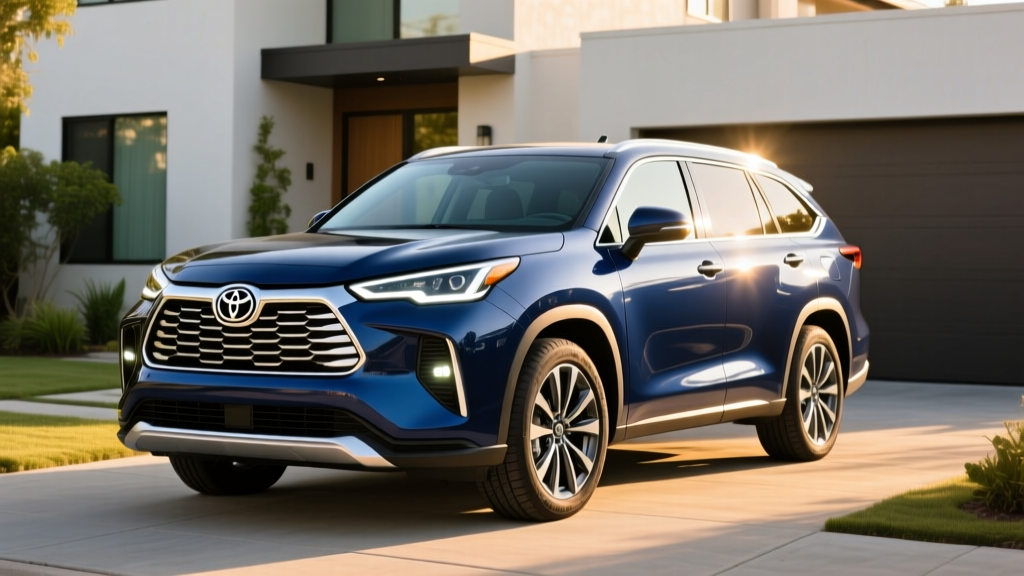
Quick Verdict: The Platinum Trim's Value Proposition
The 2025 Toyota Highlander Hybrid Platinum sits at the top of Toyota's three-row hybrid SUV lineup, layering premium features over the same proven 2.5-liter four-cylinder hybrid powertrain that makes the entire range so efficient. At an MSRP of $53,270 (including destination), the Platinum commands roughly $6,000 over the mid-tier Limited, adding a panoramic sunroof, 360-degree camera, heated and ventilated second-row seats, and a premium JBL audio system.
The core question for buyers isn't whether this SUV is efficient — it is, returning an EPA-estimated 35 MPG combined. The question is whether the Platinum's luxury additions justify the price premium over the already well-equipped Limited, and whether a conventional hybrid (HEV) still makes sense in an era of increasingly affordable plug-in hybrids and full electric SUVs. This review breaks down every spec that matters.
Fuel Economy: EPA Ratings and Real-World MPG
The 2025 Highlander Hybrid Platinum comes exclusively with electronic all-wheel drive (AWD), which slightly impacts fuel economy compared to the FWD-only lower trims. Here are the official EPA figures as published on fueleconomy.gov:
| Cycle | EPA Estimate | Real-World Expectation |
|---|---|---|
| City | 35 MPG | 36–39 MPG (hybrids excel in stop-and-go) |
| Highway | 34 MPG | 30–33 MPG (aerodynamic drag at 70+ mph) |
| Combined | 35 MPG | 32–36 MPG depending on driving mix |
Real-world note: Toyota's hybrid synergy drive system recovers energy aggressively during braking and low-speed driving, which is why city MPG often matches or exceeds the highway number. Owners doing mostly suburban and city driving consistently report 36–38 MPG on forums and fuel-tracking apps. Sustained highway travel above 70 mph, especially with a full load of passengers and cargo, pushes consumption closer to 30–31 MPG. In cold weather (below 30°F), expect a 3–5 MPG drop during short trips as the engine runs more frequently to heat the cabin.
HEV vs. PHEV vs. EV: Where the Highlander Hybrid Fits
The Highlander Hybrid is a conventional hybrid (HEV) — it does not plug in. It has no electric-only driving range to speak of (the small traction battery assists the gas engine at low speeds but cannot propel the vehicle on electricity alone for meaningful distances). This is a deliberate distinction from a plug-in hybrid (PHEV) like the Toyota RAV4 Prime, which offers 42 miles of EV range before the engine engages.
Conventional Hybrid (HEV) vs. Plug-In Hybrid (PHEV) vs. Full EV (BEV)
| Attribute | HEV (Highlander Hybrid) | PHEV (e.g., RAV4 Prime) | BEV (e.g., Kia EV9) |
|---|---|---|---|
| Plug-in charging required? | No | Optional (beneficial) | Yes (required) |
| Electric-only range | ~1 mile at low speed | 30–42 miles typical | 250–310 miles typical |
| Total range | ~600 miles | ~500+ miles combined | 250–310 miles |
| Fuel cost per mile | ~$0.10 (at $3.50/gal) | ~$0.04 electric / $0.10 gas | ~$0.04 (at $0.14/kWh) |
| Federal tax credit (§30D) | Not eligible | Up to $7,500 if eligible | Up to $7,500 if eligible |
| Home charging install needed? | No | Recommended (Level 2) | Essential (Level 2) |
Who should choose the Highlander Hybrid HEV? Families who want three-row seating, AWD capability, and maximum range without any lifestyle change — no charging cables, no route planning, no range anxiety. If you lack home charging access (apartment dwellers, street parkers), an HEV is the pragmatic electrified choice.
Who should look at a PHEV instead? Drivers with short commutes (under 35 miles round-trip) and access to Level 2 home charging. A PHEV lets you drive on electricity most weekdays and use gas only for road trips. However, no three-row PHEV currently matches the Highlander's interior space at a comparable price — the closest rival, the Chrysler Pacifica Hybrid PHEV, is a minivan.
Who should consider a full EV? Buyers with reliable home charging, mostly urban/suburban driving patterns, and a desire to minimize per-mile fuel cost. Three-row EVs like the Kia EV9 or Rivian R1S exist but start significantly higher ($54K–$76K) and still carry range compromises on road trips.
Powertrain Specs: What's Under the Hood
| Powertrain | 2.5L 4-cylinder DOHC + 3 electric motors (AWD) |
| Combined system horsepower | 243 HP |
| Gas engine output | 186 HP / 186 lb-ft torque |
| Front electric motor | 134 HP / 199 lb-ft |
| Rear electric motor (AWD) | 54 HP / 89 lb-ft |
| Transmission | eCVT (electronically controlled continuously variable) |
| Drivetrain | Electronic AWD (eAWD) — no mechanical driveshaft |
| 0–60 MPH | ~7.8 seconds |
| Towing capacity | 3,500 lbs (with tow package) |
| Fuel tank | 17.1 gallons |
| Total range (est.) | ~598 miles (17.1 gal × 35 MPG) |
| Seating | 7 passengers (2nd-row captain's chairs) |
| Cargo (behind 3rd row) | 16.1 cu ft |
| Cargo (all rows folded) | 84.3 cu ft |
The fourth-generation Toyota Hybrid System (THS) in the Highlander pairs a naturally aspirated 2.5-liter Atkinson-cycle engine with two front-mounted motor-generators and a separate rear-axle electric motor for AWD traction. The rear motor activates on demand — during acceleration from a stop, when front-wheel slip is detected, or in low-traction conditions. There is no mechanical driveshaft connecting the axles, reducing weight and parasitic loss.
Acceleration is adequate rather than thrilling. The 243 combined HP moves the 4,500-pound SUV to 60 MPH in roughly 7.8 seconds, which is competitive with the Honda Pilot Hybrid but noticeably slower than turbocharged V6 rivals like the Kia Telluride. The eCVT delivers seamless power with no shift shock, though it can hold the engine at a drone under hard acceleration — typical of Toyota's hybrid architecture.
Pricing, Trims, and Tax Credit Eligibility
The 2025 Toyota Highlander Hybrid lineup spans four trims. The Platinum sits at the top:
| Trim | MSRP (incl. destination) | Key Additions |
|---|---|---|
| LE | $42,320 | Base hybrid, 8" touchscreen, TSS 2.5+ |
| XLE | $45,770 | SofTex seats, sunroof, 2nd-row sunshades |
| Limited | $49,570 | Leather, 12.3" display, JBL audio, panoramic roof |
| Platinum | $53,270 | 360° camera, ventilated 2nd row, head-up display |
Federal Tax Credit: Does the Highlander Hybrid Qualify?
No. The Toyota Highlander Hybrid is a conventional HEV — it does not have a plug and does not meet the requirements of the IRS §30D Clean Vehicle Credit. That credit applies only to plug-in electric vehicles (PHEVs and BEVs) with battery capacities of at least 7 kWh that meet critical mineral and battery component sourcing thresholds, MSRP caps ($80,000 for SUVs), and buyer income limits ($300,000 MFJ / $150,000 single). Full details are available at irs.gov.
Some states offer rebates or HOV-lane access for conventional hybrids, but these programs are shrinking as legislatures redirect incentives toward plug-in vehicles. Check your state's energy office for current programs.
Platinum Trim Cost-Benefit
The $3,700 jump from Limited to Platinum adds:
- Heated and ventilated second-row captain's chairs
- Hybrid battery warranty: 10 years / 150,000 miles (whichever comes first), transferable to subsequent owners
- Hybrid system components warranty: 8 years / 100,000 miles (includes inverter, control module, electric motors)
- Basic vehicle warranty: 3 years / 36,000 miles
- Powertrain warranty: 5 years / 60,000 miles
- 12.3-inch infotainment touchscreen with wireless Apple CarPlay and Android Auto, built-in navigation, and JBL 11-speaker premium audio
- Toyota Safety Sense 2.5+ including pre-collision system with pedestrian detection, full-speed adaptive cruise control, lane tracing assist, and road sign assist
- Digital rearview mirror — switches from optical to a camera feed, solving the Highlander's inherent rear-visibility problem when the cargo area is loaded
- Wireless Qi phone charging and four USB-C ports across three rows
- Heads-up display projecting speed and navigation onto the windshield
- 35 MPG combined in a 7-passenger AWD SUV — best in class
- Proven hybrid reliability with 10yr/150K-mile battery warranty
- No charging infrastructure required — fill up and go
- ~600-mile total range eliminates refueling stops on most road trips
- Strong resale value — Toyota hybrids hold premium in used market
- Platinum features (360° camera, ventilated 2nd row) genuinely useful
- Third row is tight — competitors offer more space
- 243 HP feels modest; no sport mode transforms the experience
- No federal tax credit — unlike PHEV and BEV alternatives
- Platinum at $53K+ approaches luxury-SUV territory without the badge
- Cargo behind 3rd row is limited (16.1 cu ft)
- eCVT drone under hard acceleration
For families regularly hauling passengers in the second row, the ventilated seats and panoramic roof make a tangible comfort difference. The 360-degree camera is genuinely useful given the Highlander's size and limited rearward visibility. If those features matter, the Platinum premium is reasonable. If not, the Limited delivers 90% of the experience for $3,700 less.
Hybrid Battery Warranty, Reliability, and Replacement Cost
Toyota Hybrid Battery Coverage
Toyota's hybrid battery track record is among the strongest in the industry. The Highlander Hybrid uses a nickel-metal hydride (NiMH) traction battery — not the lithium-ion packs found in full EVs. NiMH chemistry is less energy-dense but extremely durable and thermally stable. Data from Toyota's own fleet and third-party sources like Consumer Reports shows that the vast majority of Toyota hybrid batteries last well beyond 150,000 miles with minimal capacity loss.
Replacement cost if out of warranty: A new OEM hybrid battery pack for the Highlander Hybrid currently runs approximately $3,000–$4,500 installed at a Toyota dealer. Independent hybrid specialists often offer refurbished packs for $1,500–$2,500 with a 1–3 year warranty. Given the 10-year/150,000-mile factory coverage, most original owners will never face this expense.
Reliability ratings for the Highlander Hybrid are strong. Toyota's hybrid system has few wear items — the eCVT has no traditional clutch packs or bands to fail, regenerative braking extends pad life (60,000+ miles is common), and the Atkinson-cycle engine operates under lighter loads than a conventional engine. IIHS has awarded the Highlander top scores in crashworthiness testing.
Platinum Trim Features and Daily Livability
Beyond the powertrain, the Platinum trim distinguishes itself with technology and comfort features that matter in daily use:
Third-row space remains the Highlander Hybrid's weakest point relative to rivals. The third row accommodates children or occasional short-trip adults, but the Kia Telluride and Hyundai Palisade offer meaningfully more legroom. Cargo volume behind the third row (16.1 cu ft) is tight for a week's groceries for a family of five — folding one or both third-row sections is routine for most trips.
The driver-assist suite is competent but clearly SAE Level 2 — it requires active driver supervision at all times. Toyota's Lane Tracing Assist centers the vehicle well on highways, and the adaptive cruise handles stop-and-go traffic smoothly. It does not replace an attentive driver and will not navigate interchanges or make lane-change decisions autonomously.
5-Year Ownership Cost Snapshot
| Category | Highlander Hybrid Platinum | Gas Highlander V6 (2024 baseline) |
|---|---|---|
| Purchase price (MSRP) | $53,270 | $48,410 |
| Fuel cost (75K mi) | $7,500 (35 MPG, $3.50/gal) | $11,030 (24 MPG, $3.50/gal) |
| Maintenance (est.) | $2,800 | $3,600 |
| Insurance (est. avg) | $8,400 | $7,800 |
| Depreciation (est.) | $22,000 | $21,000 |
| Total 5-year cost | ~$93,970 | ~$91,840 |
The hybrid's fuel savings (~$3,530 over five years) nearly offset its higher purchase price, and lower maintenance costs (fewer brake replacements, no transmission fluid changes, less engine wear) narrow the gap further. The gas Highlander still edges out on total cost over five years, but the margin is thin — and the hybrid's advantage widens significantly in years 6–10 as the gas powertrain requires more maintenance. Note: insurance premiums for the Platinum trim run slightly higher due to the replacement cost of the panoramic roof and HUD components.
Pros, Cons, and Bottom Line
Pros
Cons
The 2025 Toyota Highlander Hybrid Platinum is the right choice for families who need three rows and AWD, want to reduce fuel costs without changing their refueling habits, and plan to keep the vehicle well past 100,000 miles. The hybrid system's simplicity and Toyota's warranty coverage make it one of the lowest-risk electrified vehicles on the market. If maximum interior space is your priority, test-drive the Telluride or Palisade. If you have home charging and want to drive on electricity daily, investigate the RAV4 Prime or a three-row EV. But for the specific intersection of efficiency, space, and ownership peace of mind, the Highlander Hybrid Platinum occupies a defensible niche.
Frequently Asked Questions
How many MPG does the 2025 Highlander Hybrid Platinum get?
The EPA rates the AWD Highlander Hybrid at 35 MPG city, 34 MPG highway, and 35 MPG combined. Real-world city driving often yields 36–39 MPG, while sustained highway driving at 70+ MPH typically returns 30–33 MPG. Cold weather and heavy loads reduce these figures by 3–5 MPG.
Does the Highlander Hybrid need to be plugged in?
No. The Highlander Hybrid is a conventional hybrid (HEV), not a plug-in hybrid (PHEV). It charges its small traction battery through regenerative braking and the gas engine. You never plug it in — just refuel at any gas station.
Is there a plug-in hybrid (PHEV) version of the Highlander?
As of the 2025 model year, Toyota does not offer a Highlander PHEV in the US market. The RAV4 Prime (42 miles electric range) and the Prius Prime (40 miles) are Toyota's current PHEV offerings, but neither has three rows. If a three-row PHEV is essential, the Chrysler Pacifica Hybrid minivan is the closest option with 32 miles of EV range.
How long will the hybrid battery last and what does replacement cost?
Toyota warranties the hybrid battery for 10 years or 150,000 miles. Historical data from Toyota's hybrid fleet shows most batteries last 180,000+ miles with minimal degradation. If replacement is needed out of warranty, expect $3,000–$4,500 for a new OEM pack at a dealer, or $1,500–$2,500 for a refurbished unit from a hybrid specialist.
Does the 2025 Highlander Hybrid qualify for a federal tax credit?
No. The IRS §30D Clean Vehicle Credit applies only to plug-in vehicles (PHEVs and BEVs) with qualifying battery capacity and sourcing. The Highlander Hybrid is a conventional HEV and does not qualify. Some states may offer minor hybrid incentives — check your state energy office for details.
How does the Highlander Hybrid compare to a full EV like the Kia EV9?
The Kia EV9 (starting ~$54,900) offers 279 miles of EPA range, three rows, and significantly lower per-mile fuel cost (~$0.04/mi vs $0.10/mi for the Highlander Hybrid). However, the EV9 requires home Level 2 charging, adds range planning on road trips, and carries a higher insurance premium. The Highlander Hybrid is the pragmatic choice for buyers without reliable home charging or who frequently drive 400+ miles between stops.
Is the Platinum trim worth it over the Limited?
The $3,700 premium adds the 360-degree camera, ventilated second-row seats, head-up display, and panoramic roof. If you regularly carry second-row passengers or park in tight spaces, these features justify the cost. If you're budget-conscious, the Limited already includes leather, JBL audio, and the 12.3-inch touchscreen — the core experience is nearly identical.
Related reading
View all Hybrid & PHEV Hybrid Review
Hybrid or Electric in 2026: Which Powertrain Saves You More?
Hybrid or electric? We compare 2026 HEV, PHEV, and BEV ownership costs, MPG, range, charging, and tax credits to find the right fit for your commute.
 Hybrid Review
CR-V Hybrid vs RAV4 Hybrid: 2026 MPG, Specs & Ownership Costs Compared
Honda CR-V Hybrid vs Toyota RAV4 Hybrid: compare 2026 EPA MPG, hybrid powertrain specs, AWD performance, pricing, reliability, and total ownership cost.
 Hybrid Review
2025 RAV4 Hybrid Limited Review: MPG, Pricing & Real-World Efficiency
2025 RAV4 Hybrid Limited tested: 39 MPG combined EPA, 219 hp AWD, $40,805 MSRP. Real-world fuel economy, battery warranty, and ownership costs analyzed.