The Ford F-150 PowerBoost hybrid occupies a specific niche: a full-size truck that can tow serious weight while delivering meaningfully better fuel economy than its gas-only counterparts. But buyers researching the F-150 hybrid towing capacity need more than the brochure number — they need to understand how towing affects real-world MPG, what the hybrid powertrain actually delivers under load, and whether the premium over a conventional F-150 pays for itself.
This guide covers the 2025–2026 model-year F-150 PowerBoost (Ford's conventional hybrid system), its maximum tow rating, fuel economy data from the EPA and real-world conditions, powertrain specs, warranty coverage, and where it fits against both the F-150 Lightning EV and gas-only F-150 models.
F-150 PowerBoost Towing Capacity by Configuration
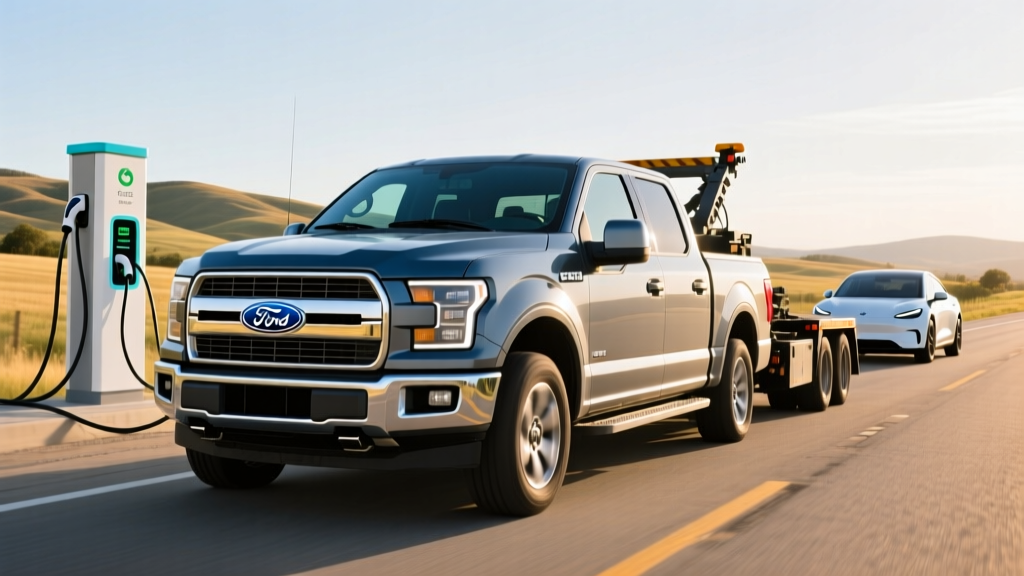
The F-150 PowerBoost hybrid's maximum towing capacity is 11,200 pounds when properly equipped. That figure requires specific configuration choices — you can't simply order any PowerBoost trim and expect to hit the maximum.
| Configuration | Max Towing (lbs) | Requirements |
|---|---|---|
| 4×2 SuperCrew, 5.5' bed | 11,200 | Max Trailer Tow Package, 3.5L PowerBoost |
| 4×4 SuperCrew, 5.5' bed | 10,800 | Max Trailer Tow Package, 3.5L PowerBoost |
| 4×4 SuperCrew, 6.5' bed | 10,600 | Max Trailer Tow Package, 3.5L PowerBoost |
| Without Max Trailer Tow Pkg | ~7,000–8,200 | Standard tow package varies by trim |
The Max Trailer Tow Package (often coded 53C on the window sticker) adds an upgraded rear axle ratio, integrated trailer brake controller, extended tow mirrors, and a 36-gallon fuel tank. Without it, most PowerBoost trims top out between 7,000 and 8,200 pounds — still useful for a boat or small camper, but well short of the headline number.
For context, the gas-only 3.5L EcoBoost V6 with the same Max Trailer Tow Package can pull up to 13,000–14,000 lbs depending on configuration, while the F-150 Lightning EV maxes at 10,000 lbs (with the Extended Range battery). The PowerBoost sits in the middle — giving up some peak tow rating to the gas model while offering efficiency the EcoBoost can't match in daily driving.
Powertrain Specs: What Drives the F-150 Hybrid
The PowerBoost system pairs Ford's 3.5-liter twin-turbo V6 with a 35 kW (47 hp) electric motor integrated into the 10-speed automatic transmission. Combined output is 430 horsepower and 570 lb-ft of torque — the highest torque figure in the F-150 lineup short of the Raptor R.
| Specification | Value |
|---|---|
| Engine | 3.5L twin-turbo V6 |
| Electric Motor | 35 kW (47 hp), integrated in transmission |
| Combined Horsepower | 430 hp |
| Combined Torque | 570 lb-ft |
| Transmission | 10-speed automatic |
| Hybrid Battery | 1.5 kWh (lithium-ion), located under bed |
| Drivetrain | RWD (4×2) or 4WD (4×4) |
| 0–60 mph (est.) | ~5.8 seconds (4×4) |
HEV vs. PHEV — Critical Distinction: The F-150 PowerBoost is a conventional hybrid (HEV), not a plug-in hybrid. It has a small 1.5 kWh battery that charges exclusively through regenerative braking and the gasoline engine. You never plug it in. It cannot drive on electric power alone for meaningful distances (less than a mile at very low speeds). This is fundamentally different from a PHEV like the Toyota RAV4 Prime, which has a larger battery (~18 kWh), a plug, and 40+ miles of electric-only range. If you see "F-150 PHEV" discussed online, that vehicle does not currently exist in Ford's lineup.
The 1.5 kWh battery is small by EV standards, but it's not meant for electric driving range. Instead, it provides torque fill during acceleration, enables engine-off coasting, and powers the truck at idle — which matters when you're running the Pro Power Onboard generator system at a job site or campsite.
Fuel Economy: EPA Ratings vs. Real-World MPG
Fuel economy is where the PowerBoost justifies its existence over the standard 3.5L EcoBoost. According to fueleconomy.gov (EPA data), the ratings break down as follows:
| Configuration | City MPG | Highway MPG | Combined MPG |
|---|---|---|---|
| 4×2 PowerBoost | 25 | 26 | 25 |
| 4×4 PowerBoost | 23 | 24 | 23 |
| 4×4 3.5L EcoBoost (gas) | 18 | 23 | 20 |
The 4×4 PowerBoost delivers a 3 MPG combined advantage over the equivalent gas EcoBoost — a 15% improvement. In city and suburban driving, the gap widens to 5 MPG, because the hybrid system recovers energy during braking and shuttles the engine off at stops. Highway driving narrows the gap since the electric motor contributes less at sustained high speeds.
Real-World MPG: What Owners Actually See
Owner-reported data and independent testing paint a more nuanced picture than EPA stickers:
- Unloaded daily driving (mixed): 22–25 MPG for 4×4 models, aligning closely with EPA. Some owners report 26–27 MPG on suburban commutes with light throttle use.
- Highway cruising (70–75 mph, unloaded): 21–23 MPG. The boxy truck shape and all-terrain tires work against highway efficiency regardless of powertrain.
- Towing a 5,000-lb trailer: Expect 11–14 MPG depending on trailer aerodynamics, terrain, and speed. This is where the hybrid advantage shrinks significantly — the engine is doing most of the work, and regenerative braking opportunities are limited on flat interstates.
- Towing near max capacity (10,000+ lbs): 8–11 MPG. At these loads, the PowerBoost's efficiency edge over the EcoBoost narrows to roughly 1–2 MPG.
The honest takeaway: the PowerBoost saves meaningful fuel in daily driving, commute traffic, and light hauling. Under heavy towing, both the hybrid and gas engines drink fuel at rates that will hurt your wallet either way. The hybrid's advantage is that you still get 23 MPG combined on the days you're not towing — which for most owners is 90%+ of their miles.
Towing Performance Under Real Conditions
The 570 lb-ft of combined torque and electric motor's instant response give the PowerBoost a distinct feel when pulling away from a stop with a trailer. There's no turbo lag and no waiting for the transmission to downshift — the electric motor fills the torque gap while the turbos spool. This makes low-speed maneuvering, boat ramp launches, and stoplight-to-stoplight towing noticeably smoother than the gas-only 3.5L EcoBoost.
However, the hybrid system does not add sustained horsepower for long mountain grades. On extended 6–8% uphill pulls with a heavy trailer, the small 1.5 kWh battery depletes quickly, and the truck operates essentially as a conventional 3.5L EcoBoost — with the added weight of the hybrid components (~200 lbs). Drivers towing near max capacity through mountainous terrain should expect the PowerBoost to perform comparably to the gas model, not better.
Ford's Pro Trailer Backup Assist and integrated trailer brake controller (included with the Max Trailer Tow Package) work identically on the PowerBoost as on gas models. The hybrid system doesn't change the truck's towing technology suite.
Pricing, Tax Credits, and Value Proposition
The PowerBoost hybrid is available across multiple F-150 trims for the 2025–2026 model year, typically as a $1,900–$2,500 option over the standard 3.5L EcoBoost (depending on trim and model year). Here's the approximate pricing landscape:
| Trim | Approx. Starting MSRP (4×4) | PowerBoost Availability |
|---|---|---|
| XLT SuperCrew | ~$56,000–$58,000 | Available as option |
| Lariat SuperCrew | ~$64,000–$67,000 | Available as option |
| King Ranch / Platinum | ~$72,000–$78,000 | Available / sometimes standard |
| Limited | ~$84,000+ | Standard |
Federal Tax Credit — §30D Eligibility: The F-150 PowerBoost is a conventional hybrid (HEV), not a plug-in vehicle. It does not qualify for the federal §30D clean vehicle credit (up to $7,500), which is restricted to plug-in electric vehicles (BEVs and PHEVs) with battery capacity ≥7 kWh. The PowerBoost's 1.5 kWh battery is far below this threshold. If tax credit eligibility is a priority, the F-150 Lightning (BEV) qualifies for up to $7,500 depending on buyer income, MSRP caps, and battery sourcing requirements — see IRS.gov §30D guidelines for current-year rules. No federal tax credit exists for conventional hybrids in 2025–2026.
Some states offer their own incentives for hybrid vehicles (Oregon and Colorado have had hybrid-related rebates, for instance), but these vary by jurisdiction and change frequently. Check your state's energy department or a local tax professional for current local programs.
Does the Hybrid Premium Pay for Itself?
At a $2,000 premium and a 3 MPG combined improvement over the gas EcoBoost, the fuel savings math depends on your mileage and local gas prices. Assuming 15,000 miles/year, $3.50/gallon, and 23 MPG (PowerBoost) vs. 20 MPG (EcoBoost):
- PowerBoost annual fuel cost: ~$2,283
- EcoBoost annual fuel cost: ~$2,625
- Annual savings: ~$342
- Payback period: ~5.8 years (not accounting for resale value differences)
If gas prices climb above $4.00/gallon or you drive more than 15,000 miles annually, payback shortens. The PowerBoost also commands a resale premium — hybrid trucks have held value well as fuel prices fluctuate, which partially offsets the upfront cost even before the payback period completes.
Battery Warranty, Reliability, and Replacement Cost
Hybrid battery longevity is a top concern for truck buyers planning to keep their vehicles 10+ years. Here's what Ford covers:
| Component | Coverage |
|---|---|
| Hybrid Battery (1.5 kWh) | 8 years / 100,000 miles (10 years / 150,000 miles in CARB states) |
| Hybrid Electric Motor | 8 years / 100,000 miles |
| Powertrain (engine + transmission) | 5 years / 60,000 miles |
| Bumper-to-Bumper | 3 years / 36,000 miles |
The 8-year/100,000-mile hybrid component warranty is federally mandated for emissions-related hybrid components and applies in all 50 states. California Air Resources Board (CARB) states — including California, New York, Massachusetts, Washington, and several others — extend this to 10 years / 150,000 miles.
The PowerBoost's 1.5 kWh battery is far smaller and less stressed than a full EV battery pack. It doesn't undergo deep charge/discharge cycles (the system keeps it in a narrow state-of-charge window, roughly 40–60%), which dramatically extends its cycle life. Ford's first-generation Fusion Hybrid taxis routinely exceeded 200,000 miles on original hybrid batteries, and the PowerBoost system uses similar principles with updated chemistry.
Out-of-warranty replacement cost: If the hybrid battery does fail outside warranty coverage, dealer replacement currently runs approximately $3,000–$5,000 for the battery pack, plus labor. This is far less than a full EV battery replacement ($10,000–$20,000+) because the pack is small. Third-party hybrid battery repair shops can often replace individual failed cells for $1,000–$2,000, extending the pack's life at lower cost.
Overall reliability data for the PowerBoost has been solid. The 3.5L EcoBoost V6 is one of Ford's most proven engines (in production since 2011), and the hybrid system adds relatively few failure points — the electric motor is sealed and essentially maintenance-free. The most commonly reported issues in early model years involved software calibration and the 10-speed transmission's shift quality, both of which Ford has addressed through updates.
F-150 PowerBoost vs. Lightning vs. Gas: Which Fits You?
F-150 PowerBoost Hybrid Pros
- 11,200-lb max tow rating (close to gas models)
- 23 MPG combined unloaded — 15% better than EcoBoost
- 570 lb-ft torque with electric motor torque fill
- No plug-in charging required — operates like a normal truck
- Pro Power Onboard (up to 7.2 kW generator output)
- 36-gallon fuel tank = ~820 miles of range unloaded
- No range anxiety or charging infrastructure dependence
F-150 PowerBoost Hybrid Cons
- $2,000+ premium over gas EcoBoost
- No federal tax credit eligibility (not a plug-in)
- Towing MPG advantage narrows under heavy loads
- ~200 lbs heavier than gas equivalent
- Small battery offers no electric-only driving range
- Hybrid battery replacement cost if out of warranty
Choose the F-150 PowerBoost Hybrid if: You tow regularly (5,000–11,000 lbs) but also use your truck as a daily driver. You want better fuel economy in commute and city driving without sacrificing tow capability. You don't have access to home charging or don't want to deal with plugs. You value the 820-mile fuel range for long road trips.
Choose the F-150 Lightning (EV) if: You tow infrequently or under 10,000 lbs. You have reliable home Level 2 charging. You want the $7,500 federal tax credit. You prioritize near-zero operating costs and instant 580 lb-ft of torque. You accept that towing range drops to 100–150 miles with a heavy trailer.
Choose the F-150 3.5L EcoBoost (gas) if: You need maximum towing capacity (up to 14,000 lbs with proper configuration). You tow heavy loads through mountainous terrain regularly. You want the lowest upfront purchase price. Fuel economy is not a primary concern.
Frequently Asked Questions
What is the F-150 hybrid towing capacity?
The F-150 PowerBoost hybrid's maximum towing capacity is 11,200 pounds when properly equipped with the Max Trailer Tow Package, 4×2 drivetrain, and SuperCrew/5.5-foot bed configuration. 4×4 models max out at 10,800 lbs. Without the Max Trailer Tow Package, expect 7,000–8,200 lbs depending on trim and configuration.
How many MPG does the F-150 hybrid get?
The EPA rates the 4×4 F-150 PowerBoost at 23 city / 24 highway / 23 combined MPG. The 4×2 model gets 25 city / 26 highway / 25 combined. Real-world unloaded driving typically matches or slightly exceeds these numbers in suburban use. When towing, expect 8–14 MPG depending on trailer weight and conditions.
Does the F-150 hybrid need to be plugged in?
No. The F-150 PowerBoost is a conventional hybrid (HEV), not a plug-in hybrid. Its 1.5 kWh battery charges exclusively through regenerative braking and the gasoline engine. You fuel it like any other truck — no plug, no charging cable, no home charger installation needed.
Does the F-150 hybrid qualify for a tax credit?
No. The federal §30D clean vehicle credit (up to $7,500) applies only to plug-in electric vehicles (BEVs and PHEVs) with battery capacity of at least 7 kWh. The PowerBoost's 1.5 kWh battery does not qualify. The F-150 Lightning (full EV) does qualify, subject to income caps, MSRP limits, and battery sourcing requirements per IRS §30D rules. Some states may offer separate hybrid incentives — check your local programs.
How long does the F-150 hybrid battery last?
Ford warranties the PowerBoost hybrid battery for 8 years / 100,000 miles (10 years / 150,000 miles in CARB states). The battery is small (1.5 kWh) and operates in a narrow charge window, which reduces stress and extends lifespan. Based on Ford's hybrid track record with the Fusion and Escape hybrids, reaching 150,000–200,000+ miles on the original battery is common. Out-of-warranty replacement costs approximately $3,000–$5,000 at a dealer.
Is the PowerBoost better for towing than the 3.5L EcoBoost?
For low-speed maneuvering and stop-and-go towing, the PowerBoost's electric torque fill is noticeably smoother. For maximum tow rating, the gas EcoBoost wins (up to 14,000 lbs vs. 11,200 lbs). For sustained mountain-grade towing near max capacity, both perform similarly — the hybrid's small battery depletes quickly on long climbs, and the truck reverts to gas-engine-only operation with added hybrid system weight.
What's the difference between the F-150 PowerBoost and the F-150 Lightning?
The PowerBoost is a conventional hybrid — gasoline engine + small electric motor, no plug, 11,200-lb tow rating, 23 MPG combined. The Lightning is a full battery-electric truck — no gasoline engine, requires plug-in charging, 10,000-lb max tow rating, 230–320 miles of EPA range (significantly less when towing), and eligibility for the $7,500 federal tax credit. They serve different use cases: the PowerBoost for buyers who need maximum range and tow flexibility; the Lightning for buyers with home charging who prioritize low operating costs and daily driving efficiency.