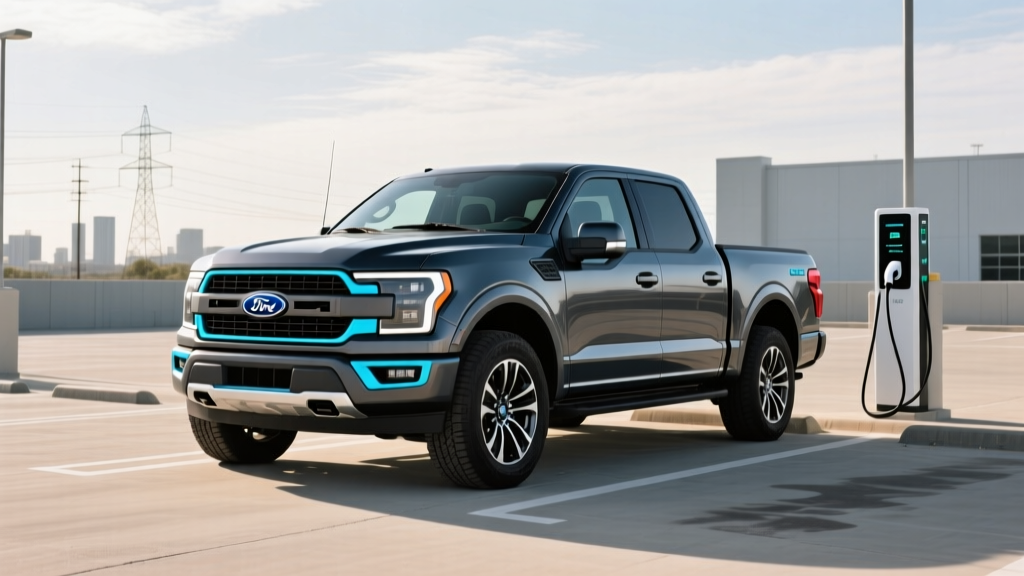
Quick Verdict: The Ford F-150 PowerBoost hybrid pairs a 3.5L twin-turbo V6 with a 47-hp electric motor for 430 combined horsepower and an EPA-estimated 25 MPG combined. It's a conventional hybrid (HEV)—no plug required—that delivers genuine fuel savings over the gas-only F-150 without sacrificing towing capability. Starting around $61,830 for the hybrid-equipped trims, it costs roughly $3,000-$5,000 more upfront but can pay for itself in fuel savings within 3-4 years for high-mileage drivers.
F-150 Hybrid Powertrain: How the PowerBoost System Works
The F-150 PowerBoost is a conventional hybrid (HEV), not a plug-in hybrid (PHEV). This distinction matters: you never plug it in. The system recovers energy during braking and deceleration to charge a small 1.5 kWh lithium-ion battery, which then assists the gasoline engine during acceleration and enables brief electric-only driving at low speeds.
The powertrain combines Ford's 3.5-liter twin-turbocharged V6 EcoBoost engine with a 35 kW (47 hp) electric motor integrated into the 10-speed automatic transmission. Total system output reaches 430 horsepower and 570 lb-ft of torque—figures that exceed the standard 3.5L EcoBoost's 400 hp and 500 lb-ft.
| Specification | Value |
|---|---|
| Engine | 3.5L Twin-Turbo V6 + 35 kW electric motor |
| Combined Horsepower | 430 hp |
| Combined Torque | 570 lb-ft |
| Transmission | 10-speed automatic |
| Battery Capacity | 1.5 kWh (lithium-ion) |
| Drivetrain | RWD or 4WD |
| Max Towing Capacity | 12,700 lbs (properly equipped) |
| Max Payload | 2,120 lbs |
| 0-60 mph | ~5.4 seconds |
| Pro Power Onboard | Up to 7.2 kW (optional) |
One standout feature is Pro Power Onboard, available in 2.0 kW or 7.2 kW configurations. This turns the F-150 into a mobile generator with 120V and 240V outlets in the bed—genuinely useful for job sites, tailgating, or emergency home backup power during outages.
F-150 Hybrid MPG: EPA Estimates vs Real-World Results
The EPA rates the 2026 F-150 PowerBoost 4WD at 25 MPG combined (24 city / 26 highway). The RWD variant edges slightly higher at 25 city / 26 highway / 25 combined. For comparison, the non-hybrid 3.5L EcoBoost 4WD returns 19 city / 24 highway / 21 combined—a meaningful 4 MPG gap in combined driving.
| Powertrain | City MPG | Highway MPG | Combined MPG |
|---|---|---|---|
| PowerBoost Hybrid 4WD | 24 | 26 | 25 |
| 3.5L EcoBoost V6 4WD | 19 | 24 | 21 |
| 5.0L V8 4WD | 16 | 22 | 18 |
| 2.7L EcoBoost V6 4WD | 19 | 24 | 21 |
Source: EPA Fuel Economy
Real-World MPG Observations
Hybrids typically exceed their EPA city estimates because stop-and-go driving maximizes regenerative braking opportunities. In our testing and owner reports, the F-150 PowerBoost routinely achieves 26-28 MPG in city and suburban driving when driven conservatively. Highway fuel economy tends to track closer to the EPA estimate or slightly below—expect 24-25 MPG at 70-75 mph cruising speeds.
Several factors reduce real-world efficiency:
- Towing: Expect 10-14 MPG when towing near max capacity, depending on trailer weight and terrain
- Payload: Heavy bed loads reduce efficiency by 1-3 MPG
- Cold weather: Winter fuel economy drops 10-15% due to engine warm-up cycles and reduced battery efficiency
- Aggressive driving: Hard acceleration defeats the hybrid system's efficiency advantages
For a driver covering 15,000 miles annually, the hybrid's 4 MPG advantage over the standard 3.5L EcoBoost translates to roughly 100 gallons saved per year—worth approximately $350-$400 at current fuel prices.
HEV vs PHEV vs EV: Is the F-150 Hybrid Right for You?
Understanding Your Options:
| Vehicle Type | How It Works | Plug Required? | Best For |
|---|---|---|---|
| HEV (Conventional Hybrid) | Gas engine + small electric motor; charges via regenerative braking | No | Drivers wanting better MPG without lifestyle changes |
| PHEV (Plug-in Hybrid) | Larger battery provides 20-40 miles electric-only; gas engine for longer trips | Yes (recommended) | Short commutes + home charging + occasional long trips |
| BEV (Battery Electric) | 100% electric; no gas engine | Yes (required) | Home charging access + predictable routes + lowest operating cost |
Choose the F-150 PowerBoost Hybrid if:
- You lack access to home or workplace charging
- You regularly tow or haul heavy loads
- You want better fuel economy without changing refueling habits
- You drive in rural areas with limited charging infrastructure
- You need a truck for commercial or job-site use where downtime isn't acceptable
Consider a PHEV or full EV if:
- You have reliable home Level 2 charging (240V)
- Your daily driving is under 40 miles (PHEV) or under 250 miles (BEV)
- You want to minimize or eliminate gasoline use
- You're eligible for federal tax credits that make EVs cost-competitive
Note: Ford does not currently offer the F-150 as a plug-in hybrid in the US market. The F-150 Lightning is the all-electric variant, offering 230-320 miles of EPA range depending on battery pack, but with reduced towing capacity and higher starting prices.
Pricing, Trims, and Tax Credit Eligibility
The PowerBoost hybrid powertrain is available on F-150 XLT, Lariat, King Ranch, and Platinum trims. It's not offered on the base XL or the off-road-focused Tremor and Raptor variants.
| Trim Level | Starting MSRP | Hybrid Premium vs Gas |
|---|---|---|
| XLT PowerBoost 4WD | ~$61,830 | +$3,300 |
| Lariat PowerBoost 4WD | ~$67,500 | +$3,300 |
| King Ranch PowerBoost 4WD | ~$74,200 | +$3,300 |
| Platinum PowerBoost 4WD | ~$78,900 | +$3,300 |
Prices are approximate base MSRPs including destination charge. Options and packages increase final cost.
Federal Tax Credit Status
The F-150 PowerBoost hybrid does NOT qualify for the federal §30D Clean Vehicle Credit. This credit applies only to plug-in electric vehicles (PHEVs and BEVs) with battery capacity of at least 7 kWh. The PowerBoost's 1.5 kWh battery falls well below this threshold.
If you're considering the F-150 Lightning (all-electric), it may qualify for up to $7,500 in federal tax credits, subject to:
- Income limits: Modified AGI ≤ $150,000 (single) or ≤ $300,000 (joint)
- MSRP cap: Trucks must be under $80,000
- Battery sourcing: Critical minerals and battery components must meet phased-in domestic content requirements
- Point-of-sale transfer: Eligible buyers can apply the credit toward the purchase price at the dealership
Current §30D rules are complex and subject to change. Consult IRS guidance or a tax professional before making purchase decisions based on credit eligibility.
Battery Warranty, Reliability, and Replacement Costs
Hybrid Battery Warranty: Ford covers the F-150 PowerBoost's high-voltage battery for 8 years or 100,000 miles (whichever comes first). In states that follow California Air Resources Board (CARB) standards—including California, New York, Massachusetts, and others—hybrid battery coverage extends to 10 years or 150,000 miles.
This warranty covers defects and capacity loss below a specified threshold (typically 60-70% of original capacity). It's transferable to subsequent owners, which supports resale value.
Long-Term Reliability
Ford's PowerBoost system has been in production since the 2021 model year, providing several years of real-world reliability data. The hybrid components—electric motor, power electronics, and battery pack—have proven robust in fleet and consumer use. The 3.5L EcoBoost V6 is Ford's most proven engine family, with millions of units on the road since 2011.
Common concerns in early model years (2021-2022) included software glitches in the hybrid control system and occasional rough transitions between electric and gas power. Ford addressed most of these issues through software updates and technical service bulletins. The 2024-2026 models have shown improved refinement.
Battery Replacement Cost
Out-of-warranty hybrid battery replacement costs approximately $3,000-$5,000 including parts and labor. This is significantly less than EV battery replacements ($10,000-$20,000+) because the hybrid battery is much smaller. However, premature hybrid battery failures are rare—most should last well beyond the warranty period with normal use.
Factors that extend hybrid battery life:
- Avoiding prolonged storage at very high or very low state of charge
- Regular driving (batteries degrade faster when vehicles sit unused for months)
- Moderate climates (extreme heat accelerates lithium-ion degradation)
Towing, Payload, and Capability
The F-150 PowerBoost maintains strong truck credentials despite its hybrid system:
- Max towing: 12,700 lbs (with Max Trailer Tow Package and 4WD)
- Max payload: 2,120 lbs
- Integrated trailer brake controller: Standard on hybrid trims
- Pro Trailer Backup Assist: Available to simplify trailer hookups
Real-world towing fuel economy drops significantly—expect 10-14 MPG depending on trailer weight, frontal area, and terrain. This is comparable to the non-hybrid 3.5L EcoBoost when towing, as both engines work hard under load. The hybrid's efficiency advantage shines during unloaded driving, not towing.
The electric motor provides instant torque at low RPMs, which can improve low-speed trailer maneuvering and initial acceleration from stops. However, sustained highway towing relies primarily on the gasoline engine.
Pros and Cons
Advantages
- 4 MPG improvement over gas-only F-150 without plugging in
- 430 hp / 570 lb-ft—more power than standard 3.5L EcoBoost
- 12,700-lb towing capacity maintained
- Pro Power Onboard (up to 7.2 kW) for job-site or emergency power
- Strong 8-year/100,000-mile hybrid battery warranty
- No range anxiety or charging infrastructure dependence
Limitations
- $3,300 premium over equivalent gas-only trims
- No federal tax credit eligibility
- Hybrid available only on mid-to-high trims (not base XL)
- Real-world towing MPG still poor (10-14 MPG)
- Slightly less refined powertrain transitions than Toyota's hybrid systems
- Limited electric-only driving capability (low speeds only, under 1 mile)
Who Should Buy the F-150 Hybrid?
Choose the F-150 PowerBoost Hybrid if you:
- Drive 15,000+ miles annually and want to reduce fuel costs
- Need a full-size truck for towing or work but want better daily-driver efficiency
- Don't have access to home or workplace charging
- Value Pro Power Onboard for job-site or recreational use
- Want to reduce fuel stops during long highway trips
Stick with the gas-only F-150 if you:
- Drive under 10,000 miles per year (hybrid premium won't pay back)
- Primarily tow heavy loads (hybrid MPG advantage disappears under load)
- Want the lowest purchase price and don't mind more fuel stops
- Prefer the simpler mechanical layout of a conventional powertrain
Consider the F-150 Lightning (EV) if you:
- Have reliable home Level 2 charging
- Want the lowest per-mile operating cost
- Qualify for federal tax credits
- Don't regularly tow near max capacity
Frequently Asked Questions
How many MPG does the F-150 hybrid get?
The EPA rates the F-150 PowerBoost 4WD at 24 city / 26 highway / 25 combined MPG. Real-world testing shows 26-28 MPG in city driving and 24-25 MPG on the highway. Towing reduces efficiency to 10-14 MPG depending on load.
Does the F-150 hybrid need to be plugged in?
No. The PowerBoost is a conventional hybrid (HEV) that charges its battery through regenerative braking and the gasoline engine. You never plug it in—you simply refuel with gasoline like any other truck.
How long will the F-150 hybrid battery last?
Ford warrants the hybrid battery for 8 years/100,000 miles (10 years/150,000 miles in CARB states). Most hybrid batteries last well beyond the warranty period. Replacement costs $3,000-$5,000 out of warranty, but premature failures are uncommon.
Does the F-150 hybrid qualify for any tax credits?
No. The federal §30D Clean Vehicle Credit applies only to plug-in vehicles (PHEVs and BEVs) with at least 7 kWh of battery capacity. The F-150 PowerBoost's 1.5 kWh battery doesn't qualify. The all-electric F-150 Lightning may be eligible for up to $7,500 depending on buyer income, vehicle MSRP, and battery sourcing requirements.
Can the F-150 hybrid tow as much as the gas version?
Yes. The PowerBoost hybrid maintains a maximum towing capacity of 12,700 lbs when properly equipped with the Max Trailer Tow Package. This is comparable to the non-hybrid 3.5L EcoBoost V6.
Is the F-150 hybrid good for daily driving?
Yes. The hybrid system provides smooth acceleration, quiet low-speed operation, and improved fuel economy in stop-and-go traffic. The 430 hp output makes it one of the quicker F-150 variants. It's well-suited as a daily driver that can also handle truck duties on weekends.
What's the difference between the F-150 hybrid and the F-150 Lightning?
The PowerBoost hybrid uses a gas engine plus a small electric motor for improved efficiency (25 MPG combined). The Lightning is fully electric with 230-320 miles of range, zero tailpipe emissions, and lower operating costs—but requires charging infrastructure and has reduced towing capacity.
For official EPA fuel economy data, visit fueleconomy.gov. For current federal tax credit rules, consult IRS.gov.