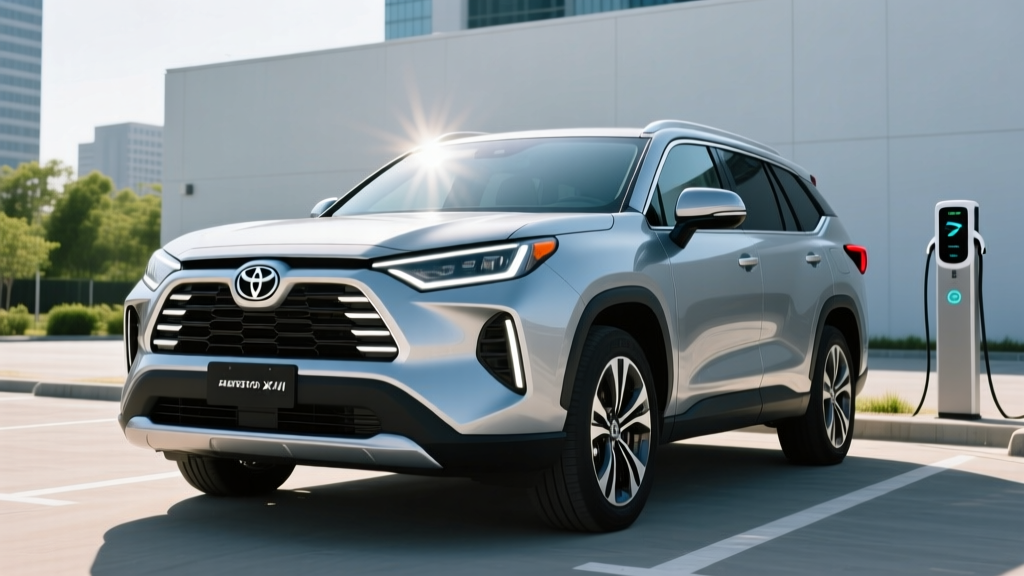
The Toyota Grand Highlander Hybrid occupies a narrow but increasingly crowded lane: a three-row family hauler that sips fuel without sacrificing cargo space or requiring you to plug in. For 2026, Toyota continues offering two distinct hybrid powertrains across the Grand Highlander lineup — a fuel-sipping standard Hybrid and a performance-oriented Hybrid MAX — while also selling a plug-in hybrid variant under a different badge strategy. If you're researching 2026 Toyota Grand Highlander Hybrid specs to decide whether this SUV fits your garage, this guide breaks down every number that matters.
Before we get into the data, a critical distinction: the Grand Highlander Hybrid is a conventional hybrid electric vehicle (HEV). It charges its own small battery through regenerative braking and the gasoline engine. You never plug it in. This is fundamentally different from a plug-in hybrid (PHEV), which carries a larger battery you charge from a wall outlet and which can drive 30–40 miles on electricity alone before the engine kicks in. We'll address both architectures below so you know exactly what you're buying.
2026 Grand Highlander Hybrid Powertrain Breakdown
Toyota offers two hybrid powertrains for the 2026 Grand Highlander. The standard Hybrid prioritizes efficiency; the Hybrid MAX prioritizes acceleration and towing. Both pair a 2.5-liter inline-four engine with electric motors, but the execution differs sharply.
| Specification | Hybrid (Standard) | Hybrid MAX |
|---|---|---|
| Engine | 2.5L inline-4 + 2 electric motors (FWD) / 3 motors (AWD) | 2.4L turbo inline-4 + electric motor |
| Combined Horsepower | 245 hp | 362 hp |
| Combined Torque | 173 lb-ft (engine) + motor torque | 400 lb-ft |
| Drivetrain | FWD or AWD (eAWD with rear motor) | AWD standard |
| Transmission | eCVT (planetary gearset) | 6-speed automatic |
| 0–60 mph (est.) | ~7.8 sec | ~5.6 sec |
| Max Towing Capacity | 3,500 lbs | 5,000 lbs |
| Battery Type | Nickel-metal hydride (NiMH) / Lithium-ion | Lithium-ion |
The standard Hybrid uses Toyota's familiar eCVT — not a belt-and-pulley CVT but a planetary gearset that blends engine and motor power seamlessly. There are no fixed gear ratios to shift, which is why acceleration feels linear and uninterrupted. The Hybrid MAX, by contrast, uses a traditional 6-speed automatic with a turbocharged engine and a single electric motor sandwiched between the engine and transmission. The result is a more conventional driving feel with genuine shift points and substantially more punch.
EPA Fuel Economy: What the Sticker Says
Fuel economy is where the standard Hybrid justifies its existence. According to fueleconomy.gov, the 2026 Grand Highlander Hybrid achieves the following EPA-estimated figures:
| Powertrain / Drivetrain | City MPG | Highway MPG | Combined MPG |
|---|---|---|---|
| Hybrid FWD | 37 | 34 | 36 |
| Hybrid AWD | 36 | 32 | 34 |
| Hybrid MAX AWD | 27 | 28 | 27 |
For a vehicle with three usable rows and over 97 cubic feet of cargo space with both rear rows folded, 36 MPG combined from the FWD Hybrid is exceptional. The Hybrid MAX sacrifices roughly 9 MPG combined in exchange for 117 additional horsepower and 1,500 lbs of extra towing capacity — a trade-off that makes sense for boat-and-trailer families but not for school-run commuters.
Real-World MPG: What Owners Actually See
EPA estimates for Toyota hybrids tend to be conservative in city driving and optimistic on the highway. The standard Hybrid's electric motors do their heaviest lifting at low speeds, where the engine can shut off entirely during coasting and stops. In real-world suburban and urban driving — school drop-offs, grocery runs, stoplight-to-stoplight commutes — owners of Toyota's 2.5L hybrid system routinely report matching or slightly exceeding the EPA city number.
Highway driving tells a different story. At sustained 75–80 mph speeds, the aerodynamic penalty of a large three-row SUV and the engine's continuous operation reduce efficiency. Expect the AWD Hybrid to deliver roughly 30–31 MPG on a flat interstate at 75 mph, dropping to 28–29 MPG in mountainous terrain or with a full load of passengers and cargo. Cold weather (below 35°F) further reduces real-world efficiency by roughly 5–8% as the engine runs more frequently to provide cabin heat and maintain catalyst temperature.
The Hybrid MAX, with its turbocharged engine and performance tuning, is more consistent between EPA and real-world figures. Expect 25–27 MPG combined in mixed driving, with highway cruising yielding around 28 MPG. This powertrain is tuned for responsiveness, not hypermiling.
HEV vs PHEV vs EV: Which Grand Highlander Fits You?
Toyota sells the Grand Highlander as a conventional hybrid (HEV). If you're cross-shopping electrified three-row SUVs, here's how the three architectures compare in practical terms:
| Factor | HEV (Grand Highlander Hybrid) | PHEV (e.g., Kia Sorento PHEV) | BEV (e.g., Kia EV9) |
|---|---|---|---|
| Plug-in Required? | No — self-charging | Yes — Level 2 recommended | Yes — Level 2 essential |
| Electric-Only Range | None (motor assists engine) | 30–35 miles typical | 250–300+ miles (full battery) |
| Home Charging Needed? | No | Strongly recommended for value | Yes — mandatory |
| Combined Efficiency | 34–36 MPG | 79 MPGe (electric) / 34 MPG (gas) | 85–97 MPGe |
| Upfront Cost | $$ | $$$ | $$$–$$$$ |
| Federal Tax Credit (§30D) | Not eligible | Up to $7,500 (if eligible) | Up to $7,500 (if eligible) |
| Best For | No home charging access; road trips | Short commutes + home charger | Home charging + low running cost |
The Grand Highlander Hybrid's advantage is simplicity. There's no charging logistics, no range planning, no dependency on electrical infrastructure. You fill up at any gas station and drive. For families without a garage or dedicated parking spot where a Level 2 charger could be installed, this is the only electrified option that makes sense.
If you do have home charging and your daily driving stays under 35 miles, a PHEV competitor like the Kia Sorento PHEV or Mazda CX-90 PHEV lets you complete most commutes on electricity alone, only burning gas on longer trips. And if you're ready to commit fully, a battery-electric SUV like the Kia EV9 eliminates gas entirely — but demands reliable home charging and acceptance of 20–40 minute DC fast-charging stops on road trips.
Pricing and Trim Levels
The 2026 Grand Highlander Hybrid carries a modest price premium over the gas-only Grand Highlander, one that pays back through fuel savings within roughly three to four years for drivers covering 15,000 miles annually.
| Trim | Powertrain | Drivetrain | Starting MSRP |
|---|---|---|---|
| XLE | Hybrid | FWD | $42,170 |
| XLE | Hybrid | AWD | $43,770 |
| Limited | Hybrid | AWD | $48,455 |
| Limited | Hybrid MAX | AWD | $53,070 |
| Platinum | Hybrid MAX | AWD | $58,125 |
All prices exclude a $1,395 destination charge. Toyota typically bundles the hybrid powertrain into the trim price rather than offering it as a standalone option, which simplifies comparison shopping.
Does the Grand Highlander Hybrid Qualify for a Federal Tax Credit?
No. Under current IRS §30D rules, conventional hybrids (HEVs) do not qualify for the federal clean vehicle tax credit. Only plug-in hybrids (PHEVs) and battery-electric vehicles (BEVs) with sufficient battery capacity and meeting critical-mineral and battery-component sourcing requirements are eligible. The Grand Highlander Hybrid is a self-charging HEV — it has no plug and no externally chargeable battery — so it falls outside the credit's scope entirely.
Some states offer their own incentives for hybrid purchases, though these are increasingly rare and typically modest ($250–$500 rebates). Check your state's energy office or department of environmental quality for current programs. Toyota's own website occasionally lists regional incentives as well.
Battery Warranty, Reliability, and Replacement Cost
Hybrid battery longevity is consistently the top concern among first-time hybrid buyers. Toyota's track record here is among the strongest in the industry, dating back to the original Prius in 1997.
Toyota covers the hybrid battery and all hybrid system components (inverter, control module, electric motors) for 10 years or 150,000 miles, whichever comes first. This applies to all 50 states and is transferable to subsequent owners. This warranty guarantees that the battery will retain sufficient capacity to operate the hybrid system normally — it is not a capacity-retention percentage guarantee like you'd see on a BEV.
In practice, Toyota's hybrid batteries — particularly the NiMH packs used in many of their hybrid systems — routinely last well beyond 200,000 miles before requiring replacement. The hybrid system is far less stressful on a battery than a full EV because the battery is small (roughly 1.6–1.9 kWh usable), never fully depletes, and never charges to 100%. Toyota's battery management system keeps the state of charge in a narrow middle band (roughly 40–80%), which dramatically reduces degradation.
If the hybrid battery does fail outside of warranty, replacement cost for a Toyota 2.5L hybrid battery pack typically runs between $2,500 and $4,000 installed at a dealership, with refurbished and aftermarket options available for $1,500–$2,500. This is a fraction of the $10,000–$20,000 replacement cost associated with a full EV traction battery.
According to IIHS, the Grand Highlander has earned strong safety ratings, and Toyota's hybrid powertrains consistently rank at or near the top of J.D. Power and Consumer Reports reliability surveys. The hybrid system has fewer wear components than a conventional gas powertrain — no alternator, no starter motor, no traditional friction brakes wearing quickly (regenerative braking handles most deceleration), and the eCVT has no belts, clutches, or bands to fail.
Who Should Buy the Grand Highlander Hybrid?
- You need three rows but want to minimize fuel costs
- You don't have access to home or workplace charging
- You frequently take long road trips and don't want to plan charging stops
- You want Toyota's proven hybrid reliability and 10-year battery warranty
- Your daily driving is a mix of city and highway
- You have home charging and a short commute (a PHEV saves more)
- You want zero tailpipe emissions in daily driving (consider a BEV)
- You need more than 5,000 lbs of towing (look at body-on-frame SUVs)
- You want the lowest possible running cost (BEV charging at home beats gas at any MPG)
- You want to qualify for the $7,500 federal tax credit
The Grand Highlander Hybrid's sweet spot is the family that drives 12,000–18,000 miles per year in mixed conditions, lacks reliable charging infrastructure, and values long-term mechanical simplicity. At 36 MPG combined (FWD), you're looking at roughly 500 miles per tank — fewer fill-ups, lower annual fuel spend, and no behavioral changes required from your current gas-car routine.
Frequently Asked Questions
How many MPG does the 2026 Grand Highlander Hybrid get?
The EPA estimates 37 city / 34 highway / 36 combined for the FWD Hybrid, and 36 city / 32 highway / 34 combined for the AWD Hybrid. The Hybrid MAX rates at 27 city / 28 highway / 27 combined. In real-world driving, expect city MPG to match or slightly exceed EPA figures, while highway MPG may fall 2–4 MPG below the sticker, especially at speeds above 70 mph or in cold weather.
Do I need to plug in the Grand Highlander Hybrid?
No. The Grand Highlander Hybrid is a conventional HEV. It charges its battery through regenerative braking and the gasoline engine. There is no plug, no charging port, and no electric-only driving mode. You fuel it exactly like a gas car.
How far can the Grand Highlander Hybrid drive on electric power alone?
Effectively zero miles in sustained electric-only mode. The hybrid system can propel the vehicle at very low speeds (parking lots, brief coasting) on electric power, but the engine engages almost immediately under any meaningful acceleration or above roughly 25 mph. If you want substantial electric-only range, you need a PHEV, not an HEV.
Is the Grand Highlander Hybrid reliable?
Toyota's hybrid system is one of the most proven powertrains in automotive history. The 2.5L hybrid architecture has been in continuous production since 2018 (with earlier generations dating to 1997). The eCVT has no friction components to wear, regenerative braking extends brake pad life to 80,000–100,000+ miles, and the hybrid battery is warranted for 10 years / 150,000 miles. Independent reliability data from Consumer Reports and J.D. Power consistently ranks Toyota hybrids among the most dependable vehicles in their segments.
What does it cost to replace the hybrid battery?
Out-of-warranty replacement for a Toyota 2.5L hybrid battery typically costs $2,500–$4,000 at a dealership, including labor. Refurbished and third-party replacement batteries are available for $1,500–$2,500. Given Toyota's 10-year / 150,000-mile hybrid battery warranty and the historical longevity of these packs, most owners will never face this expense.
Does the Grand Highlander Hybrid qualify for any tax credit?
No federal tax credit is available. The IRS §30D clean vehicle credit applies only to plug-in hybrids (PHEVs) and battery-electric vehicles (BEVs) that meet battery-sourcing and MSRP requirements. The Grand Highlander Hybrid is a self-charging HEV with no plug, making it ineligible. Some state-level hybrid incentives may exist but are increasingly uncommon — check your state's energy agency for current programs.
Hybrid MAX vs standard Hybrid — which should I pick?
Choose the standard Hybrid (245 hp, 34–36 MPG combined) if fuel economy is your priority and you don't tow more than 3,500 lbs. Choose the Hybrid MAX (362 hp, 27 MPG combined) if you need 5,000 lbs of towing capacity, want brisk acceleration (5.6 sec 0–60), or prefer the feel of a traditional geared transmission. The MAX costs roughly $5,000–$10,000 more depending on trim and uses significantly more fuel over the life of the vehicle.