Quick Verdict: The Hornet R/T PHEV in 2026
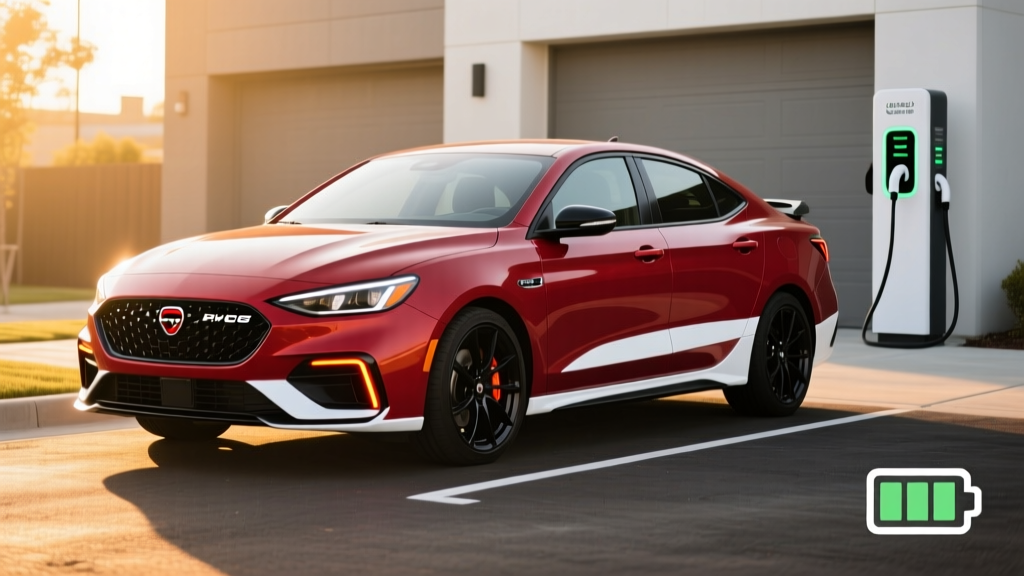
The 2026 Dodge Hornet R/T is a plug-in hybrid (PHEV) compact crossover that pairs a turbocharged 1.3-liter engine with a rear-axle electric motor for a combined 288 horsepower and 383 lb-ft of torque. With an EPA-rated 32 miles of electric-only range and 29 MPG combined once the battery depletes, it targets buyers who want EV-like daily commuting without range anxiety on longer trips. Starting around $41,490 before destination, it occupies a narrow lane: more performance-oriented than a Toyota RAV4 Prime, but less electric range than a Hyundai Tucson PHEV. Here's the data-driven breakdown.
| Spec | 2026 Dodge Hornet R/T PHEV |
|---|---|
| Powertrain | 1.3L Turbo I-3 + rear e-motor (PHEV) |
| Combined HP / Torque | 288 hp / 383 lb-ft |
| 0-60 mph | 6.1 seconds |
| Battery (usable) | 15.5 kWh (NMC lithium-ion) |
| EPA Electric-Only Range | 32 miles |
| EPA Combined Range (gas + electric) | ~370 miles |
| EPA MPG (charge-sustaining) | 29 combined (28 city / 30 hwy) |
| MPGe (electric + gas combined) | 77 MPGe |
| Level 2 Charge Time (0-100%) | ~2.5 hours at 7.4 kW |
| DC Fast Charging | Not available |
| Drivetrain | AWD (eAWD — electric rear axle) |
| Base MSRP (R/T trim) | $41,490 + $1,595 destination |
| Federal Tax Credit (§30D) | Up to $3,750 (see eligibility below) |
| Battery Warranty | 8 years / 100,000 miles |
HEV vs PHEV: Where the Hornet R/T Fits
Before diving into numbers, it's worth clarifying what the Hornet R/T actually is — because Dodge also sells a conventional gas-only Hornet (the GT and GT Plus trims) that is not a hybrid of any kind. There is no conventional hybrid (HEV) version of the Hornet.
| Feature | Conventional Hybrid (HEV) | Plug-In Hybrid (PHEV) — Hornet R/T | Battery Electric (BEV) |
|---|---|---|---|
| Plug-in Charging | No — self-charging via regen | Yes — plug in to unlock EV range | Yes — only propulsion source |
| Electric-Only Range | 0-1 miles at low speed | 32 miles (EPA) | 200-400+ miles |
| Gas Engine | Yes — always available | Yes — kicks in after battery depletes | None |
| Fuel Economy (no plug-in) | 40-55 MPG typical | 29 MPG (Hornet R/T) | N/A |
| Best For | No home charging access | Home charging + short commutes | Full EV commitment |
The Hornet R/T is strictly a PHEV. If you never plug it in, you're carrying 400+ pounds of battery dead weight and getting a middling 29 MPG — worse than many conventional hybrids. You must have access to a plug (home Level 2 or regular 120V outlet) to extract value from this powertrain.
Electric-Only Range: 32 Miles EPA, What to Expect in Reality
The EPA rates the 2026 Hornet R/T at 32 miles of electric-only driving on its 15.5 kWh battery pack. That's competitive with the Ford Escape PHEV (37 mi) but trails the Toyota RAV4 Prime (42 mi) and Hyundai Tucson PHEV (33 mi).
EPA Electric Range: 32 miles
Real-World Expectation: 25-28 miles in mixed driving with climate control on; as low as 20-22 miles in sustained cold weather (below 32°F) or at highway speeds above 70 mph. In mild weather with gentle city driving, some owners report touching 34 miles.
The 15.5 kWh pack uses NMC (nickel manganese cobalt) chemistry, chosen for energy density over cycle life. A buffer of roughly 1.5 kWh is software-locked to protect longevity, giving you approximately 14 kWh usable. At an efficiency of about 2.3 miles/kWh in EV mode, the math tracks to the EPA figure — but cold-weather cabin heating and battery thermal management will eat into that by 20-30%.
Fuel Economy: EPA MPG and Real-World Numbers
Once the battery is depleted, the Hornet R/T operates as a charge-sustaining hybrid. The 1.3-liter turbocharged three-cylinder engine (180 hp on its own) takes over, augmented by brief electric assist from the remaining battery buffer.
| Mode | City | Highway | Combined |
|---|---|---|---|
| Charge-Sustaining (gas hybrid) | 28 MPG | 30 MPG | 29 MPG |
| Charge-Depleting (full battery, EV mode) | 77 MPGe / 32 mi electric | ||
| Real-World Hybrid Mode (owner reports) | 27-31 MPG | 27-29 MPG | 27-30 MPG |
The highway-biased EPA split (30 highway vs 28 city) is unusual for a hybrid — most hybrids favor city driving where regenerative braking recaptures energy. The Hornet R/T's eAWD system and relatively heavy curb weight (~3,900 lbs) work against it in stop-and-go traffic. On the highway, the small-displacement turbo engine operates in a more efficient load range.
For context, if your daily commute is under 30 miles round-trip and you charge nightly, you may burn gasoline only on weekend road trips. Owners who plug in regularly report using fewer than 15 gallons per month.
Charging: Level 1, Level 2, and the No-DCFC Limitation
The Hornet R/T accepts up to 7.4 kW on Level 2 (240V) AC charging via its J1772 port. It does not support DC fast charging — a common PHEV limitation, but one worth flagging if you planned to top up at Electrify America or Tesla Supercharger stations during road trips.
| Charging Level | Power | 0-100% Time | Miles of EV Range Added per Hour |
|---|---|---|---|
| Level 1 (120V household) | ~1.4 kW | ~11 hours | ~5 miles/hr |
| Level 2 (240V, 32A) | 7.4 kW | ~2.5 hours | ~13 miles/hr |
| DC Fast Charge | Not supported | ||
For most PHEV owners, overnight Level 1 charging from a standard 120V outlet is sufficient — 11 hours easily replenishes the 15.5 kWh pack while you sleep. A Level 2 home charger (like a ChargePoint Home Flex or Emporia Vue) cuts that to 2.5 hours, useful if you need a midday top-up or have a split-shift schedule. Installation for a Level 2 circuit typically runs $500-$1,500 depending on panel proximity; consult a licensed electrician for your specific setup.
The lack of DCFC is irrelevant for daily use but matters if you expected to charge on road trips. In practice, most PHEV road-trippers simply let the gas engine handle highway miles and plug in at their destination.
Powertrain Deep Dive: 288 HP eAWD System
The Hornet R/T's powertrain is a collaboration between Stellantis and its European engineering teams (the platform shares architecture with the Alfa Romeo Tonale). The front wheels are driven by the 1.3-liter turbo three-cylinder through a six-speed automatic transmission, while the rear axle is powered exclusively by an electric motor.
Key powertrain specs:
- Gas engine: 1.3L turbocharged inline-3, 180 hp, 200 lb-ft
- Rear electric motor: 108 hp (80 kW), 183 lb-ft
- Combined system output: 288 hp, 383 lb-ft
- Transmission: 6-speed automatic (front axle only)
- AWD type: eAWD — no mechanical driveshaft to the rear
The eAWD system means the rear wheels are only powered when the battery has charge. In charge-sustaining mode (battery depleted), the Hornet R/T becomes front-wheel drive only — a significant consideration for buyers in snow-belt states. The small battery buffer still allows brief rear-axle engagement for traction events, but sustained AWD requires battery charge.
The 6.1-second 0-60 time makes it the quickest compact PHEV crossover in its price class, outpacing the RAV4 Prime (5.7 seconds, but $5,000+ more) and Tucson PHEV (7.1 seconds). Power delivery is punchy off the line thanks to instant electric torque, though the six-speed automatic introduces slight hesitation during mid-range passing maneuvers compared to the e-CVT transmissions in Toyota and Hyundai competitors.
Pricing, Trims, and Federal Tax Credit Eligibility
The 2026 Dodge Hornet R/T PHEV is offered in two trims:
- R/T: $41,490 MSRP + $1,595 destination = $43,085
- R/T Plus: $46,490 MSRP + $1,595 destination = $48,085
The R/T Plus adds features like a panoramic sunroof, leather-trimmed seats, a Harman Kardon audio system, and additional ADAS features (adaptive cruise with stop-and-go, lane centering).
Federal §30D Tax Credit for the Hornet R/T PHEV (2026 rules):
- Credit amount: Up to $3,750 (battery component requirement met; critical minerals requirement may not be fully met — verify with your dealer and tax professional)
- MSRP cap: Vehicle MSRP must be under $80,000 for SUVs — Hornet R/T qualifies ✓
- Buyer income cap: AGI must not exceed $150,000 (single) / $300,000 (joint) / $225,000 (head of household)
- Point-of-sale transfer: Available — you can apply the credit as a down-payment reduction at the dealership
- Battery sourcing: Verify current-year critical mineral and battery component compliance on IRS.gov's eligible vehicle list before purchasing
The credit situation for PHEVs is fluid. The Hornet R/T's battery is assembled in Europe, which affects critical-mineral sourcing compliance. Some buyers may qualify for the full $3,750, others for $0 depending on the model year's sourcing certification. Always check the IRS clean vehicle credit page and consult a tax professional before relying on a specific credit amount.
Reliability, Battery Warranty, and Replacement Cost
High-Voltage Battery Warranty: 8 years / 100,000 miles (whichever comes first), covering defects and capacity loss below 70% of original capacity.
Powertrain Warranty: 5 years / 60,000 miles
Bumper-to-Bumper: 3 years / 36,000 miles
The 15.5 kWh NMC battery pack is warrantied for 8 years or 100,000 miles, which aligns with federal minimum requirements for emission-related components (PHEV batteries fall under this umbrella). If the battery degrades below 70% of its original capacity within the warranty period, Stellantis will repair or replace it at no cost.
For out-of-warranty replacement, expect a PHEV battery pack of this size to cost between $5,000 and $8,000 (parts and labor) based on current Stellantis PHEV service pricing. However, NMC packs in PHEV applications typically see 8-12% degradation over 10 years with normal use — well above the 70% warranty threshold. The smaller daily cycle depth (compared to a full EV using 80-90% of its pack daily) is easier on battery chemistry long-term.
Reliability data for the Hornet specifically is limited — it's a relatively new nameplate (introduced for 2024). The 1.3L FireFly turbo engine has been used in other Stellantis products globally with mixed reviews; some owners report minor turbo lag and occasional rough idle, but no systemic failures have emerged as of early 2026. The six-speed automatic is a conventional torque-converter unit (not the problematic dual-clutch transmissions from Stellantis's past). Check NHTSA.gov for any active recalls or technical service bulletins.
Who Should Choose the Hornet R/T PHEV — And Who Shouldn't
Choose the Dodge Hornet R/T PHEV if:
- Your daily commute is under 30 miles round-trip and you can charge at home
- You want AWD capability and above-average acceleration in a compact crossover
- You take 3-5 road trips per year and don't want to plan around DC charging
- You value driving engagement over maximum efficiency
Look elsewhere if:
- You want 40+ miles of electric range (consider RAV4 Prime or Tucson PHEV)
- You prioritize fuel economy above all else (a conventional hybrid like the Honda CR-V Hybrid gets 40 MPG without plugging in)
- You need sustained AWD in deep snow (eAWD is FWD-only when battery is depleted)
- You can't charge at home or work — an uncharged PHEV is an expensive, heavy gas car
Pros
- 288 hp makes it the quickest PHEV in its class at this price
- 32 miles EV range covers most daily commutes
- Level 1 (120V) overnight charging is sufficient — no 240V install required
- eAWD provides confident launch in rain and light snow
- Competitive starting price for a PHEV crossover
Cons
- 29 MPG in hybrid mode is mediocre vs. competitors (RAV4 Hybrid: 39 MPG)
- No DC fast charging capability
- eAWD reverts to FWD when battery is depleted
- Tight rear seat and cargo space vs. RAV4/Tucson
- 6-speed automatic feels dated vs. e-CVT smoothness in rivals
- Tax credit limited to $3,750 (or $0 depending on sourcing year)
Frequently Asked Questions
How many MPG does the Dodge Hornet R/T PHEV get?
The EPA rates it at 29 MPG combined (28 city / 30 highway) in charge-sustaining hybrid mode. When the battery is fully charged, it achieves 77 MPGe over the first 32 miles. Real-world results cluster around 27-30 MPG in hybrid mode, depending on driving style and temperature.
How far can the Hornet R/T go on electric only?
The EPA rates it at 32 miles electric-only. Expect 25-28 miles in real-world mixed driving, and potentially as low as 20-22 miles in freezing weather or at sustained highway speeds above 70 mph.
Hybrid vs PHEV vs EV — which is right for me?
If you have home charging and a short commute, the Hornet R/T PHEV lets you drive electric daily while keeping a gas engine for road trips. A conventional hybrid (HEV) is better if you can't plug in — you'll get consistent MPG without behavior change. A full EV (BEV) makes sense if you want zero gasoline use, have reliable charging access, and your longest regular trip is under 250 miles or you're willing to plan DC fast-charging stops.
Is the Dodge Hornet R/T PHEV reliable?
Long-term reliability data is still limited as the nameplate launched in 2024. The 1.3L turbo engine and 6-speed automatic are proven designs in other Stellantis vehicles. The high-voltage battery carries an 8-year/100,000-mile warranty. Out-of-warranty battery replacement is estimated at $5,000-$8,000, though most PHEV packs last well beyond the warranty period with modest (8-12%) degradation.
Does the Dodge Hornet R/T qualify for a tax credit?
It may qualify for up to $3,750 under the federal §30D clean vehicle credit, depending on battery sourcing compliance for the specific model year. The vehicle meets the MSRP cap (under $80,000 for SUVs), but buyer income limits apply ($150K single / $300K joint). The credit can be transferred to the dealer at point of sale as a down-payment reduction. Always verify eligibility on IRS.gov and consult a tax professional before purchasing.
Can the Hornet R/T PHEV DC fast charge?
No. Like most PHEVs, it is limited to AC charging (Level 1 at 1.4 kW and Level 2 at 7.4 kW). This is standard for the segment — the Toyota RAV4 Prime and Hyundai Tucson PHEV also lack DCFC. For a 15.5 kWh battery, overnight Level 1 charging is practical and sufficient.
What happens when the battery runs out on a road trip?
The gas engine seamlessly takes over in charge-sustaining mode. You'll get 29 MPG combined and can refuel at any gas station. The transition from EV to hybrid mode is nearly imperceptible — the engine starts quietly and the car continues driving normally. Total combined range (electric + full 11.4-gallon tank) is approximately 370 miles.