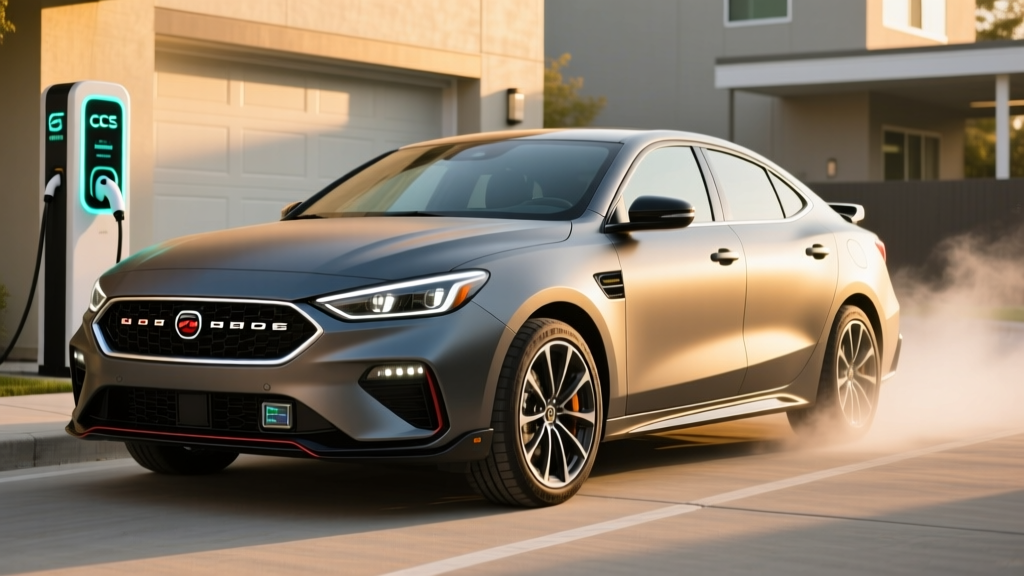
The Dodge Hornet R/T is a plug-in hybrid (PHEV) compact crossover that tries to thread a difficult needle: deliver meaningful electric-only commuting range, retain all-wheel-drive capability, and still offer the kind of punchy acceleration Dodge is known for. For 2026, the Hornet R/T PHEV AWD continues with its turbocharged 1.3-liter engine paired with a rear-axle electric motor, producing a combined 288 horsepower and 383 lb-ft of torque. With an EPA-rated 32 miles of electric-only range and a total driving range exceeding 380 miles, it targets buyers who want EV-like daily driving without range anxiety on longer trips.
But how does it stack up in the real world? And does it still qualify for any federal incentives? This guide breaks down every spec that matters — from battery chemistry and charging speed to real-world fuel economy and total cost of ownership — so you can decide whether the Hornet R/T PHEV is the right electrified vehicle for your garage.
HEV vs. PHEV: Where the Hornet R/T Fits
Before diving into specs, it's essential to understand the distinction between a conventional hybrid (HEV) and a plug-in hybrid (PHEV), because Dodge sells the Hornet in both configurations.
| Feature | Hornet GT (HEV / Mild Hybrid) | Hornet R/T (PHEV) |
|---|---|---|
| Battery size | ~0.8 kWh (small buffer) | 15.5 kWh (usable ~12 kWh) |
| Plug-in charging | No — charges via engine/regen only | Yes — Level 1 and Level 2 AC |
| Electric-only range | None (electric assist only) | EPA 32 miles |
| Fuel economy (gas mode) | ~29 MPG combined | ~29 MPG combined (after battery depleted) |
| MPGe (electric + gas) | N/A | 77 MPGe combined |
| Combined horsepower | 268 hp | 288 hp |
| 0–60 mph | ~6.5 sec | 5.6 sec |
The Hornet GT is a conventional hybrid (technically a mild-hybrid-assisted turbo). You never plug it in; the small battery charges through regenerative braking and the engine. It improves stop-and-go efficiency but offers no electric-only driving.
The Hornet R/T is a full plug-in hybrid. Its larger 15.5 kWh battery allows genuine zero-emission commuting for up to 32 miles, and you recharge it by plugging into a wall outlet or Level 2 charger. When the battery is depleted, it operates as a conventional hybrid, seamlessly switching to gas-electric mode. This dual personality is the core PHEV value proposition.
Powertrain Specs: 288 HP and AWD From Two Sources
| Specification | 2026 Dodge Hornet R/T PHEV AWD |
|---|---|
| Engine | 1.3L turbocharged inline-4 |
| Engine output | 180 hp / 199 lb-ft |
| Electric motor (rear axle) | 121 hp / 184 lb-ft |
| Combined system output | 288 hp / 383 lb-ft |
| Transmission | 6-speed automatic (front); single-speed reduction gear (rear e-axle) |
| Drivetrain | AWD (eAWD — engine drives front, motor drives rear) |
| 0–60 mph | 5.6 seconds |
| Battery capacity | 15.5 kWh total (~12 kWh usable) |
| Battery chemistry | NMC (nickel manganese cobalt) |
| EPA electric-only range | 32 miles |
| EPA MPGe (combined) | 77 MPGe |
| EPA MPG (gas-only hybrid mode) | 29 combined (26 city / 32 highway) |
| Total driving range | ~380+ miles |
| DC fast charging | Not available (AC only) |
| Level 2 charge time (0–100%) | ~2.5 hours at 7.4 kW |
| Level 1 charge time (0–100%) | ~7.5 hours at 120V |
The Hornet R/T's powertrain is a PHEV architecture shared with the Alfa Romeo Tonale — both ride on the same Stellantis platform. The front wheels are driven by the turbo 1.3L through a conventional automatic, while the rear axle gets its own dedicated electric motor. This "eAWD" setup means the AWD system doesn't require a mechanical driveshaft connecting front and rear — the electric motor handles the rear axle independently.
The result is a 5.6-second 0–60 time that makes the Hornet R/T one of the quickest vehicles in its compact crossover segment. The instant torque from the rear electric motor gives it a responsive, eager feel off the line that a gas-only Hornet GT can't quite match.
Fuel Economy: EPA Ratings and Real-World MPG
| Driving Mode | City | Highway | Combined |
|---|---|---|---|
| Electric + Gas (MPGe) | — | — | 77 MPGe |
| Gas-only (hybrid mode, battery depleted) | 26 MPG | 32 MPG | 29 MPG |
According to EPA data at fueleconomy.gov, the Hornet R/T PHEV achieves 77 MPGe when operating with a charged battery, blending electric and gas driving. Once the battery is depleted and the vehicle operates as a conventional hybrid, it returns 29 MPG combined — 26 city and 32 highway.
Real-world expectations: The 32-mile electric range is achievable in mild weather on suburban roads at moderate speeds. In our experience, highway driving at 70+ mph reduces electric-only range to roughly 22–25 miles. In cold weather (below 32°F), expect 20–25 miles of electric range due to battery chemistry limitations and cabin heating demands. In gas-only hybrid mode, real-world highway cruising can yield 30–33 MPG, while aggressive city driving may dip to 24–25 MPG.
The PHEV advantage is most pronounced for commuters who can charge at home and whose round-trip commute falls within that 32-mile electric envelope. If you drive 25 miles each way and charge nightly, you might visit a gas station only a few times a year. But if your daily drive regularly exceeds 40 miles, the Hornet operates primarily as a 29-MPG hybrid — still efficient, but not dramatically better than a conventional HEV.
Charging the Hornet R/T PHEV: What You Need to Know
One of the most common questions from prospective PHEV buyers is about charging logistics. Here's what the Hornet R/T requires:
| Charging Level | Power | Connector | 0–100% Time | Notes |
|---|---|---|---|---|
| Level 1 (120V household) | ~1.4 kW | Standard J1772 | ~7.5 hours | Overnight charging; works with any outlet |
| Level 2 (240V) | Up to 7.4 kW | J1772 | ~2.5 hours | Recommended; requires home charger install |
| DC Fast Charging | Not supported | N/A | N/A | No CCS or NACS capability |
The Hornet R/T PHEV does not support DC fast charging. This is typical for PHEVs — the battery is small enough that Level 2 charging fully replenishes it in about 2.5 hours, making DC fast-charging hardware unnecessary for most use cases. However, it means you cannot top up quickly at a highway rest stop the way a full BEV owner can.
For home charging, a Level 2 wallbox (like a ChargePoint Home Flex or Emporia Vue) is strongly recommended. Installation costs for a 240V Level 2 circuit typically range from $500 to $2,000 depending on your electrical panel's capacity and the distance from the panel to your parking spot. If your panel is maxed out, a panel upgrade (to 200A) can add $1,500–$3,000. Always consult a licensed electrician for a site-specific quote.
Level 1 charging (plugging into a standard 120V household outlet) is viable if you drive less than 30 miles daily and can leave the car plugged in overnight. The included charging cord handles this, though it's noticeably slower.
Pricing, Trims, and Federal Tax Credit Eligibility
For 2026, the Dodge Hornet R/T PHEV AWD starts at approximately $42,530 (including destination). Key trim and option notes:
- R/T base: ~$42,530 — includes AWD, 15.5 kWh battery, 10.25-inch infotainment, wireless Apple CarPlay/Android Auto, heated front seats
- R/T Plus: ~$46,000 — adds leather, panoramic sunroof, upgraded audio, additional driver-assistance features
- Federal §30D tax credit: Under current IRS rules, the Hornet R/T PHEV may qualify for a partial or full $7,500 federal tax credit, but eligibility depends on battery component sourcing, critical minerals requirements, MSRP caps (SUVs capped at $80,000 — the Hornet clears this easily), and buyer income limits ($300,000 joint / $150,000 single). As of 2026, Stellantis PHEVs face evolving sourcing compliance — always verify current eligibility at irs.gov before purchasing.
- Point-of-sale transfer: If eligible, the credit can be applied at the dealership as an immediate price reduction rather than waiting for a tax refund.
§30D credit checklist for the Hornet R/T PHEV:
- ✅ MSRP under $80,000 (SUV cap) — Hornet qualifies
- ✅ Buyer income under $300K joint / $150K single — verify your AGI
- ⚠️ Battery sourcing/critical minerals — confirm current-year compliance with dealer or IRS
- ✅ New vehicle purchase (not lease — leased PHEVs fall under §45W commercial credit instead)
- ✅ Vehicle assembled in North America — Hornet is built in Italy; verify current assembly-status rules
Important caveat: The Hornet is manufactured in Pomigliano, Italy. Under §30D rules, final assembly in North America is a hard requirement for the new-vehicle credit. Stellantis has navigated this through various compliance pathways, but buyers should confirm with their dealer and check the latest DOE eligible-vehicle list before counting on the credit.
Battery Longevity, Warranty, and Replacement Costs
Dodge Hornet R/T PHEV Battery Warranty:
- Hybrid/EV battery warranty: 8 years / 100,000 miles (whichever comes first)
- Capacity retention threshold: Stellantis typically warrants against failure or significant capacity loss below ~70% of original capacity
- Powertrain warranty: 5 years / 60,000 miles
- Basic bumper-to-bumper: 3 years / 36,000 miles
PHEV batteries experience less stress than full EV batteries because the usable window is smaller and the engine provides backup. The Hornet's 15.5 kWh NMC pack is modest in size, meaning replacement cost — if needed out of warranty — is estimated in the $5,000–$8,000 range (parts and labor), substantially less than a full EV battery replacement that can exceed $15,000.
In practice, modern PHEV batteries rarely require full replacement within the warranty period. Degradation is gradual — expect roughly 5–10% capacity loss over 8–10 years under normal use. That might reduce your electric-only range from 32 miles to 27–29 miles over a decade, which is manageable for most owners.
To maximize battery life:
- Avoid routinely charging to 100% and letting it sit in extreme heat (though the Hornet's battery management system handles most of this automatically)
- Use Level 2 charging rather than relying exclusively on Level 1 for daily needs (the car's thermal management benefits from the higher-power charge cycle)
- Don't let the battery sit at 0% for extended periods — the vehicle's buffer prevents true zero, but it's good practice to keep it plugged in if storing
Who Should Buy the Hornet R/T PHEV — And Who Shouldn't
Pros
- Quick: 5.6-second 0–60 with instant electric torque
- 32-mile EV range covers most commutes
- AWD standard — genuine all-weather capability
- No range anxiety — gas engine for long trips
- Distinctive styling in a segment of lookalikes
- Potential §30D tax credit eligibility (verify current rules)
Cons
- No DC fast charging
- Electric range drops in cold weather and at highway speeds
- 29 MPG in gas-only mode isn't class-leading for a hybrid
- Smaller cargo area than some competitors (due to battery placement)
- Italy-built — North American assembly requirement complicates tax credit
- Infotainment and interior quality lag behind some rivals
Choose the Dodge Hornet R/T PHEV if:
- Your daily round-trip commute is under 30 miles and you can charge at home
- You want AWD and quick acceleration in a compact crossover
- You take occasional long road trips and don't want to plan around charging stations
- You value performance and styling alongside efficiency
Choose a full EV instead if:
- You have reliable home charging and your daily driving is under 250 miles
- You want zero tailpipe emissions and minimal maintenance (no oil changes, no gas engine)
- You're eligible for the full $7,500 credit on a BEV like the Hyundai Ioniq 5 or Tesla Model Y
Choose a conventional hybrid (HEV) instead if:
- You cannot install a home charger (apartment, street parking)
- You want hybrid efficiency without any plug-in routine
- Your budget is tighter — the Hornet GT HEV starts ~$8,000 less
How the Hornet R/T PHEV Compares to Key Rivals
| Spec | Dodge Hornet R/T PHEV | Toyota RAV4 Prime PHEV | Ford Escape PHEV | Hyundai Tucson PHEV |
|---|---|---|---|---|
| EV range (EPA) | 32 mi | 42 mi | 37 mi | 33 mi |
| Combined HP | 288 hp | 302 hp | 210 hp | 261 hp |
| 0–60 mph | 5.6 sec | 5.7 sec | ~7.5 sec | ~6.8 sec |
| Gas-mode MPG | 29 combined | 38 combined | 40 combined | 35 combined |
| AWD | Standard | Standard | FWD only | Standard |
| DC fast charge | No | No | No | No |
| Starting MSRP | ~$42,530 | ~$44,500 | ~$39,500 | ~$40,250 |
The Hornet R/T trades best-in-class efficiency for best-in-class acceleration feel. The RAV4 Prime remains the segment benchmark for overall PHEV capability (42-mile range, 38 MPG hybrid mode, proven Toyota reliability), while the Escape PHEV leads on pure fuel economy — but neither matches the Hornet's combination of sub-6-second acceleration and aggressive styling. Your choice depends on whether you prioritize sportiness or maximum efficiency.
Frequently Asked Questions
How many MPG does the Dodge Hornet R/T PHEV get?
The EPA rates the Hornet R/T PHEV at 77 MPGe combined when using both electric and gas power. Once the battery is depleted, it operates as a hybrid returning 29 MPG combined (26 city / 32 highway). Real-world results vary: expect 30–33 MPG on flat highway cruising and 24–26 MPG in aggressive city driving.
How far can the Hornet R/T go on electric only?
The EPA rates it at 32 miles of electric-only range. In real-world conditions, expect 22–28 miles at highway speeds, 28–32 miles in suburban driving at moderate speeds, and 20–25 miles in cold winter weather. The range is sufficient for many daily commutes but falls short of the RAV4 Prime's 42 miles.
Does the Dodge Hornet R/T PHEV qualify for a tax credit?
It may qualify for up to $7,500 under the IRS §30D clean vehicle credit, but eligibility depends on several factors: buyer income limits, battery sourcing/critical minerals compliance, and the North American final assembly requirement. Because the Hornet is built in Italy, confirm current eligibility with your dealer and at irs.gov before purchasing. The MSRP is well under the $80,000 SUV cap.
Is the Hornet R/T PHEV reliable? What about battery replacement cost?
The Hornet shares its PHEV powertrain with the Alfa Romeo Tonale, which has been on the market since 2023. Long-term reliability data is still accumulating, though the 8-year/100,000-mile hybrid battery warranty provides substantial coverage. Out-of-warranty battery replacement is estimated at $5,000–$8,000 — less than a full EV. For safety ratings, check NHTSA and IIHS for the latest crash-test results.
Can I charge the Hornet R/T PHEV at a DC fast charger?
No. The Hornet R/T PHEV supports only AC charging — Level 1 (120V, ~7.5 hours) and Level 2 (240V, ~2.5 hours). There is no CCS or NACS DC fast-charging port. This is standard for PHEVs — the small battery doesn't require fast charging.
Hybrid vs. PHEV vs. EV — which is right for me?
If you can charge at home and your daily driving is under 30 miles, the PHEV gives you electric commuting with gas-engine backup for road trips — the best of both worlds. If you have home charging and rarely drive more than 250 miles in a day, a full EV offers lower running costs and zero tailpipe emissions. If you can't charge at home at all, a conventional hybrid (HEV) avoids the plug-in requirement entirely while still improving fuel economy.
Does the Hornet R/T PHEV have regenerative braking?
Yes. The Hornet R/T offers regenerative braking that recovers energy during deceleration and sends it back to the battery. It's not a true one-pedal driving experience like some full EVs, but it does extend electric range in stop-and-go traffic and reduces brake wear.