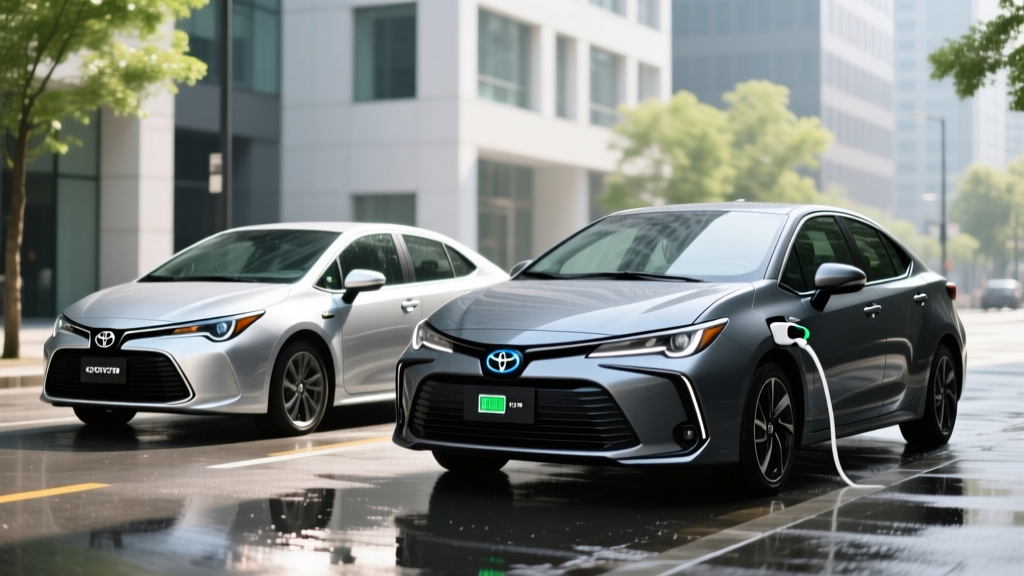
If you are cross-shopping Toyota's two mainstream hybrids, the decision comes down to how much you value maximum fuel economy versus cabin space, refinement, and a lower starting price. The 2026 Toyota Prius returns up to 57 MPG combined in its front-wheel-drive LE trim, while the 2026 Toyota Corolla Hybrid achieves 53 MPG combined — a narrow four-MPG gap that rarely plays out the same way in real-world driving. Both use Toyota's latest fifth-generation hybrid system, but they target different buyers.
This comparison covers conventional hybrid (HEV) versions only. The Prius Prime plug-in hybrid is a different animal entirely and is addressed separately below. Neither the Corolla Hybrid nor the standard Prius requires plugging in — both recharge their small traction batteries through regenerative braking and the gasoline engine.
Corolla Hybrid vs Prius: Head-to-Head Spec Table
| Specification | Corolla Hybrid LE | Prius LE |
|---|---|---|
| Powertrain | 1.8L 4-cyl + electric motor | 2.0L 4-cyl + electric motor |
| Combined Horsepower | 138 hp | 194 hp |
| Drivetrain | AWD (standard) | FWD (AWD optional on LE) |
| EPA City MPG | 51 | 57 |
| EPA Highway MPG | 49 | 56 |
| EPA Combined MPG | 53 | 57 |
| 0–60 mph | ~8.0 sec | ~7.0 sec |
| Cargo Volume (rear seats up) | 13.1 cu ft | 23.8 cu ft |
| Starting MSRP | $24,995 | $29,495 |
| Federal Tax Credit | None | None (HEV) |
| Hybrid Battery Warranty | 10 yr / 150,000 mi | 10 yr / 150,000 mi |
Sources: fueleconomy.gov (EPA), Toyota Corolla Hybrid specs, Toyota Prius specs.
How Many MPG Do These Hybrids Actually Get?
The EPA numbers tell a clear story: the Prius LE's 57 MPG combined beats the Corolla Hybrid LE's 53 MPG by four miles per gallon. On paper, that translates to roughly 50 extra miles per tankful (the Prius holds 11.4 gallons; the Corolla Hybrid holds 11.3). Over 15,000 miles per year at $3.40/gallon, the Prius saves approximately $115 annually in fuel — meaningful but not dramatic.
| Metric | Corolla Hybrid LE | Prius LE |
|---|---|---|
| City MPG | 51 | 57 |
| Highway MPG | 49 | 56 |
| Combined MPG | 53 | 57 |
| Est. Annual Fuel Cost | ~$960 | ~$845 |
| Est. Total Range | ~599 mi | ~650 mi |
Real-World MPG: What Owners Actually See
Toyota's hybrid system excels in stop-and-go city driving, where the electric motor handles low-speed propulsion and the engine shuts off at stops. In real-world commuting, both cars routinely meet or slightly exceed their EPA city figures — 52–55 MPG for the Corolla Hybrid and 58–61 MPG for the Prius are common owner-reported numbers in mixed suburban driving.
Highway cruising is a different story. At sustained 70–75 mph speeds, expect the Corolla Hybrid to deliver 44–47 MPG and the Prius to return 48–52 MPG. Cold weather (below 40°F) reduces efficiency by 5–10% in both models because the engine runs more frequently to provide cabin heat and maintain catalyst temperature. If your commute is mostly highway, the real-world MPG gap between these two narrows to roughly 2–3 MPG.
Powertrain and Performance: 138 hp vs 194 hp
This is where the comparison shifts decisively in the Prius's favor. The current-generation Prius uses a 2.0-liter Dynamic Force engine paired with Toyota's fifth-generation hybrid transaxle, producing a combined 194 hp. The Corolla Hybrid carries over the proven 1.8-liter system at 138 hp — a carryover from the previous-generation Prius architecture.
On the road, the difference is obvious. The Prius merges onto highways with authority, and its 7.0-second 0–60 time feels genuinely quick for a fuel-economy car. The Corolla Hybrid's 8.0-second run to 60 is adequate but will have you planning overtakes more carefully. The Corolla Hybrid does come standard with electronic on-demand AWD (a small rear motor), which the Prius LE offers only as an option (AWD drops the Prius to 53 MPG combined).
If you regularly carry passengers, drive in mountainous terrain, or want confident highway passing power, the Prius's 56-hp advantage is worth the premium. If your driving is mostly flat and urban, the Corolla Hybrid's output is sufficient.
Interior, Cargo, and Daily Usability
The Prius's hatchback design is its secret weapon. With 23.8 cu ft of cargo space behind the rear seats (and over 50 cu ft with them folded), it swallows luggage, groceries, and dog crates with room to spare. The Corolla Hybrid is a traditional sedan with a 13.1 cu ft trunk — fine for daily commuting but tight for road trips or bulk shopping.
Both vehicles come equipped with Toyota Safety Sense 3.0 (adaptive cruise control, lane tracing, pre-collision braking, road sign assist). Infotainment is an 8-inch touchscreen on base trims; higher trims offer a 12.3-inch display. The Prius's low-slung, aero-optimized roofline does cut into rear headroom for taller passengers — anyone over 6'1" may find the back seat snug compared to the Corolla's more upright seating position.
Hybrid vs PHEV vs EV: Which Fits Your Life?
Quick decision framework:
- Choose the Corolla Hybrid or Prius (HEV) if you cannot charge at home or work, want zero lifestyle change from a gas car, and drive 10,000–15,000 miles/year in mixed conditions.
- Choose the Prius Prime (PHEV) if you have home Level 2 charging, your daily commute is under 44 miles round-trip, and you still want gas-engine flexibility for road trips. The Prius Prime delivers 44 miles of electric-only range on a full charge and a total range of roughly 510 miles.
- Choose a full EV (BEV) if you have reliable home charging, rarely drive more than 250 miles in a single day, and want the lowest per-mile energy cost and zero tailpipe emissions.
What About the Prius Prime PHEV?
The 2026 Prius Prime pairs the same 2.0L hybrid system with a larger 13.6 kWh lithium-ion battery pack, delivering 44 miles of EPA-rated electric-only range. On electricity alone, it achieves 127 MPGe. Once the battery is depleted, it operates as a conventional hybrid at 52 MPG combined. Charging the Prime takes approximately 4 hours on a 240V Level 2 home charger (3.3 kW onboard charger); it does not support DC fast charging.
Critically, the Prius Prime may qualify for the federal §30D clean vehicle credit — up to $3,750 depending on battery mineral sourcing and your individual tax situation. The standard Prius and Corolla Hybrid, as conventional HEVs, do not qualify for any federal purchase credit. Check current eligibility on IRS.gov §30D guidelines, as battery sourcing rules change annually.
Pricing, Value, and Tax Credit Reality
The Corolla Hybrid LE starts at $24,995 — roughly $4,500 less than the Prius LE at $29,495. That price gap buys a lot of fuel: at the Prius's $115/year fuel savings, it would take 39 years to recoup the difference. The Corolla Hybrid is the clear value winner for budget-conscious buyers who don't need the extra cargo space or horsepower.
However, the Prius XLE ($32,495) and Limited ($36,495) trims add features the Corolla Hybrid doesn't offer: heated/ventilated front seats, a panoramic fixed glass roof, a 12.3-inch display, and available digital key. If you were going to option a Corolla Hybrid XLE ($28,595) with similar equipment anyway, the Prius becomes more competitive.
Federal Tax Credits: The Hard Truth
- Corolla Hybrid (HEV): Not eligible for the §30D federal tax credit. This credit applies only to plug-in vehicles (PHEVs and BEVs).
- Prius (HEV): Not eligible for the §30D credit.
- Prius Prime (PHEV): May qualify for up to $3,750 under §30D, subject to MSRP caps (under $55,000 for sedans), buyer income limits ($150K single / $300K joint), and critical mineral/battery component sourcing requirements. Point-of-sale transfer is available at participating dealers.
Some states offer additional rebates for PHEVs (not HEVs). Check your state energy office or AFDC state incentive database for current programs.
Battery Warranty, Reliability, and Replacement Costs
Toyota Hybrid Battery Warranty: Both the Corolla Hybrid and Prius carry a 10-year / 150,000-mile hybrid battery warranty (whichever comes first) in all 50 states. This covers defects and capacity loss below a defined threshold.
Toyota's hybrid synergy drive system has an exceptional reliability track record spanning two decades. The nickel-metal hydride (NiMH) battery in the Corolla Hybrid and the lithium-ion pack in the Prius are both proven designs. Real-world data from fleet operators and long-term owners shows these batteries routinely lasting 180,000–250,000 miles before significant degradation.
If a replacement is needed out of warranty, expect to pay $2,500–$4,500 for a new OEM hybrid battery (installed) depending on the model. Refurbished/remanufactured batteries are available for $1,200–$2,000. This is a fraction of full EV battery replacement costs and is rarely needed within the vehicle's normal service life.
Both models carry Toyota's standard 3-year/36,000-mile bumper-to-bumper warranty and 5-year/60,000-mile powertrain warranty. Toyota's long-term reliability ratings from Consumer Reports and owner surveys consistently place the Prius and Corolla among the top-ranked vehicles in their classes.
Pros and Cons at a Glance
2026 Corolla Hybrid
Pros:
- Lower starting price ($24,995) — best value in Toyota's hybrid lineup
- Standard AWD — all-weather confidence without a fuel-economy penalty
- Proven 1.8L hybrid system with decades of reliability data
- Upright sedan seating — better rear headroom for tall passengers
Cons:
- 138 hp feels modest on highway on-ramps
- 13.1 cu ft trunk limits cargo versatility
- Older-generation infotainment on base trim
2026 Prius
Pros:
- Best-in-class 57 MPG combined (FWD LE)
- 194 hp — genuinely quick for a hybrid
- 23.8 cu ft hatchback cargo area
- Available Prius Prime PHEV variant with 44 mi EV range
Cons:
- $4,500 more expensive at base level
- Low roofline reduces rear headroom
- AWD option drops fuel economy to 53 MPG combined
Which Toyota Hybrid Should You Buy?
Choose the Corolla Hybrid if:
- You want the lowest purchase price and simplest ownership experience
- Your driving is mostly city/suburban at moderate speeds
- You value standard AWD for snow or rain
- You don't regularly haul large cargo
Choose the Prius if:
- Maximum fuel economy is your top priority
- You want confident highway acceleration (194 hp)
- You need hatchback cargo flexibility
- You're considering the Prius Prime PHEV for electric commuting with gas backup
Frequently Asked Questions
How many MPG does the Corolla Hybrid get in real-world driving?
Expect 50–55 MPG in mixed city/suburban driving and 44–47 MPG at sustained highway speeds. Cold weather and aggressive acceleration reduce these figures by 5–10%. The EPA combined rating is 53 MPG.
Does the Prius Prime qualify for a tax credit?
The Prius Prime PHEV may qualify for up to $3,750 under the federal §30D credit, subject to income limits, MSRP caps, and battery sourcing rules. The standard Prius HEV does not qualify. Always verify current eligibility at IRS.gov before purchasing.
How long do Toyota hybrid batteries last?
Toyota hybrid batteries routinely last 180,000–250,000 miles. Both the Corolla Hybrid and Prius include a 10-year/150,000-mile hybrid battery warranty. Out-of-warranty replacement costs $2,500–$4,500 for an OEM pack.
Is the Corolla Hybrid AWD system always engaged?
No. The Corolla Hybrid uses an electronic on-demand AWD system with a small independent rear motor. It activates automatically during acceleration from a stop, in low-traction conditions, and during cornering. Under steady cruising, the car operates in front-wheel drive to maximize efficiency.
Can I plug in the standard Prius or Corolla Hybrid to charge?
No. Both are conventional hybrids (HEVs). They charge their batteries exclusively through regenerative braking and the gasoline engine. Only the Prius Prime (PHEV) has a charging port and can be plugged in for electric-only driving.
Which is cheaper to own over five years: Corolla Hybrid or Prius?
The Corolla Hybrid wins on total cost of ownership for most buyers. Its $4,500 lower purchase price, combined with insurance premiums that are typically $50–$100/year lower, more than offsets the Prius's slightly better fuel economy. Over five years and 75,000 miles, the Corolla Hybrid's total cost advantage is approximately $3,800–$4,200 before accounting for resale value differences.