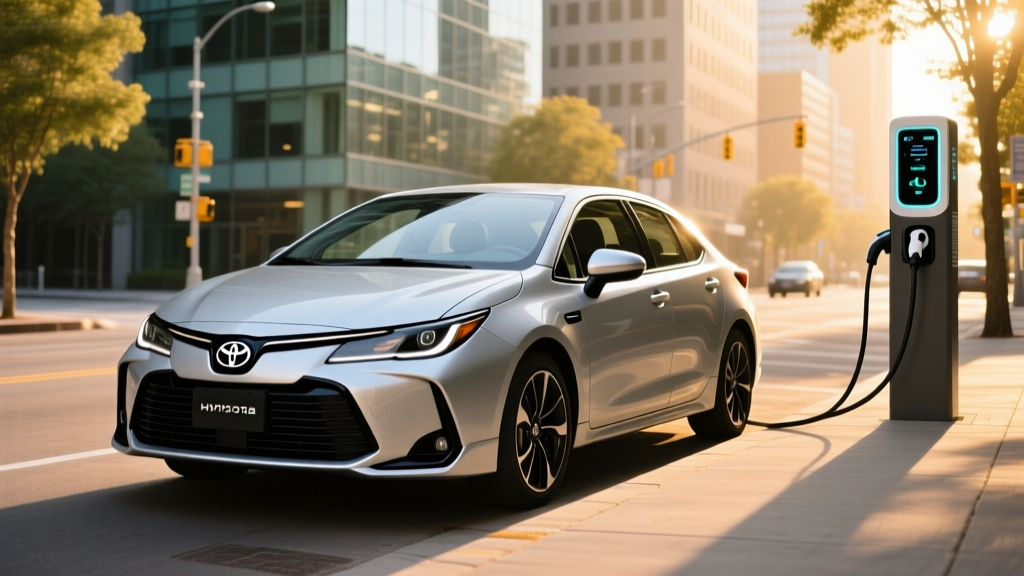
The 2024 Toyota Corolla Hybrid occupies a specific niche: maximum fuel economy with zero lifestyle change required. You never plug it in, you never think about range, and you fill up at the same gas stations you always have. For buyers who want to cut fuel costs without the infrastructure demands of a plug-in hybrid (PHEV) or battery electric vehicle (BEV), this conventional hybrid (HEV) is one of the most efficient options on the market. Here's a data-driven breakdown of what you actually get — and what you give up.
Corolla Hybrid 2024: Quick Verdict
The 2024 Corolla Hybrid pairs a 1.8-liter four-cylinder engine with two motor-generators through Toyota's fifth-generation Hybrid Synergy Drive. Combined system output is 138 horsepower — adequate for commuting, modest for highway passing. The LE trim starts at $23,500 (including destination), and the available electronic AWD adds a third motor on the rear axle. EPA fuel economy peaks at 53 city / 46 highway / 50 combined MPG on the LE FWD trim, with AWD dropping those figures by only 1 MPG across the board.
| Specification | LE FWD | LE AWD | SE / Nightshade AWD |
|---|---|---|---|
| EPA City / Highway / Combined | 53 / 46 / 50 MPG | 51 / 44 / 48 MPG | 50 / 43 / 47 MPG |
| Combined Horsepower | 138 HP (net system) | ||
| Engine | 1.8L DOHC 4-cyl + 2 motor-generators | ||
| AWD Rear Motor | None | MM 'R' rear motor (41 HP max) | |
| Transmission | eCVT (planetary gearset) | ||
| 0–60 MPH (est.) | ~9.0 sec | ||
| Fuel Tank | 11.4 gal | ||
| Total Range (est.) | ~570 mi | ~547 mi | ~536 mi |
| Hybrid Battery | Lithium-ion, ~1.0 kWh (nominal, not plug-in) | ||
| Base MSRP (incl. destination) | $23,500 | $24,900 | $27,540 |
| Federal §30D Tax Credit | Not eligible (HEV — not plug-in) | ||
HEV vs PHEV vs EV: Where the Corolla Hybrid Fits
Buyers cross-shopping electrified vehicles encounter three distinct architectures. Understanding the difference is essential before evaluating the Corolla Hybrid against alternatives like the Prius Prime (PHEV) or the bZ4X (BEV).
| Feature | HEV (Corolla Hybrid) | PHEV (e.g., Prius Prime) | BEV (e.g., bZ4X) |
|---|---|---|---|
| Plug-in Required? | No | Yes | Yes |
| Electric-Only Range | None (EV assist only) | ~39–44 mi | 222–252 mi (EPA) |
| Total Range | ~540–570 mi | ~440+ mi combined | 222–252 mi |
| Fuel Economy (gas mode) | 47–50 MPG combined | 48 MPG combined (gas) | N/A (electric only) |
| Home Charging Needed? | No | Recommended (Level 2) | Essential (Level 2) |
| Federal Tax Credit (§30D) | Not eligible | Up to $7,500* | Up to $7,500* |
| Best For | Apt/curb parking, no charger access | Short commutes + home charging | Home charging + daily driving under range |
*§30D credit subject to MSRP caps, buyer income limits, and battery critical-mineral sourcing rules per IRS guidelines. Consult a tax professional.
The Corolla Hybrid is the right choice if you lack access to any plug — whether you live in an apartment, park on the street, or simply don't want to install a Level 2 charger. It captures regenerative braking energy and uses the electric motors to assist the gasoline engine, but it never drives on electricity alone for meaningful distances. If you have a garage and a short commute, a PHEV like the Prius Prime may save more fuel on a daily basis.
Fuel Economy: EPA Ratings vs Real-World MPG
| Trim | City MPG | Highway MPG | Combined MPG |
|---|---|---|---|
| LE FWD | 53 | 46 | 50 |
| LE AWD | 51 | 44 | 48 |
| SE AWD / Nightshade AWD | 50 | 43 | 47 |
Source: fueleconomy.gov
Toyota's hybrid system excels in city driving, where the electric motor handles low-speed propulsion and the engine shuts off at stops. Many owners report exceeding the EPA city figure — 54–56 MPG is common in stop-and-go traffic with moderate temperatures. Highway driving tells a different story: aerodynamic drag and sustained engine load reduce real-world highway economy to roughly 41–44 MPG, slightly below the EPA estimate.
In mixed real-world driving (50/50 city-highway), expect approximately 47–50 MPG for the LE FWD. Cold weather (below 35°F) reduces efficiency by 5–10% as the engine runs more frequently to provide cabin heat and maintain battery temperature. This is a smaller penalty than BEVs face in winter, but it's real.
The SE and Nightshade trims sacrifice 2–3 MPG compared to the LE due to larger 18-inch alloy wheels, a sport-tuned suspension, and slightly wider tires. If maximum efficiency is the goal, the LE FWD is the clear pick.
Powertrain and Performance
The 2024 Corolla Hybrid uses Toyota's fifth-generation Hybrid Synergy Drive. The 1.8-liter Atkinson-cycle four-cylinder engine produces 96 HP and 105 lb-ft of torque on its own. Two front motor-generators — one primarily for propulsion assist, the other for starting the engine and generating electricity — supplement this. Combined net system output is 138 HP.
AWD models add an independent rear motor (MM 'R') that produces up to 41 HP, engaging automatically from a stop and during low-traction conditions up to approximately 43 MPH. This isn't a performance AWD system — it's a traction and stability aid. The eCVT transmission is a planetary gearset, not a belt-driven CVT, which eliminates the rubber-band acceleration feel common in competitors.
The 0–60 MPH time of roughly 9.0 seconds is unhurried. Highway merging requires planning, and steep grades demand a heavier throttle foot. This is a powertrain optimized for efficiency, not acceleration. For context, the gas-only Corolla SE with the 2.0L engine hits 60 MPH in about 7.3 seconds but returns only 34 MPG combined.
Battery, Warranty, and Long-Term Reliability
Hybrid Battery Warranty
Toyota covers the Corolla Hybrid's lithium-ion traction battery for 10 years or 150,000 miles, whichever comes first. This applies in all 50 states. The hybrid system components (motor-generators, inverter, eCVT) carry the same 10-year/150,000-mile coverage.
The Corolla Hybrid's traction battery is small — approximately 1.0 kWh nominal capacity — because it's not designed to store energy from a plug. It buffers regenerative braking energy and provides brief electric assist. This small size, combined with Toyota's conservative charge/discharge strategy (the battery typically cycles between ~40% and ~80% state of charge), significantly reduces degradation stress.
Toyota's hybrid battery track record is among the best in the industry. The Prius, which shares similar architecture, routinely sees original batteries lasting 150,000–200,000+ miles. If replacement becomes necessary out of warranty, a new OEM hybrid battery for the Corolla Hybrid typically costs between $2,000 and $3,500 installed, depending on dealer labor rates. Refurbished and aftermarket options are available for $1,200–$2,000.
The 12V auxiliary battery (a standard AGM unit, not part of the hybrid system) will need replacement every 4–6 years at typical cost of $150–$250, the same as any conventional vehicle.
Pricing, Tax Credits, and Ownership Economics
The 2024 Corolla Hybrid is available in three trims:
- LE FWD: $23,500 — the efficiency leader at 50 MPG combined
- LE AWD: $24,900 — adds electronic on-demand AWD for $1,400 more
- SE AWD / Nightshade AWD: $27,540 — sport-tuned suspension, 18-inch wheels, premium audio
Federal tax credit: The Corolla Hybrid does not qualify for the IRS §30D Clean Vehicle Credit. That credit is reserved for plug-in vehicles (PHEVs and BEVs) with a minimum battery capacity of 7 kWh. The Corolla Hybrid's ~1.0 kWh battery places it outside eligibility. This is a common point of confusion — many buyers assume all "hybrids" qualify. They do not.
Despite lacking a tax credit, the Corolla Hybrid's ownership economics are strong. At 50 MPG combined and $3.50/gallon regular unleaded, annual fuel cost for 12,000 miles is approximately $840. Compare that to a 28 MPG combined gas compact at $1,500/year — the Corolla Hybrid saves roughly $660 annually in fuel, paying back its ~$1,500 price premium over the gas Corolla LE ($22,050) in about 2.3 years.
Insurance premiums for the Corolla Hybrid are typically on par with the gas model — no EV surcharge applies. Maintenance costs are low: no oil changes are needed more frequently than the gas model (every 10,000 miles), and regenerative braking extends brake pad life considerably, often to 80,000+ miles.
Pros
- 50 MPG combined (LE FWD) — among the highest of any non-plug-in vehicle
- No plug-in charging required — works with existing infrastructure
- AWD available for $1,400 — rare in this price and efficiency bracket
- 10-year / 150,000-mile hybrid battery warranty
- Proven Toyota Hybrid Synergy Drive reliability (5th generation)
- Low starting price ($23,500) with strong standard safety features
Cons
- 138 HP — noticeably underpowered for highway passing and merging
- No federal tax credit eligibility
- Highway MPG falls below EPA estimate in real-world testing
- SE/Nightshade trims sacrifice 2–3 MPG for sport styling
- Rear seat and cargo space are compact-class typical (13.1 cu ft trunk)
- No EV-only driving mode — always burns some gasoline
Who Should Buy the Corolla Hybrid?
Decision Framework
Choose the Corolla Hybrid if:
- You can't install a home charger (apartment, street parking, condo)
- Your daily driving exceeds 40 miles, making a PHEV's electric range insufficient
- You want the simplest path to lower fuel costs with no behavior change
- You live in a region with harsh winters and want AWD without an efficiency penalty
Choose a PHEV (e.g., Prius Prime) if:
- You have home Level 2 charging and a commute under 40 miles round-trip
- You want to drive most daily miles on electricity and qualify for the §30D credit
Choose a BEV if:
- You have reliable home charging and want zero tailpipe emissions
- Your daily driving is within the vehicle's range and you want the lowest per-mile energy cost
Frequently Asked Questions
How many MPG does the 2024 Corolla Hybrid actually get?
The EPA rates the LE FWD at 53 city / 46 highway / 50 combined MPG. In real-world mixed driving, most owners see 47–50 MPG. City driving often exceeds the EPA figure, while sustained highway driving at 70+ MPH typically yields 41–44 MPG. Cold weather reduces efficiency by roughly 5–10%.
Does the Corolla Hybrid need to be plugged in?
No. The Corolla Hybrid is a conventional hybrid (HEV), not a plug-in hybrid (PHEV). It charges its small battery through regenerative braking and the gasoline engine. You never plug it in — you simply refuel at any gas station with regular unleaded.
Does the 2024 Corolla Hybrid qualify for any tax credit?
No. The federal §30D Clean Vehicle Credit requires a minimum 7 kWh battery and plug-in capability. The Corolla Hybrid has a ~1.0 kWh battery and no plug. Some states offer separate incentives for conventional hybrids, but these vary by jurisdiction — check your state's energy office or department of revenue for current programs.
How reliable is the Corolla Hybrid's battery and what does replacement cost?
Toyota covers the hybrid battery for 10 years or 150,000 miles. Based on the Prius platform's long track record, these batteries frequently last 150,000–200,000+ miles. If replacement is needed out of warranty, expect $2,000–$3,500 for a new OEM battery installed. The conservative charge strategy (never fully charging or fully depleting the pack) is key to longevity.
Is the AWD system always active?
No. The electronic AWD on the Corolla Hybrid is on-demand. The rear motor engages from a stop and during low-traction conditions up to approximately 43 MPH. It's designed for launch traction and stability, not performance driving. Under normal dry-road cruising, the car operates as FWD to maximize efficiency.
Hybrid vs PHEV vs EV — which is right for me?
If you have no access to charging (apartment, street parking), the Corolla Hybrid (HEV) is the simplest path to better fuel economy. If you have home charging and a short commute, a PHEV like the Prius Prime lets you drive 39–44 miles on electricity daily while keeping a gas engine for longer trips. A BEV makes sense if you have reliable home charging, want the lowest operating cost, and your daily driving fits within the vehicle's range.
What's the difference between the Corolla Hybrid and the Prius?
Both use Toyota's hybrid system, but the 2024 Prius is redesigned on a newer platform with 194 HP (vs. the Corolla's 138 HP), a more aerodynamic body, and up to 57 MPG combined. The Prius starts about $4,000 higher. The Corolla Hybrid offers AWD (Prius does not on the standard HEV) and a lower entry price, making it the value-oriented choice.