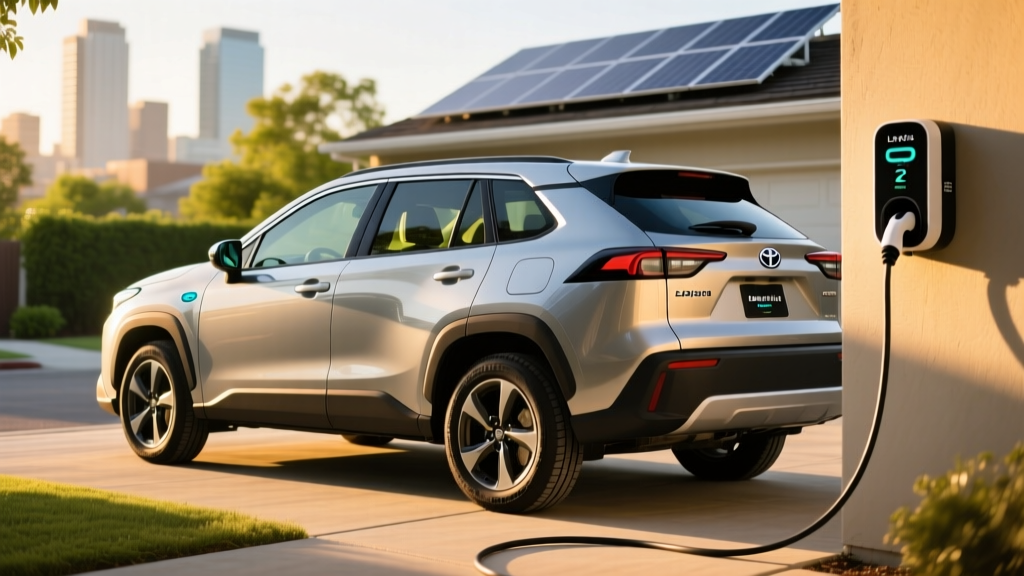
The compact crossover segment is crowded, but the 2024 Toyota Corolla Cross Hybrid occupies a specific niche: an all-wheel-drive, self-charging hybrid that prioritizes fuel efficiency over flash. With an EPA-estimated 42 MPG combined and a starting MSRP around $28,295, it undercuts most competitors on fuel cost while offering standard electronic AWD. If you're searching for a practical daily driver that sips fuel without requiring a plug, this is one of the most compelling options on the market.
But spec sheets don't tell the whole story. Real-world highway driving, cold-weather impacts, and long-term battery reliability all factor into whether this hybrid makes financial sense for your commute. Below, we break down every number that matters — from city vs. highway MPG splits to battery warranty terms — so you can decide if the Corolla Cross Hybrid fits your garage.
Hybrid vs. Plug-In Hybrid: Where the Corolla Cross Fits
Before evaluating specs, it's essential to distinguish what this vehicle is — and what it isn't. The 2024 Corolla Cross Hybrid is a conventional hybrid electric vehicle (HEV). It pairs a gasoline engine with electric motors and a small battery that recharges through regenerative braking and the engine itself. You never plug it in. There is no electric-only driving range to manage.
This is fundamentally different from a plug-in hybrid (PHEV) like the Toyota RAV4 Prime or Hyundai Tucson PHEV, which carries a larger battery (typically 12–20 kWh), offers 25–45 miles of electric-only range, and requires access to a wall outlet or Level 2 charger for maximum benefit. PHEVs also tend to qualify for federal tax credits under IRS §30D; conventional HEVs like the Corolla Cross Hybrid do not.
| Feature | HEV (Corolla Cross Hybrid) | PHEV (e.g., RAV4 Prime) |
|---|---|---|
| Plugs in? | No | Yes (Level 1/2) |
| Electric-only range | None | 25–45 miles typical |
| Battery size | ~1.3 kWh (buffer) | 12–20 kWh usable |
| Federal tax credit | No (§30D requires plug-in) | Up to $7,500 (eligibility varies) |
| Best for | No home charging, mixed driving | Home charging, short commutes |
The Corolla Cross Hybrid is the right call if you lack reliable access to a plug — apartment dwellers, street parkers, or those who simply don't want to think about charging. If you have a garage outlet and a commute under 35 miles, a PHEV will save more on fuel.
Fuel Economy: EPA Ratings and Real-World MPG
According to fueleconomy.gov, the 2024 Corolla Cross Hybrid (all trims, with standard electronic on-demand AWD) earns:
| Metric | EPA Estimate |
|---|---|
| City MPG | 45 |
| Highway MPG | 38 |
| Combined MPG | 42 |
| Annual fuel cost (15,000 mi) | ~$1,400 (at $3.50/gal) |
Hybrids typically exceed their EPA city rating in stop-and-go traffic because regenerative braking recovers energy that a gas car wastes as heat. Expect 46–50 MPG on city commutes with moderate braking. Highway driving is a different story: above 70 mph, aerodynamic drag dominates and the electric motors contribute less. Plan for 34–37 MPG on sustained interstate runs. In cold weather (below 32°F), expect a 5–10% combined drop due to engine warm-up cycles and reduced battery efficiency — roughly 38–40 MPG combined.
With a 10.6-gallon fuel tank, real-world total range sits between 380 and 450 miles depending on your driving mix. That's enough for most weekly commutes on a single fill-up.
Powertrain Specs: 196 HP with Electronic AWD
Every 2024 Corolla Cross Hybrid uses Toyota's fifth-generation hybrid system, which pairs a 2.0-liter four-cylinder engine with two front motor-generators and a dedicated rear-axle motor for electronic all-wheel drive. Unlike mechanical AWD systems with a driveshaft, the rear motor engages only when slip is detected or during hard acceleration, minimizing parasitic loss.
| Specification | Value |
|---|---|
| Engine | 2.0L DOHC 4-cylinder (M20A-FXS) |
| Combined system horsepower | 196 hp |
| 0–60 mph | ~7.5 seconds |
| Drivetrain | Electronic on-demand AWD (eAWD) |
| Transmission | eCVT (planetary gearset) |
| Hybrid battery | Lithium-ion, ~1.3 kWh (sealed) |
| Towing capacity | Not rated for towing |
The 196 hp output is a meaningful upgrade over the non-hybrid Corolla Cross (169 hp), making highway merging and uphill passes noticeably more confident. The eCVT is a gearless planetary system — not a belt-driven CVT — so it avoids the "rubber band" drone common in older continuously variable transmissions.
Pricing, Trims, and Tax Credit Eligibility
The 2024 Corolla Cross Hybrid is available in three trims. Pricing below reflects MSRP before destination charges:
| Trim | MSRP | Key Features |
|---|---|---|
| S | $28,295 | 8" touchscreen, TSS 3.0, LED headlights |
| SE | $29,535 | SofTex seats, 18" alloy wheels, roof rails |
| XSE | $31,345 | JBL audio, heated front seats, power liftgate |
The Corolla Cross Hybrid is a conventional HEV, not a plug-in vehicle. Under current IRS §30D rules, only plug-in electric vehicles (BEVs and PHEVs with ≥7 kWh battery capacity) qualify for the federal clean vehicle credit. No federal tax credit applies to this model. Some states offer separate rebates for hybrids, but these vary by jurisdiction — check your state energy office or DMV for current programs.
Even without a federal credit, the Corolla Cross Hybrid's fuel savings are meaningful. Compared to a gas-only compact crossover averaging 28 MPG combined, the Hybrid's 42 MPG saves roughly $550–$700 per year at 15,000 miles driven and $3.50/gallon. Over a 10-year ownership period, that's $5,500–$7,000 in fuel savings — effectively paying back the hybrid premium over the gas-only Corolla Cross.
Battery Warranty, Longevity, and Replacement Cost
Hybrid battery anxiety is one of the most common buyer concerns, and it's worth addressing with data. Toyota provides the following coverage for the Corolla Cross Hybrid's traction battery:
- Hybrid battery: 10 years / 150,000 miles (whichever comes first) — applicable in all 50 states for 2020+ models
- Hybrid system components: 8 years / 100,000 miles (inverter, motor-generators, control module)
- Emissions warranty: Varies by state; California and CARB states extend to 10 yr / 150,000 mi
Toyota's hybrid batteries have demonstrated exceptional longevity in real-world use. The Prius, which uses a similar hybrid architecture, regularly exceeds 200,000 miles on its original battery pack. The Corolla Cross Hybrid's lithium-ion pack is smaller and less stressed than a full EV battery — it operates within a narrow state-of-charge window (roughly 40–80% SoC), which dramatically reduces degradation. Toyota's battery management system never allows full charge or full discharge, preserving cycle life.
If a replacement is needed out of warranty, a new OEM hybrid battery for this platform typically costs between $2,000 and $3,500 installed at a dealership. Third-party refurbished packs are available for $1,000–$1,800. Given the 10-year warranty and Toyota's track record, unplanned battery replacement during typical ownership is statistically unlikely.
Who Should Buy the Corolla Cross Hybrid — And Who Shouldn't
- You want maximum MPG without plugging in
- You live in an apartment or lack home charging
- You need AWD for snow/rain but want low fuel costs
- You drive a mix of city and highway (under 200 mi/day)
- You prioritize long-term reliability and low maintenance
- You want electric-only driving or a plug-in experience
- You need more than 21.5 cu ft of cargo space (it's compact)
- You want to tow a trailer (not rated for towing)
- You qualify for the §30D federal tax credit and want to use it
- You regularly drive 300+ mile trips and want fewer fuel stops
Corolla Cross Hybrid vs. EV vs. Gas: The Decision Framework
Choosing between a conventional hybrid, a plug-in hybrid, a full battery-electric vehicle, or a gas-only car depends on three factors: charging access, daily mileage, and budget. Here's how the Corolla Cross Hybrid stacks up against each alternative:
| Factor | Corolla Cross Hybrid (HEV) | Full EV (e.g., Chevy Equinox EV) | Gas-Only Crossover |
|---|---|---|---|
| Fuel cost per mile | ~$0.09 | ~$0.04–$0.06 (home charging) | ~$0.14 |
| Home charging needed? | No | Yes (Level 2 strongly recommended) | No |
| Federal tax credit | None | Up to $7,500 (§30D) | None |
| Maintenance cost | Low (no plug, regenerative braking saves pads) | Very low (no engine oil, fewer fluids) | Higher (oil, filters, more brake wear) |
| Cold-weather range loss | ~5–10% MPG drop | ~20–30% range loss | Minimal |
| Road-trip convenience | Gas station stops, 5-min refuel | DC fast charging, 25–40 min | Gas station stops, 5-min refuel |
- Choose the Corolla Cross Hybrid if you lack home charging, want AWD, and drive under 200 miles daily.
- Choose a full EV if you have Level 2 home charging, qualify for the §30D credit, and want the lowest per-mile cost.
- Choose a PHEV if you have home charging and a short commute but still want gas flexibility for road trips.
- Choose gas-only only if the hybrid premium doesn't pencil out for your low annual mileage (under 8,000 mi/yr).
Frequently Asked Questions
How many MPG does the 2024 Corolla Cross Hybrid get?
The EPA rates it at 45 city / 38 highway / 42 combined MPG. In real-world city driving with regenerative braking, owners commonly report 46–50 MPG. Highway-only driving at 75+ mph drops to roughly 34–37 MPG. Cold weather reduces combined efficiency by 5–10%.
Does the Corolla Cross Hybrid need to be plugged in?
No. It is a conventional hybrid (HEV). The battery charges through regenerative braking and the gasoline engine. There is no plug, no charging port, and no electric-only driving mode. You fuel it exclusively at a gas station.
Does it qualify for any federal or state tax credit?
No federal tax credit applies — IRS §30D requires a plug-in vehicle with at least 7 kWh of battery capacity. Some states offer separate hybrid incentives, but these vary widely. Check your state's energy office or a qualified tax professional for current eligibility.
How long will the hybrid battery last?
Toyota covers the hybrid battery for 10 years or 150,000 miles. In practice, Toyota hybrid batteries routinely last 200,000+ miles because the system keeps the battery in a narrow, low-stress charge window. If replacement is needed out of warranty, expect $2,000–$3,500 for a new OEM pack.
Is the Corolla Cross Hybrid reliable?
Toyota's hybrid powertrain is among the most proven in the industry, with decades of Prius data supporting its durability. The eCVT has no belts or clutches to wear, and regenerative braking reduces brake pad wear significantly. Toyota Safety Sense 3.0 is standard across all trims. IIHS and NHTSA ratings should be consulted for the latest crash-test results.
How does it compare to the gas-only Corolla Cross?
The gas-only Corolla Cross (2.0L, 169 hp, CVT) earns roughly 31 MPG combined with AWD. The Hybrid adds 27 hp, standard AWD, and 11 more MPG combined for a modest price premium. At 15,000 miles per year, the Hybrid saves approximately $550–$700 annually in fuel, paying back the trim premium in 3–5 years depending on gas prices.