Quick Verdict: The Civic Sport Touring Hybrid at a Glance
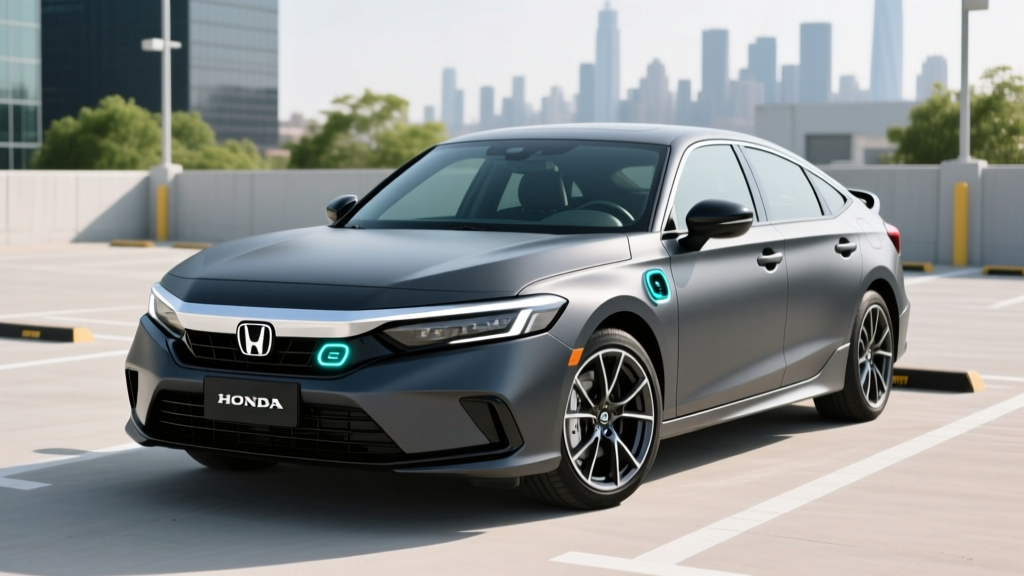
The 2026 Honda Civic Sport Touring Hybrid sits at the top of the Civic Hybrid lineup, pairing a 2.0-liter Atkinson-cycle four-cylinder with a two-motor hybrid system for a combined 200 horsepower and 232 lb-ft of torque. EPA-rated at 49 MPG combined, it's one of the most efficient non-plug-in compact sedans on the market — and it achieves that without requiring you to change how you fuel or maintain your car.
This is a conventional hybrid (HEV), not a plug-in hybrid (PHEV). You never plug it in. The system recovers energy through regenerative braking and the gasoline engine to keep its small lithium-ion battery charged. For buyers who want dramatic fuel savings without the complexity, cost, or charging logistics of a PHEV or full battery-electric vehicle (BEV), the Sport Touring Hybrid makes a compelling case.
| Spec | 2026 Civic Sport Touring Hybrid |
|---|---|
| Powertrain | 2.0L I-4 Atkinson + two-motor hybrid |
| Combined Output | 200 hp / 232 lb-ft torque |
| Transmission | e-CVT (direct-drive) |
| EPA MPG (City / Hwy / Combined) | 50 / 47 / 49 |
| Fuel Tank | 12.4 gallons |
| Total Range | ~607 miles |
| Drivetrain | FWD |
| 0–60 mph | ~7.2 seconds (est.) |
| Hybrid Battery | ~1.1 kWh lithium-ion |
| Battery Warranty | 8 years / 100,000 miles (10 yr / 150,000 mi in CARB states) |
| MSRP (Sport Touring Hybrid) | $32,350 |
| Federal Tax Credit | Not eligible (§30D is BEV/PHEV only) |
HEV vs PHEV: Why the Civic Hybrid Doesn't Plug In
One of the most common points of confusion for shoppers entering the hybrid market is the difference between a conventional hybrid (HEV) and a plug-in hybrid (PHEV). The 2026 Civic Sport Touring Hybrid is strictly an HEV. Here's what that means in practice:
| Feature | HEV (Civic Hybrid) | PHEV (e.g., Toyota Prius Prime) |
|---|---|---|
| Plugs in? | No — self-charging via regen + engine | Yes — Level 1/Level 2 AC charging |
| Battery Size | ~1.1 kWh | 13–19 kWh typical |
| Electric-Only Range | <1 mile (low-speed assist only) | 25–44 miles EPA |
| Electric-Only Speed | N/A (motor assists engine) | Up to ~75–84 mph |
| DC Fast Charging | No | Rare (most PHEVs lack DC capability) |
| Fuel Economy (gas-only) | 49 MPG combined | 48–52 MPG combined (after battery depleted) |
| Price Premium | Lower (~$1,500–$2,500 over gas) | Higher (~$4,000–$7,000 over gas) |
| Federal Tax Credit | Not eligible | Up to $7,500 (if §30D criteria met) |
The Civic Hybrid's small battery is there to buffer energy recovered during braking and to provide torque fill during acceleration. The electric motor can propel the car at very low speeds for brief distances, but this isn't meaningful "electric-only driving" — it's hybrid assist. If you want 30+ miles of true zero-emission commuting, you need a PHEV or a BEV.
Fuel Economy: EPA Ratings vs Real-World MPG
| Driving Condition | EPA Rating | Real-World Expectation |
|---|---|---|
| City | 50 MPG | 50–55 MPG (hybrids often exceed EPA in stop-and-go) |
| Highway | 47 MPG | 43–47 MPG (sustained 75+ mph reduces regen benefit) |
| Combined | 49 MPG | 46–52 MPG (depends on driving mix) |
| Cold Weather (below 32°F) | — | 40–45 MPG (engine runs more for cabin heat, battery less efficient) |
Honda's fourth-generation two-motor hybrid system is particularly strong in city driving. The system operates primarily in EV mode at low speeds, with the gasoline engine acting as a generator rather than directly driving the wheels. Only at highway cruising speeds does the engine engage a lockup clutch to drive the wheels directly, which is where it's most thermally efficient.
In real-world testing, owners frequently report exceeding the EPA city rating. Regenerative braking recaptures energy that a conventional gas car wastes as heat, so the more you stop, the more the hybrid system benefits. Highway driving is where the advantage narrows — at steady 70–80 mph speeds, there's less braking to recapture energy, and aerodynamic drag dominates.
Cold weather is the main MPG killer for hybrids. Below freezing, the engine must run more frequently to provide cabin heating (since there's no large battery to power a heat pump, as a BEV would), and the lithium-ion battery's charge acceptance rate drops. Expect a 10–15% fuel economy reduction in sustained winter conditions, according to fueleconomy.gov cold-weather data.
Powertrain and Driving Performance
The Sport Touring Hybrid's two-motor system produces a combined 200 horsepower — a meaningful step up from the 158 hp in the non-hybrid Civic's 2.0L engine and even the 180 hp turbocharged 1.5L. The electric motor delivers its 232 lb-ft of torque from near-zero RPM, which gives the Civic Hybrid strong initial acceleration and responsive around-town manners.
The e-CVT (electronically controlled continuously variable transmission) isn't a traditional belt-and-pulley CVT. Honda's system uses a direct-drive architecture where the electric motor handles most propulsion duties, and the gasoline engine either generates electricity or, at highway speeds, mechanically connects to the drive axle through a single gear ratio. The result is smoother and more linear acceleration than the rubber-band feeling associated with older CVTs.
The Sport Touring trim also adds a sport-tuned suspension, 18-inch alloy wheels, and paddle shifters that let you select from four levels of regenerative braking. In the maximum regen setting, you can approximate one-pedal driving in city traffic — lift off the accelerator and the car decelerates briskly, though it won't come to a complete stop without touching the brake pedal.
Sport Touring Trim: What You Get for $32,350
The Sport Touring Hybrid is the top-tier Civic Hybrid trim for 2026, and Honda loads it with features that justify the price premium over the Sport Hybrid ($29,850):
- Bose premium audio system (12 speakers)
- Wireless Apple CarPlay and Android Auto
- 9-inch touchscreen with built-in navigation
- Wireless phone charging pad
- Heated front seats and heated steering wheel
- Leather-trimmed seats
- Low Speed Braking Control (enhanced ADAS)
- Honda Sensing suite (adaptive cruise, lane keeping, collision mitigation)
- LED headlights with auto high-beam
- Sport-tuned suspension and 18-inch wheels
At $32,350 (including destination), the Civic Sport Touring Hybrid undercuts comparably equipped compact sedans from European brands while offering better fuel economy. The Honda Civic lineup page lists current trim pricing and availability.
Tax Credits and Incentives: What the Civic Hybrid Qualifies For
Here's where the math requires honesty: the 2026 Civic Sport Touring Hybrid does not qualify for the federal §30D Clean Vehicle Credit. That credit — up to $7,500 — is reserved for battery-electric vehicles (BEVs) and plug-in hybrids (PHEVs) that meet battery sourcing, critical mineral, MSRP cap, and buyer income requirements. Conventional hybrids (HEVs) have never been eligible under current IRS §30D rules.
What the Civic Hybrid may qualify for:
- State-level incentives: Some states offer rebates or HOV lane access for hybrids, though these are increasingly targeted at PHEVs and BEVs. Check your state's energy office or DMV for current programs.
- Insurance discounts: Several insurers offer "green vehicle" discounts for hybrids, typically 5–10% off comprehensive and collision premiums.
- Employer commuter benefits: Some workplace programs extend preferred parking or commuter incentives to hybrid owners.
The lack of a federal credit is offset by the Civic Hybrid's lower purchase price compared to PHEVs and BEVs. A PHEV like the Toyota Prius Prime starts around $33,000–$36,000 and requires home charging access to realize its electric-range benefit. The Civic Hybrid delivers its efficiency gains with zero behavioral change.
Reliability, Battery Lifespan, and Replacement Cost
Hybrid Battery Warranty: Honda covers the Civic Hybrid's lithium-ion battery pack for 8 years or 100,000 miles nationwide. In states that follow California Air Resources Board (CARB) emissions standards — including California, New York, Massachusetts, Washington, Oregon, and several others — the warranty extends to 10 years or 150,000 miles.
Honda's hybrid systems have a strong reliability track record. The fourth-generation two-motor system used in the Civic Hybrid is a mature design that has been deployed across the Accord Hybrid, CR-V Hybrid, and other models. The lithium-ion battery pack is small (~1.1 kWh) and operates within a narrow state-of-charge window — typically between 40% and 80% — which significantly reduces degradation stress compared to the deep cycling seen in BEV batteries.
Real-world data from earlier Honda hybrid models (Insight, Accord Hybrid) shows that battery packs routinely last 150,000–200,000+ miles before significant capacity loss. When replacement is eventually needed, Honda hybrid battery packs are smaller and less expensive than BEV packs. Current replacement cost estimates for a Civic-class Honda hybrid battery range from $2,000 to $4,000 including labor — a fraction of the $10,000–$20,000+ replacement costs for full EV batteries.
The rest of the powertrain benefits from Honda's standard 5-year/60,000-mile powertrain warranty, and the e-CVT has proven far more durable than traditional belt-type CVTs since it uses a fixed gear ratio with fewer wear-prone components.
Who Should Choose the Civic Sport Touring Hybrid?
Choose the Civic Sport Touring Hybrid if:
- You want 45+ MPG without changing your fueling habits or installing a home charger
- You drive a mix of city and highway miles and want strong real-world efficiency in both
- You want a well-equipped compact sedan under $33,000 with premium features
- You're not ready for EV range planning, charging logistics, or PHEV plug-in routines
- You live in an apartment or lack reliable home/work charging access
Consider a PHEV or full EV instead if:
- Your commute is under 30 miles and you have home charging — a PHEV can cover it on electricity alone
- You want to qualify for the $7,500 federal tax credit (requires a BEV or qualifying PHEV)
- You want zero tailpipe emissions for daily driving
- You have access to affordable Level 2 charging and want to minimize gasoline use entirely
Pros
- 49 MPG combined — exceeds many competitors in its class
- 200 hp makes it genuinely quick for a hybrid
- No plug-in required; zero lifestyle adjustment
- Sport Touring trim is loaded with premium features
- Strong hybrid battery warranty (up to 10 yr / 150k mi)
- Honda Sensing ADAS suite is standard
Cons
- No federal tax credit eligibility
- FWD only — no AWD option for snow-belt buyers
- No meaningful electric-only driving range
- Cargo space slightly reduced vs. non-hybrid Civic (battery placement)
- Road noise at highway speed remains a Civic weak point
Frequently Asked Questions
How many MPG does the 2026 Civic Sport Touring Hybrid get?
The EPA rates it at 50 MPG city, 47 MPG highway, and 49 MPG combined. In real-world driving, expect 50–55 MPG in city traffic (hybrids excel in stop-and-go) and 43–47 MPG at sustained highway speeds. Cold weather can drop combined MPG to the low-to-mid 40s.
Does the Civic Hybrid need to be plugged in?
No. The Civic Sport Touring Hybrid is a conventional hybrid (HEV). It charges its small battery through regenerative braking and the gasoline engine. You fuel it like any other car — just less often thanks to the 49 MPG combined rating and 600+ mile total range.
Is the Civic Hybrid reliable?
Honda's hybrid systems have demonstrated strong long-term reliability across multiple model lines. The lithium-ion battery is covered by an 8-year/100,000-mile warranty (10 years/150,000 miles in CARB states) and typically lasts 150,000–200,000+ miles in service. The e-CVT direct-drive system has fewer failure points than traditional automatic or belt-type CVT transmissions.
What does a Civic Hybrid battery replacement cost?
Current estimates for Honda compact hybrid battery replacement range from $2,000 to $4,000 including labor. Because the battery is small (~1.1 kWh) and operates within a conservative charge window, most owners will never need a replacement during typical ownership. The 8–10 year warranty covers premature failure.
Does the Civic Sport Touring Hybrid qualify for any tax credit?
It does not qualify for the federal §30D Clean Vehicle Credit, which is limited to BEVs and PHEVs. Some states may offer separate incentives for hybrids — check your state energy office. The lower purchase price and strong fuel economy partially offset the lack of a federal incentive.
Hybrid vs PHEV vs EV — which should I choose?
If you lack home charging access or don't want to think about range and charging, the HEV (like this Civic) is the lowest-friction path to high efficiency. If you have home charging and a short commute, a PHEV lets you drive on electricity most days while keeping a gas engine for road trips. If you have home charging, want maximum operating savings, and can accommodate range planning, a BEV offers the lowest per-mile energy cost and zero tailpipe emissions — but at a higher purchase price.