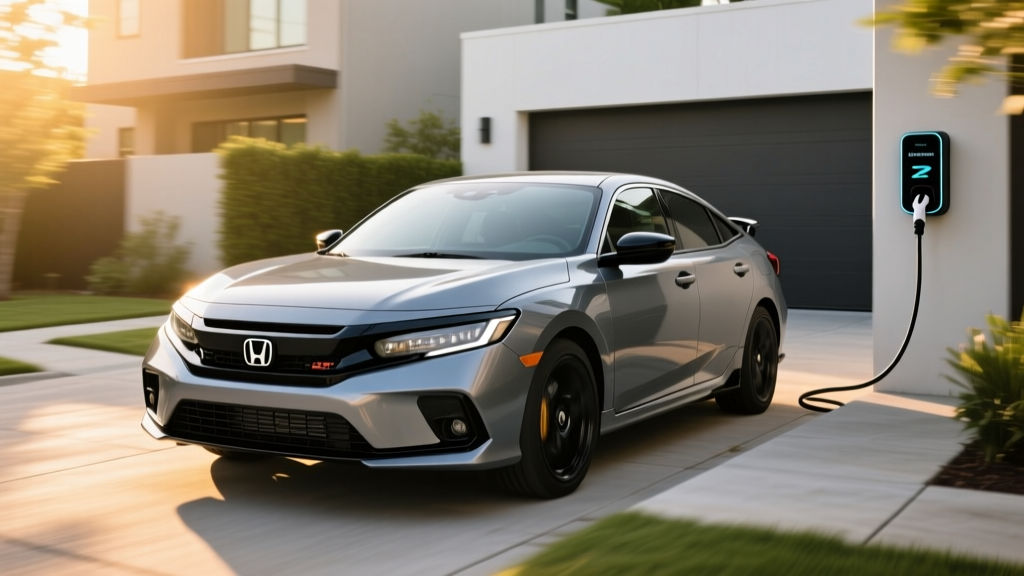
The 2026 Honda Civic Sport Hybrid occupies a specific niche: buyers who want electrified efficiency without plugging in, changing driving habits, or paying a battery-electric premium. Honda's two-motor hybrid system pairs a 2.0-liter Atkinson-cycle engine with a drive motor and a generator motor, delivering 181 combined horsepower and an EPA-estimated 49 MPG combined. This is a conventional hybrid (HEV), not a plug-in — it refuels only at the gas pump and charges its small battery through regenerative braking and engine operation.
For shoppers cross-referencing compact hybrids, the Civic Sport Hybrid competes directly with the Toyota Corolla Hybrid, Hyundai Elantra Hybrid, and Kia Niro. Here's the data you need to evaluate whether it fits your commute, budget, and ownership timeline.
Fuel Economy: EPA Ratings and Real-World MPG
The Civic Sport Hybrid's EPA figures place it among the most efficient non-plug-in compacts available. Honda's hybrid system operates primarily in electric-drive mode at low and moderate speeds, with the engine acting as a generator. At highway cruising speeds, a lock-up clutch connects the engine directly to the wheels for efficiency.
| Metric | EPA Estimate |
|---|---|
| City MPG | 50 MPG |
| Highway MPG | 47 MPG |
| Combined MPG | 49 MPG |
| Fuel Tank Capacity | 10.6 gallons |
| Total Range (est.) | ~519 miles |
Real-world expectation: Honda's two-motor hybrid system tends to meet or slightly exceed its EPA city estimate in stop-and-go traffic, where regenerative braking and electric-only low-speed operation shine. Highway driving at sustained 75-80 MPH typically yields 42-45 MPG — slightly below the EPA highway figure. Cold-weather operation (below 35°F) reduces efficiency by roughly 8-12% as the engine runs more frequently for cabin heat and battery thermal management. Owners who drive predominantly in urban and suburban conditions often report 48-52 MPG on the trip computer over a full tank, per aggregated owner data on fueleconomy.gov.
Powertrain: Two-Motor Hybrid System Specs
The Civic Sport Hybrid uses Honda's fourth-generation two-motor hybrid architecture. Unlike traditional parallel hybrids that blend engine and motor torque through a planetary gearset, Honda's system operates in three distinct modes: EV Drive (motor only, at low speeds), Hybrid Drive (engine spins the generator, which powers the drive motor), and Engine Drive (engine directly connected to wheels via clutch at highway cruising RPM).
| Component | Specification |
|---|---|
| Engine | 2.0L DOHC Atkinson-cycle 4-cylinder |
| Engine Power | 143 HP @ 6,000 RPM |
| Drive Motor Output | 181 HP / 232 lb-ft torque |
| Combined System Output | 181 HP |
| Transmission | Direct-drive (no traditional gearbox) |
| Drivetrain | Front-wheel drive |
| 0-60 MPH (est.) | ~7.5 seconds |
| Hybrid Battery | Lithium-ion, ~1.1 kWh (gross) |
The 181 HP combined output gives the Civic Sport Hybrid a meaningful acceleration advantage over most compact hybrid competitors. The electric drive motor's 232 lb-ft of torque is available from near-zero RPM, providing responsive off-the-line acceleration that conventional gas Civics can't match. The Sport trim also includes paddle-shift-mounted regen selectors, letting you choose from three levels of regenerative braking deceleration — though this is not full one-pedal driving as found in BEVs.
HEV vs PHEV vs EV: Which Powertrain Fits You?
The Civic Sport Hybrid is a conventional hybrid (HEV). It has no plug, no electric-only range to speak of (the small battery supports only brief low-speed electric assist), and requires zero behavioral change from a gas-car owner. Here's how it compares to the other electrified options:
No plug. Refuels at gas station only. Small battery (~1 kWh) charged by regen braking and engine. Best for: drivers without home charging access, those who want efficiency without lifestyle change, high-mileage commuters.
Has a plug and a larger battery (typically 12-20 kWh). Offers 25-45 miles of electric-only driving before the gas engine engages. Best for: drivers with home Level 2 charging who commute under 40 miles round-trip but want gas flexibility for road trips.
No gas engine. 200-350+ miles of range from a large battery (60-100+ kWh). Requires home or reliable public charging. Best for: drivers with home charging, shorter commutes, or those ready to eliminate gas entirely.
The Civic Sport Hybrid makes the most sense if you lack reliable access to Level 2 home charging (apartment dwellers, street parkers) or regularly drive 400+ miles between stops where charging infrastructure is sparse. If you have a garage with a 240V outlet and a sub-40-mile commute, a PHEV like the Toyota Prius Prime (44 miles electric-only) may save more fuel — but at a higher purchase price.
Pricing, Trims, and Tax Credit Eligibility
The 2026 Civic Sport Hybrid is offered in a single Sport Hybrid trim, positioned between the gas-only Sport and the Sport Touring Hybrid. Pricing reflects a modest premium over the gas Civic Sport, offset quickly by fuel savings.
| Trim | MSRP (incl. destination) |
|---|---|
| Civic Sport Hybrid | $30,650 |
| Civic Sport Touring Hybrid | $33,650 |
Battery Warranty, Longevity, and Replacement Cost
Hybrid battery longevity is a top concern for buyers, and Honda backs the Civic Sport Hybrid's lithium-ion pack with strong warranty coverage.
Honda covers the hybrid battery and all hybrid-system components (drive motor, generator motor, power control unit) for 8 years / 100,000 miles (10 years / 150,000 miles in CARB-emissions states including CA, CO, CT, DE, ME, MD, MA, NJ, NM, NY, OR, RI, VT, WA). If the battery degrades below a functional threshold during the warranty period, Honda replaces it at no cost.
Real-world longevity: Honda's hybrid systems have demonstrated strong durability. The two-motor architecture places less stress on the battery than older single-motor designs because the battery is smaller and operates in a narrower state-of-charge window (roughly 40-80% SoC), which minimizes degradation. Based on fleet data from earlier-generation Honda hybrids (Insight, Accord Hybrid), most hybrid batteries last 150,000-200,000+ miles before requiring replacement.
Out-of-warranty replacement cost: If the hybrid battery fails outside the warranty window, a replacement from Honda typically costs between $2,000 and $4,000 including parts and labor. Third-party refurbished hybrid battery packs are available for $1,200-$2,000. This is substantially less than BEV battery replacement ($8,000-$20,000+), reflecting the Civic Hybrid's much smaller battery capacity.
Reliability and Ownership Costs
The Civic platform carries a strong reliability reputation, and Honda's hybrid system adds fewer wear components than a conventional powertrain — there's no traditional automatic transmission (the direct-drive system has no bands, clutches, or torque converter to fail), and regenerative braking reduces wear on the friction brake pads and rotors.
Five-year fuel cost estimate: At 15,000 miles/year, 49 MPG combined, and $3.40/gallon regular unleaded, annual fuel cost is approximately $1,041. A comparable gas-only Civic Sport (33 MPG combined) would cost roughly $1,545/year — a savings of about $504 annually, or $2,520 over five years. That nearly covers the hybrid's MSRP premium over the gas model.
The Civic Sport Hybrid carries Honda's standard 3-year/36,000-mile bumper-to-bumper warranty and 5-year/60,000-mile powertrain warranty in addition to the 8-year hybrid-system coverage. Honda Sensing (adaptive cruise, lane-keeping, collision mitigation) is standard on all trims.
Pros and Cons
Pros
- 49 MPG combined EPA — top-tier for the compact segment
- 181 HP provides genuinely quick acceleration for a hybrid
- No plug required — zero lifestyle change from a gas car
- 8-year/100,000-mile hybrid battery warranty (10 yr in CARB states)
- Standard Honda Sensing ADAS suite
- Real-world city MPG often exceeds EPA estimate
Cons
- No federal tax credit eligibility (HEV, not PHEV/BEV)
- Highway MPG drops to low 40s at sustained 75-80 MPH
- FWD only — no AWD option (Toyota Corolla Hybrid offers AWD)
- Small battery means minimal electric-only operation
- Sport Hybrid trim only — limited interior color/material choices
Frequently Asked Questions
How many MPG does the Civic Sport Hybrid actually get?
The EPA rates it at 50 city / 47 highway / 49 combined. In real-world driving, city-heavy commutes often yield 48-52 MPG on the trip computer. Sustained highway driving at 75+ MPH typically returns 42-45 MPG. Cold weather (below 35°F) reduces efficiency by 8-12% due to increased engine operation for cabin heating.
Does the Civic Sport Hybrid need to be plugged in?
No. This is a conventional hybrid (HEV), not a plug-in hybrid. It charges its small lithium-ion battery through regenerative braking and the gasoline engine. You refuel only at the gas station, exactly like a standard Civic.
How far can it drive on electric power alone?
Essentially zero miles in any practical sense. The ~1.1 kWh battery supports very brief low-speed electric assist (under 1 mile at speeds below 25 MPH in stop-and-go traffic), but this is not usable electric-only range. If you want meaningful electric-only driving, look at a PHEV like the Toyota Prius Prime (44 miles EV range) or a full BEV.
Is the Civic Sport Hybrid reliable? What does battery replacement cost?
Honda's hybrid system has a strong reliability track record, and the Civic platform is one of the brand's most proven. The hybrid battery is warranted for 8 years/100,000 miles (10 years/150,000 miles in CARB states). Based on data from prior Honda hybrids, the battery typically lasts 150,000-200,000+ miles. Out-of-warranty replacement runs $2,000-$4,000 at a Honda dealer.
Does the Civic Sport Hybrid qualify for any tax credit?
It does not qualify for the federal IRS §30D New Clean Vehicle Credit, which requires plug-in capability and a minimum 7 kWh battery. Conventional hybrids are ineligible. Some states or municipalities offer smaller incentives for hybrids — check your local energy office. The IRS page on the clean vehicle credit details current eligibility requirements.
How does it compare to the Toyota Corolla Hybrid?
The Corolla Hybrid (50 MPG combined EPA) matches the Civic on efficiency but produces only 138 HP versus the Civic's 181 HP. The Corolla Hybrid offers available AWD; the Civic is FWD only. The Civic Sport Hybrid is slightly more expensive (~$30,650 vs ~$25,000 for the Corolla Hybrid LE) but offers a more powerful, engaging drive and a more premium interior. Both carry 8-year/100,000-mile hybrid warranties.
Should I get this hybrid or a full EV?
Choose the Civic Sport Hybrid if you lack reliable home Level 2 charging, frequently drive 400+ miles without stopping, live in an area with sparse public charging infrastructure, or want to minimize upfront cost. Choose a BEV if you have home charging, your daily driving is under 250 miles, you want to eliminate gas costs entirely, and you want to take advantage of the up-to-$7,500 federal tax credit on qualifying models.