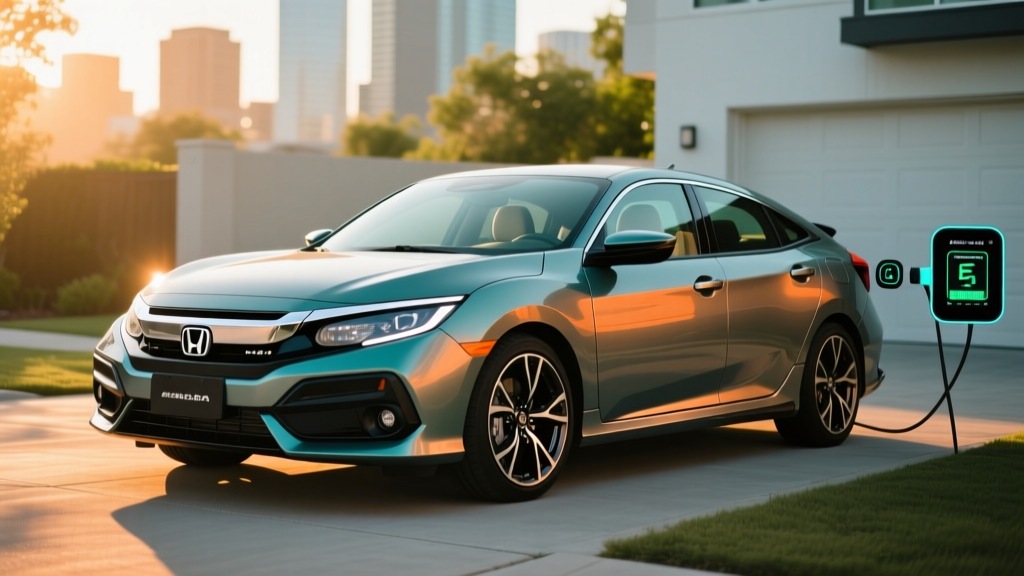
The 2026 Honda Civic Hybrid Sport Touring occupies a rare sweet spot in the compact segment: it delivers near-50 MPG without requiring you to plug in, sacrifice performance, or accept a penalty-box interior. With a combined 200 horsepower from its two-motor hybrid system, the Sport Touring trim is the range-topper — loaded with Honda Sensing, a 9-inch touchscreen, wireless Apple CarPlay and Android Auto, a Bose 12-speaker audio system, and leather-trimmed seats. But does the real-world fuel economy match the EPA sticker, and is a conventional hybrid (HEV) the right call over a plug-in hybrid or full EV? Here is every number you need to decide.
Quick Verdict: Who the Civic Hybrid Sport Touring Is For
The Civic Hybrid Sport Touring is built for buyers who want maximum fuel efficiency with zero lifestyle change. There is no plug, no range anxiety, no charging-app juggling. You fill up at any gas station and go. The tradeoff versus a full battery-electric vehicle (BEV) is that you still burn gasoline — roughly 2.0 gallons per 100 miles in mixed driving — and you miss out on the $7,500 federal EV tax credit. The tradeoff versus a PHEV is that there is no electric-only commute mode. If your priority is simplicity, low running costs, and a premium compact experience, this is one of the strongest choices on the market.
Fuel Economy: EPA Ratings vs. Real-World MPG
The EPA rates the 2026 Civic Hybrid sedan at 50 MPG city / 47 MPG highway / 49 MPG combined for the Sport and Sport Touring trims, according to fueleconomy.gov. That places it among the most efficient non-plug-in vehicles sold in the United States, trailing only the Toyota Prius and Hyundai Ioniq hybrid in the compact class.
| Cycle | EPA Rating | Real-World Expectation |
|---|---|---|
| City | 50 MPG | 50–55 MPG (hybrids often exceed EPA in stop-and-go) |
| Highway | 47 MPG | 42–46 MPG (sustained 75+ MPH reduces regen benefit) |
| Combined | 49 MPG | 46–52 MPG depending on commute mix and climate |
With a 12.4-gallon fuel tank, the real-world driving range sits between 570 and 645 miles per fill-up depending on your driving mix — enough for most drivers to visit a gas station once every two to three weeks.
Powertrain Specs: 200 HP Two-Motor Hybrid System
Honda's fourth-generation two-motor hybrid system pairs a 2.0-liter direct-injected Atkinson-cycle four-cylinder engine with two electric motors and a lithium-ion battery pack. Unlike some competitors that use a traditional planetary gearset, Honda's system can operate in three modes: EV Drive (battery to motor), Hybrid Drive (engine generates electricity for the motor), and Engine Drive (engine directly connected to the wheels via a lock-up clutch at highway speeds).
| Specification | Value |
|---|---|
| Engine | 2.0L DOHC Atkinson-cycle 4-cylinder |
| Engine Power | 146 HP @ 6,000 RPM |
| Engine Torque | 134 lb-ft @ 4,500 RPM |
| Electric Motor Output | 184 HP / 232 lb-ft |
| Combined System Output | 200 HP / 232 lb-ft |
| Transmission | e-CVT (single-speed direct drive with lock-up clutch) |
| Drivetrain | Front-wheel drive |
| 0–60 MPH | ~7.3 seconds (estimated) |
| Hybrid Battery Type | Lithium-ion (sealed, non-plug-in) |
| Battery Capacity | ~1.1 kWh (small buffer for HEV regen/assist) |
| Curb Weight | ~3,100 lbs |
The 200 combined horsepower gives the Civic Hybrid a meaningful edge over the Toyota Prius (194 HP AWD / 196 HP FWD) and the Hyundai Elantra Hybrid (139 HP). In practice, the instant electric-motor torque makes the Civic Hybrid feel punchy around town, and highway passing is confident — a welcome change from the drone-heavy CVT experience of earlier Honda hybrids.
HEV vs. PHEV vs. Full EV: Which Powertrain Fits You?
The Civic Hybrid is a conventional hybrid (HEV) — it charges its small battery exclusively through regenerative braking and the gasoline engine. You never plug it in. This is fundamentally different from a plug-in hybrid (PHEV) like the Toyota Prius Prime, which has a larger battery you charge from a wall outlet for 30–45 miles of electric-only driving, or a full battery-electric vehicle (BEV) like the Chevrolet Equus EV or Tesla Model 3.
| Factor | HEV (Civic Hybrid) | PHEV (e.g., Prius Prime) | BEV (e.g., Model 3) |
|---|---|---|---|
| Plug-in Required? | No | Yes (for EV mode benefit) | Yes (always) |
| Electric-Only Range | ~1 mile at low speed | 30–45 miles | 250–360 miles |
| Total Range | ~570–645 miles | ~400–500 miles combined | 250–360 miles |
| Fuel/Energy Cost per Mile | ~$0.08–$0.10 | ~$0.04 (EV mode) / $0.09 (gas) | ~$0.03–$0.06 |
| Federal Tax Credit (§30D) | Not eligible | Up to $7,500 (if eligible) | Up to $7,500 (if eligible) |
| Home Charging Needed? | No | Recommended (Level 2) | Essential (Level 2) |
| Best For | No home charging; simplicity | Short EV commute + road trips | Home charging + lowest running cost |
- You lack access to home or workplace charging
- You want zero change to your refueling habits
- Your annual mileage is moderate (10,000–15,000 miles) and gas savings alone justify the hybrid premium
- You frequently drive long highway trips where PHEV electric range adds little value
- You have home Level 2 charging and a commute under 40 miles round-trip
- You want electric-only daily driving but gas backup for road trips
- You have reliable home charging and want the lowest per-mile energy cost
- You qualify for the full $7,500 federal tax credit and want to eliminate gasoline entirely
Pricing, Trims, and Tax Credit Eligibility
The 2026 Honda Civic Hybrid Sport Touring sedan carries an MSRP of approximately $32,350 (including destination charge). This is the top-of-the-line Civic Hybrid trim and includes features not available on the Sport trim: leather-trimmed seats, a power-adjustable driver's seat, Bose 12-speaker premium audio, a wireless phone charger, heated rear seats, and low-speed braking control.
| Trim | MSRP (incl. destination) | Key Additions Over Base Hybrid |
|---|---|---|
| Sport | ~$29,850 | Hybrid powertrain, 9-inch touchscreen, Honda Sensing |
| Sport Touring | ~$32,350 | Leather, Bose audio, wireless charging, heated rear seats, navigation |
Federal Tax Credit Status
The Civic Hybrid is a conventional hybrid (HEV), not a plug-in. Under current IRS §30D rules, the federal clean vehicle credit applies only to plug-in electric vehicles (PHEVs and BEVs) with a battery capacity of at least 7 kWh. The Civic Hybrid's ~1.1 kWh battery does not qualify. There is no federal tax credit for conventional hybrids as of the 2026 tax year. For the latest rules on plug-in vehicle credits, see IRS.gov Clean Vehicle Tax Credits.
Some states offer their own hybrid or efficient-vehicle rebates, but these vary widely by jurisdiction and change frequently. Check your state's energy office or DMV for current programs.
Battery Warranty, Reliability, and Replacement Cost
Hybrid battery longevity is consistently the top concern for first-time hybrid buyers. Honda backs the Civic Hybrid's lithium-ion battery pack and all hybrid-system components with a comprehensive warranty.
- Hybrid Battery: 8 years / 100,000 miles (10 years / 150,000 miles in CARB states including CA, NY, MA, and others)
- Hybrid System Components: 8 years / 100,000 miles
- Powertrain Warranty: 5 years / 60,000 miles
- Limited Vehicle Warranty: 3 years / 36,000 miles
Real-World Reliability
Honda's hybrid systems have accumulated over two decades of field data, starting with the original Insight and continuing through multiple generations of Accord, CR-V, and Civic hybrids. Third-generation systems in the 2014–2020 Accord Hybrid demonstrated excellent long-term durability, with battery failures before 150,000 miles being uncommon. The fourth-generation system in the 2026 Civic is more compact and uses improved cell chemistry, but long-term data is still accumulating.
For context, Toyota's Prius hybrid batteries routinely last 200,000+ miles, and Honda's track record is comparable in most owner surveys. The smaller battery in an HEV undergoes shallower charge-discharge cycles than a PHEV or BEV, which generally favors longevity.
Battery Replacement Cost
If the hybrid battery does fail outside of warranty, expect a dealer replacement to cost between $2,000 and $4,000 including labor, based on current Honda hybrid battery pricing. Independent hybrid-specialist shops may offer refurbished or reconditioned battery packs for $1,500–$2,500. Given the 8-to-10-year warranty coverage, most original owners will never face this cost.
Safety, Tech, and Daily Livability
The Sport Touring trim comes standard with the full Honda Sensing suite: adaptive cruise control with low-speed follow, lane-keeping assist, road-departure mitigation, collision mitigation braking, traffic-sign recognition, and traffic-jam assist. These are SAE Level 2 driver-assistance features — the driver must remain attentive and keep hands on the wheel at all times.
The 9-inch touchscreen with wireless Apple CarPlay and Android Auto is responsive, and the physical volume knob is a welcome ergonomic choice. The Bose 12-speaker system is a meaningful upgrade over the base audio, and the heated and ventilated front seats (standard on Sport Touring) add year-round comfort.
Cargo space in the Civic Hybrid sedan is approximately 14.8 cubic feet — competitive with the segment and only slightly reduced from the non-hybrid Civic due to the battery's placement under the rear seats. The rear seats do not fold flat in the Hybrid due to the battery position, which is worth noting if you regularly haul long cargo.
The NHTSA and IIHS historically rate the Civic highly; check their sites for the latest 2026 crash-test results as they are released.
Pros and Cons at a Glance
- 49 MPG combined EPA — among the best non-PHEV numbers available
- 200 HP feels genuinely quick for a 49-MPG car
- No plug-in or charging infrastructure required
- Sport Touring trim is well-equipped: Bose, leather, wireless CarPlay
- 8–10 year hybrid battery warranty provides peace of mind
- 570+ mile real-world range per tank
- Honda Sensing safety suite is standard on all trims
- No federal tax credit (HEV, not PHEV/BEV)
- ~$32,350 MSRP is premium for a compact sedan
- Highway MPG drops to 42–44 at sustained 75+ MPH
- Rear seats do not fold flat (battery placement)
- No all-wheel-drive option (unlike Toyota Prius AWD)
- Cold-weather efficiency loss of 5–10%
Frequently Asked Questions
How many MPG does the 2026 Civic Hybrid Sport Touring get?
The EPA rates it at 50 MPG city, 47 MPG highway, and 49 MPG combined. In real-world driving, city commuters often see 50–55 MPG, while highway-heavy driving at 75+ MPH yields 42–46 MPG.
Do I need to plug in the Civic Hybrid to charge it?
No. The Civic Hybrid is a conventional hybrid (HEV). The battery charges through regenerative braking and the gasoline engine. You simply fill up at any gas station as you would with a regular car.
Does the Civic Hybrid qualify for any tax credit?
No. The federal §30D clean vehicle credit applies only to plug-in vehicles (PHEVs and BEVs) with at least 7 kWh of battery capacity. The Civic Hybrid's ~1.1 kWh battery does not qualify. Some state-level incentives may apply — check your local programs.
How reliable is the Civic Hybrid battery?
Honda backs the hybrid battery with an 8-year/100,000-mile warranty (10 years/150,000 miles in CARB states). Honda's hybrid systems have demonstrated strong long-term durability across multiple model lines. Replacement cost outside of warranty is typically $2,000–$4,000, but most owners will never need it.
Should I get the Civic Hybrid or a full EV like the Tesla Model 3?
If you have reliable home charging, drive under 300 miles daily, and qualify for the $7,500 federal EV tax credit, a BEV will cost less per mile to operate. If you lack home charging, frequently take long road trips, or want zero change to your refueling routine, the Civic Hybrid is the more practical choice.
Is the Civic Hybrid Sport Touring worth the premium over the Sport trim?
The $2,500 step up to Sport Touring adds leather seats, Bose premium audio, wireless phone charging, heated rear seats, navigation, and low-speed braking control. If you plan to keep the car 5+ years, the added comfort and features justify the cost. Budget-focused buyers will find the Sport trim well-equipped at ~$29,850.
How does the Civic Hybrid compare to the Toyota Prius?
The Prius achieves slightly higher EPA ratings (up to 57 MPG combined on the LE trim) and offers available all-wheel drive. The Civic Hybrid counters with more horsepower (200 vs. 194/196 HP), a more upscale Sport Touring interior, and arguably better driving dynamics. Both are excellent choices — the decision often comes down to whether you prioritize maximum MPG (Prius) or premium feel and performance (Civic Hybrid Sport Touring).