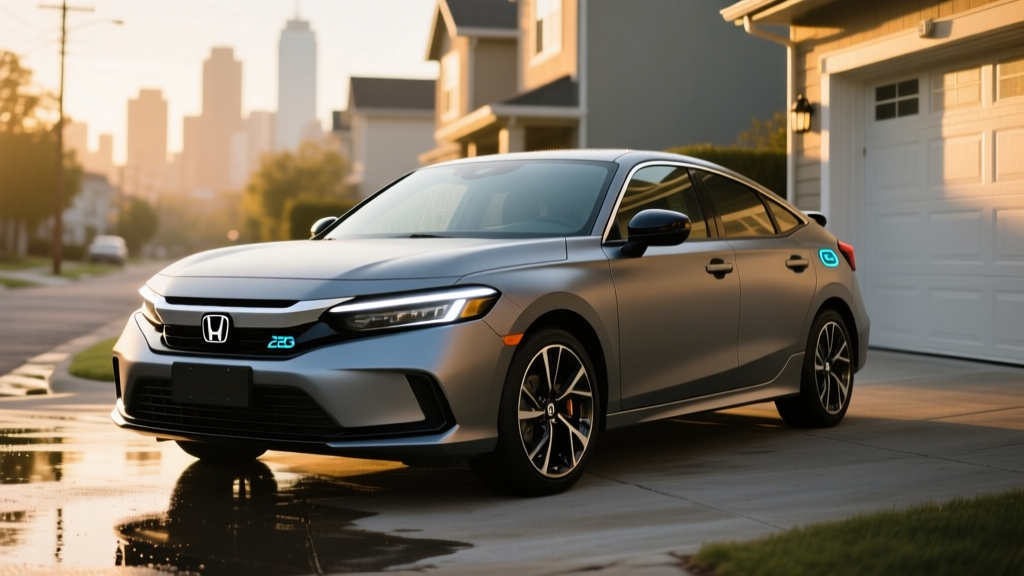
The Honda Civic Hatchback Hybrid pairs one of the most practical compact hatches on the market with a two-motor hybrid system that pushes EPA ratings past 50 MPG combined. For 2026, it continues as a conventional hybrid (HEV) — no plug required — making it a compelling choice for drivers who want EV-like city efficiency without altering their fueling habits.
This guide covers the 2026 Civic Hatchback Hybrid's powertrain, real-world MPG behavior, battery longevity, pricing, and where it fits against plug-in hybrids and full battery-electric vehicles.
How the Civic Hatchback Hybrid Works: HEV, Not PHEV
The Civic Hatchback Hybrid is a conventional hybrid (HEV). It has a small lithium-ion battery pack that recharges through regenerative braking and the gasoline engine — you never plug it in. This is fundamentally different from a plug-in hybrid (PHEV) like the Toyota Prius Prime, which offers 30–40 miles of electric-only driving before the engine kicks in.
HEV vs PHEV: Key Differences
| Feature | Civic Hatchback Hybrid (HEV) | PHEV Example (e.g., Prius Prime) |
|---|---|---|
| Plug-in charging | No — self-charging | Yes — Level 1/2 plug-in |
| Electric-only range | ~1 mile at low speeds | 30–45 miles (model dependent) |
| Battery size | ~1.0 kWh (nominal) | 13–18 kWh typical |
| Home charger needed | No | Recommended for full benefit |
| Federal tax credit (§30D) | Not eligible | Up to $7,500 (if eligible) |
| Best for | No home charging access; want simplicity | Home charging + short daily commutes |
Honda's two-motor hybrid system in the Civic Hatchback operates primarily in EV mode at low and moderate speeds, with the gasoline engine acting as a generator. At highway speeds, a lock-up clutch connects the engine directly to the wheels for efficiency. This architecture mimics EV driving feel in city traffic while avoiding range anxiety entirely.
Fuel Economy: EPA Ratings and Real-World MPG
The 2026 Civic Hatchback Hybrid carries EPA estimates that place it among the most efficient non-plug-in compacts available. According to fueleconomy.gov, the ratings break down as follows:
| Driving Cycle | EPA Estimate | Real-World Expectation |
|---|---|---|
| City | 50 MPG | 50–55 MPG (hybrids often exceed EPA in stop-and-go) |
| Highway | 47 MPG | 42–46 MPG (sustained 70+ mph reduces regen benefit) |
| Combined | 49 MPG | 46–52 MPG depending on driving mix |
Hybrids like the Civic tend to beat their EPA city rating in real-world driving because regenerative braking recovers energy that a gas car wastes as heat. Conversely, highway MPG often falls slightly below the EPA sticker since sustained high-speed driving limits the hybrid system's advantage. On a 200-mile mixed-terrain road trip at 75 mph, expect roughly 43–45 MPG. In urban commuting with frequent stops, 52+ MPG is achievable, especially in mild weather.
Cold weather reduces efficiency by roughly 5–10% as the engine runs more often to provide cabin heat and maintain battery temperature. This penalty is far smaller than the 20–35% range loss a full EV experiences in freezing conditions.
Powertrain Specs: Two-Motor Hybrid System
The Civic Hatchback Hybrid uses Honda's fourth-generation two-motor hybrid system, pairing a 2.0-liter Atkinson-cycle four-cylinder engine with two electric motors integrated into the transmission housing.
| Specification | 2026 Civic Hatchback Hybrid |
|---|---|
| Engine | 2.0L DOHC Atkinson-cycle 4-cylinder |
| Engine output | 143 hp / 134 lb-ft torque |
| Drive motor output | 184 hp / 232 lb-ft torque |
| Combined system output | 200 hp / 232 lb-ft torque |
| Transmission | Direct-drive (no traditional gearbox) |
| Drivetrain | Front-wheel drive |
| 0–60 mph | ~7.4 seconds |
| Hybrid battery | Lithium-ion, ~1.0 kWh nominal |
| Cargo volume (rear seats up) | 24.5 cu ft |
| Cargo volume (rear seats folded) | 46.2 cu ft |
The 200 combined horsepower puts the Civic Hatchback Hybrid ahead of most competing compact hybrids and close to sporty gas-only hot hatches. The electric motor's 232 lb-ft of torque is available instantly from a stop, giving it punchy acceleration in city driving that belies its efficiency focus.
Pricing, Trims, and Tax Credit Eligibility
The 2026 Civic Hatchback Hybrid is available across multiple trims. Pricing starts in the low $30,000s before destination:
- Sport Hybrid: ~$30,950 MSRP (plus destination)
- Sport Touring Hybrid: ~$34,950 MSRP (plus destination)
The Sport Touring trim adds leather-trimmed seats, Bose premium audio, wireless phone charging, a 9-inch touchscreen with wireless Apple CarPlay/Android Auto, and Honda Sensing suite with low-speed braking control and traffic jam assist.
Federal Tax Credit Status
The Civic Hatchback Hybrid does not qualify for the federal §30D clean vehicle tax credit (up to $7,500). Under current IRS rules, the §30D credit applies only to plug-in electric vehicles (BEVs and PHEVs) with battery capacities of at least 7 kWh and meeting critical-mineral and battery-component sourcing requirements. Conventional hybrids like this Civic do not meet the plug-in threshold.
Some states offer their own hybrid incentives or HOV lane access for efficient vehicles — check your state's energy office or DMV for current programs. These vary by jurisdiction and change frequently.
Hybrid Battery Warranty, Lifespan, and Replacement Cost
Battery longevity is consistently a top concern for hybrid buyers. Honda backs the Civic Hatchback Hybrid's battery with robust coverage:
Battery & Hybrid System Warranty
- Hybrid battery warranty: 8 years / 100,000 miles (10 years / 150,000 miles in CARB states including CA, CT, ME, MA, NJ, NY, OR, RI, VT, WA)
- Hybrid system components: 8 years / 100,000 miles
- Capacity retention threshold: Warranty covers failure or significant capacity loss below functional thresholds
Real-world data from Honda's hybrid fleet (Insight, Accord Hybrid, CR-V Hybrid) shows that the lithium-ion packs typically last well beyond the warranty period. Many Honda hybrids from the 2010s are still running on original batteries at 150,000+ miles. The Civic's relatively small ~1.0 kWh pack undergoes shallow charge/discharge cycles — it rarely drops below 40% or above 80% state of charge — which is the gentlest usage pattern for lithium-ion chemistry.
If replacement is needed out of warranty, a Civic Hatchback Hybrid battery pack costs approximately $2,000–$3,500 for the part, plus $500–$800 in labor, based on current Honda hybrid service pricing. This is dramatically lower than full EV battery replacements ($5,000–$20,000) because the pack is small. Refurbished and aftermarket options are increasingly available for older Honda hybrids at lower cost.
Who Should Buy the Civic Hatchback Hybrid?
Choose the Civic Hatchback Hybrid If:
- You lack access to home or workplace charging (apartment, street parking)
- You want 45–50+ MPG without changing your fueling routine
- You need hatchback cargo versatility (24.5 cu ft behind rear seats)
- You want a responsive, 200-hp powertrain that doesn't feel like an eco-compromise
- You plan to keep the car 8–12 years and want proven Honda reliability
Consider a PHEV Instead If:
- You have Level 2 home charging and a commute under 35 miles
- You want to drive most days on electricity alone with gas backup
- You want eligibility for the $7,500 federal §30D tax credit
Consider a Full EV Instead If:
- You have reliable home Level 2 charging
- Your daily driving is under 250 miles and you rarely road-trip beyond charger coverage
- You want zero tailpipe emissions and the lowest per-mile fuel cost
The Civic Hatchback Hybrid occupies a specific niche: maximum fuel efficiency with zero lifestyle compromise. No charging cords, no range planning, no cold-weather anxiety — just fill up at any gas station and go, while spending roughly 40% less on fuel than a comparable gas-only Civic.
Pros and Cons at a Glance
Pros
- 49 MPG EPA combined; often exceeds 50 MPG in city driving
- 200 hp with instant electric torque — genuinely quick off the line
- 24.5 cu ft cargo space with hatchback utility
- No plug-in charging required — works with existing habits
- Honda Sensing ADAS suite standard on all trims
- 8-year/100,000-mile hybrid battery warranty (10/150k in CARB states)
- Lower battery replacement cost than PHEVs or BEVs ($2,000–$3,500)
Cons
- No federal tax credit eligibility (HEV, not PHEV)
- Highway MPG drops to low-to-mid 40s at sustained 75+ mph
- No all-wheel-drive option (FWD only)
- Only ~1 mile of electric-only driving at low speeds
- Sport Touring trim pushes price near $35,000 before options
Frequently Asked Questions
How many MPG does the 2026 Civic Hatchback Hybrid get?
The EPA rates it at 50 city / 47 highway / 49 combined MPG. In real-world city driving with frequent stops, owners commonly see 50–55 MPG thanks to regenerative braking. Highway driving at sustained speeds typically yields 42–46 MPG.
Does the Civic Hatchback Hybrid need to be plugged in?
No. It is a conventional hybrid (HEV), not a plug-in hybrid (PHEV). The battery recharges through regenerative braking and the gasoline engine. You fuel it exclusively at gas stations.
How far can it drive on electric power alone?
Approximately 1 mile at very low speeds (under 30 mph) in EV mode. The battery is too small (~1.0 kWh) for meaningful electric-only range. The system uses electric drive primarily to assist the engine and enable engine-off coasting, not to replace gasoline entirely.
Is the Civic Hatchback Hybrid reliable?
Honda's hybrid systems have an extensive track record across the Accord Hybrid, CR-V Hybrid, and discontinued Insight. The two-motor architecture has fewer moving parts than a conventional automatic transmission. The hybrid battery carries an 8-year/100,000-mile warranty (extended in CARB states), and real-world data shows most Honda hybrid batteries last 150,000+ miles without replacement.
What does a hybrid battery replacement cost?
Out-of-warranty replacement for the Civic Hatchback Hybrid's lithium-ion pack runs approximately $2,000–$3,500 for the part plus $500–$800 labor. The small pack size keeps costs far below EV or PHEV battery replacements. Refurbished options may reduce this further.
Does the Civic Hatchback Hybrid qualify for any tax credit?
It does not qualify for the federal §30D clean vehicle credit, which requires plug-in capability and a minimum 7 kWh battery. Some states offer separate incentives for high-efficiency vehicles — check your state energy office for current programs.
How does it compare to the Toyota Prius?
The Prius (liftback, not hatchback) achieves up to 57 MPG combined EPA but produces less power (196 hp for AWD, 194 hp FWD). The Civic Hatchback Hybrid trades a few MPG for more cargo space (24.5 vs 23.8 cu ft), a more conventional driving feel, and Honda's infotainment ecosystem. The Prius Prime PHEV offers 40+ miles of electric-only range if you have home charging.
Fuel economy figures sourced from fueleconomy.gov. Tax credit rules per IRS §30D guidelines — eligibility varies by buyer income, vehicle sourcing, and current-year rules. Always confirm with a tax professional. MSRP figures are approximate and subject to change; verify with Honda's official site or a local dealer.