Quick Verdict: A Luxury PHEV That Actually Replaces Most Daily Driving on Electric
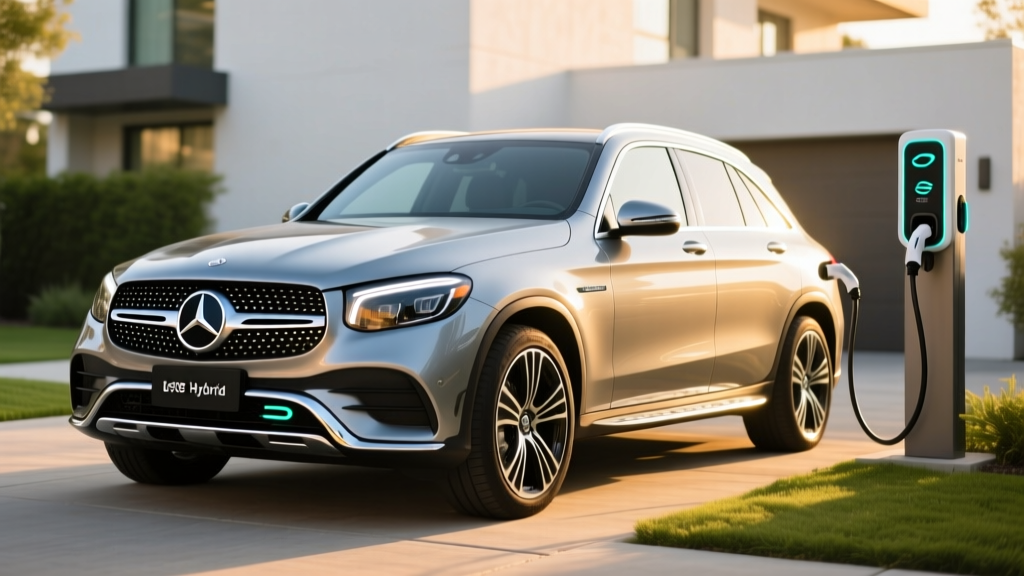
The 2026 Mercedes-Benz GLC 350e is not a conventional hybrid. It is a plug-in hybrid electric vehicle (PHEV) with one of the largest battery packs in the luxury compact SUV segment — a 31.2 kWh lithium-ion unit that delivers an EPA-estimated 54 miles of electric-only range. For most commuters, that means zero gasoline on weekdays, with the 2.0-liter turbocharged four-cylinder engine standing by for road trips and longer hauls.
At a starting MSRP of approximately $60,550 (including destination), the GLC 350e sits in a narrow lane: pricier than mainstream PHEVs like the Toyota RAV4 Prime, but offering the cabin refinement, MBUX tech suite, and ride quality that justify the Mercedes badge. The question is whether the electric range, charging practicality, and ownership economics hold up under scrutiny.
2026 Mercedes-Benz GLC 350e Key Specifications
| Spec | Value |
|---|---|
| Powertrain | 2.0L turbo I4 + permanent-magnet electric motor (PHEV) |
| Combined System Output | 312 hp / 406 lb-ft torque |
| Battery (Usable) | 31.2 kWh lithium-ion |
| EPA Electric-Only Range | 54 miles |
| EPA MPGe (Electric + Gas) | 56 MPGe combined |
| EPA MPG (Gas Only, Charge-Sustaining) | 25 city / 28 hwy / 26 combined |
| Total Combined Range | ~440 miles |
| 0–60 mph | 6.2 seconds |
| Onboard Charger (Level 2) | 9.6 kW (AC) |
| DC Fast Charging | Not available |
| Level 2 Charge Time (0–100%) | ~3.5 hours at 9.6 kW |
| Drivetrain | 4MATIC all-wheel drive |
| Cargo Volume | 21.9 cu ft (rear seats up) / 56.3 cu ft (folded) |
| Starting MSRP | ~$60,550 (incl. destination) |
| Battery / Hybrid System Warranty | 6 years / 62,000 miles |
HEV vs. PHEV: Where the GLC 350e Fits
Buyers often conflate hybrid types. Here is the critical distinction:
| Feature | Conventional Hybrid (HEV) | Plug-In Hybrid (PHEV) — GLC 350e | Battery Electric (BEV) |
|---|---|---|---|
| Plugs in? | No — self-charging via regen & engine | Yes — Level 1 or Level 2 AC | Yes — Level 1, 2, or DC fast |
| Electric-only range | 0–2 miles at low speed | 54 miles (EPA) | 200–400+ miles |
| Gas engine? | Yes — always available | Yes — kicks in when battery depletes or under heavy load | No |
| Tailpipe emissions (electric mode) | N/A (always burns fuel) | Zero in EV mode | Zero |
| Typical battery size | 1–2 kWh | 15–35 kWh | 60–120 kWh |
| Best for | No home charging access | Home charging + road-trip flexibility | Full electric commitment |
The GLC 350e is firmly a PHEV. You can drive it without ever plugging in — the gas engine and regenerative braking will keep it running like a heavy conventional hybrid. But doing so forfeits its biggest advantage: 54 miles of silent, zero-emission commuting at a per-mile energy cost roughly one-third that of gasoline.
Electric-Only Range and Efficiency: What to Expect in the Real World
The EPA rates the 2026 GLC 350e at 54 miles of electric-only range and 56 MPGe combined when operating in blended electric-gas mode. According to fueleconomy.gov, the gas-only (charge-sustaining) figure is 26 MPG combined (25 city / 28 highway).
Real-World Range Reality Check
EPA electric range: 54 miles
Expect in warm weather, mixed driving: 45–52 miles
Expect in cold weather (below 35°F): 35–42 miles (battery chemistry loses efficiency; cabin heating draws heavily from the pack)
Highway-only at 75+ mph: ~38–44 miles (higher aerodynamic drag depletes the battery faster)
The 31.2 kWh usable capacity is generous for a PHEV, but the GLC 350e is also a ~4,700 lb luxury SUV. Efficiency drops predictably at highway speeds and in winter conditions.
In daily use, owners with a home Level 2 charger and a sub-40-mile round-trip commute will rarely visit a gas station outside of road trips. One owner pattern we see consistently: plug in overnight, drive 30–45 miles on electricity all week, fill the 16.9-gallon tank once a month or less.
Charging: Level 2 at Home, No DC Fast Charging
The GLC 350e comes equipped with a 9.6 kW onboard AC charger and a J1772 connector (the North American standard for Level 1 and Level 2 AC charging). Here is the important limitation: there is no DC fast-charging capability. You cannot use CCS or NACS DC fast chargers to replenish the battery quickly on a road trip.
| Charging Level | Power | 0–100% Time | Miles of EV Range Added Per Hour |
|---|---|---|---|
| Level 1 (120V household outlet) | ~1.4 kW | ~22 hours | ~4–5 miles/hr |
| Level 2 (240V, 40A circuit) | 9.6 kW (max onboard) | ~3.5 hours | ~15–18 miles/hr |
| DC Fast Charge | Not supported | N/A | N/A |
For a PHEV with 54 miles of range, the lack of DC fast charging is a minor practical issue. The battery recharges fully overnight on any Level 2 home charger, and you can top up at public Level 2 stations (grocery stores, workplaces, parking garages) during the day. On road trips, the gas engine takes over seamlessly — there is no need to hunt for a fast charger.
Home charging setup: A Level 2 wallbox (such as a ChargePoint Home Flex or Emporia Vue) installed on a 240V/50A circuit by a licensed electrician typically costs $800–$2,000 including equipment and labor, depending on your panel capacity and run length. This is the single best investment for any PHEV owner.
Powertrain and Performance
The GLC 350e pairs a 2.0-liter turbocharged inline-four (producing approximately 215 hp on its own) with a 134-hp permanent-magnet electric motor integrated into the transmission housing. Combined system output is 312 horsepower and 406 lb-ft of torque, routed through a 9-speed automatic and Mercedes' 4MATIC all-wheel-drive system.
The result is a 0–60 mph time of 6.2 seconds — brisk for a compact luxury SUV and noticeably quicker than the gas-only GLC 300 (6.8 seconds). The electric motor fills in the torque gap before the turbo spools, making acceleration feel immediate from a stop.
Driving modes include Electric, Hybrid, and Battery Hold. In Electric mode, the gas engine stays dormant unless you floor the accelerator or deplete the pack. Hybrid mode blends both sources intelligently. Battery Hold preserves your state of charge for later — useful when entering a city center after a highway stretch.
Pricing, Tax Credits, and Ownership Economics
The 2026 GLC 350e starts at approximately $60,550 (MSRP including destination). The Exclusive and Pinnacle trim levels add $3,000–$6,500 respectively, pushing well-equipped examples past $70,000 with options.
Federal Tax Credit Eligibility (§30D — 2026 Rules)
Under the Inflation Reduction Act, the GLC 350e's PHEV powertrain may qualify for a partial or full federal tax credit of up to $7,500, but eligibility depends on several factors that change frequently:
- MSRP cap: SUVs must have an MSRP at or below $80,000 — the GLC 350e clears this in most trims.
- Buyer income cap: Modified AGI must not exceed $150,000 (single) / $300,000 (joint filing).
- Battery sourcing: The credit splits into two $3,750 halves — one for critical-minerals sourcing, one for battery-component manufacturing. Mercedes-Benz's supply-chain compliance varies by model year and production batch.
- Point-of-sale transfer: As of 2024, eligible buyers can transfer the credit to the dealer for an upfront price reduction rather than waiting until tax filing.
Always verify current eligibility on the IRS clean vehicle credit page and confirm with your tax professional before purchase. State and local incentives may stack on top — check AFDC's incentive database for your jurisdiction.
Total cost of ownership: If you charge at home and commute within the 54-mile electric window, your per-mile fuel cost drops to roughly $0.04–$0.06/mile (at $0.14/kWh national average electricity), versus $0.16–$0.20/mile for a comparable gas-only GLC 300 at $3.50/gallon. Over five years and 75,000 miles, that is $6,000–$9,000 in fuel savings — partially offsetting the GLC 350e's premium over the GLC 300.
Reliability, Battery Warranty, and Replacement Cost
Mercedes-Benz Hybrid Battery Warranty
Coverage: 6 years or 62,000 miles (whichever comes first) for the high-voltage battery and hybrid system components.
Capacity threshold: Mercedes warrants the battery against defects and excessive capacity loss (typically defined as falling below 70% of original capacity, though confirm exact terms in your warranty booklet).
Out-of-warranty replacement estimate: $8,000–$14,000 for the high-voltage battery pack, plus labor. This is a significant sum, though PHEV batteries rarely require full replacement within the first 10–12 years based on degradation data from similar Mercedes PHEV architectures.
Mercedes-Benz's PHEV systems have been in production since the mid-2010s (starting with the S 500 Plug-In Hybrid and C 350e), and the technology is now in its third generation. Real-world degradation on the 31.2 kWh pack is expected to be modest — roughly 10–15% capacity loss over 100,000 miles based on industry data for liquid-cooled NMC cells in PHEV duty cycles.
To maximize battery longevity:
- Avoid routinely charging to 100% and leaving the vehicle parked in extreme heat. The GLC 350e's battery management system includes thermal conditioning, but ambient heat stress is cumulative.
- Use the built-in charge-limit settings (if available in MBUX) to cap daily charging at 80–90%.
- Precondition the cabin while still plugged in during winter to reduce cold-weather battery drain.
Who Should Buy the GLC 350e — and Who Should Look Elsewhere
Choose the GLC 350e PHEV if:
- You have home Level 2 charging and a daily commute under 50 miles — you'll drive on electricity most days.
- You want a luxury compact SUV but aren't ready to commit to a full BEV due to road-trip habits or charging-infrastructure gaps in your area.
- You value the 4MATIC AWD system, MBUX infotainment, and Mercedes cabin quality over maximum fuel savings.
- You want to reduce (not eliminate) your gasoline consumption and tailpipe emissions.
Choose a full BEV (like the Mercedes EQB or Tesla Model Y) if:
- You want zero gasoline use, zero oil changes, and minimal powertrain maintenance.
- Your daily driving regularly exceeds 54 miles and you want 250+ miles of range without an engine.
- You want access to DC fast charging for road trips.
Choose a conventional HEV (like the Lexus NX 350h) if:
- You cannot install a home charger and have no reliable access to Level 2 charging.
- You want hybrid fuel savings with no behavioral change — no plugging in, no charge management.
Pros
- 54-mile EPA electric range is among the best in the luxury PHEV segment
- 312 hp combined output provides confident acceleration (6.2s 0–60)
- Quiet, refined cabin with MBUX and available Burmester audio
- No range anxiety — gas engine covers unlimited distance
- Significant per-mile fuel savings when charged regularly
Cons
- No DC fast-charging capability
- Starting MSRP above $60,000; well-optioned examples exceed $70K
- Battery warranty (6 yr/62K mi) is shorter than some competitors' 8–10 year coverage
- Cargo floor is slightly raised vs. gas GLC due to battery placement
- Tax credit eligibility is not guaranteed — depends on sourcing rules and buyer income
Frequently Asked Questions
How many MPG does the Mercedes GLC 350e hybrid get?
The EPA rates the 2026 GLC 350e at 56 MPGe combined when using both electric and gas power. Once the battery is depleted and the vehicle operates on gasoline alone, it returns an EPA-estimated 26 MPG combined (25 city / 28 highway). Real-world gas-only MPG on highway trips typically lands between 24–28 MPG depending on speed and terrain.
How far can the GLC 350e go on electric only?
The EPA estimates 54 miles of electric-only range from the 31.2 kWh battery. In warm weather with mixed city/suburban driving, expect 45–52 real-world miles. In cold weather (below 35°F) or sustained highway driving above 70 mph, that drops to 35–44 miles. For a daily commute under 40 miles round-trip, most owners will rarely use gasoline on weekdays.
Is the GLC 350e a hybrid or a plug-in hybrid?
It is a plug-in hybrid (PHEV), not a conventional hybrid (HEV). You can plug it in to charge the 31.2 kWh battery and drive up to 54 miles on electricity alone. A conventional hybrid like the Lexus NX 350h cannot plug in and offers only 1–2 miles of low-speed electric assist. The GLC 350e can also operate without plugging in, but you forfeit most of its efficiency advantage.
Does the Mercedes GLC 350e qualify for a federal tax credit?
It may qualify for a partial or full federal tax credit under IRS §30D, but eligibility depends on battery-component and critical-mineral sourcing requirements, buyer income limits ($150K single / $300K joint), and the vehicle's MSRP (must be ≤$80,000 for SUVs). The credit can be up to $7,500 and can be transferred to the dealer at point of sale. Always check the current IRS clean vehicle credit page and consult a tax professional before purchasing.
Is the GLC 350e reliable, and what does battery replacement cost?
Mercedes-Benz's PHEV powertrain is now in its third generation, and the liquid-cooled battery system has shown modest degradation (roughly 10–15% capacity loss over 100,000 miles) based on data from prior-generation models. The high-voltage battery is warranted for 6 years / 62,000 miles. Out-of-warranty replacement is estimated at $8,000–$14,000, though full replacements are uncommon within the first decade. Routine maintenance (brake fluid, cabin filters, tire rotation) is lower-cost than a gas-only GLC, and regenerative braking extends pad life significantly.
Can I charge the GLC 350e at a Tesla Supercharger or DC fast charger?
No. The GLC 350e only supports AC charging (Level 1 at 120V or Level 2 at 240V via J1772). It does not have a DC fast-charging port. This is typical for PHEVs — the battery is small enough that overnight Level 2 charging is sufficient, and road trips are handled by the gasoline engine.
How does the GLC 350e compare to a full electric SUV?
A BEV like the Tesla Model Y or Mercedes EQB offers 250–320 miles of range, DC fast charging, and zero gasoline use — but requires reliable access to charging infrastructure and a willingness to plan around charging stops on long trips. The GLC 350e gives you electric commuting with unlimited gas-powered range, at the cost of maintaining two powertrains and lower total electric range. If your lifestyle includes frequent 300+ mile road trips and uncertain charging access, the PHEV is the more practical bridge.