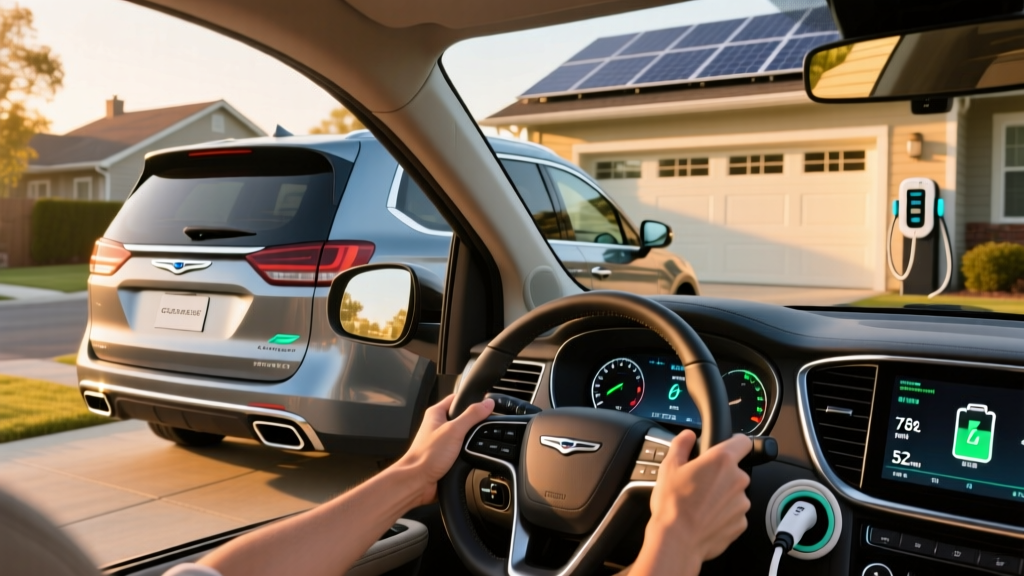
The Chrysler Pacifica Hybrid remains the only plug-in hybrid minivan on the U.S. market in 2026, and the Touring trim serves as the entry point into Chrysler's electrified family hauler. If you've been searching for a touring hybrid that can handle school runs on battery power yet cross the country without range anxiety, this is the vehicle that defines that niche. But with a starting price near $50,000 and a PHEV system that prioritizes efficiency over performance, buyers need to know exactly what they're signing up for before heading to the dealer.
We've broken down the 2026 Pacifica Hybrid Touring's real-world fuel economy, electric-only range, charging behavior, ownership costs, and how it stacks up against both full EVs and conventional gas minivans. Let's get into the numbers.
HEV vs PHEV: What the Pacifica Hybrid Touring Actually Is
The Pacifica Hybrid is a plug-in hybrid electric vehicle (PHEV), not a conventional hybrid (HEV). That distinction matters enormously for how you'll use it daily:
| Feature | Conventional Hybrid (HEV) | Pacifica Hybrid (PHEV) |
|---|---|---|
| Plug-in charging | No — charges via regen & engine | Yes — plug in for electric-only miles |
| Electric-only range | 0–2 miles at low speed | 32 miles (EPA) |
| Battery size | ~1–2 kWh | 16 kWh usable |
| Fuel economy (gas only) | Typically 35–50 MPG | 30 MPG combined (after battery depleted) |
| Federal tax credit | Not eligible (§30D) | Eligible — up to $7,500 (rules apply) |
If you never plug in, the Pacifica Hybrid still operates as a conventional hybrid using its engine and regenerative braking — but you'll miss the entire point of the PHEV system and forfeit the fuel savings that justify its price premium over a gas-only Pacifica.
2026 Pacifica Hybrid Touring: Core Specs at a Glance
| Specification | 2026 Pacifica Hybrid Touring |
|---|---|
| Powertrain | 3.6L V6 + 2 electric motors (eCVT) |
| Combined horsepower | 261 hp |
| Battery (usable) | 16 kWh lithium-ion |
| EPA electric-only range | 32 miles |
| Total combined range | ~430 miles (electric + gas) |
| EPA MPG (gas-only, combined) | 30 MPG combined / 29 city / 30 highway |
| MPGe (electric + gas) | 82 MPGe combined |
| Level 2 charge time (0–100%) | ~2 hours at 7.2 kW |
| DC fast charging | Not available |
| 0–60 mph | ~7.1 seconds |
| Seating | 7 passengers (Stow 'n Go 2nd row removed for battery) |
| Cargo (behind 3rd row) | 32.3 cu ft |
| Base MSRP | $49,995 (before incentives) |
| Battery warranty | 10 years / 100,000 miles |
Fuel Economy: EPA Numbers vs Real-World MPG
The EPA rates the 2026 Pacifica Hybrid at 30 MPG combined when operating on gasoline alone (after the battery is depleted), and 82 MPGe when factoring in electric operation. Here's the full breakdown:
| Driving Condition | EPA Estimate | Real-World Expectation |
|---|---|---|
| City (gas only) | 29 MPG | 30–33 MPG (regen-heavy city driving favors hybrids) |
| Highway (gas only) | 30 MPG | 27–29 MPG (aerodynamic drag and weight hurt at speed) |
| Combined (gas only) | 30 MPG | 28–31 MPG depending on mix |
| Combined MPGe | 82 MPGe | 70–85 MPGe (depends on how often you charge) |
Real-world insight: The Pacifica Hybrid's eCVT and generous regenerative braking mean city drivers often exceed EPA estimates by 2–3 MPG, since every stop recaptures energy. Highway drivers towing or carrying a full load of passengers and cargo should expect numbers closer to 25–27 MPG. In cold weather (below 30°F), expect a 10–15% drop in both electric range and gas-only efficiency as the engine runs more frequently for cabin heat and battery thermal management.
Electric-Only Range and Charging: The Daily Commute Test
The Pacifica Hybrid Touring delivers 32 miles of EPA-rated electric-only range, which covers the average American's one-way commute and a round of local errands without burning a drop of gasoline. That range is drawn from a 16 kWh (usable) lithium-ion battery pack mounted beneath the second-row floor.
EPA sticker: 32 miles.
Expect 28–30 miles in mild weather with moderate driving.
Expect 20–24 miles in winter or at sustained highway speeds (above 65 mph).
Aggressive acceleration and heavy cargo loads further reduce range.
Charging the Pacifica Hybrid Touring:
- Level 1 (120V household outlet): ~13 hours for a full charge — adequate only if you drive very little and park for long stretches.
- Level 2 (240V, 32A): ~2 hours for a full charge at 7.2 kW. This is the practical charging method and what most owners should install at home.
- DC fast charging: Not supported. The Pacifica Hybrid uses a J1772 connector for Level 1 and Level 2 only. You will not find DC fast-charge capability on any PHEV minivan currently on the market.
A 2-hour Level 2 charge cycle means you can easily top up during the workday or between school runs if you have access to a Level 2 charger. However, the lack of DC fast charging means road trips rely entirely on the gasoline engine once the battery is depleted — which is exactly how PHEVs are designed to work.
Powertrain Deep Dive: V6 Meets Dual Electric Motors
The Pacifica Hybrid pairs Chrysler's familiar 3.6-liter Pentastar V6 engine with two electric motors integrated into an electronically controlled continuously variable transmission (eCVT). Combined system output is 261 horsepower.
Unlike the gas-only Pacifica's available AWD, the Hybrid is front-wheel drive only — a trade-off for packaging the battery and electric motors. The eCVT delivers smooth, stepless acceleration without the gear hunting of a traditional automatic. Off the line, the electric motors provide immediate torque, making the Pacifica Hybrid feel surprisingly quick around town despite its 5,000+ pound curb weight.
The 0–60 mph time of approximately 7.1 seconds is adequate for merging and passing, though it won't win any drag races. More importantly, the transition between electric and gas power is nearly imperceptible in normal driving — Chrysler's powertrain integration is one of the smoother PHEV systems on the market.
Tax Credit Eligibility: Does the Pacifica Hybrid Qualify?
Under current IRS §30D rules for the 2026 tax year, the Chrysler Pacifica Hybrid is eligible for the federal clean vehicle credit — but eligibility depends on several buyer- and vehicle-specific factors:
- Vehicle MSRP cap: Vans/minivans must be under $80,000 MSRP. The Pacifica Hybrid Touring at $49,995 clears this easily.
- Buyer income cap: Adjusted gross income must not exceed $150,000 (single), $225,000 (head of household), or $300,000 (married filing jointly).
- Battery sourcing requirements: A percentage of critical minerals and battery components must be sourced from the U.S. or free-trade-agreement countries. These thresholds tighten annually — confirm current-year compliance on the IRS qualified vehicles list before purchasing.
- Point-of-sale transfer: As of 2024, buyers can transfer the credit to the dealer at purchase, reducing the vehicle's price at the point of sale rather than waiting for a tax refund.
- Credit amount: Up to $7,500, split between a $3,750 critical-minerals requirement and a $3,750 battery-components requirement. The Pacifica Hybrid has historically qualified for the full amount, but verify on the fueleconomy.gov tax credit lookup before signing.
Important caveat: Tax credit eligibility rules change and are subject to battery sourcing verification by model year and build date. Always confirm with your tax professional and the IRS qualified vehicles list before relying on a specific credit amount.
Reliability and Battery Warranty: Long-Term Ownership Costs
10 years or 100,000 miles (whichever comes first), covering defects and capacity loss below a defined threshold.
This is a federal mandate for emissions-related components and applies in all 50 states.
Chrysler's hybrid battery warranty is among the most comprehensive in the segment.
The Pacifica Hybrid's 16 kWh battery pack is liquid-cooled and managed by a thermal system designed to minimize degradation. In real-world ownership data, Chrysler PHEV batteries have shown modest degradation — typically losing 5–10% of original capacity over the first 5 years and 60,000 miles. Most owners report the battery lasting well beyond the warranty period without requiring replacement.
Battery replacement cost: If the battery does need replacement outside of warranty, expect a cost in the range of $6,000–$9,000 for the pack itself plus labor. This is a significant expense, but it's comparable to a major engine or transmission repair on a conventional vehicle — and far less frequent based on current data.
The 3.6L Pentastar V6 is one of Stellantis's most proven engines, with millions on the road. The eCVT has fewer moving parts than a conventional automatic transmission, reducing long-term drivetrain risk. Overall, the Pacifica Hybrid's reliability profile is reasonable for a complex PHEV, though it carries more potential repair points than a simple gas-only vehicle.
Who Should Buy the Pacifica Hybrid Touring — and Who Shouldn't
Pros
- Only PHEV minivan available — no direct competitor
- 32 miles electric covers most daily driving without gas
- Smooth, quiet electric operation around town
- Eligible for up to $7,500 federal tax credit (verify eligibility)
- 10-year / 100,000-mile hybrid battery warranty
- 430+ mile total range eliminates road-trip range anxiety
Cons
- $49,995 starting price is steep for a minivan
- No DC fast charging — road trips run on gas only
- FWD only — no AWD option unlike gas Pacifica
- Second-row Stow 'n Go removed (battery occupies under-floor space)
- Electric range drops significantly in cold weather and at highway speeds
- Only 30 MPG gas-only — less efficient than some HEV SUVs once battery is depleted
Pacifica Hybrid vs Full EV vs Gas Minivan: Which Fits Your Family?
Choose the Pacifica Hybrid Touring if: You can charge at home (Level 2), your daily driving is under 30 miles, you take road trips where charging infrastructure is uncertain, and you need minivan space with 7-passenger seating.
Choose a full EV (like a Kia EV9 or Tesla Model X) if: You have reliable home charging, your daily driving is under 250 miles, you want the lowest per-mile fuel cost, and you're ready to plan road-trip charging stops.
Choose a gas-only minivan (Honda Odyssey, Toyota Sienna HEV, or gas Pacifica) if: You cannot charge at home, your budget is under $40,000, you want AWD availability, or you need full Stow 'n Go second-row folding (gas Pacifica only).
The Pacifica Hybrid occupies a very specific lane: families who want electric daily driving but can't commit to a full EV due to road-trip needs, charging access limitations, or the lack of a fully electric minivan alternative from any automaker. If that describes you, there's literally nothing else on the market that does what this vehicle does.
Frequently Asked Questions
How many MPG does the Pacifica Hybrid Touring get?
The EPA rates the 2026 Pacifica Hybrid at 30 MPG combined (29 city / 30 highway) when running on gasoline after the battery is depleted. In real-world city driving with frequent stops and regenerative braking, many owners see 31–33 MPG. Highway driving at 75+ mph typically yields 26–28 MPG. When factoring in electric-only driving, the combined rating is 82 MPGe.
How far can the Pacifica Hybrid go on electric power alone?
The EPA rates the Pacifica Hybrid at 32 miles of electric-only range. In practice, expect 28–30 miles in mild weather with moderate driving habits. In cold weather or at sustained highway speeds, that drops to 20–24 miles. The gasoline engine seamlessly engages once the battery is depleted, so you're never stranded.
Does the Pacifica Hybrid qualify for a tax credit?
The Pacifica Hybrid has historically qualified for up to $7,500 under the IRS §30D federal clean vehicle credit. However, eligibility depends on your income (caps apply), the vehicle's battery sourcing compliance for the specific model year, and the MSRP cap ($80,000 for vans, which the Pacifica clears). Verify current eligibility on the IRS qualified vehicles list and consult a tax professional before purchasing.
Is the Pacifica Hybrid reliable, and what does battery replacement cost?
The Pacifica Hybrid uses Chrysler's proven 3.6L V6 and a well-tested eCVT system. The hybrid battery is covered by a 10-year / 100,000-mile warranty. Real-world degradation data suggests the battery retains 90–95% of its capacity after 5 years. Out-of-warranty battery replacement costs approximately $6,000–$9,000. Overall reliability is average for the segment, with the added complexity of a PHEV system being the main long-term risk factor compared to a conventional vehicle.
Do I need to plug in the Pacifica Hybrid, or does it charge itself?
Unlike a conventional hybrid (HEV) that charges its small battery solely through regenerative braking and the engine, the Pacifica Hybrid is a PHEV designed to be plugged in for maximum benefit. If you never plug it in, it will still drive as a regular hybrid at ~30 MPG — but you'll miss the 32 miles of electric-only range and the fuel savings that justify the PHEV price premium. A Level 2 home charger (240V) is strongly recommended for daily use.
Can the Pacifica Hybrid DC fast charge on road trips?
No. The Pacifica Hybrid supports only Level 1 (120V) and Level 2 (240V / 7.2 kW) charging via a J1772 connector. There is no DC fast-charge port. On road trips, once the 32-mile battery range is used up, the vehicle operates entirely on its gasoline engine — which is the intended design of a PHEV for long-distance travel.