The Chrysler Pacifica Hybrid remains the only plug-in hybrid minivan on the U.S. market, and the Touring L trim sits at the intersection of value and features. For families who want electric-only school runs but need the range flexibility of a gasoline engine for road trips, the 2026 Pacifica Hybrid Touring L makes a compelling, if imperfect, case.
This guide breaks down exactly what you get for the money: real-world MPG, the 16 kWh battery's usable electric range, charging logistics, powertrain specs, and whether the Pacifica Hybrid qualifies for federal tax credits under current IRS §30D rules.
HEV vs PHEV: Where the Pacifica Hybrid Fits
Before diving into specs, it's worth clarifying what the Pacifica Hybrid actually is — because the "hybrid" label causes real confusion at dealerships.
Conventional Hybrid (HEV)
A standard hybrid like the Toyota Sienna uses a small battery (typically 1-2 kWh) and regenerative braking to assist a gas engine. You never plug it in. The electric motor improves fuel economy, especially in city driving, but cannot propel the vehicle on electricity alone for meaningful distances.
Plug-In Hybrid (PHEV) — Pacifica Hybrid
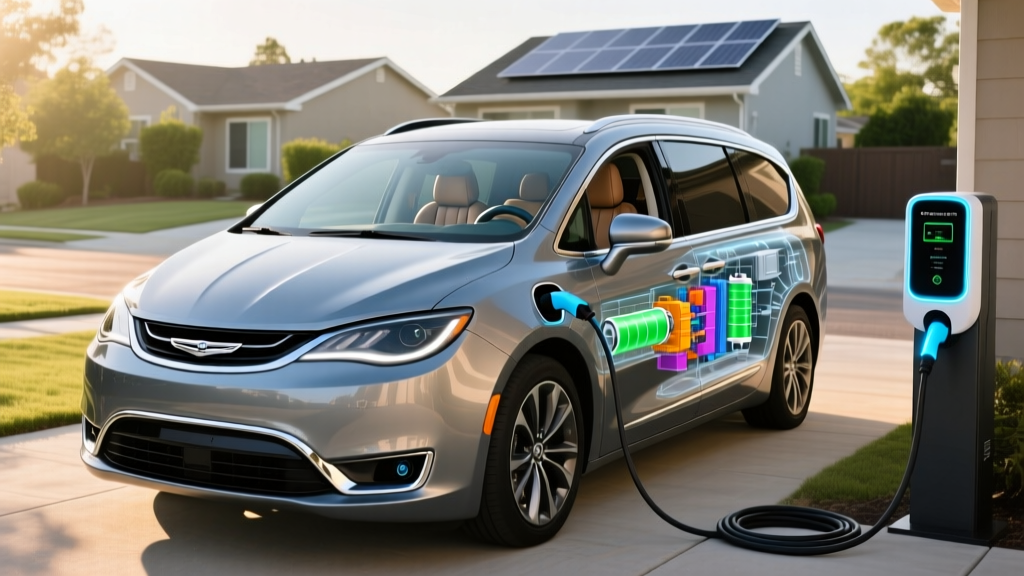
The Pacifica Hybrid carries a much larger 16 kWh battery pack and a dedicated electric drive motor capable of powering the van without the gasoline engine for up to 32 EPA-rated miles. You can plug it in to recharge (Level 1 or Level 2), and doing so unlocks the electric-only range. If you never plug it in, it operates as a conventional hybrid — but you're leaving efficiency on the table.
The Pacifica Hybrid is a PHEV, not an HEV. To get the full benefit, you need access to a 120V outlet (Level 1) or a 240V Level 2 charger at home or work.
Electric-Only Range, Total Range, and the 16 kWh Battery
The Pacifica Hybrid's 16 kWh lithium-ion battery pack (manufactured by LG Energy Solution) delivers an EPA-rated 32 miles of electric-only range. That figure has remained consistent across recent model years, and the 2026 Pacifica Hybrid Touring L carries the same rating.
EPA Electric-Only Range: 32 miles
Real-World Expectation: 25–30 miles in mixed driving; 20–25 miles at sustained highway speeds or in cold weather (below 40°F). The electric-only range drops noticeably when the climate system draws heavily from the pack.
Total Combined Range (EV + Gas): Approximately 520 miles with a full tank and full battery, per fueleconomy.gov.
For context, 32 miles of electric range covers the daily round-trip commute or school run for a significant portion of American drivers. The U.S. average one-way commute is roughly 16 miles, meaning many Pacifica Hybrid owners could complete weekday driving entirely on electricity — plugging in overnight — and only use gasoline on weekends or longer trips.
The battery pack sits beneath the second-row floor, which means the Pacifica Hybrid sacrifices the Stow 'n Go second-row seating that the gas-only Pacifica offers. The second-row captain's chairs are removable but do not fold into the floor. This is a meaningful trade-off for cargo-heavy families.
Fuel Economy: EPA MPG, MPGe, and Real-World Numbers
The Pacifica Hybrid's efficiency is reported two ways: MPGe (miles per gallon equivalent) when operating in electric mode, and conventional MPG when the gasoline engine is running.
| Metric | EPA Rating | Real-World Expectation |
|---|---|---|
| Combined MPGe (EV mode) | 82 MPGe | 75–85 MPGe depending on conditions |
| City MPG (gas only, battery depleted) | 29 MPG | 28–32 MPG (city regen helps) |
| Highway MPG (gas only, battery depleted) | 30 MPG | 27–30 MPG |
| Combined MPG (gas only) | 30 MPG | 28–31 MPG |
| Electric-only range | 32 miles | 25–30 miles (see above) |
A few things worth noting from real-world ownership:
- City driving favors the PHEV. Regenerative braking recaptures energy in stop-and-go traffic, and the electric motor handles low-speed acceleration where gasoline engines are least efficient. Many owners report 31–34 MPG in city driving once the battery is depleted.
- Highway driving narrows the gap. At 70+ mph, the Pacifica Hybrid's weight (roughly 5,000 lbs) and aerodynamic profile work against it. Expect 27–29 MPG on the highway with a depleted battery — comparable to the non-hybrid Pacifica and notably less than the Toyota Sienna HEV's 36 MPG combined.
- Cold weather impact. Below freezing, the gasoline engine may engage sooner to provide cabin heat, reducing electric-only range by 25–35%. The Pacifica Hybrid does not have a dedicated heat pump for the cabin; it relies on engine waste heat and resistive electric heating.
Compared to the gas-only 2026 Pacifica (rated at 19 city / 28 highway / 22 combined), the PHEV's 30 MPG combined with a depleted battery represents a substantial improvement — and the 32 miles of electric range further reduces gasoline consumption for those who plug in regularly.
Powertrain, Performance, and Charging Specs
| Specification | 2026 Pacifica Hybrid Touring L |
|---|---|
| Engine | 3.6L Pentastar V6 (Atkinson cycle) |
| Electric Motors | Dual-motor eFlite EVT (one drive, one generator) |
| Combined System Horsepower | 260 hp |
| Battery Capacity | 16 kWh (lithium-ion, LG Energy Solution) |
| Usable Battery Capacity | ~13 kWh (buffer protects longevity) |
| Electric-Only Range (EPA) | 32 miles |
| 0–60 mph | ~7.1 seconds |
| Drivetrain | Front-wheel drive (no AWD option for PHEV) |
| Level 1 Charging (120V, 12A) | ~14 hours (0–100%) |
| Level 2 Charging (240V, 32A) | ~2 hours (0–100%) |
| DC Fast Charging | Not available |
| Towing Capacity | Not rated (PHEV not recommended for towing) |
| Cargo Volume (behind 3rd row) | 32.3 cu ft |
| Cargo Volume (max, all seats folded/removed) | 140.5 cu ft |
Charging the Pacifica Hybrid: What You Need to Know
The Pacifica Hybrid uses a standard J1772 connector for AC charging. It does not support DC fast charging — a limitation shared with most PHEVs, which prioritize overnight home charging over rapid public charging.
With the included Level 1 cordset plugged into a standard 120V household outlet, a full charge takes approximately 14 hours. This means a nightly plug-in will replenish the battery fully, but a mid-day top-up won't add much range.
A Level 2 home charger (240V, 32 amps) reduces that to roughly 2 hours — practical for topping up during the workday or between morning and evening school runs. Most Pacifica Hybrid owners benefit significantly from a Level 2 installation. Expect to pay $600–$1,200 for a quality Level 2 unit (e.g., ChargePoint Home Flex or Emporia Vue) plus $500–$2,000 for electrician installation, depending on panel proximity and local permitting.
The onboard charger is rated at 7.2 kW, meaning it can accept the full output of a 32A Level 2 circuit. You won't benefit from a 48A or 80A charger — the van's hardware caps the intake at 7.2 kW.
Pricing, Trims, and Federal Tax Credit Eligibility
The 2026 Chrysler Pacifica Hybrid Touring L carries a starting MSRP of approximately $46,995 (including destination). Higher trims — Limited and Pinnacle — push the Pacifica Hybrid past $53,000–$57,000.
Federal Tax Credit (§30D) — Current Rules:
- Credit Amount: Up to $7,500 for qualifying new PHEVs (must have ≥4 kWh battery — the Pacifica's 16 kWh qualifies).
- MSRP Cap: Vans/SUVs must be under $80,000 — the Pacifica Hybrid clears this easily.
- Buyer Income Cap: AGI must not exceed $150,000 (single), $225,000 (head of household), or $300,000 (joint).
- Battery Sourcing Requirements: Critical minerals and battery components must meet phased-in domestic/free-trade sourcing thresholds. The Pacifica Hybrid's LG battery has faced scrutiny under these rules — verify current-year eligibility at the IRS qualified vehicles list before purchasing.
- Point-of-Sale Transfer: If eligible, you can transfer the credit to the dealer at purchase, reducing the purchase price directly rather than waiting for a tax refund.
Important: Tax credit eligibility changes frequently due to sourcing-rule phase-ins. Always confirm the specific VIN's eligibility on the IRS website or with a tax professional before finalizing a purchase.
At the Touring L trim with a $46,995 MSRP, the Pacifica Hybrid is positioned below most three-row electric SUVs (the Kia EV9 starts around $55,000; the Rivian R1S above $75,000). If you qualify for the full $7,500 credit via point-of-sale transfer, the effective price drops to roughly $39,500 — competitive with well-equipped gas-only minivans.
Reliability, Battery Warranty, and Replacement Cost
Hybrid and PHEV battery longevity is consistently a top buyer concern. Here's what the data shows for the Pacifica Hybrid:
Hybrid Battery Warranty: 10 years / 100,000 miles (whichever comes first), covering defects and capacity loss below a usable threshold. This is federally mandated for emissions-related components in PHEVs and applies in all 50 states. In CARB states (California and states adopting CARB standards), coverage may extend further.
Powertrain Warranty: 5 years / 60,000 miles.
Battery Replacement Cost (out of warranty): A replacement 16 kWh Pacifica Hybrid battery pack currently costs between $5,500 and $8,000 for the part, plus $1,000–$2,000 in labor. Total replacement: approximately $6,500–$10,000.
The Pacifica Hybrid's battery has been in production since the 2017 model year, giving nearly a decade of field data. Degradation reports from high-mileage owners suggest the 16 kWh pack retains roughly 85–90% of original capacity after 100,000 miles — meaning electric-only range may drop from 32 miles to approximately 27–29 miles over that period. This is typical for a PHEV battery with a conservative buffer (the Pacifica uses ~13 kWh of its 16 kWh total, leaving top and bottom buffers to reduce stress on cells).
Reliability has been mixed across Pacifica Hybrid model years. Early models (2017–2019) experienced recalls related to the 12V auxiliary battery and certain electrical system faults. More recent model years have improved. Check NHTSA for open recalls on any specific VIN before purchasing.
The V6 Atkinson-cycle engine is a proven, low-stress design (shared across Stellantis hybrids) and should prove durable with standard maintenance. The eFlite dual-motor transmission has no traditional gears or torque converter, reducing mechanical wear points compared to a conventional automatic.
Pacifica Hybrid vs. Full EV vs. Gas Minivan: Which Fits You?
Choose the Pacifica Hybrid Touring L if:
- You need a minivan's interior (sliding doors, three rows, flat-load cargo) but want to reduce gasoline consumption.
- You can charge at home (Level 1 or 2) and your daily driving falls under 30–35 miles.
- You take road trips where charging infrastructure is unreliable and can't risk range limitations.
- You want a lower purchase price than a three-row EV (Kia EV9, Tesla Model X) while still driving partially on electricity.
Choose a full EV (BEV) if:
- You have reliable home charging and access to DC fast chargers for road trips.
- You want zero tailpipe emissions and lower long-term maintenance (no oil changes, no engine).
- You drive primarily in urban/suburban areas with robust charging networks.
- You can accept a higher upfront cost (EV9: ~$55K+, Model X: ~$80K+) for a three-row electric vehicle.
Choose a gas-only minivan if:
- You cannot charge at home (apartment, street parking, no garage).
- You need Stow 'n Go second-row seating for frequent cargo hauling (the Pacifica Hybrid's battery eliminates this feature).
- You tow regularly — the Pacifica Hybrid is not rated for towing, while the gas Pacifica handles up to 3,600 lbs.
- Your budget is under $40,000 and you don't qualify for tax credits.
The Toyota Sienna (HEV, non-plug-in) deserves mention as the Pacifica Hybrid's closest efficiency rival. The Sienna achieves 36 MPG combined without ever plugging in — better than the Pacifica Hybrid's 30 MPG in gas-only mode. However, the Sienna offers no electric-only range, and its hybrid system prioritizes efficiency over the Pacifica's stronger 260-hp combined output. The Sienna also comes standard with AWD, which the Pacifica Hybrid does not offer.
Pros
- Only PHEV minivan available — unique market position
- 32 miles electric-only range covers most daily driving
- 82 MPGe in EV mode significantly reduces fuel cost
- 260 hp combined provides confident highway merging
- Qualifies for HOV lane access in several states
- 10-year/100,000-mile battery warranty
- Federal tax credit eligible (verify current sourcing rules)
Cons
- No Stow 'n Go second-row seating (battery occupies the well)
- No DC fast charging — limited to 7.2 kW AC
- 14-hour Level 1 charge time is slow without Level 2
- FWD only — no AWD option (unlike Sienna or gas Pacifica)
- Not rated for towing
- Gas-only MPG (30 combined) trails Toyota Sienna HEV (36 combined)
- Higher base price than gas Pacifica (~$7,000 premium)
Ownership Costs: Fuel Savings vs. Upfront Premium
The Pacifica Hybrid Touring L costs roughly $7,000 more than a comparably equipped gas-only Pacifica Touring L. Does the fuel savings justify that premium?
| Cost Factor (5 years / 75,000 miles) | Pacifica Hybrid PHEV | Pacifica Gas-Only |
|---|---|---|
| Purchase Price (MSRP) | $46,995 | $39,995 |
| Federal Tax Credit (if eligible) | −$7,500 | $0 |
| Effective Purchase Price | $39,495 | $39,995 |
| Fuel Cost (est., $3.50/gal avg, daily charging) | ~$4,800 | ~$11,900 |
| Home Charging Electricity (est.) | ~$2,100 | $0 |
| Maintenance (5 yr) | ~$2,800 | ~$3,500 |
| 5-Year Total (purchase + fuel + maint.) | ~$49,195 | ~$55,395 |
If you qualify for the full $7,500 federal credit and charge daily, the Pacifica Hybrid breaks even on the upfront premium within the first year and saves approximately $6,000+ over five years. Without the tax credit, the payback period extends to roughly 3–4 years depending on driving patterns and local fuel/electricity prices.
Electricity cost for charging assumes $0.14/kWh national average and 75% of driving on electric. Actual costs vary significantly by utility rate and charging behavior. Owners on time-of-use plans who charge overnight at off-peak rates will see lower electricity costs.
Frequently Asked Questions
How many MPG does the Chrysler Pacifica Hybrid get?
The 2026 Pacifica Hybrid is EPA-rated at 82 MPGe in electric mode and 30 MPG combined (29 city / 30 highway) when running on gasoline with a depleted battery. Real-world city MPG often reaches 31–34 thanks to regenerative braking, while highway driving typically yields 27–29 MPG.
How far can the Pacifica Hybrid go on electric only?
The EPA rates the Pacifica Hybrid at 32 miles of electric-only range. In real-world conditions, expect 25–30 miles in mild weather with mixed driving, and 20–25 miles in cold weather or at sustained highway speeds. Total combined range (electric + gasoline) is approximately 520 miles.
Does the Chrysler Pacifica Hybrid qualify for the federal tax credit?
The Pacifica Hybrid meets the battery capacity requirement (16 kWh, well above the 4 kWh minimum) and the MSRP cap ($80,000 for vans). However, eligibility for the full $7,500 credit depends on current-year battery sourcing and critical mineral requirements under IRS §30D, as well as your income. Always verify on the IRS qualified clean vehicles list before purchasing.
Is the Pacifica Hybrid reliable, and what does battery replacement cost?
The Pacifica Hybrid's powertrain has improved in reliability since early model years (2017–2019), which saw electrical system recalls. The 16 kWh battery is covered by a 10-year/100,000-mile warranty. Out-of-warranty battery replacement costs approximately $6,500–$10,000 (parts and labor). Long-term data shows ~85–90% capacity retention at 100,000 miles.
Do I need to plug in the Pacifica Hybrid?
You don't have to — it will operate as a conventional hybrid using regenerative braking and the gasoline engine if you never plug it in. However, you'll miss the 32 miles of electric-only range and the 82 MPGe efficiency. To maximize savings, plug in nightly using the included Level 1 cordset (120V) or an optional Level 2 home charger (240V, ~2-hour full charge).
Can the Pacifica Hybrid tow or get AWD?
No on both counts. The Pacifica Hybrid is front-wheel drive only — Stellantis has not offered AWD on the PHEV variant due to packaging constraints with the battery and rear electric motor. It is also not rated for towing. If you need AWD or towing (up to 3,600 lbs), consider the gas-only Pacifica or the Toyota Sienna HEV (AWD standard, 3,500-lb towing).
How does the Pacifica Hybrid compare to the Toyota Sienna hybrid?
The Sienna is a conventional hybrid (HEV) — no plug, no electric-only range — but achieves 36 MPG combined vs. the Pacifica Hybrid's 30 MPG in gas-only mode. The Pacifica Hybrid wins on electric-only capability (32 miles), stronger acceleration (260 hp vs. 245 hp), and potential tax credit eligibility. The Sienna wins on fuel economy in gas mode, standard AWD, and a lower starting price (~$38,000). Your choice depends on whether you can charge at home and value electric-only driving.