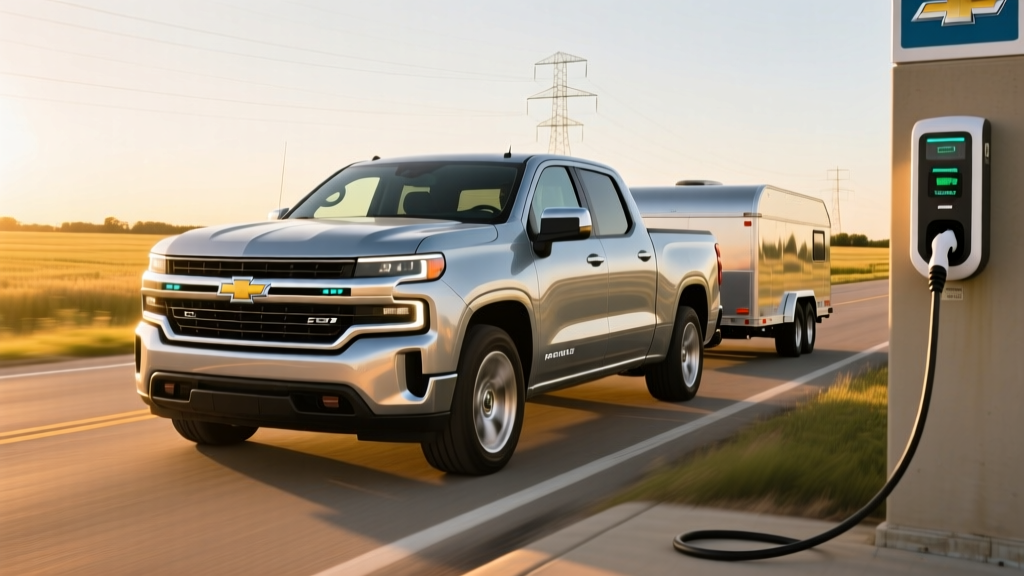
The full-size pickup segment has been slow to embrace electrification, and the Chevy Silverado hybrid occupies a specific niche: a conventional gas-electric hybrid (HEV) that improves fuel economy without requiring a plug. For the 2026 model year, the Silverado's hybrid powertrain pairs a turbocharged four-cylinder with an electric motor integrated into the transmission, targeting buyers who want better MPG without changing their fueling habits.
This guide breaks down exactly what the 2026 Silverado Hybrid delivers — EPA fuel economy, real-world MPG expectations, towing capability, powertrain specs, warranty coverage, and whether this HEV makes sense versus a plug-in hybrid rival or a full battery-electric truck like the Silverado EV.
HEV vs PHEV: What Kind of Hybrid Is the Silverado?
Before diving into specs, it's critical to understand what you're buying. The 2026 Chevy Silverado Hybrid is a conventional hybrid (HEV), not a plug-in hybrid (PHEV). That distinction changes everything about how you use it.
| Feature | Silverado Hybrid (HEV) | Plug-In Hybrid (PHEV) Example |
|---|---|---|
| Plug-in charging required? | No — charges via regenerative braking and engine | Yes — plug in for electric-only miles |
| Electric-only range | None (electric motor assists engine only) | Typically 20–40 miles EV-only |
| Battery size | ~1.5 kWh (small, self-charging) | 15–25 kWh (larger, plug-in capable) |
| Fueling | Gas station only | Gas station + Level 1/2 charging |
| Federal tax credit (§30D) | Not eligible | Up to $7,500 (if eligible) |
| Best for | Drivers without home charging access | Drivers with home/garage charging |
The Silverado Hybrid's small battery pack captures energy from braking and deceleration, then deploys it to assist the gas engine during acceleration and low-speed driving. You never plug it in. You simply fill up at the pump and let the hybrid system work in the background.
Fuel Economy: EPA Ratings and Real-World MPG
Fuel economy is the primary reason buyers consider the Silverado Hybrid over the standard gas model. Here's what the EPA rates it at for the 2026 model year with the available hybrid powertrain:
| Configuration | City MPG | Highway MPG | Combined MPG |
|---|---|---|---|
| Silverado Hybrid 2WD | 24 | 25 | 24 |
| Silverado Hybrid 4WD | 22 | 23 | 22 |
| Silverado Gas 2.7L Turbo (4WD, baseline) | 18 | 21 | 19 |
Source: fueleconomy.gov — EPA estimates. Your mileage will vary.
Real-World MPG: What to Actually Expect
Hybrid trucks behave differently than their EPA stickers suggest, and the direction of that variance depends heavily on your driving pattern:
- City and suburban driving: This is where hybrids shine. Expect to meet or slightly exceed the EPA city rating. The electric motor handles low-speed acceleration, stop-and-go traffic, and idle reduction, where gas engines waste the most fuel. Real-world city MPG of 24–26 in 2WD is achievable.
- Highway driving at 70–80 mph: The hybrid advantage shrinks considerably at sustained highway speeds. Aerodynamic drag dominates, and the engine does nearly all the work. Expect 21–23 MPG in 4WD highway cruising — close to or slightly below the EPA highway figure.
- Towing and hauling: When towing a 5,000–7,000 lb trailer, fuel economy drops significantly. Expect 12–16 MPG depending on trailer weight, terrain, and speed. The hybrid system still assists during acceleration from stops, but sustained towing load falls on the gas engine.
- Cold weather: Hybrid fuel economy drops 10–15% in sub-freezing temperatures. The engine runs more frequently to maintain cabin heat and battery temperature, reducing electric-motor assist time.
The bottom line: if your driving is predominantly city and suburban, the Silverado Hybrid delivers meaningful savings over the gas-only model. If you spend most of your miles at highway speed or towing, the gap narrows considerably.
Powertrain Specs: Engine, Motor, and Horsepower
The 2026 Silverado Hybrid uses GM's turbocharged 2.7L inline-four engine paired with an electric motor-generator integrated into the transmission housing. Here's the complete powertrain breakdown:
| Specification | Value |
|---|---|
| Engine | 2.7L Turbocharged Inline-4 |
| Engine horsepower | 310 hp @ 5,600 rpm |
| Engine torque | 430 lb-ft @ 1,500–4,000 rpm |
| Electric motor assist | ~20 hp (integrated motor-generator) |
| Combined system output | ~330 hp |
| Transmission | 10-speed automatic with integrated hybrid module |
| Hybrid battery | ~1.5 kWh lithium-ion (self-charging) |
| Drivetrain options | 2WD or 4WD |
| Max towing capacity | ~9,300 lbs (properly equipped, 2WD) |
| 0–60 mph (est.) | ~6.8 seconds |
The hybrid system's primary contribution isn't raw power — it's torque fill. The electric motor-generator provides instant low-end torque while the turbo spools, eliminating the lag that some drivers notice in the standard 2.7L turbo. Off the line, the hybrid feels more responsive than its gas-only counterpart, particularly in stop-and-go traffic and when pulling away from stops with a load.
Towing capacity is slightly reduced compared to the most powerful gas Silverado configurations (the 6.2L V8 can tow up to ~13,300 lbs), but the hybrid's ~9,300 lb rating covers the needs of most recreational trailer, boat, and equipment haulers.
Pricing, Trims, and Tax Credit Eligibility
The 2026 Silverado Hybrid is available across multiple trim levels. Here's the approximate MSRP by trim:
| Trim Level | Approx. MSRP (4WD) | Hybrid Premium vs Gas |
|---|---|---|
| LT | $52,500 | +$2,500–$3,000 |
| RST | $55,800 | +$2,500–$3,000 |
| LTZ | $59,200 | +$2,500–$3,000 |
| High Country | $64,500 | +$2,500–$3,000 |
Prices are approximate and vary by dealer. Destination charges additional.
Federal Tax Credit: Not Eligible Under §30D
Because the Silverado Hybrid is a conventional HEV — not a plug-in hybrid or battery-electric vehicle — it does not qualify for the federal §30D Clean Vehicle Credit. That credit, worth up to $7,500, is reserved for new PHEVs and BEVs that meet battery sourcing, MSRP cap, and buyer income requirements, per IRS guidelines.
Some states offer their own incentives for conventional hybrids, though these are increasingly rare as state programs shift focus to plug-in vehicles. Check your state's energy or environmental agency for current programs.
Fuel Savings Payback
The hybrid premium of ~$2,500–$3,000 over the gas model needs to be justified by fuel savings. At 15,000 miles per year, $3.50/gallon gas, and a 3–5 MPG improvement in mixed driving:
- Gas Silverado (19 combined): ~789 gallons/year = $2,763
- Hybrid Silverado (22 combined): ~682 gallons/year = $2,386
- Annual savings: ~$377/year
- Payback period: ~7–8 years at current fuel prices
If gas prices rise, or if your driving skews heavily toward city conditions where the hybrid advantage is larger, the payback shortens. But buyers should view the hybrid primarily as an emissions reduction and driving-refinement upgrade rather than a fast-payback financial decision.
Reliability and Battery Warranty Coverage
Hybrid battery longevity is the number one concern for buyers new to hybrid technology. Here's what GM provides:
Silverado Hybrid Battery Warranty
- Hybrid battery coverage: 8 years / 100,000 miles (whichever comes first)
- Powertrain warranty: 5 years / 60,000 miles
- Bumper-to-bumper: 3 years / 36,000 miles
- Coverage threshold: Battery capacity must remain above ~60–70% of original (varies by warranty terms)
GM's hybrid battery packs are designed to last the life of the vehicle under normal use. The small ~1.5 kWh battery in the Silverado Hybrid undergoes far less stress than a large PHEV or BEV pack because it operates in a narrow state-of-charge window — it never fully charges or fully depletes. This shallow cycling significantly extends cell life.
Based on data from GM's earlier hybrid systems (including the Malibu Hybrid and previous Silverado eAssist), hybrid battery failures before 150,000 miles are uncommon. If a replacement is needed out of warranty, expect a cost in the range of $2,000–$4,000 for the hybrid battery pack — substantially less than a full EV battery replacement, which can exceed $10,000–$15,000.
The hybrid system adds complexity (motor-generator, inverter, high-voltage wiring), but these components are also covered under the powertrain warranty. Independent reliability data from sources like Consumer Reports generally rates GM's hybrid truck powertrains as average to above average for the segment.
Silverado Hybrid vs Silverado EV vs Gas: Which Fits You?
The Silverado lineup now offers three distinct powertrain paths. Here's a decision framework to determine which is right for your situation:
Choose the Silverado Hybrid (HEV) if:
- You don't have access to home or workplace charging
- You want better MPG without changing your fueling routine
- You tow regularly but within the ~9,300 lb range
- You want a lower upfront cost than a full EV
- Your driving mix includes significant city and suburban miles
Choose the Silverado EV (BEV) if:
- You have reliable Level 2 home charging (240V)
- You want zero tailpipe emissions and the lowest per-mile fuel cost
- Your daily driving is under 300 miles and you can plan road-trip charging
- You qualify for the $7,500 federal tax credit (subject to IRS §30D requirements)
- You want maximum torque and instant acceleration
Choose the Gas Silverado if:
- You tow near or above 10,000 lbs regularly (V8 configurations)
- You drive predominantly highway miles where the hybrid advantage is smallest
- You want the lowest possible purchase price
- You operate in extremely remote areas with limited service infrastructure
There's also a competitive consideration: the Ford F-150 PowerBoost remains a full hybrid V6 with more established market presence, delivering EPA combined ratings around 23–24 MPG in 4WD and a higher max towing rating (~12,700 lbs). Cross-shoppers should test-drive both to compare transmission behavior, regenerative braking feel, and cabin integration.
Pros and Cons at a Glance
Pros
- 3–5 MPG improvement over gas model, especially in city driving
- No plug-in charging required — zero lifestyle change
- Improved low-end torque response from electric motor assist
- 8-year/100,000-mile hybrid battery warranty
- Available across multiple trims (LT through High Country)
- Competitive towing capacity (~9,300 lbs)
Cons
- No federal tax credit eligibility (HEV, not PHEV/BEV)
- Hybrid premium adds $2,500–$3,000 to purchase price
- Fuel savings payback period of 7–8 years at current gas prices
- Highway MPG improvement is modest vs gas model
- Towing fuel economy still drops significantly under load
- Less powerful than available V8 gas configurations
Frequently Asked Questions
How many MPG does the Chevy Silverado Hybrid get?
The 2026 Silverado Hybrid is EPA-rated at 24 combined MPG (2WD) and 22 combined MPG (4WD). In real-world city driving, some owners report meeting or slightly exceeding these figures thanks to the hybrid system's regenerative braking and electric-motor assist at low speeds. Highway-only driving and towing will produce lower numbers.
Does the Silverado Hybrid need to be plugged in?
No. The Silverado Hybrid is a conventional HEV (hybrid electric vehicle). Its small battery recharges through regenerative braking and the gas engine. You fuel it exclusively at gas stations — there is no plug, no charging cable, and no electric-only driving range.
Can the Silverado Hybrid drive on electric power alone?
Only at very low speeds for very short distances (under 1 mile, typically in parking lots or heavy traffic). The electric motor primarily assists the gas engine rather than replacing it. This is fundamentally different from a PHEV, which can travel 20–40 miles on electricity alone before the engine starts.
Is the Silverado Hybrid reliable, and what does battery replacement cost?
GM's hybrid systems have demonstrated solid reliability in their passenger car and truck applications. The hybrid battery is warrantied for 8 years/100,000 miles. Out-of-warranty replacement costs are estimated at $2,000–$4,000 — significantly less than a full EV battery. The shallow charge-discharge cycles of a conventional hybrid battery typically yield a long service life.
Does the Chevy Silverado Hybrid qualify for a tax credit?
No. The federal §30D Clean Vehicle Credit applies only to plug-in hybrid (PHEV) and battery-electric (BEV) vehicles that meet battery sourcing, MSRP, and buyer income requirements. Conventional hybrids like the Silverado Hybrid are not eligible. Some state-level incentives may apply — check your state's energy office for details.
How does the Silverado Hybrid compare to the Ford F-150 PowerBoost hybrid?
The F-150 PowerBoost uses a 3.5L twin-turbo V6 hybrid producing 430 combined horsepower and up to ~12,700 lbs of towing capacity, with EPA combined ratings around 23–24 MPG (4WD). It's a more powerful and higher-towing hybrid, but typically priced higher. The Silverado Hybrid offers a lower entry price and competitive city MPG, but less peak output and towing headroom.
What's the towing capacity of the Silverado Hybrid?
The 2026 Silverado Hybrid can tow up to approximately 9,300 lbs when properly equipped (2WD configuration). Four-wheel-drive models and higher trim levels with more payload may see slightly reduced ratings. This covers most boat, utility, and travel trailer needs but falls short of the V8 gas Silverado's maximum rating of ~13,300 lbs.
Always verify current pricing, specifications, and incentive eligibility with your local Chevrolet dealer and official sources including chevrolet.com and fueleconomy.gov. Specifications and availability may vary by market and model year.