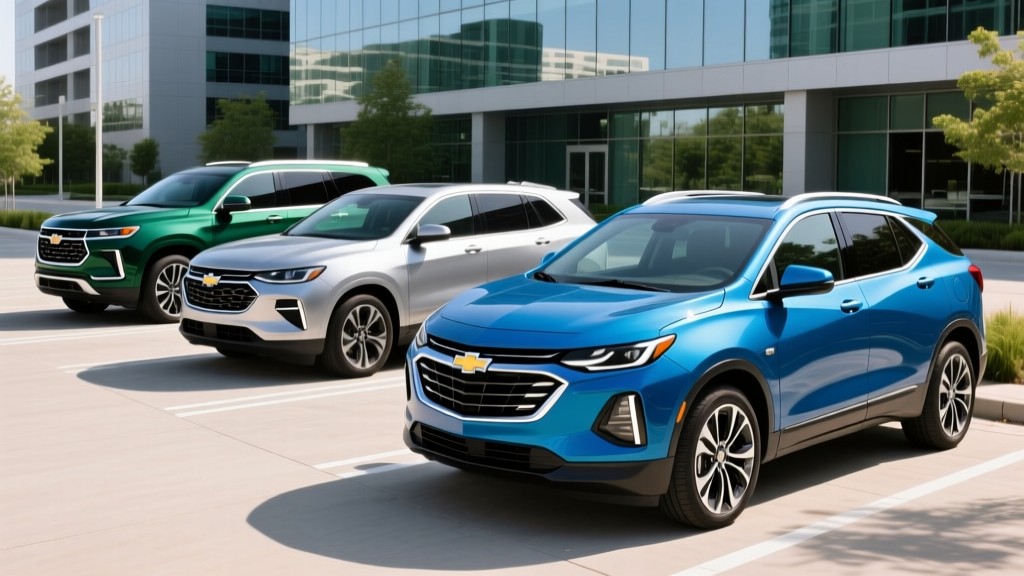
If you're researching Chevy hybrid SUVs for the 2026 model year, you're looking at a lineup that spans compact crossovers to full-size three-row haulers — and an important split between conventional hybrids (HEVs) you never plug in and plug-in hybrids (PHEVs) that deliver short electric-only commutes. Chevrolet has restructured its electrified SUV offerings significantly since the discontinuation of the original Volt and the first-gen Bolt era, and the 2026 lineup reflects a strategy built on hybridizing its highest-volume nameplates rather than relying solely on battery-electric models.
This guide breaks down every current Chevy hybrid SUV — the Equinox Hybrid, Blazer Hybrid, and Tahoe Hybrid — with exact EPA figures, powertrain specs, pricing, and real-world ownership considerations. Whether you're trying to dodge the gas pump without committing to full EV charging infrastructure, or you want a PHEV that handles a 30-mile electric commute before the gas engine kicks in, we'll help you match the right Chevy hybrid to your driving pattern.
HEV vs PHEV: Which Chevy Hybrid Type Fits You?
Before diving into specific models, it's critical to understand the two hybrid architectures Chevrolet uses. Confusing them is the single most common mistake hybrid shoppers make.
Conventional Hybrid (HEV)
A conventional hybrid like the Tahoe Hybrid uses a small battery (typically 1–2 kWh) paired with a gasoline engine and one or more electric motors. The battery charges through regenerative braking and engine power — you never plug it in. It improves fuel economy by 20–40% over a gas-only equivalent, especially in stop-and-go city driving where the electric motor does the heavy lifting at low speeds.
Plug-In Hybrid (PHEV)
A plug-in hybrid like the Equinox PHEV carries a much larger battery (15–20+ kWh) that you charge via a wall outlet, Level 2 home charger, or public station. It delivers a meaningful electric-only range (typically 30–50 miles) before the gas engine activates. Think of it as a short-range EV for daily commuting that transforms into a conventional hybrid for road trips. If your commute falls within the electric range and you charge nightly, you may burn almost no gasoline on weekdays.
| Feature | Conventional Hybrid (HEV) | Plug-In Hybrid (PHEV) |
|---|---|---|
| Plug in to charge? | No | Yes |
| Battery size | ~1–2 kWh | ~15–22 kWh |
| Electric-only range | None (motor assists engine) | 30–50+ miles |
| Home charging needed? | No | Recommended (Level 2 ideal) |
| Federal tax credit (§30D) | No | Up to $7,500 (eligibility varies) |
| Best for | Drivers who want better MPG without lifestyle change | Commuters with home charging and short daily drives |
2026 Chevy Equinox Hybrid & Equinox PHEV
The Equinox is Chevrolet's volume compact SUV, and for 2026 it's available in both conventional hybrid and plug-in hybrid configurations — making it the most versatile entry point into the Chevy hybrid SUV lineup.
Equinox Hybrid (HEV) Specs
| Powertrain | 1.5L turbo 4-cyl + electric motor |
| Combined horsepower | ~200 hp |
| Battery | ~1.8 kWh (self-charging) |
| EPA MPG (city / hwy / combined) | 38 / 36 / 37 MPG |
| Electric-only range | N/A (motor assist only) |
| Total range | ~520 miles |
| Drivetrain | FWD standard, AWD available |
| 0–60 mph | ~7.8 sec |
| Starting MSRP | ~$31,900 |
| Federal tax credit | Not eligible (HEV) |
Equinox PHEV Specs
| Powertrain | 1.5L turbo 4-cyl + electric motor |
| Combined horsepower | ~225 hp |
| Battery | 18.4 kWh usable (NMC lithium-ion) |
| EPA electric-only range | ~38 miles |
| EPA MPG (gas-only, combined) | ~35 MPG combined |
| MPGe (electric + gas combined) | ~84 MPGe |
| Total combined range | ~470 miles |
| Level 2 charge time (0–100%) | ~4.5 hours at 3.6 kW |
| DC fast charging | Not available |
| Drivetrain | FWD standard, AWD available |
| 0–60 mph | ~7.2 sec |
| Starting MSRP | ~$36,400 |
| Federal tax credit | Up to $7,500 (see eligibility below) |
Real-world range note: The Equinox PHEV's 38-mile EPA electric range assumes moderate temperatures and mixed driving. Expect 30–34 electric miles in cold weather (below 40°F) due to cabin heating demands and reduced battery efficiency. Highway-speed electric driving at 70+ mph will also reduce range to roughly 28–32 miles. For commuters within 25 miles each way, the PHEV still covers most weekday driving on electricity alone.
Real-World MPG: Equinox Hybrid
Conventional hybrids consistently overperform their EPA city estimates in real-world stop-and-go traffic, where the electric motor handles most low-speed propulsion. The Equinox Hybrid's 38 MPG city rating is conservative — owners regularly report 40–42 MPG in urban driving. Highway MPG, however, tends to run 1–2 MPG below the EPA sticker at sustained 70–75 mph speeds because the gas engine carries the full load. According to fueleconomy.gov, the combined 37 MPG figure is a realistic expectation for mixed driving.
2026 Chevy Blazer Hybrid
The midsize Blazer slots between the compact Equinox and the full-size Tahoe. For 2026, Chevrolet offers the Blazer exclusively as a conventional hybrid (HEV) — there is no PHEV variant. This positions the Blazer Hybrid as a sport-oriented midsize crossover for buyers who want improved fuel economy without plug-in logistics.
| Powertrain | 2.5L 4-cyl + electric motor |
| Combined horsepower | ~240 hp |
| Battery | ~1.9 kWh (self-charging) |
| EPA MPG (city / hwy / combined) | 33 / 31 / 32 MPG |
| Electric-only range | N/A |
| Total range | ~530 miles |
| Drivetrain | FWD standard, AWD available |
| 0–60 mph | ~7.0 sec |
| Starting MSRP | ~$39,500 |
| Federal tax credit | Not eligible (HEV) |
The Blazer Hybrid's 32 MPG combined represents roughly a 28% improvement over the gas-only Blazer's ~25 MPG combined. That translates to approximately $400–$550 in annual fuel savings for a driver covering 15,000 miles per year at $3.40/gallon regular unleaded. The trade-off versus the Equinox PHEV is clear: the Blazer offers more interior space and a more powerful engine, but no electric-only commuting capability and no federal tax credit.
2026 Chevy Tahoe Hybrid
For three-row, full-size SUV buyers, the Tahoe Hybrid is the only electrified option in the Chevy stable. It uses a conventional hybrid system — no plug-in variant exists — and is designed to reduce fuel costs on a vehicle that would otherwise consume significant gasoline.
| Powertrain | 5.3L V8 + electric motor assist |
| Combined horsepower | ~395 hp |
| Battery | ~1.7 kWh (self-charging) |
| EPA MPG (city / hwy / combined) | 24 / 22 / 23 MPG |
| Electric-only range | N/A |
| Total range | ~550 miles |
| Drivetrain | 4WD standard |
| Towing capacity | ~7,800 lbs |
| 0–60 mph | ~6.5 sec |
| Starting MSRP | ~$62,500 |
| Federal tax credit | Not eligible (HEV) |
The Tahoe Hybrid's 23 MPG combined is a meaningful upgrade over the gas-only V8 Tahoe's ~17 MPG combined — a roughly 35% improvement. For families towing boats or trailers, the hybrid system provides low-speed electric torque assist that smooths acceleration and reduces fuel consumption in parking-lot and neighborhood driving. Highway fuel economy gains are more modest because the V8 still dominates at cruising speed.
Side-by-Side MPG Comparison
| Model | Type | City MPG | Hwy MPG | Combined | Electric Range | MSRP |
|---|---|---|---|---|---|---|
| Equinox Hybrid | HEV | 38 | 36 | 37 | N/A | $31,900 |
| Equinox PHEV | PHEV | 35 (gas) | 34 (gas) | 35 / 84 MPGe | 38 mi | $36,400 |
| Blazer Hybrid | HEV | 33 | 31 | 32 | N/A | $39,500 |
| Tahoe Hybrid | HEV | 24 | 22 | 23 | N/A | $62,500 |
Federal Tax Credit Eligibility for Chevy PHEVs
Only the Equinox PHEV in the 2026 Chevy hybrid SUV lineup may qualify for the federal §30D clean vehicle tax credit — up to $7,500. Conventional hybrids (HEVs) do not qualify because they lack plug-in capability and sufficient battery capacity under IRS rules.
§30D Credit Requirements (2026 tax year):
- Vehicle type: Must be a new plug-in electric or fuel-cell vehicle with ≥7 kWh battery capacity — Equinox PHEV qualifies (18.4 kWh)
- MSRP cap: SUVs/vans/pickups capped at $80,000 MSRP — Equinox PHEV qualifies
- Buyer income cap: Modified AGI ≤ $150,000 (single), $225,000 (head of household), $300,000 (joint) — verify against your tax situation
- Battery sourcing: Critical minerals and battery components must meet escalating domestic-content thresholds per the Inflation Reduction Act — percentages increase annually; check IRS.gov §30D guidance for current-year requirements
- Point-of-sale transfer: Eligible buyers can transfer the credit to the dealer at purchase, reducing the purchase price directly rather than waiting for a tax refund
- Assembly: Final assembly must occur in North America — Equinox PHEV qualifies (assembled in Mexico or US depending on trim/year; verify VIN via the DOE VIN lookup tool)
Critical caveat: Battery component and critical-mineral sourcing rules tighten each year. A PHEV that qualifies for the full $7,500 in one model year may qualify for only $3,750 or zero in the next if its supply chain doesn't meet updated thresholds. Always verify eligibility at the time of purchase using the IRS vehicle eligibility list and your dealer's point-of-sale documentation. Consult a tax professional for your specific situation.
Battery Warranty, Reliability & Replacement Costs
Hybrid battery longevity is the top concern for buyers new to electrified vehicles. Here's what Chevrolet covers and what you should realistically expect.
Chevrolet Hybrid & PHEV Battery Warranty:
- HEV models (Equinox Hybrid, Blazer Hybrid, Tahoe Hybrid): 8 years / 100,000 miles (whichever comes first) on the hybrid battery pack and hybrid-specific components
- PHEV models (Equinox PHEV): 8 years / 100,000 miles on the high-voltage battery, with a capacity retention guarantee — Chevrolet warrants the battery will retain a minimum percentage (typically 60–70%) of original capacity over the warranty period
- California & CARB states: Extended emissions-related warranty coverage may extend to 10 years / 150,000 miles on certain hybrid components — check your state's specific requirements
How Long Do Chevy Hybrid Batteries Actually Last?
Modern hybrid batteries rarely fail catastrophically within the warranty period. Data from Toyota's decades-long hybrid dominance (the Prius fleet) shows that nickel-metal hydride and lithium-ion hybrid batteries commonly last 150,000–200,000+ miles before significant degradation. Chevrolet's smaller hybrid batteries (1.7–1.9 kWh in HEVs) undergo shallow charge-discharge cycles that are far less stressful than full EV deep cycles, contributing to long lifespan.
The Equinox PHEV's 18.4 kWh battery undergoes deeper cycling, so gradual capacity loss is expected. Most PHEV owners report 5–8% capacity loss over the first 5 years — meaning the 38-mile electric range might decrease to 34–36 miles by year five. This is normal lithium-ion behavior, not a defect.
Battery Replacement Cost
If a hybrid battery does need replacement outside warranty:
- HEV battery (Equinox, Blazer, Tahoe): $2,000–$4,000 for the battery pack, plus $500–$1,000 labor. Total: roughly $2,500–$5,000.
- PHEV battery (Equinox PHEV): $5,000–$8,000 for the larger battery pack, plus $800–$1,500 labor. Total: roughly $6,000–$9,500.
These are worst-case scenarios. In practice, individual cell modules can sometimes be replaced rather than the entire pack, reducing costs significantly. Independent hybrid battery repair shops have also emerged as a lower-cost alternative to dealer replacement.
Hybrid vs PHEV vs Full EV: Which Chevy Is Right for You?
Choose a Chevy HEV (Equinox Hybrid, Blazer Hybrid, Tahoe Hybrid) if:
- You don't have access to home or workplace charging
- You want better fuel economy with zero change to your driving routine
- You frequently take long road trips and don't want to plan around charging stops
- You want a lower purchase price (no PHEV battery premium)
- You tow regularly (Tahoe Hybrid)
Choose the Equinox PHEV if:
- You can install a Level 2 home charger or have reliable workplace charging
- Your daily round-trip commute is under 35 miles
- You want to drive mostly on electricity during the week but need gas-engine range for weekend trips
- You qualify for the §30D federal tax credit, which can reduce effective cost below the HEV variant
- You want to reduce gasoline consumption by 60–80% on average
Choose a full BEV (like the Equinox EV or Blazer EV) if:
- You have reliable home Level 2 charging
- Your daily driving is under 200 miles and you're comfortable with public DC fast charging for road trips
- You want to eliminate gasoline entirely and minimize maintenance (no oil changes, no engine)
- You want the maximum federal tax credit benefit and lowest per-mile fuel cost
Pros and Cons: Chevy Hybrid SUV Lineup
Pros
- No range anxiety — gas engine provides 500+ miles of total range on all models
- HEV models need no charging infrastructure — fill up at any gas station
- Equinox PHEV delivers 38 electric miles for near-zero weekday fuel consumption
- Strong city MPG across the lineup (hybrids excel in stop-and-go traffic)
- 8-year/100,000-mile hybrid battery warranty provides long-term peace of mind
- Tahoe Hybrid offers three-row space and towing with a 35% MPG improvement over gas V8
- Equinox PHEV may qualify for up to $7,500 federal tax credit (point-of-sale available)
Cons
- No DC fast charging on any Chevy hybrid or PHEV — Level 2 only for the PHEV
- PHEV electric range (38 miles) is shorter than some competitors (Toyota RAV4 Prime: 42 miles)
- HEV models do not qualify for any federal tax credit
- Highway MPG gains are modest — hybrids shine in the city, less so at 75 mph
- Tahoe Hybrid's $62,500 starting price is a significant premium over the gas Tahoe
- AWD availability on PHEV may reduce electric range by 2–3 miles
- Blazer Hybrid has no PHEV option — HEV only
Frequently Asked Questions
How many MPG do Chevy hybrid SUVs get?
The 2026 Equinox Hybrid leads the lineup at 37 MPG combined (38 city / 36 highway). The Blazer Hybrid achieves 32 MPG combined, and the Tahoe Hybrid reaches 23 MPG combined — a major improvement over the gas-only Tahoe's ~17 MPG. The Equinox PHEV delivers 84 MPGe when using its electric range, dropping to 35 MPG combined once the battery is depleted and the gas engine takes over.
How far can the Equinox PHEV go on electric only?
The EPA rates the Equinox PHEV at approximately 38 miles of electric-only range. In real-world conditions, expect 30–34 miles in cold weather and 35–38 miles in mild temperatures with mixed driving. Highway-speed electric-only driving at 70+ mph reduces range to roughly 28–32 miles.
Do Chevy hybrid SUVs need to be plugged in?
Only the Equinox PHEV needs to be plugged in to access its electric-only range — and even it operates as a normal hybrid if you never plug it in, just with less electric benefit. The Equinox Hybrid, Blazer Hybrid, and Tahoe Hybrid are conventional HEVs that never require plugging in. They self-charge through regenerative braking and the gasoline engine.
Does the Equinox PHEV qualify for a tax credit?
The Equinox PHEV may qualify for up to $7,500 under the IRS §30D clean vehicle credit, subject to buyer income limits (≤$150K single / $300K joint), the $80,000 MSRP cap for SUVs, and battery component/critical-mineral sourcing requirements that tighten annually. The credit can be transferred to the dealer at point of sale, reducing your purchase price directly. Always verify current eligibility on IRS.gov before purchasing.
Are Chevy hybrid SUVs reliable? What about battery replacement?
Chevrolet's hybrid systems are backed by an 8-year/100,000-mile battery warranty. Real-world data from the broader hybrid market (led by Toyota's millions of Prius vehicles) shows that modern hybrid batteries commonly last 150,000–200,000+ miles. If replacement is needed outside warranty, HEV batteries cost roughly $2,500–$5,000 and PHEV batteries cost $6,000–$9,500 installed. These are worst-case scenarios; most owners never need a battery replacement.
Which Chevy hybrid SUV is best for towing?
The Tahoe Hybrid is the clear choice, rated at approximately 7,800 lbs of towing capacity. The hybrid system's electric motor provides additional low-speed torque that helps when maneuvering trailers in tight spaces. The Equinox and Blazer hybrids are rated for light towing (1,500–3,500 lbs depending on configuration) but are not designed for heavy-duty hauling.
Can I charge the Equinox PHEV at a public DC fast charger?
No. The Equinox PHEV does not support DC fast charging. It charges via Level 1 (120V household outlet, ~12 hours for a full charge) or Level 2 (240V, ~4.5 hours at 3.6 kW). This is typical for PHEVs — their smaller batteries don't justify the cost and weight of DC fast-charge hardware. Overnight Level 2 home charging is the intended use case.
The Bottom Line on Chevy Hybrid SUVs
Chevrolet's 2026 hybrid SUV lineup covers three distinct buyer profiles: the Equinox Hybrid and PHEV serve compact-SUV shoppers choosing between simplicity and electric commuting; the Blazer Hybrid targets midsize buyers who want sport styling with improved fuel economy; and the Tahoe Hybrid addresses the full-size three-row market where even modest MPG gains translate to meaningful fuel savings on a heavy vehicle.
The Equinox PHEV is the standout value if you qualify for the §30D tax credit and have home charging — the credit can bring its effective price close to or below the conventional Equinox Hybrid while delivering dramatically lower fuel costs. For everyone else, the HEV models offer a no-compromise path to better fuel economy with zero infrastructure changes. Check current EPA ratings at fueleconomy.gov and verify tax credit eligibility before you buy.