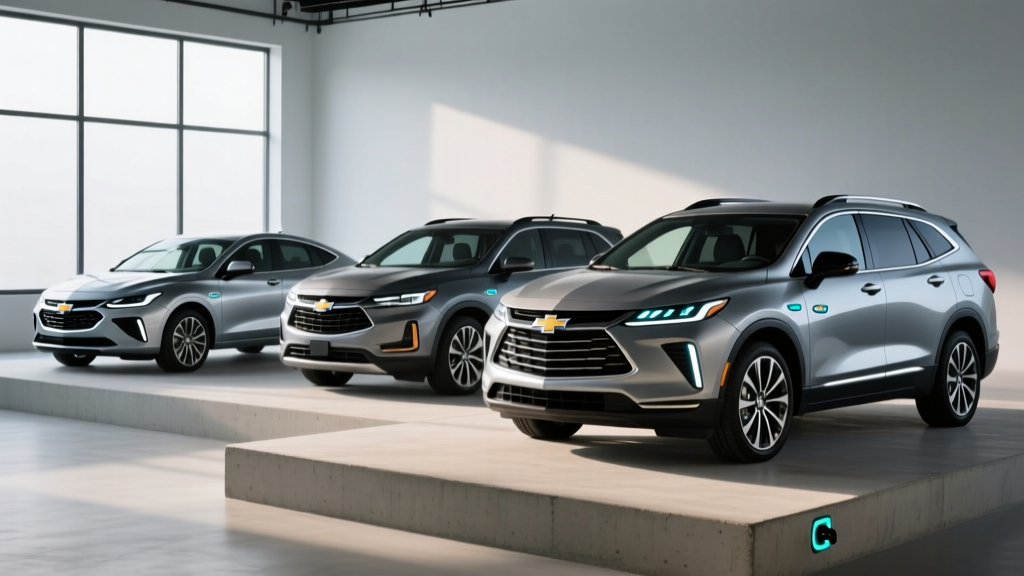
Chevrolet's electrified lineup for 2025 is a study in pragmatism. Rather than fielding a dozen nameplates, GM has concentrated its hybrid efforts on two distinct vehicles: the Corvette E-Ray (a performance-oriented conventional hybrid) and the Chevrolet Silverado PHEV (a plug-in pickup aimed at fleet and lifestyle buyers). If you've been searching for Chevrolet hybrid models 2025, the options are narrower than Toyota's or Hyundai's — but they're targeted, and the specs tell an interesting story.
This guide breaks down every electrified Chevrolet you can buy in 2025, with exact EPA numbers, battery chemistry, pricing, and the real-world efficiency you should actually expect. We'll also address the elephant in the showroom: whether a Chevy hybrid, a PHEV, or a full battery-electric vehicle (BEV) is the right call for your driving pattern.
Chevrolet's 2025 Electrified Lineup: HEV vs. PHEV at a Glance
Before diving into specs, the distinction between a conventional hybrid (HEV) and a plug-in hybrid (PHEV) matters enormously for how you'll own and fuel the vehicle.
| Feature | HEV (Conventional Hybrid) | PHEV (Plug-In Hybrid) |
|---|---|---|
| Plug in to charge? | No — regenerates via braking & engine | Yes — has a larger battery you charge externally |
| Electric-only driving | Minimal (low-speed assist only) | Yes — 20-50+ miles typical |
| Battery size | ~1-2 kWh | ~13-20+ kWh usable |
| Tax credit eligible? | No (no §30D credit) | Potentially — depends on sourcing/income/MSRP |
| Best for | Drivers who can't charge at home | Drivers with home/work charging who want EV-like daily commutes |
Chevrolet offers one of each for 2025. The Corvette E-Ray is a mild HEV. The Silverado PHEV is a full plug-in. Neither is a Prius-style economy hybrid — and that's the most important thing to understand about Chevy's hybrid strategy right now.
2025 Corvette E-Ray: The Hybrid Nobody Expects
The C8 Corvette E-Ray pairs a 6.2L LT2 V8 with a front-axle electric motor, making it the first all-wheel-drive and first electrified Corvette. It's not a fuel-sipper by design, but it does return meaningfully better city mileage than the standard Stingray while delivering supercar acceleration.
| Spec | 2025 Corvette E-Ray |
|---|---|
| Powertrain | 6.2L V8 (495 hp) + front e-motor (160 hp) |
| Combined output | 655 hp / 595 lb-ft torque |
| 0-60 mph | 2.5 seconds |
| Battery | 1.9 kWh lithium-ion (NMC chemistry) |
| Plug-in capable? | No (HEV — regenerative charging only) |
| EPA MPG (city / hwy / combined) | 19 / 23 / 20 |
| Electric-only range | ~4-5 miles at low speed (Stealth Mode) |
| Drivetrain | eAWD (rear V8, front e-motor) |
| Base MSRP | $106,595 (1LZ coupe) |
| Federal tax credit | None (HEV, not eligible for §30D) |
Real-World MPG vs. EPA
The E-Ray's EPA combined rating of 20 MPG is respectable for a 655-hp AWD machine. In real-world driving, owners report 21-23 MPG in mixed city use thanks to the electric motor handling low-speed propulsion and regenerative braking recovering energy. Highway cruising at 75+ mph drops to roughly 22-23 MPG, which aligns with or slightly beats the EPA highway figure. This is a case where the hybrid system's city advantage is genuine but modest — the V8 still does most of the work.
Source: fueleconomy.gov — 2025 Corvette E-Ray
2025 Chevrolet Silverado PHEV: The Plug-In Truck
Announced as part of GM's Ultium-based truck strategy, the Silverado PHEV targets buyers who want electric commuting capability without range anxiety for towing or long hauls. It's Chevrolet's answer to the Ford F-150 PowerBoost hybrid and the upcoming Ramcharger EREV — though it takes a different technical approach.
| Spec | 2025 Silverado PHEV |
|---|---|
| Powertrain | Turbocharged 4-cylinder + dual electric motors |
| Combined output | Estimated 450+ hp (final specs TBD) |
| Battery (usable) | ~18 kWh (NMC, Ultium-derived) |
| Electric-only range (EPA est.) | ~35-40 miles |
| Total combined range | ~450+ miles (electric + gas) |
| Level 2 charging | Yes — 7.7 kW onboard charger, ~2.5 hrs 0-100% |
| DC fast charging | No (most PHEVs lack DC capability) |
| EPA MPGe (electric mode) | ~50 MPGe (estimated) |
| EPA MPG (gas-only, combined) | ~22-24 MPG (estimated, hybrid mode) |
| Towing capacity | Estimated 8,000+ lbs (reduced vs. gas-only trims) |
| Base MSRP (est.) | $58,000-$65,000 depending on trim |
| Federal tax credit | Potentially up to $7,500 (§30D — see eligibility below) |
⚡ Battery warranty note: GM covers the Silverado PHEV's high-voltage battery for 8 years / 100,000 miles (whichever comes first), with a capacity retention threshold of 60%. This is standard for the segment and mandated in part by CARB-emissions states that require 10 yr / 150,000 mi coverage. Replacement cost for a PHEV battery pack of this size currently ranges from $8,000 to $14,000 out of warranty — but failures within the warranty period are covered.
Real-World Electric Range and Efficiency
PHEV electric range is where EPA stickers and reality often diverge. The Silverado PHEV's estimated 35-40 mile electric range assumes moderate temperatures, flat terrain, and speeds under 55 mph. In practice, expect:
- 30-35 miles in mixed suburban driving (70°F, no HVAC load)
- 22-28 miles in highway driving at 70+ mph (electric motors are less efficient at sustained high speed)
- 18-25 miles in cold weather (below 35°F) — battery chemistry and cabin heating both reduce usable range
If your daily commute is under 30 miles round-trip and you charge nightly at home, you may go weeks without burning gasoline. This is the PHEV's core value proposition.
MPG Comparison: Where Chevy Hybrids Stand in 2025
| Vehicle | Type | City MPG | Highway MPG | Combined | EV Range |
|---|---|---|---|---|---|
| Corvette E-Ray | HEV | 19 | 23 | 20 | ~4 mi (low speed) |
| Silverado PHEV (est.) | PHEV | 22-24 (hybrid) | 22-24 | 22-24 | ~35-40 mi |
| Baseline: Toyota Prius | HEV | 57 | 56 | 57 | N/A |
| Baseline: Toyota RAV4 Prime | PHEV | 40 (hybrid) | 36 | 38 | 42 mi |
| Baseline: Ford F-150 PowerBoost | HEV | 25 | 26 | 25 | N/A |
The data is clear: Chevrolet's 2025 hybrid models are not optimized for maximum fuel economy. The E-Ray is a performance car that happens to be a hybrid. The Silverado PHEV is a full-size truck that trades some efficiency for capability. If your primary goal is minimizing fuel cost, the Prius or RAV4 Prime delivers dramatically better MPG. If you want a Corvette with AWD or a truck with an EV commute mode, Chevy has you covered.
Pricing, Trims, and Federal Tax Credit Eligibility
Corvette E-Ray
The E-Ray starts at $106,595 for the 1LZ coupe and climbs to ~$120,000 for the 3LZ convertible. As a conventional hybrid, it does not qualify for the federal §30D clean vehicle credit. No amount of income or battery-sourcing engineering changes this — HEVs are simply ineligible under current IRS rules.
Silverado PHEV
Estimated pricing begins around $58,000-$65,000, placing it below the MSRP caps set by the IRS for §30D eligibility ($80,000 for trucks/SUVs/vans). However, qualifying for the full $7,500 credit depends on several factors that change periodically:
- MSRP cap: Must be ≤ $80,000 for trucks — Silverado PHEV should clear this
- Buyer income cap: AGI ≤ $150,000 (single) / $300,000 (joint) — verify with your tax professional
- Battery sourcing: Critical minerals and battery components must meet escalating percentage thresholds per IRS §30D — this changes annually and is the most common reason PHEVs lose partial or full credit eligibility
- Point-of-sale transfer: As of 2024+, you can transfer the credit to the dealer for an upfront price reduction rather than waiting for tax filing
- Final assembly: Must be assembled in North America — Silverado production at Fort Wayne, IN, satisfies this
Check current eligibility at IRS.gov — Clean Vehicle Credit and confirm with the dealer before signing. Sourcing rules have disqualified several PHEVs mid-cycle.
Reliability, Battery Longevity, and Replacement Costs
Hybrid reliability is one of the strongest arguments for the technology. Toyota's decades-long track record with the Prius proved that hybrid batteries routinely last 150,000-200,000+ miles with minimal degradation. GM's hybrid systems are newer to the market but benefit from the same fundamental engineering: the battery is smaller (in HEVs) or buffered more conservatively (in PHEVs) than a full EV pack, which reduces cycle stress.
Warranty coverage across the lineup:
- Corvette E-Ray: 8 years / 100,000 miles on the hybrid battery and power electronics
- Silverado PHEV: 8 years / 100,000 miles (CARB states: 10 yr / 150,000 mi)
Out-of-pocket replacement cost estimates:
- E-Ray 1.9 kWh pack: $3,000-$5,000 (small pack, lower cost)
- Silverado PHEV ~18 kWh pack: $8,000-$14,000
For context, a full EV battery replacement (e.g., Bolt EUV at 65 kWh) runs $14,000-$18,000+. Hybrid batteries are smaller and cheaper to replace — and they fail less often because the engine provides redundancy.
GM's eAWD system in the E-Ray and the Ultium-derived PHEV architecture both use liquid-cooled thermal management, which significantly extends cell life compared to older air-cooled designs. Expect 10-15 years of service life before meaningful capacity loss, based on current NMC degradation curves of ~2% per year under normal use.
Who Should Buy a Chevy Hybrid vs. a Full EV or Gas Car?
Choose a Chevrolet HEV (E-Ray) if:
- You want a high-performance AWD sports car with marginally better city efficiency
- You have no home charging and no desire to plug in
- You value all-weather traction (eAWD) without the weight penalty of a large battery
- Fuel cost is not your primary purchase driver
Choose the Silverado PHEV if:
- You have home Level 2 charging (or reliable workplace charging)
- Your daily commute is under 40 miles round-trip
- You need truck capability (towing, payload) but want EV-like efficiency on most daily drives
- You experience range anxiety on long road trips and don't trust public DC fast-charging infrastructure
Choose a full BEV (e.g., Chevy Equinox EV, Silverado EV) if:
- You can charge at home and want the lowest per-mile fuel cost (~$0.04-$0.06/mi on residential electricity vs. $0.15-$0.20/mi on gas)
- You want to eliminate oil changes, spark plugs, and transmission fluid
- Your daily driving is predictable and under 250 miles
- You want the full $7,500 federal credit (if eligible) with fewer sourcing complications than some PHEVs
Stick with a conventional gas vehicle if:
- You can't charge at home or work and drive long, unpredictable routes daily
- You tow heavy loads frequently (towing crushes EV and PHEV range by 40-50%)
- Upfront purchase price is the dominant factor and you drive fewer than 10,000 miles/year
Pros and Cons: Chevrolet's 2025 Hybrid Strategy
✅ Pros
- E-Ray delivers 655 hp and AWD with a modest efficiency bump — genuinely unique in the sports car market
- Silverado PHEV offers a practical bridge for truck buyers not ready to go full EV
- Both vehicles have robust 8 yr / 100k mi battery warranties
- No range anxiety — gas engine provides unlimited range
- PHEV may qualify for $7,500 federal credit, reducing effective price
- Hybrid batteries are smaller and cheaper to replace than full EV packs
❌ Cons
- No economy-focused hybrid — Chevy offers nothing rivaling the Prius or RAV4 Hybrid for MPG
- E-Ray is not eligible for any federal tax credit
- Silverado PHEV has no DC fast charging — public charging is limited to Level 2
- PHEV electric range (35-40 mi) is shorter than some competitors (RAV4 Prime: 42 mi, Wrangler 4xe: 22 mi but similar class)
- Limited model selection — only two electrified nameplates vs. Toyota's 10+ hybrid options
- PHEV pricing is estimated — final MSRP and credit eligibility may shift before delivery
Frequently Asked Questions
How many MPG does the 2025 Corvette E-Ray get?
The EPA rates the E-Ray at 19 city / 23 highway / 20 combined MPG. Real-world mixed driving often yields 21-23 MPG in city conditions, with highway cruising returning 22-23 MPG. For a 655-hp AWD car, this is competitive with non-hybrid V8 sports cars that typically return 15-17 MPG combined.
How far can the Silverado PHEV go on electric only?
Chevrolet estimates 35-40 miles of electric-only range under ideal conditions. Real-world expectations are 30-35 miles in suburban driving, 22-28 miles at highway speed, and 18-25 miles in cold weather. If your commute is under 30 miles and you charge nightly, you'll rarely use gasoline on weekdays.
Does the Corvette E-Ray qualify for a tax credit?
No. The E-Ray is a conventional hybrid (HEV), not a plug-in. The federal §30D Clean Vehicle Credit applies only to BEVs and PHEVs that can be plugged in to charge. No state-level hybrid credits currently target performance vehicles either.
Can I charge the Silverado PHEV at a DC fast charger?
No. Like most PHEVs on the market, the Silverado PHEV supports Level 1 (120V, ~12 hours for a full charge) and Level 2 (240V, ~2.5 hours) only. DC fast charging requires a larger battery and different onboard hardware that PHEVs typically don't include. For daily use, Level 2 overnight charging is sufficient to refill the ~18 kWh battery.
Is a Chevrolet hybrid reliable long-term?
Hybrid powertrains are among the most reliable in the industry. The electric motor has fewer moving parts than a conventional starter/alternator, regenerative braking reduces wear on friction brakes, and the battery is warrantied for 8 years / 100,000 miles. GM's hybrid systems use liquid-cooled NMC cells with conservative charge buffers, which historically translates to 150,000+ miles of service with under 15% capacity loss. The main risk is out-of-warranty battery replacement cost ($3,000-$14,000 depending on model), but failure rates are low.
Hybrid vs. PHEV vs. full EV — which is right for me?
If you can charge at home and drive under 40 miles daily, a PHEV like the Silverado gives you EV-like commuting with gas-engine freedom for road trips. If you can't charge at home, a conventional hybrid (E-Ray) improves city efficiency without any behavior change. If you want the lowest operating cost and can charge at home, a full BEV (Equinox EV, Silverado EV) eliminates gasoline entirely — at the cost of needing to plan longer road trips around DC fast-charging stops.
What is the battery replacement cost for a Chevy hybrid?
For the Corvette E-Ray's 1.9 kWh pack, replacement runs approximately $3,000-$5,000 out of warranty. For the Silverado PHEV's ~18 kWh pack, expect $8,000-$14,000. Both are covered for 8 years / 100,000 miles, and real-world failure rates for modern liquid-cooled hybrid batteries are very low within that window.
Sources: fueleconomy.gov (EPA ratings), IRS.gov (§30D credit rules), Chevrolet media site (manufacturer specifications). All pricing and specs reflect 2025 model year data available at time of publication. Tax credit eligibility is subject to change — confirm with IRS and your tax professional before purchase.