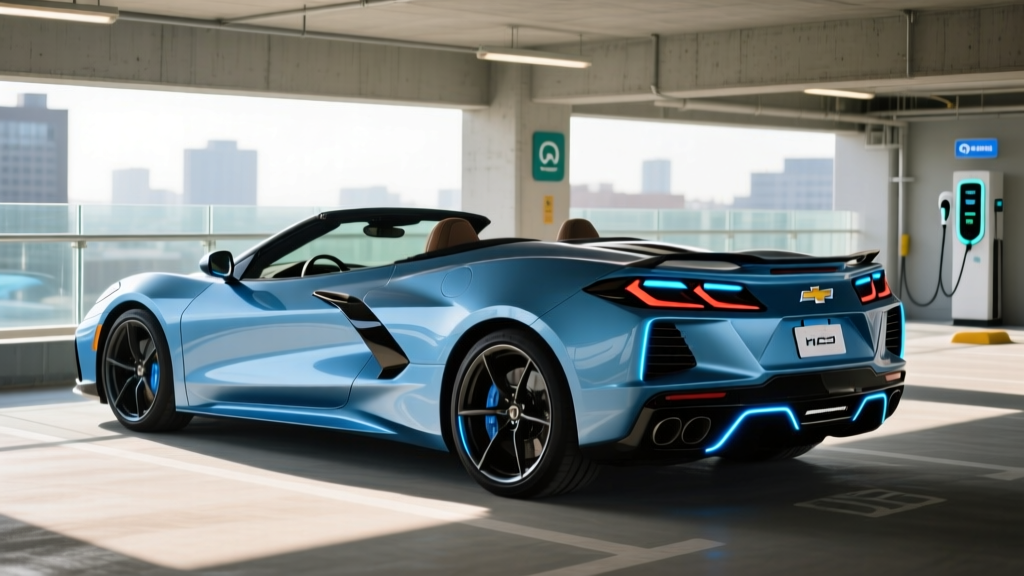
If you search for a hybrid convertible in 2026, the results are remarkably short: the Chevrolet Corvette E-Ray stands virtually alone. No other automaker currently sells a hybrid drop-top in the United States. That exclusivity makes the E-Ray worth a deep, spec-driven look — not just as a novelty, but as a genuine grand-touring machine that trades some V8 fuel thirst for all-wheel-drive grip and a modest efficiency bump.
Below, we dissect the E-Ray's powertrain, real-world fuel economy, battery longevity, pricing, and whether this particular hybrid convertible actually makes sense for your garage.
HEV vs PHEV: Where the Corvette E-Ray Fits
Before diving into specs, it's essential to distinguish the two hybrid architectures on the market, because the E-Ray uses a less common setup:
Conventional Hybrid (HEV)
- Small battery (typically 1–2 kWh) recharged by the engine and regenerative braking
- No plug-in charging required — you never plug it in
- No meaningful electric-only range; the motor assists the engine at low speeds and during acceleration
- Federal §30D tax credit: not eligible
Plug-In Hybrid (PHEV)
- Larger battery (typically 10–30 kWh) that can be plugged in to charge
- Offers 20–50 miles of electric-only driving before the engine engages
- May qualify for the federal §30D tax credit (up to $7,500) if battery sourcing, MSRP caps, and buyer income limits are met
The Corvette E-Ray uses a performance-oriented HEV system with a 1.9 kWh lithium-ion battery. It is not a plug-in hybrid — you never plug it in. The battery charges through regenerative braking and the V8 engine. Electric-only propulsion is limited to very low-speed maneuvers (parking lots, brief EV-mode coasting), not sustained driving. This matters for tax-credit eligibility, which we'll address later.
Powertrain and Performance Specs
The E-Ray pairs Chevrolet's familiar 6.2-liter LT2 V8 (495 hp, 470 lb-ft) driving the rear wheels with a front-axle electric motor producing 160 hp and 125 lb-ft. Combined output lands at 655 horsepower and 595 lb-ft of torque, making it the most powerful Corvette in the lineup aside from the Z06 and ZR1.
| Specification | Value |
|---|---|
| Engine | 6.2L LT2 V8, 495 hp / 470 lb-ft (rear wheels) |
| Electric Motor | Front-axle eAWD motor, 160 hp / 125 lb-ft |
| Combined Output | 655 hp / 595 lb-ft |
| Battery | 1.9 kWh lithium-ion (NMC chemistry) |
| Transmission | 8-speed dual-clutch automatic (rear); single-speed reduction (front) |
| Drivetrain | eAWD (electric all-wheel drive) |
| 0–60 mph | 2.5 seconds (manufacturer) |
| Top Speed | 183 mph |
| Curb Weight | ~3,950 lbs |
| Body Style | 2-door convertible (removable hardtop) or coupe |
The front electric motor provides torque-fill at low RPMs before the V8 reaches its power band, and it enables all-wheel-drive traction off the line. This is how a 3,950-pound convertible achieves a 2.5-second 0–60 time — the electric motor eliminates wheelspin that would otherwise plague a rear-drive V8 on street tires.
Fuel Economy: EPA Ratings and Real-World MPG
The hybrid system's efficiency gains are modest compared to a Prius-style HEV. The E-Ray's EPA ratings, per fueleconomy.gov, are as follows:
| Driving Cycle | EPA MPG |
|---|---|
| City | 19 MPG |
| Highway | 28 MPG |
| Combined | 22 MPG |
For context, the standard rear-drive C8 Stingray convertible rates at approximately 16 city / 24 highway / 19 combined. The E-Ray's eAWD hybrid system yields a roughly 3 MPG combined improvement — meaningful for a V8 sports car, but don't expect Prius territory.
Real-world expectation: In mixed grand-touring use (interstate cruising at 70–80 mph with moderate throttle), owners typically report 24–27 MPG on the highway, occasionally exceeding the EPA highway figure thanks to the engine's cylinder deactivation (AFM) and the electric motor handling accessory loads. In aggressive canyon driving or track use, expect 12–15 MPG. City driving with frequent regenerative-braking opportunities can push toward 21–22 MPG.
Battery Warranty, Lifespan, and Replacement Cost
Hybrid battery anxiety is the number-one concern we hear from buyers. Here's what you need to know about the E-Ray's 1.9 kWh pack:
E-Ray Hybrid Battery Coverage
- Warranty: 8 years / 100,000 miles (hybrid-specific components, including the battery pack and front e-motor), per Chevrolet's hybrid component warranty
- Powertrain warranty: 5 years / 60,000 miles
- Battery chemistry: NMC (nickel-manganese-cobalt) lithium-ion
- Expected lifespan: Hybrid batteries in performance applications typically last 150,000–200,000+ miles before significant degradation, based on industry data from Toyota, Honda, and GM hybrid platforms
- Replacement cost (out of warranty): Estimated $4,000–$7,000 for the battery pack module; front e-motor replacement would be additional
Because the E-Ray's battery is small (1.9 kWh) and operates in a shallow state-of-charge window — it never fully depletes or fully charges, which is the key to hybrid battery longevity — degradation is minimal. The battery management system (BMS) maintains a buffer at both the top and bottom of the charge range. In practice, this means the battery is never stressed the way a full EV's pack might be during repeated DC fast charges to 100%.
For comparison, Toyota's hybrid batteries in the Prius and Camry Hybrid have demonstrated 200,000+ mile lifespans routinely. The E-Ray's performance-tuned pack operates under higher discharge rates, but its small capacity and limited cycle depth work in its favor.
Pricing, Trims, and Tax Credit Eligibility
The 2026 Corvette E-Ray convertible starts at approximately $112,795 (1LZ trim, including destination). Key trim pricing:
- E-Ray 1LZ Convertible: ~$112,795
- E-Ray 2LZ Convertible: ~$120,795 (adds GT2 seats, performance data recorder, upgraded audio, head-up display)
- E-Ray 3LZ Convertible: ~$127,795 (adds Nappa leather, suede microfiber interior, carbon fiber trim)
Options like the carbon fiber aero package, visible carbon wheels, and Competition Sport exhaust can push a 3LZ convertible past $140,000.
Does the E-Ray Qualify for the Federal EV Tax Credit?
No. Under current IRS §30D clean vehicle credit rules, the Corvette E-Ray does not qualify for the federal tax credit. The §30D credit requires a vehicle to have a battery capacity of at least 7 kWh and to be a plug-in electric vehicle or fuel cell vehicle. The E-Ray's 1.9 kWh battery and non-plug-in HEV architecture disqualify it entirely.
There is no federal hybrid-specific tax credit for conventional HEVs. Some states may offer minor incentives for hybrid purchases, but these vary by jurisdiction — check your state's energy office or department of revenue for current programs.
Who Should Buy This Hybrid Convertible?
The E-Ray occupies a narrow but compelling niche. Here's a decision framework:
Choose the Corvette E-Ray Hybrid Convertible If:
- You want a V8 convertible with all-weather/all-wheel-drive capability — the eAWD system makes the E-Ray a genuine four-season sports car in rain and light snow
- You value the torque-fill and launch performance that the electric motor provides (2.5s 0–60 is supercar territory)
- You want marginally better fuel economy than a standard Stingray without sacrificing any V8 character
- You're a Corvette enthusiast who wants the most technologically advanced C8 variant short of the ZR1
Look Elsewhere If:
- You want meaningful electric-only range or plug-in capability — the E-Ray offers neither. Consider a PHEV like the Jeep Wrangler 4xe (21 miles EV-only, eligible for tax credit) if open-air + electrification is the goal
- Fuel economy is a primary purchase driver — the 22 MPG combined is good for a V8, but a 4-cylinder hybrid convertible (none currently exist) would be far more efficient
- You need rear seats or practical cargo space — the E-Ray is a strict two-seater with limited trunk room (especially with the roof panel stored)
- You're budget-conscious — at $113K+, this is a premium-priced performance car, not an efficiency play
Hybrid Convertible Alternatives: What Else Exists?
The honest answer is: almost nothing. The hybrid convertible market in 2026 is essentially a one-model segment. Here's why:
- Jeep Wrangler 4xe (PHEV): While it has a removable soft/hard top, it's an off-road SUV, not a roadster. It offers 21 miles of electric-only range and a 17 kWh battery, and it qualifies for up to $3,750 under the revised §30D credit (battery sourcing requirements reduce the full $7,500). Starting around $50,000.
- Ford Mustang (no hybrid): The current S650 Mustang convertible is gas-only with no hybrid variant announced.
- Mazda MX-5 Miata (no hybrid): Still purely internal combustion as of 2026. No hybrid or electrified variant is in production.
- BMW 4 Series / 8 Series Convertibles (mild-hybrid): BMW's current convertibles use a 48-volt mild-hybrid system (not a full HEV), which provides negligible efficiency gains — roughly 1 MPG improvement over a non-hybrid equivalent. These are not classified as true hybrids by EPA standards.
If you want a true hybrid convertible with a conventional HEV or PHEV powertrain, the Corvette E-Ray is your only option in the US market for 2026.
Reliability and Ownership Costs
The C8 Corvette platform, now in its sixth model year, has proven mechanically solid. The LT2 V8 is a well-understood pushrod engine shared with the Camaro SS and Cadillac CT5-V, with extensive service history. The 8-speed dual-clutch transmission (DCT), built by Tremec, has been reliable in owner reports, though it requires specific fluid service intervals.
Key ownership considerations:
- Insurance: Expect $2,400–$4,000 annually depending on age, driving record, and coverage levels — typical for a $113K+ sports car
- Maintenance: Chevrolet recommends oil changes every 7,500 miles under normal use. The hybrid system adds minimal maintenance — no additional fluid changes are required for the front e-motor under normal conditions
- Tires: The E-Ray's eAWD system and 655 hp are hard on tires. Expect 15,000–25,000 miles from a set of Michelin Pilot Sport All-Season 4 tires (the OEM fitment), at roughly $1,200–$1,600 per set
- Depreciation: C8 Corvettes have held value well, with 3-year depreciation averaging 20–28% per industry data. The E-Ray's exclusivity and limited production may support stronger residuals than the base Stingray
For detailed reliability and crash-test data, consult NHTSA and IIHS. Note that sports cars in this segment are often not crash-tested by IIHS due to low production volume.
Pros and Cons
Pros
- Only true hybrid convertible available in the US market
- 2.5-second 0–60 mph with eAWD launch grip
- All-weather capability rare in the sports car segment
- 3 MPG combined improvement over the standard Stingray
- 8-year / 100,000-mile hybrid component warranty
- V8 sound and character fully preserved — no CVT, no downsizing
Cons
- $112,795+ starting price is $40K more than a base Stingray convertible
- No federal tax credit eligibility
- Electric-only driving limited to parking-lot speeds — not a meaningful EV experience
- 3,950-lb curb weight (heavier than the Stingray by ~200 lbs)
- No manual transmission option
- Limited production — dealer markups are common
Frequently Asked Questions
How many MPG does the Corvette E-Ray hybrid convertible get?
The EPA rates the 2026 Corvette E-Ray at 19 city / 28 highway / 22 combined MPG. Real-world highway driving often yields 24–27 MPG in relaxed cruising. This is approximately 3 MPG better than the standard Stingray combined rating.
Can the Corvette E-Ray drive on electric power only?
Only at very low speeds — think parking lots or brief coasting moments. The 1.9 kWh battery and 160-hp front motor are not designed for sustained electric-only driving. There is no EV-mode range figure because it is not a plug-in hybrid.
Is the Corvette E-Ray a plug-in hybrid (PHEV)?
No. The E-Ray is a conventional hybrid (HEV). Its battery recharges exclusively through regenerative braking and the V8 engine. You never plug it in.
Does the Corvette E-Ray qualify for any federal tax credit?
No. The IRS §30D clean vehicle credit requires a minimum 7 kWh battery and plug-in capability. The E-Ray's 1.9 kWh non-plug-in system does not meet these criteria. No federal hybrid-specific credit exists for conventional HEVs.
How reliable is the E-Ray's hybrid system, and what does battery replacement cost?
Chevrolet covers the hybrid battery and front e-motor for 8 years / 100,000 miles. Industry data from GM, Toyota, and Honda hybrid platforms suggests these batteries routinely last 150,000–200,000+ miles. Out-of-warranty battery pack replacement is estimated at $4,000–$7,000, though this is rarely needed within the vehicle's typical ownership lifecycle.
Is the E-Ray better than the Stingray for daily driving?
For all-weather daily use, yes — the eAWD system provides significantly better traction in rain and light snow than the rear-drive Stingray. For dry-weather track driving, the lighter Stingray (or Z06) may be preferable. The E-Ray's torque-fill makes it more tractable in stop-and-go traffic, and the 3 MPG improvement adds up on commutes.
Are there any other hybrid convertibles I can buy?
In 2026, no other true hybrid (HEV or PHEV) convertible is sold in the US market. The Jeep Wrangler 4xe has a removable top and a plug-in hybrid powertrain, but it's an SUV. BMW's convertibles use mild-hybrid systems that don't qualify as full hybrids. The E-Ray is the only option.
The Verdict
The 2026 Corvette E-Ray convertible is a compelling but expensive answer to a question almost nobody asked — and that's precisely what makes it interesting. It's not an efficiency play. It's a performance car that happens to use hybrid technology for traction and torque-fill, with a modest fuel-economy bonus as a side effect.
If you want a hybrid convertible because you need a drop-top that can handle four-season driving with AWD grip, the E-Ray delivers at a level no other vehicle can match. If you want hybrid efficiency as the primary goal, this isn't it — look at PHEV SUVs or wait for the industry to produce a more efficiency-focused drop-top. But as a singular, no-compromise grand-touring convertible with a V8 heart and an electric kick, the E-Ray has no rival.